
 100% FREE ACCESS
11th Standard CBSE Syllabus & Materials
11th Standard CBSE
CBSE 11th Economics PART-A - Presentation of Data - New Sample Question Papers Study Material - QB365 Set A
NEW11th Standard CBSE
CBSE 11th Economics PART-A - Organisation of Data - New Sample Question Papers Study Material - QB365 Set A
NEW11th Standard CBSE
CBSE 11th Economics PART-A - Collection of Data - New Sample Question Papers Study Material - QB365 Set A
NEW11th Standard CBSE
CBSE 11th Economics PART-A - Introduction to Economics and Statistics - New Sample Question Papers Study Material - QB365 Set A
NEW11th Standard CBSE
CBSE 11th Business Studies International Trade Sample Question Papers Study Material - QB365 Set A
NEW11th Standard CBSE
CBSE 11th Business Studies Evolution and Fundamentals of Business Sample Question Papers Study Material - QB365 Set A

Published on: 05/10/2019
Waves
Download CBSE Class 11th Standard CBSE Physics question papers, sample papers, important questions, and previous year solved papers in PDF format. Get free study materials, NCERT solutions, and exam preparation resources for Class 11th Standard CBSE Physics
Questions + Answers key
Take MCQ Physics Test
1.
The amplitude of a wave disturbed propagating in the positive x direction is given by \(y=\frac{1}{1+x^{2}}\) at t = 0 and \(y=\frac{1}{[1+(x-1)^{2}]}\) at t=2s where x and y in metre. The shape of disturbance does not change during the propagation. What is the velocity of the wave?
2.
A metallic rod of length 1m is rigidly clamped at its midpoint. Longitudinal stationary waves are set up in the rod in such a way that there are two nodes on either side of the midpoint. The amplitude of an antinode is 2 x 10⁻⁶ m. Write the equation of motion at a point 2 cm from the midpoint and those of the constituent waves in the rod. (Young's modulus = 2 x 10¹¹ Nm-2 and density = 8000 kg m-3)
3.
What do you understand by beat? Explain beats analytically.
4.
Discuss the various factors influencing velocity of sound. A sonometer wire of length 110 cm is stretched with a tension T and fixed at its ends. The wire is divided into three segments by placing two bridges beloui it. Where should the bridges be placed so that the fundamental frequencies of the segments are in the ratio 1 : 2 : 3?
5.
What are the characteristics of stationary waves? Distinguish between stationary waves and progressive waves.
6.
What do you mean by interference of waves? Distinguish between constructive and destructive inerference. Standing waves are produced by the superposition of two waves y1 = 0.05 sin(3ㅠt - 2x) and y2 = 0.05 sin(3ㅠt + 2x) where y and x are measured in metres and t in seconds. Find the amplitude of a particle at x = 0.5 m.
7.
Given below are some examples of wave motion. State in each case if the wave motion is transverse, longitudinal or a combination of both:
(a) Motion of a kink in a longitudinal spring produced by displacing one end of the spring sideways.
(b) Waves produced in a cylinder containing a liquid by moving its piston back and forth.
(c) Waves produced by a motorboat sailing in water.
(d) Ultrasonic waves in air produced by a vibrating quartz crystal.
1.
At t = 0, \(y=\frac{1}{1+x^{2}}\)
∴ \(1+x^{2}=\frac{1}{y}\)
\(x^{2}=\frac{1}{y}-1=\frac{1-y}{y} x= (\frac{1-y}{y})^{\frac{1}{2}}\)
At t = 2s, \(y=\frac{1}{[1+(x+1)^{2}]}\)
\(1+(x-1)^{2} =\frac{1}{y}\)
\((x-1)^{2} = \frac{1}{y}-1 = \frac{1-y}{y}\)
\((x-1)=(\frac{1-y}{y})^{\frac{1}{2}}\)
⇒ \(x=1+(\frac{1-y}{y})^{\frac{1}{2}}\)
Since, \(v=\frac{x_2-x_1}{t_2-t_1}\)
∴ \(v=\frac{1}{2-0}=0.5 ms^{-1}\)
2.
The equation of standing wave can be written as
y = 2A sin kx cos ωt
where \(k=\frac{2\pi}{\lambda}\ and \ \omega = \frac{2\pi V}{\lambda}\)
The standing wave is obtained by adding the equation of two identical progressive waves travelling in opposite directions
y1 = A (sin kx - ωt); y2 = A (sin kx + ωt)
In the present problem the length L of the rod = 1 metre.

i.e., \(L=\frac{5\lambda}{2} \ and \ \frac{2}{5}\) metre.
Velocity of longitudinal wave is given by
\(V=\sqrt{\frac{\gamma}{\rho}} = \sqrt{\frac{2\times 10^{11}}{8000}}=5 \times 10^{3} ms^{-1}\)
\(k=\frac{2\pi}{\lambda}=\frac{2\pi}{2/5}\) = 5π metre-1
\(\omega=\frac{2\pi V}{\lambda} = \frac{2\pi \times 5 \times 10^{3}}{2/5}=(2 \times 10^{3}\pi) s^{-1}\)
Hence equation of standing wave is
\(y=(2\times 10^{-6}) sin \ 5\pi \ x\ cos \ 25\times 10^{3}\ \pi t\)
Equations of component waves are
\(y_1=(1\times 10^{-6}) sin (\ 5\pi \ x -\ 25\times 10^{3}\ \pi t)\)
\(y_2=(1\times 10^{-6}) sin (\ 5\pi \ x+\ 25\times 10^{3}\ \pi t)\)
3.
direction and in the same medium. Let
(i) 'A' be the amplitude of each wave.
(ii) There is no initial phase difference between them.
(iii) v1 and v2 be their frequencies.
If y1 and y2 be displacements of the two waves, then
y1= A sin 2ㅠ v1 t and y2 = A sin 2ㅠ v2 t
If Y be the result and displacement at any instant, then
y = y1 + y2 = A (sin (2ㅠ v1 t) + sin (2ㅠ v2 t)
= \(A[2 sin (\frac{2\pi (v_{1}+v_{2}t)}{2})cos (\frac{2\pi (v_{1}-v_{2})t}{2})]\)
= 2A cos ㅠ(v1-v2)t sinㅠ(v1+v2)t
= R sinㅠ(v1 + v2)t --- (1)
where R = 2A cos ㅠ (v1-v2)t --- (2)
is the amplitude of the resultant displacement and depends upon t. The following cases arise.
(a) If R is maximum, then
cos ㅠ(v1 - v2) t max. = ± 1 = cosnㅠ
∴ ㅠ(v1-v2)t = nㅠ
or \(t=\frac{n}{v_1-v_2}\) --- (3)
where n = 0,1,2 ...
∴ Amplitude becomes maximum at times given by
\(t=0, \frac{1}{v_1-v_2},\frac{2}{v_1-v_2},\frac{3}{v_1-v_2},...\)
∴ Time interval between two consecutive maxima is = \(\frac{1}{v_{1}-v_{2}}\)
∴ Beat period = \(\frac{1}{v_{1}-v_{2}}\)
∴ Beat frequency = v1-v2
∴ no. of beats formed per sec. = v1-v2
(b) If R is minimum, then
cos π (v1-v2)t = min = 0 = cos(2n+1)\(\frac{\pi}{2}\)
or \(t=\frac{(2n+1)}{2(v_1+v_2)^{'}}\) where n = 0,1,2,...
∴ Amplitude becomes minimum at times given by
t = \(\frac{1}{2(v_{1}-v_{2})},\frac{3}{2(v_{1}-v_{2})},\frac{5}{2(v_{1}-v_{2})}\),....
∴ Time interval-between two consecutive minima is = \(\frac{1}{v_1-v_2}\)
ஃ Beat period = \(\frac{1}{v_1-v_2} \)
∴ Beat requency = v1-v2
∴ No. of beats formed per sec = v1-v2.
Hence the number of beats formed per second is equal to the difference between the frequencies of two component waves.
4.
For factors influencing velocity of sound, see text.
Numerical: Let L1, L2 and L3 be the lengths of the segments of wire AB (Fig.).
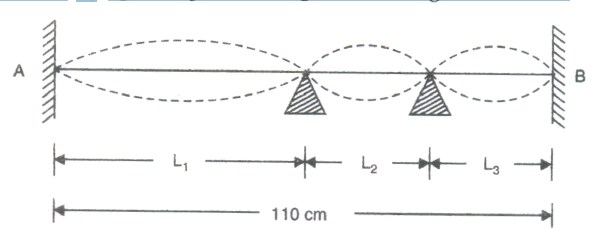
Then L1 + L2 + L3 = 110 cm --- (1)
Let n1 n2 and n3 be their respective fundamental frequencies. Thus
\(n_{1}=\frac{1}{2L_{1}}=\sqrt{\frac{T}{m}}\)
\(n_{2}=\frac{1}{2L_{2}}\sqrt{\frac{T}{m}}\)
and \(n_{3}=\frac{1}{2L_{3}}\sqrt{\frac{T}{m}}\)
Hence n1L1 = n2L2 = n3L3 --- (2)
But n1 : n2 : n3 = 1 : 2 : 3
∴ n2 = 2n1 and n3 = 3n1 --- (3)
From (2) and (3) we have
L1 = 2L2 = 3L3 --- (4)
Substituting (4) in (1) we get
\(L_{1}+\frac{1}{2} L_{1}+\frac{1}{3} L_{1}=110\)
or L1 = 60 cm
Hence L2 = 30 cm and L3 = 20 cm
Thus, the bridges should be placed at distances of 60 cm and 90 cm from end A.
5.
Characteristics of Stationary waves
(i) Stationary waves are produced in a bounded medium. A medium whose boundaries are separated from other media by distinct surfaces is called bounded medium. The boundaries of a bounded medium may be rigid or free. For example, string fixed at both the ends (i.e., string of a guitar), closed and open organ pipes.
(ii) There are certain points in the bounded medium (in which stationary waves are formed) which are always in the state of rest. These points are called nodes. If the stationary waves are longitudinal, then the change in pressure and density is maximum at nodes as compared to the other points.
(iii) There are points in between the nodes whose displacement is maximum as compared
to other points. These points are called anti-nodes. In the longitudinal stationary waves, there is no change in pressure and density of the medium at anti-nodes.
(iv) The distance between any two successive nodes or antinodes is \(\frac{\lambda}{2}\). The distance between a node and the neighbouring anti-node is \(\frac{\lambda}{4}\).
(v) All particles of the medium lying between two successive nodes vibrate but the amplitude of vibration is different for different particles. The amplitude of vibration is zero at nodes and maximum at anti-nodes.
(vi) All particles between two successives nodes vibrate in the same phase. They pass simultaneously through their mean positions and also pass simultaneously through their positions of maximum displacement.
(vii) At any instant, the phase of vibration of the particles on one side of a node is opposite from the phase of vibration of the particles on the other side.
(viii) All particles of the medium pass through their equilibrium positions (i.e., mean positions) simultaneously twice in each period. That is, the stationary wave takes the form of a straight line twice.
(ix) In a stationary wave, the medium splits up into a number of segments. Each segment vibrates up and down as a whole.
(x) All the particles except those at nodes, execute simple harmonic motion about their mean positions with the same time period.
(xi) In a stationary wave, there is no onward motion of the disturbance from one particle to the other particle.
(xii) Stationary wave does not advance in the medium, but remains steady at its place. In other words, stationary wave does not transmit energy in the medium.
6.
Interference of waves is the phenomenon of redistribution of energy in space on account of superposition of two waves of same nature, same frequency and equal or comparable amplitudes and travelling in the given medium in the same direction
Constructive interference takes place when the two superposing waves are in same phase i.e., crest of one wave (in transverse waves) coincides with crest of another wave and viceversa. As a result, the resultant amplitude and hence intensity of the resultant wave is maximum. Thus, for constructive interference, the phase difference between the superposing waves Δф = 0 or 2nπ, where n is an integer i.e., n = 1,2,3 .....
Destructive interference takes place when two superposing waves are in mutually opposite
phase i.e., in superposing of two transverse waves crest of one wave exactly coincides
with trough of another wave. As a result, the resultant amplitude and hence intensity of
the resultant wave is minimum. For destructive interference, the phase difference Δф = (2n-1)π, where n = 1, 2, 3 .....
Numerical:
The resultant displacement is given by
\(y=y_{1}+y_{2}=0.05 \){\(sin(3\pi t-2x)+sin(3 \pi t+2x)\)}
Using trigonometric relation
sin(α+β)+sin(α-β) = 2sinα cosβ, we have
y = 0.1 cos2x sin 3πt.
or y = A sin 3πt
where A, the amplitude of standing waves, is
given by A = 0.1 cos 2x with
x = 0.5 m
cos 2x = cos (2 x 0.5 rad)
= cos (1 rad) = cos (\(\frac{\pi}{3.142}\))
= cos 57.30 = 0.54
Amplitude A at (x = 0.5) = 0.1 x 0.54 = 0.054 m.
7.
(a) Transverse and longitudinal
(b) Longitudinal
(c) Transverse and longitudinal
(d) Longitudinal

11th Standard CBSE Syllabus & Materials
11th Standard CBSE
CBSE 11th Business Studies Forms of Business Organisation Sample Question Papers Study Material - QB365 Set A
NEW11th Standard CBSE
CBSE 11th Business Studies Business, Trade and Commerce Sample Question Papers Study Material - QB365 Set A
NEW11th Standard CBSE
CBSE 11th Physics Waves Sample Question Papers Study Material - QB365 Set A
NEW11th Standard CBSE
CBSE 11th Physics Kinetic Theory Sample Question Papers Study Material - QB365 Set A



CBSE 11th Standard CBSE Subjects
CBSE Standards









