
 100% FREE ACCESS
11th Standard CBSE Syllabus & Materials
11th Standard CBSE
CBSE 11th Economics PART-A - Presentation of Data - New Sample Question Papers Study Material - QB365 Set A
NEW11th Standard CBSE
CBSE 11th Economics PART-A - Organisation of Data - New Sample Question Papers Study Material - QB365 Set A
NEW11th Standard CBSE
CBSE 11th Economics PART-A - Collection of Data - New Sample Question Papers Study Material - QB365 Set A
NEW11th Standard CBSE
CBSE 11th Economics PART-A - Introduction to Economics and Statistics - New Sample Question Papers Study Material - QB365 Set A
NEW11th Standard CBSE
CBSE 11th Business Studies International Trade Sample Question Papers Study Material - QB365 Set A
NEW11th Standard CBSE
CBSE 11th Business Studies Evolution and Fundamentals of Business Sample Question Papers Study Material - QB365 Set A

Published on: 04/12/2019
Waves
Download CBSE Class 11th Standard CBSE Physics question papers, sample papers, important questions, and previous year solved papers in PDF format. Get free study materials, NCERT solutions, and exam preparation resources for Class 11th Standard CBSE Physics
Questions + Answers key
Take MCQ Physics Test
1.
Why bells are made of metal and not wood?
2.
Which harmonics are absent in a closed organ pipe?
3.
What is the nature of light waves?
4.
A narrow sound pulse (e.g. a short pip by a whistle) is sent across a medium.
(i) Does the pulse have a definite (a) frequency, (b) wavelength, (c) speed of propagation?
(ii) If the pulse rate is 1 after every 20 s, (that is the whistle is blown for a split of second after every 20 s), is the frequency of the note produced by the whistle equal to 1/20 or 0.05 Hz?
5.
What is the amplitude of a point 0.375 m away from one end?
6.
The following equation represents standing wave set up in medium, \(y=4 cos \frac{\pi}{3} sin 40 \ \pi t\) where x and y are in cm and t in sec. Find out the amplitude and the velocity of the two component waves and calculate the distance between adjacent nodes. What is the velocity of a medium particle at x = 3 cm at time \(\frac{1}{8}\) sec?
7.
Write basic conditions for formation of stationary waves.
8.
A transverse harmonic wave on a string is described by y(x, t) = 3.0sin (36t + 0.018x + \(\pi /4\)) Where x and y are in cm and t in seconds. The positive direction of x is from left to right|
What are its amplitude and frequency?
9.
Earthquakes generate sound waves inside the earth. Unlike a gas, the earth can experience both transverse (S) and longitudinal (P) sound waves. Typically the speed of S wave is about 4.0 km s–1, and that of P wave is 8.0 km s–1. A seismograph records P and S waves from an earthquake. The first P wave arrives 4 min before the first S wave. Assuming the waves travel in straight line, at what distance does the earthquake occur?
10.
A metallic rod of length 1m is rigidly clamped at its midpoint. Longitudinal stationary waves are set up in the rod in such a way that there are two nodes on either side of the midpoint. The amplitude of an antinode is 2 x 10⁻⁶ m. Write the equation of motion at a point 2 cm from the midpoint and those of the constituent waves in the rod. (Young's modulus = 2 x 10¹¹ Nm-2 and density = 8000 kg m-3)
11.
What do you understand by beat? Explain beats analytically.
12.
A string is stretched between fixed points separated by 75.0 cm. It is observed to have resonant frequencies of 420 Hz and 315 Hz. There are no other resonant frequencies between these two. Then the lowest resonance frequency for this string is
1.05 Hz
1050 Hz
10.5 Hz
105 Hz
13.
Two sound waves with wavelength 5.0m and 5.5m respectively, each propagate in a gas with velocity 330 m/ s. We expect the following number of beats/ sec.
6
12
0
1
14.
A source X of unknown frequency produces 8 beats per second with a source of 250 Hz and 12 beats per second with a source of 270 Hz. The frequency of the source X is
242 Hz
258 Hz
282 Hz
262 Hz
15.
Which of the following statements is true?
Both light and sound waves can travel in vacuum
Both light and sound waves in air are transverse
The sound waves in air are longitudinal, while the light waves are transverse
Both light and sound waves in air are longitudinal.
16.
A transverse wave propagating along X-axis is represented by y(x, t) = 8.0 sin(0.5 πx-4πt-π/4) where x is in metre and t is in seconds. The speed of the wave is
8 m/s
4π m/s
0.5π m/s
\(\frac{\pi}{4}\) m/s
17.
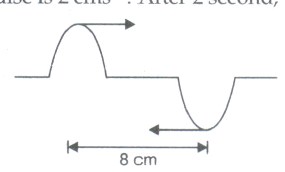
Two pulses in a stretched string whose centres are initially 8 cm apart are moving towards each other as shown in figure. The speed of each pulse is 2 cms-1. After 2 second, the total energy of the pulses will be
zero
purely kinetic
purely potential
Partly kinetic and partly potential
18.
The time period ofmass suspended from a spring is T. Ifthe spring is cut into four equal parts and the same mass is suspended from one of the parts, then the new time period will be
T/4
T
T/2
2T
1.
This is because wood has high damping.
2.
All even harmonics are absent.
3.
Transverse.
4.
(i) A short pip by a whistle
(a) will not have a fixed frequency.
(b) will not have fixed wavelength.
(c) will have the definite speed that will be equal to the speed of sound in air.
(ii) 0.05 Hz will be the frequency of repetition of the short pip.
5.
Given, \(Y=0.06\sin { \frac { 2\pi }{ 3 } } x\cos { \left( 120\pi \right) } \)
Putting x = 0.375 m
Amplitude, \(Y=0.06\sin { \frac { 2\pi }{ 3 } } \times \left( 0.375 \right) \)
\(=0.06\sin { \frac { \pi }{ 4 } } =\frac { 0.06 }{ \sqrt { 2 } } =0.042\quad m\)
6.
The given equation of stationary wave is \(y=4 cos \frac{\pi}{3} sin 40 \ \pi t\)
or \(y=2 \times 2 cos \frac{2\pi x}{6} sin \frac{2x(120)t}{6}\) --- (i)
We know that \(y=2a cos \frac{2\pi x}{\lambda} sin \frac{2x vt}{\lambda}\) --- (ii)
By comparing tow equations, we get
a = 2 cm,λ = 6 cm and v = 220 cm /sec.
The component waves are
\(y_{1}= a sin \frac{2\pi}{\lambda}(vt-x)\)
and \(y_{2}= a sin \frac{2\pi}{\lambda}(vt+x)\)
Distance between two adjacent nodes = \(\frac{\lambda}{2}=\frac{6}{2}=3 cm\).
Particle velocity \(\frac{dy}{dt} = 4 cos\frac{\pi}{x}cos(40\pi t).40 \pi\)
\(= 160 \ cos \frac{\pi x}{3} \ cos 40\pi t\)
=\(160 \ \pi \ cos \frac{\pi x}{3} cos (40\pi \times \frac{1}{8}) = 160 \pi \ \ [∵ cos \pi=cos 5\pi = -1]\)
Hence, particle velocity = 160 cm/sec.
7.
The basic conditions for formation of stationary waves are listed below:
(i) The direct and reflected waves must be travelling along the same line.
(ii) For stationary wave formation, the superposing waves should either be longitudinal or transverse. A longitudinal and a transverse wave cannot superposition.
(iii) For formation of stationary waves, there should not be any relative motion between the medium and oppositely travelling waves.
(iv) Amplitude and period of the superposing waves should be same.
8.
Given equation is y(x,t) = 3.0sin(36t + 0.018x + \(\pi /4\)) Comparing with standard equation
y(x,t) = \(asin(\omega t+kx+\phi )\)
By comparing amplitude, a=3cm
\(\Rightarrow 2\pi v=36\)
\(\Rightarrow v=\frac { 36 }{ 2\pi } =5.73Hz\)
9.
Let v1,v2 be the velocities of S wave and P wave and t1, t2 be the time taken by these waves to reach the seismograph
l= distance of occurrence of earthquake from the seismograph
\(v_{ 1 }t_{ 1 }=v_{ 2 }t_{ 2 }\)
\( \Rightarrow v_{ 1 }=4kms^{ -1 },v_{ 2 }=8kms^{ -1 }\)
\( \Rightarrow 4t_{ 1 }=8t_{ 2 }\Rightarrow t_{ 1 }=2t_{ 2 }\)
\( t_{ 1 }-t_{ 2 }=4min=\ 240s\)
\(On\ solving\ Eqs.\ (i)\ and\ (ii),\ t_{ 2 }=240s\)
\(\Rightarrow t_{ 1 }=2t_{ 2 }=2\times 240=480s\)
\(\Rightarrow l=v_{ 1 }t_{ 1 }=4\times 480=1920km\)
10.
The equation of standing wave can be written as
y = 2A sin kx cos ωt
where \(k=\frac{2\pi}{\lambda}\ and \ \omega = \frac{2\pi V}{\lambda}\)
The standing wave is obtained by adding the equation of two identical progressive waves travelling in opposite directions
y1 = A (sin kx - ωt); y2 = A (sin kx + ωt)
In the present problem the length L of the rod = 1 metre.

i.e., \(L=\frac{5\lambda}{2} \ and \ \frac{2}{5}\) metre.
Velocity of longitudinal wave is given by
\(V=\sqrt{\frac{\gamma}{\rho}} = \sqrt{\frac{2\times 10^{11}}{8000}}=5 \times 10^{3} ms^{-1}\)
\(k=\frac{2\pi}{\lambda}=\frac{2\pi}{2/5}\) = 5π metre-1
\(\omega=\frac{2\pi V}{\lambda} = \frac{2\pi \times 5 \times 10^{3}}{2/5}=(2 \times 10^{3}\pi) s^{-1}\)
Hence equation of standing wave is
\(y=(2\times 10^{-6}) sin \ 5\pi \ x\ cos \ 25\times 10^{3}\ \pi t\)
Equations of component waves are
\(y_1=(1\times 10^{-6}) sin (\ 5\pi \ x -\ 25\times 10^{3}\ \pi t)\)
\(y_2=(1\times 10^{-6}) sin (\ 5\pi \ x+\ 25\times 10^{3}\ \pi t)\)
11.
direction and in the same medium. Let
(i) 'A' be the amplitude of each wave.
(ii) There is no initial phase difference between them.
(iii) v1 and v2 be their frequencies.
If y1 and y2 be displacements of the two waves, then
y1= A sin 2ㅠ v1 t and y2 = A sin 2ㅠ v2 t
If Y be the result and displacement at any instant, then
y = y1 + y2 = A (sin (2ㅠ v1 t) + sin (2ㅠ v2 t)
= \(A[2 sin (\frac{2\pi (v_{1}+v_{2}t)}{2})cos (\frac{2\pi (v_{1}-v_{2})t}{2})]\)
= 2A cos ㅠ(v1-v2)t sinㅠ(v1+v2)t
= R sinㅠ(v1 + v2)t --- (1)
where R = 2A cos ㅠ (v1-v2)t --- (2)
is the amplitude of the resultant displacement and depends upon t. The following cases arise.
(a) If R is maximum, then
cos ㅠ(v1 - v2) t max. = ± 1 = cosnㅠ
∴ ㅠ(v1-v2)t = nㅠ
or \(t=\frac{n}{v_1-v_2}\) --- (3)
where n = 0,1,2 ...
∴ Amplitude becomes maximum at times given by
\(t=0, \frac{1}{v_1-v_2},\frac{2}{v_1-v_2},\frac{3}{v_1-v_2},...\)
∴ Time interval between two consecutive maxima is = \(\frac{1}{v_{1}-v_{2}}\)
∴ Beat period = \(\frac{1}{v_{1}-v_{2}}\)
∴ Beat frequency = v1-v2
∴ no. of beats formed per sec. = v1-v2
(b) If R is minimum, then
cos π (v1-v2)t = min = 0 = cos(2n+1)\(\frac{\pi}{2}\)
or \(t=\frac{(2n+1)}{2(v_1+v_2)^{'}}\) where n = 0,1,2,...
∴ Amplitude becomes minimum at times given by
t = \(\frac{1}{2(v_{1}-v_{2})},\frac{3}{2(v_{1}-v_{2})},\frac{5}{2(v_{1}-v_{2})}\),....
∴ Time interval-between two consecutive minima is = \(\frac{1}{v_1-v_2}\)
ஃ Beat period = \(\frac{1}{v_1-v_2} \)
∴ Beat requency = v1-v2
∴ No. of beats formed per sec = v1-v2.
Hence the number of beats formed per second is equal to the difference between the frequencies of two component waves.
12.
(d)
105 Hz
13.
(a)
6
14.
(b)
258 Hz
15.
(d)
Both light and sound waves in air are longitudinal.
16.
(d)
\(\frac{\pi}{4}\) m/s
17.
(b)
purely kinetic
18.
(d)
2T

11th Standard CBSE Syllabus & Materials
11th Standard CBSE
CBSE 11th Business Studies Forms of Business Organisation Sample Question Papers Study Material - QB365 Set A
NEW11th Standard CBSE
CBSE 11th Business Studies Business, Trade and Commerce Sample Question Papers Study Material - QB365 Set A
NEW11th Standard CBSE
CBSE 11th Physics Waves Sample Question Papers Study Material - QB365 Set A
NEW11th Standard CBSE
CBSE 11th Physics Kinetic Theory Sample Question Papers Study Material - QB365 Set A



CBSE 11th Standard CBSE Subjects
CBSE Standards









