
 100% FREE ACCESS
11th Standard CBSE Syllabus & Materials
11th Standard CBSE
CBSE 11th Economics PART-A - Presentation of Data - New Sample Question Papers Study Material - QB365 Set A
NEW11th Standard CBSE
CBSE 11th Economics PART-A - Organisation of Data - New Sample Question Papers Study Material - QB365 Set A
NEW11th Standard CBSE
CBSE 11th Economics PART-A - Collection of Data - New Sample Question Papers Study Material - QB365 Set A
NEW11th Standard CBSE
CBSE 11th Economics PART-A - Introduction to Economics and Statistics - New Sample Question Papers Study Material - QB365 Set A
NEW11th Standard CBSE
CBSE 11th Business Studies International Trade Sample Question Papers Study Material - QB365 Set A
NEW11th Standard CBSE
CBSE 11th Business Studies Evolution and Fundamentals of Business Sample Question Papers Study Material - QB365 Set A

Published on: 05/10/2019
Work, Energy and Power
Download CBSE Class 11th Standard CBSE Physics question papers, sample papers, important questions, and previous year solved papers in PDF format. Get free study materials, NCERT solutions, and exam preparation resources for Class 11th Standard CBSE Physics
Questions + Answers key
Take MCQ Physics Test
1.
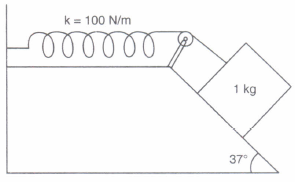
A 1 kg block situated on a rough incline is connected to a spring with spring constant 100 Nm-1 as shown in Figure. The block is released from rest with the spring in the unstretched position. The block moves 10 cm down the incline before coming to rest. Find the coefficient offriction between the block and the incline. Assume that the spring has negligible mass and the pulley is frictionless.
2.
A particle of mass moving with an initial velocity u collides inelastically with a particle of mass M initially at rest. if the collision is completely inelastic, then find expressions for
final velocity of combined entity and
3.
A railway carriage of mass 9000kg moving with a speed of 36km/h collides with stationary carriage of the same mass. After the collision, the carriage get coupled of the same mass. After the collision, the carriage get coupled and move together. What is their common speed after collision? what type of collision is this?
4.
When a pebble Hits the Ground
Consider a drop of small pebble of mass 1.00 g falling from a cliff of height 1.00 km. It hits the ground with a speed of 50.0 ms-1. What is the work done by the unknown resistive force ?
5.
Rocket Propulsion
A toy rocket of mass 0.1 kg has a small fuel of mass 0.02 kg which it burns out in 3 s. Starting from rest on horizontal smooth track it gets a speed of 20 ms-1 after the fuel is burnt out. What is the approximate thrust of the rocket ? What is the energy content per unit mass of the fuel ? (Ignore the small mass variation of the rocket of the rocket during fuel burning).
6.
The sign of work done by a force on a body is important to understand .State carefully if the following quantities are positive or negative
(i) Work done by gravitational force in the above cases.
(ii) Work done by friction on a body sliding down on inclined plane.
(iii) Work done by an applied force on a body moving on a rough horizontal plane with uniform velocity
(iv) Work done by the resistive force of air on a vibrating pendulum in bringing it to rest .
7.
The nucleus Fe27 emits a \(\gamma \)-ray of energy 14.4 keV. If the mass of the nucleus is 56.935 amu, calculate the recoil energy of the nucleus.
8.
One day Pawan went to super market to purchase some groceries. There he saw an old lady struggling with her shopping. He immediately showed her the lift and explained to her how she can carry her goods from one floor to the other. Even then the old lady showed hesitation to use the lift. On seeing this, Pawan took the lady into the lift and showed her how to operate the lift. The old lady was very happy and easily finished her shopping.
(i) An elevator which can carry a maximum load of 1800 of 2m/s. The frictional force opposing he motion is 4000 N.Determine the maximum power delivered by the motor to the elevator in horse power.
1.
From the above figure,
R = mg cos \(\theta\)
F = \(\mu\)R = \(\mu\) mg cos \(\theta\)
Net force on the block down the incline
= mg sin \(\theta\) - F
= mg sin \(\theta\) - \(\mu\) mg cos \(\theta\)
= mg (sin \(\theta\) - \(\mu\) cos \(\theta\))
Here distance moved x = 10 cm = 0.1 m
I equilibrium,
work done = Potential energy of stretched spring
\(mg(sin\ \theta -\mu \ cos\ \theta )x=\frac { 1 }{ 2 } { kx }^{ 2 }\)
or 2mg (sin \(\theta\) - \(\mu\) cos \(\theta\)) = kx
or 2 \(\times\) 1 kg \(\times\) 10 ms-2(sin 37° - \(\mu\) cos 37°) = 100 \(\times\) 0.1 m
or 20(0.601 - \(\mu\) \(\times\) 0.798) = 10
or 0.601 - 0.798\(\mu\) = \(\frac { 10 }{ 20 } =0.5\)
or -0.798\(\mu\) = 0.5 - 0.601 = -0.101
or \(\mu =\frac { -0.101 }{ -0.798 } =\frac { 101 }{ 798 } =0.126\)
Hence \(\mu\) = 0.126
2.
Let a particle of mass m moving with an initial velocity u collides inelastically with another particle of mass M initially at rest. Let after collision the combined entity moves with a velocity v. Then, from the conservation of linear momentum, we have \(m\mu +0=(m+M)v\Rightarrow v=\frac { mu }{ m+M } \)
3.
Given, m1 = 9000 kg, u1 = 36 km/h = =10m/s
m2 = 9000 kg, u2 = 0, v1 = v2 = v
By conservation of momentum
m1u1 + m2u2 = (m1 + m2)v
\(9000\times 10\times 9000\times 0=\left( 9000+9000 \right) v\)
or \(v=\frac { 90000 }{ 18000 } =5m/s\)
Total KE before collision = \(\frac { 1 }{ 2 } { m }_{ 1 }{ u }_{ 1 }^{ 2 }+\frac { 1 }{ 2 } { m }_{ 2 }{ u }_{ 2 }^{ 2 }\)
\(=\frac { 1 }{ 2 } \times 9000\times 10\times 10+0\)
\(\\ =450000J\)
Total KE after collision=\(\frac { 1 }{ 2 } \left( { m }_{ 1 }+{ m }_{ 2 } \right) { v }^{ 2 }\)
\(=\frac { 1 }{ 2 } \times 2\times 9000\times { \left( 5 \right) }^{ 2 }\)
\( =225000J\)
Thus, total KE collision < Total KE before collision. Hence, the collision is inelastic.
4.
We assume that the pebble is initially at rest on the cliff.
u = 0, m = 1.00 g = 103 kg
v = 50 ms-1 , h = 1.00 km = 103 m
The change in KE of the pebble is
\(\Delta K=\frac { 1 }{ 2 } m{ v }^{ 2 }-\frac { 1 }{ 2 } m{ u }^{ 2 }\) = \(\frac { 1 }{ 2 } \) x 10-3 x (50)2 - 0 = 1.25 J
Assuming that g = 10 ms-2 is constant, the work done by the gravitational force is
Wg = F . h = mgh = 10-3 x 10 x 103 = 10.0 J
If Wr is the work done by the resistive force on the pebble, then from the work energy theorem,
\(\Delta K\) = Wg + Wr
or Wr = \(\Delta K\) - Wg = 1.25 - 10.0 = - 8.75 J
5.
Here, m = 0.1 kg, u = 0, v = 20 ms-1, t = 3s
Thrust of the rocket = ma = m \(\frac { v-u }{ t } \)
= o.i x \(\frac { 20-0 }{ 3 } \) = \(\frac { 2 }{ 3 } \) N \(\left[ \because v=u+at\quad or\ a=\frac { v-u }{ t } \right] \)
Kinetic energy gained by the rocket
K = \(\frac { 1 }{ 2 } m{ v }^{ 2 }\) = \(\frac { 1 }{ 2 } \) x 0.1 x (20)2 = 20 J
Energy content per unit mass of the fuel
= \(\frac { Total\ energy }{ Mass\ of\ the\ fuel } =\frac { 20J }{ 0.02kg } =1000Jk{ g }^{ -1 }\)
6.
(i) Negative In the given case, the direction of force (vertically downward) and displacement (vertically upward) are opposite to each other. Hence, the sign of work done is negative
(ii) Work done is -ve because direction if friction force is opposite to sliding motion.
(iii) Work done by an applied force on body moving on a rough horizontal plane is positive because force is being applied in the direction of motion so as to overcome friction .
(iv) Work done is negative because the resistive force of air acts in a direction opposite to the direction of motion of the vibrating pendulum.
7.
The nuclear decay may be represented as follows
Fe57\(\rightarrow\) Fe57 + hv (\(\gamma \)-ray photon)
According to de-Broglie hypothesis, momentum of a photon of energy y E is
\(p=\frac { E }{ c } =\frac { 14.4\times 1.6\times { 10 }^{ -16 }J }{ 3\times { 1 }0^{ 8 }{ ms }^{ -1 } } \)
\(\\ p=\ 7.68\ \times { 10 }^{ -24 }kg { ms }^{ -1 }\)
By conservation of momentum, the momentum of daughter nucleus, p=momentum of \(\gamma \) -ray photon
\(=d\ 7.68 \ \times { 10 }^{ -24 }kg \ { ms }^{ -1 }\)
The recoil energy of the nucleus will be
\(k= \ \frac { { p }^{ 2 } }{ 2m } =\frac { ({ 7.68 \ \times { 10 }^{ -24 }) }^{ 2 } }{ 2\times \ 56.935 \ \times 1.66 \times { 10 }^{ -27 } }\)
\( \\ =0.32\times { 10 }^{ -21 }\)
\(\\ =\frac { 0.312\times { 10 }^{ -21 } }{ 1.6\times { 10 }^{ -16 } } keV\)
\(K=1.95{ \times 10 }^{ -16 }keV\)
8.
59 hp

11th Standard CBSE Syllabus & Materials
11th Standard CBSE
CBSE 11th Business Studies Forms of Business Organisation Sample Question Papers Study Material - QB365 Set A
NEW11th Standard CBSE
CBSE 11th Business Studies Business, Trade and Commerce Sample Question Papers Study Material - QB365 Set A
NEW11th Standard CBSE
CBSE 11th Physics Waves Sample Question Papers Study Material - QB365 Set A
NEW11th Standard CBSE
CBSE 11th Physics Kinetic Theory Sample Question Papers Study Material - QB365 Set A



CBSE 11th Standard CBSE Subjects
CBSE Standards









