
 100% FREE ACCESS
11th Standard CBSE Syllabus & Materials
11th Standard CBSE
CBSE 11th Economics PART-A - Presentation of Data - New Sample Question Papers Study Material - QB365 Set A
NEW11th Standard CBSE
CBSE 11th Economics PART-A - Organisation of Data - New Sample Question Papers Study Material - QB365 Set A
NEW11th Standard CBSE
CBSE 11th Economics PART-A - Collection of Data - New Sample Question Papers Study Material - QB365 Set A
NEW11th Standard CBSE
CBSE 11th Economics PART-A - Introduction to Economics and Statistics - New Sample Question Papers Study Material - QB365 Set A
NEW11th Standard CBSE
CBSE 11th Business Studies International Trade Sample Question Papers Study Material - QB365 Set A
NEW11th Standard CBSE
CBSE 11th Business Studies Evolution and Fundamentals of Business Sample Question Papers Study Material - QB365 Set A

Published on: 04/12/2019
Work, Energy and Power
Download CBSE Class 11th Standard CBSE Physics question papers, sample papers, important questions, and previous year solved papers in PDF format. Get free study materials, NCERT solutions, and exam preparation resources for Class 11th Standard CBSE Physics
Questions + Answers key
Take MCQ Physics Test
1.
A block of mass m moving with speed v compresses a spring through a distance x before its speed is halved. What is the value of spring constant?
2.
Draw a graph showing variation of potential energy, kinetic energy and the total energy of a body freely falling on Earth from a height h.
3.
A body of mass 3 kg is under a constant force, which causes a displacement S in metre in it, given by the relation S = \(\frac{1}{3}\) t2, where t is in an second. Find the work done by the force in 2s.
4.
To simulate car accidents, auto manufacturers study the collisions of moving cars with mounted springs of different spring constants. Consider a typical simulation with a car of mass 1000 kg moving with a speed 18.0 km/h on a smooth road and colliding with a horizontally mounted spring of spring constant 5.25 × 10 3 N m–1 . What is the maximum compression of the spring ?
5.
Estimate the amount of energy released in the nuclear fusion reaction.
1H2 + 1H2 \(\rightarrow\)2He3 + 0n1
Given that M (1H2 ) =2.0141 u,
M (2He3) =3.0160 u
Mn =1.0087 u, where 1 u =1.1661 \(\times\)10-27 kg
Express your answer in units of MeV.
6.
What is a variable force?
7.
Name the parameter which is a measure of the degree of elasticity of a body.
8.
Calculate the work done by a car against gravity is zero because force of gravity is vertical and motion of car is along a straight horizontal road.
9.
A body constrained to move along the z-axis of a coordinate system is subject to a constant force F given by F =\((-\hat{i}+\hat{2j}+\hat{3k})\) N, Where \(\hat{i}\), \( \hat{j} \)and \(\hat{k}\) are unit vectors along the x-, y- and z-axis of the system respectively. What is the work done by this force in moving the body a distance of 4 m along the z-axis ?
10.
Two ball bearings of mass m each moving in oppsite directions with equal speed v coollide head-on with each other. Predict the outcome of the collision, assuming it to be perfectly elastic.
11.
What is the dimensions of power:
[MLT-2]
[ML2T]
[ML2T2]
[MLT-3]
12.
The work done by the external forces on a system equals the change in
total energy
kinetic energy
potential energy
none of these
13.
Two bodies of masses m and 4 m are moving with equal linear momentum. The ratio of their kinetic energies is
1 : 4
4 : 1
1 : 1
1 : 2
14.
Two bodies of masses m and 4 m are moving with equal kinetic energy. The ratio of their linear momenta is
1 : 4
4 : 1
1 : 2
1 : 1
15.
A heavy stone is thrown from a cliff of height h with a speed v. The stone will hit the ground with maximum speed if it is thrown
vertically downward
vertically upward
horizontally
the speed does not depend on the initial direction
16.
The work done by all the forces (external and internal) on a system equals the change in
total energy
kinetic energy
potential energy
none of these
17.
Equal masses (m each) are attached at the two ends of a string passing over two pulleys. Another mass is attached at the centre of the string. In order that there is no sag in the string, this mass should be
m
m/2
2 m
Zero
1.
Initial Kinetic energy = \(\frac { 1 }{ 2 } { mv }^{ 2 }\)
Final Energy = \(\frac { 1 }{ 2 } m{ \left( \frac { v }{ 2 } \right) }^{ 2 }+\frac { 1 }{ 2 } { kx }^{ 2 }\)
By the principle of conservation of energy,
\(\frac { 1 }{ 2 } { mv }^{ 2 }=\frac { 1 }{ 2 } \frac { { mv }^{ 2 } }{ 4 } +\frac { 1 }{ 2 } { k }x^{ 2 }\)
\(\therefore \quad K=\frac { 3{ mv }^{ 2 } }{ 4{ x }^{ 2 } } \)
2.
Graphs depicting variation of (i) gravitational potential energy (P.E.), (ii) kinetic energy (K.E.),and (iii) the total sum of potential and kinetic energies for a freely falling body are as shown in adjoining Fig. From the graphs, it is clear that:
(a) Gravitational potential energy decreases as the body falls downwards and is zero at the Earth.
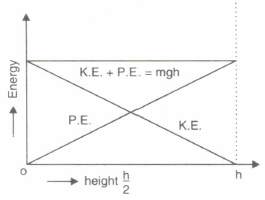
(b) Kinetic energy increases as the body falls downwards and is maximum when the body just strikes the ground.
(c) The sum of kinetic and potential energies remains constant at all points during its free fall.
3.
Work done by the force = force\( \times \)displacement
or W = F \( \times \) S
But from Newton's 2nd law , we have
Force = mass\( \times \)acceleration
i.e. F = ma ...(ii)
hence , from Eqs (i) and (ii), we get
W = m( \(\frac{d^2s}{dt^2}\) ) S [ \(\because\) a = [ \(\frac{d^2s}{dt^2}\)]........(iii)
now, we have
S = \(\frac{1}{3}\)t2
\(\therefore\) \(\frac{d^2s}{dt^2}\) = \(\frac{d}{dt}\)[\(\frac{d}{dt}\)( \(\frac{1}{3}\)t2)]
= \( \frac{d}{dt}\) \( \times \)( \(\frac{2}{3}\)t )
= \( \frac{2}{3}\)\(\frac{dt}{dt}\)
= \(\frac{2}{3}\)
Hence Eq. (iii) becomes
W = \( \frac{2}{3} \)ms
= \(\frac{2}{3}\)\( \times \) m\( \times \)\(\frac{1}{3}\)t2
= \(\frac{2}{9}\)mt2
We have , m = 3 kg , t = 2s
\(\therefore\) W = \(\frac{2}{9}\)\( \times \)3\( \times \)(2)2
= \(\frac{8}{3}\) J
4.
At maximum compression the kinetic energy of the car is converted entirely into the potential energy of the spring.
The kinetic energy of the moving car is
\(K=\frac{1}{2} m v^{2}\)
\(=\frac{1}{2} \times 10^{3} \times 5 \times 5\)
K = 1.25 x 10⁴ J
where we have converted 18 km h–1 to 5 m s–1 [It is useful to remember that 36 km h–1 = 10 m s–1]. At maximum compression xm , the potential energy V of the spring is equal to the kinetic energy K of the moving car from the principle of conservation of mechanical energy.
\(V=\frac{1}{2} k x_{m}^{2}\)
= 1.25 x 10⁴ J
We obtain
xm = 2.00 m
We note that we have idealised the situation. The spring is considered to be massless. The surface has been considered to possess negligible friction.
5.
Given 1H2 = 2.014 u, 2He3 = 3.0160 u, Mn =1.0087 u
1 u = 1661 \(\times\)10-27 kg
Energy released =?
mass of reacant, massr = 2 \(\times\)2.0141=4.0282 u
mas of product, massp = 3.0160 +1.0087 = 4.0247 u
Loss of mass =massp - massr
\(\Delta\)M =(4.0282 - 4.0247) u =0.0035 u
= 0.0035 \(\times\)1.66\(\times\) 10-13 J
Energy released =\(\frac { 52.2\times { 10 }^{ -14 } }{ 1.602\times { 10 }^{ -13 } } =3.26\quad Mev\quad \)
6.
Force whose either magnitude or direction or both change.
7.
Coefficient of restitution.
8.
The workdone by a car against gravity is zero because force of gravity is vertical and motion of car is along a straight horizontal road. As angle \(\theta\) between directions of force and displacement is 900 , hence work done is zero.
9.
Here, F = \((-\hat{i}+\hat{2j}+\hat{3k})\) N and s = \((\hat{4k})\) m
W = F.s = Fz.Sz
= 3 \(\times\) 4
= 12N - m
= 12 J
10.
Here, \((\frac { 1 }{ 2 } m{ \mu }^{ 2 }){ 30 }^{ o }\)
\(\\ { M }_{ 1 }={ M }_{ 2 }=m,{ \mu }_{ 1 }=v\quad and\quad { \mu }_{ 2 }=-v\)
\(\\ Now,\quad { v }_{ 1 }=\frac { ({ M }_{ 1 }-{ M }_{ 2 }){ \mu }_{ 1 }+{ 2M }_{ 2 }{ \mu }_{ 2 } }{ { M }_{ 1 }+{ M }_{ 2 } } \)
\(= \frac { (m-m)v+2m(-v) }{ m+{ m } } =-v\)
\(and\ { v }_{ 2 }=\frac { ({ M }2-{ M }_{ 1 }){ \mu }_{ 2 }+{ 2M }_{ 1 }{ \mu }_{ 1 } }{ { M }_{ 1 }+{ M }_{ 2 } } \)
\(=\frac { (m-m)v+2m(-v) }{ m+{ m } } =v\)
After collision, the two ball bearings will move with same speed but their directions of motion will be reserved.
11.
(d)
[MLT-3]
12.
(a)
total energy
13.
(b)
4 : 1
14.
(c)
1 : 2
15.
(d)
the speed does not depend on the initial direction
16.
(b)
kinetic energy
17.
(d)
Zero

11th Standard CBSE Syllabus & Materials
11th Standard CBSE
CBSE 11th Business Studies Forms of Business Organisation Sample Question Papers Study Material - QB365 Set A
NEW11th Standard CBSE
CBSE 11th Business Studies Business, Trade and Commerce Sample Question Papers Study Material - QB365 Set A
NEW11th Standard CBSE
CBSE 11th Physics Waves Sample Question Papers Study Material - QB365 Set A
NEW11th Standard CBSE
CBSE 11th Physics Kinetic Theory Sample Question Papers Study Material - QB365 Set A



CBSE 11th Standard CBSE Subjects
CBSE Standards









