
 100% FREE ACCESS
11th Standard CBSE Syllabus & Materials
11th Standard CBSE
CBSE 11th Economics PART-A - Presentation of Data - New Sample Question Papers Study Material - QB365 Set A
NEW11th Standard CBSE
CBSE 11th Economics PART-A - Organisation of Data - New Sample Question Papers Study Material - QB365 Set A
NEW11th Standard CBSE
CBSE 11th Economics PART-A - Collection of Data - New Sample Question Papers Study Material - QB365 Set A
NEW11th Standard CBSE
CBSE 11th Economics PART-A - Introduction to Economics and Statistics - New Sample Question Papers Study Material - QB365 Set A
NEW11th Standard CBSE
CBSE 11th Business Studies International Trade Sample Question Papers Study Material - QB365 Set A
NEW11th Standard CBSE
CBSE 11th Business Studies Evolution and Fundamentals of Business Sample Question Papers Study Material - QB365 Set A

Published on: 25/09/2019
Anatomy of Flowering Plants Five Mark Question Paper
Download CBSE Class 11th Standard CBSE Biology question papers, sample papers, important questions, and previous year solved papers in PDF format. Get free study materials, NCERT solutions, and exam preparation resources for Class 11th Standard CBSE Biology
Questions + Answers key
Take MCQ Biology Test
1.
Make a list of common fruits, their type and their edible parts.
2.
Describe stem. Explain various modifications of stem.
3.
Draw a diagram of a flowering plant and write functions of different parts.
4.
What is a flower? Describe the parts of a typical angiosperm flower.
5.
Describe modifications of stem with suitable examples.
6.
Define the following terms:
(a) Aestivation
(b) Placentation
(c) Actinomorphic
(d) Zygomorphic
(e) Superior ovary
(f) Perigynous flower
(g) Epipetalous stamen
7.
What is the commercial source of cork?How is it formed?
8.
What is the difference between lenticels and stomata
1.
| Fruits | Type | Edible Parts |
|---|---|---|
| Apple, Pear | Pome | Fleshy thalamus |
| Banana | Berry | Mesocarp |
| Cashewnut | Nut | Cotyledons, fleshy thalamus |
| Coconut | Drupe | Endosperm |
| Cucumber | Pepo | Mesocarp, endocarp, seeds |
| Date palm | Berry | Pericarp |
| Fig | Synconus | Thalamus |
| Jack fruit | Sorosis | Bracts, perianth & seeds |
| Grapes | Berry | Pericarp and placenta |
| Guava | Berry | Thalamus and pericarp |
| Litchi | Nut | Aril |
| Wheat, maize | Caruopsis | Endosperm |
| Mango | Drupe | Mesocarp |
| Pea, Gram | Legume | Cotyledons |
| Orange | Lemon | Hesperidium Juicy placentae |
| Papaya | Berry | Mesocarp |
| Pineapple | Sorosis | Bracts, receptacle |
| Pomegranate | Balausta | Seed coat |
| Tomato | Berry | Pericarp and placentae |
| Mustard | Siliqua | Seed |
2.
Stem : The stem is the ascending part of the axis bearing branches, leaves, flowers and fruits. It develops from the plumule of the embryo of a germinating seed. The stem bears nodes and internodes. The region of the stem where leaves are born are called nodes while internodes are the portions between two nodes. The stem bears buds, which may be terminal or axillary.Stem is generally green when young and later often become woody and dark brown
Functions of Stem : The main function of the stem is spreading out branches bearing leaves, flowers and fruits. It conducts water, minerals and photosynthates. Some stems perform the function of storage of food, support, protection and of vegetative propagation.
Modifications of Stem : Stems are modified to perform different functions.
Modification for food storage. Underground stems of potato, ginger, turmeric, zaminkand, Colocasia are modified to store food in them. They also act as organs of perenation to tide over conditions unfavourable for growth.
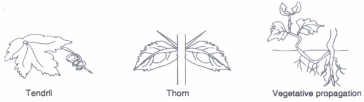
Modification for Climbing. Stem tendrils which develop from axillary buds, are slender and spirally coiled and help plants to climb such as in gourds (cucumber, pumpkins, watermelon) and grapevines.
Modification for Defence. Axillary buds of stems may also get modified into woody, straight and pointed thorns. Thorns are found in many plants such as Citrus, Bougainvillea. They protect plants from browsing animals.
Modification for Photosynthesis. Some plants of arid regions modify their stems into flattened (Opuntia), or fleshy cylindrical (Euphorbia) structures. They contain chlorophyll and carry out photosynthesis.
Modification for Vegetative Propagation. Underground stems of some plants such as grass and strawberry, etc., spread to new niches and when older parts die new plants are formed. In plants like mint and jasmine a slender lateral branch arises from the base of the main axis and after growing aerially for some time arch downwards to touch the ground. A lateral branch with short internodes and each node bearing a rosette of leaves and a tuft of roots is found in aquatic plants like Pistia and Eichhornia. In banana, pineapple and Chrysanthemum, the lateral branches originate from the basal and underground portion of the main stem, grow horizontally beneath the soil and then come out obliquely upward giving rise to leafy shoots.
3.
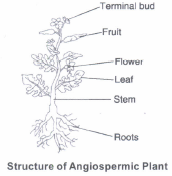
Functions of major parts of a flowering plant
(i) Root. Absorption of water and minerals, anchorage, food storage and hormone synthesis.
(ii) Stem. Mechanical support and base for aerial parts, conduction of water, minerals and food.
(iii) Leaf. Photosynthesis, food storage
(iv) Flower. Sexual Reproduction
(v) Fruit. Storage of seed and nutrients for seed.
4.
The flower is the reproductive unit in the angiosperms. It is meant for sexual reproduction. A typical flower has four different kinds of whorls arranged successively on the swollen end of the stalk or pedicel, called thalamus or receptacle. These are calyx, corolla, androecium and gynoecium. Calyx and corolla are accessory organs, while androecium and gynoecium are reproductive organs. In some flowers like lily, the calyx and corolla are not distinct and are termed as perianth.
Parts of a Flower :
Each flower normally has four floral whorls, viz., calyx, corolla, androecium and gynoecium.
Calyx. The calyx is the outermost whorl of the flower and the members are called sepals. Generally, sepals are green, leaf like and protect the flower in the bud stage. The calyx may be gamosepalous (sepals united) or polysepalous (sepals free).
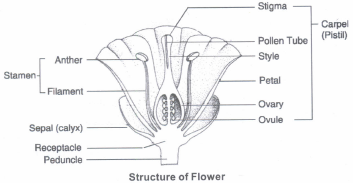
Corolla. Corolla is composed of petals. Petals are usually brightly coloured to attract insects for pollination. Like calyx, corolla may be also free (gamopetalous) or united (polypetalous). The shape and colour of corolla vary greatly in plants. Corolla may be tubular, bell-shaped, funnel-shaped or wheel-shaped.
Androecium :
Androecium is composed of stamens. Each stamen which represents the male reproductive organ consists of a stalk or a filament and an anther. Each anther is usually bilobed and each lobe has two chambers, the pollen-sacs. The pollen grains are produced in pollen-sacs. A sterile stamen is called staminode.
Stamens of flower may be united with other members such as petals or among themselves. When stamens are attached to the petals, they are epipetalous as inbrinjal, or epiphyUous when attached to the perianth as in the flowers of lily. The stamens in a flower may either remain free (polyandrous) or may be united in varying degrees. The stamens may be united into one bunch or one bundle (monoadelphous) as in china rose, or two bundles (diadelphous) as in pea, or into more than two bundles (polyadelphous) as in citrus. There may be a variation in the length of filaments within a flower, as in Salvia and mustard.
Gynoecium :
Gynoecium is the female reproductive part of the flower and is made up of one or more carpels. A carpel consists of three parts namely stigma, style and ovary. Ovary is the enlarged basal part, on which lies the elongated tube, the style. The style connects the ovary to the stigma. The stigma is usually at the tip of the style and is the receptive surface for pollen grains. Each ovary bears one or more ovules attached to a flattened, cushion-like placenta. When more than one carpel is present, they may be free (as in lotus and rose) and are called apocarpous. They are termed syncarpous when carpels are fused, as in mustard and tomato. After fertilisation, the ovules develop into seeds and the ovary matures into a fruit.
5.
Modifications of Stem
Food Storage. Stems are modified to perform different functions. Underground stems of potato, ginger, turmeric, zaminkand, Colocasia are modified to store food in them. They also act as organs of perenation to tide over conditions unfavourable for growth.
Tendrils. Stem tendrils which develop from axillary buds, are slender and spirally coiled and help plants to climb, such as in gourds (cucumber, pumpkins, watermelon) and grapevines
Thorns. Axillary buds of stems may also get modified into woody, straight and pointed thorns. Thorns are found in many plants such as Citrus, Bougainvillea. They protect plants from browsing animals.
Some plants of arid regions modify their stems into flattened (Opuntia), or fleshy cylindrical (Euphorbia) structures. They contain chlorophyll and carry out photosynthesis.
Vegetative Reproduction. Underground stems of some plants such as grass and strawberry, etc., spread to new niches and when older parts die new plants are formed. In plants, like mint and jasmine a slender lateral branch arises from the base of the main axis and after growing aerially for some time arch downwards to touch the ground. A lateral branch with short internodes and each node bearing a rosette of leaves and a tuft of roots is found in aquatic plants like Pistia and Eichhornia. In banana, pineapple and Chrysanthemum, the lateral branches originate from the basal and underground portion of the main stem, grow horizontally beneath the soil and then come out obliquely upward giving rise to leafy shoots.
6.
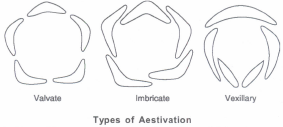
(a) Aestivation. The mode of arrangement of sepals or petals in floral bud with respect to the other members of the same whorl is known as aestivation. The main types of aestivation are valvate, twisted, imbricate and vexillary. Valvate. When sepals or petals in a whorl just touch one another at the margin, without overlapping, as in Calotropis, it is said to be valvate.
Twisted. If one margin of the appendage overlaps that of the next one and so on, as in china rose, lady's finger and cotton, it is called twisted. Imbricate. If the margins of sepals or petals overlap one another but not in any particular direction as in Cassia and gulmohur, the aestivation is called imbricate
Vexillary. In pea and bean flowers, there are five petals, the largest (standard) overlaps the two lateral petals (wings) which in turn overlap the two smallest anterior petals (keel); this type of aestivation is known as vexillary or papilionaceous, e.g. pea
(b) Placentation. The arrangement of ovules within the ovary is known as placentation. The placentation are of different types namely, marginal, axile, parietal, basal, central and free central.
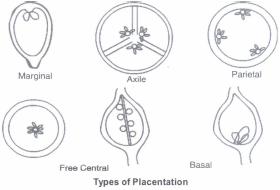
Marginal. In marginal placentation the placenta forms a ridge along the ventral suture of the ovary and the ovules are borne on this ridge forming two rows, as in pea.
Axile. When the placenta is axial and the ovules are attached to it in a multilocular ovary, the placentaion is said to be axile, as in china rose, tomato and lemon.
Parietal. In parietal placentation, the ovules develop on the inner wall of the ovary or on peripheral part. Ovary is one-chambered but it becomes two - chambered due to the formation of the false septum, e.g., mustard and Argemone. When the ovules are borne on central axis and septa are absent, as in Dianthus and Primrose the placentation is called free central.
Basal. In basal placentation, the placenta develops at the base of ovary and a single ovule is attached to it, as in sunflower, marigold.
(c) Actinomorphic. When a flower can be divided into two equal radial halves in any radial plane passing through the centre, it is said to be actinomorphic, e.g., mustard, datura, chilli.
(d) Zygomorphic. When a flower can be divided into two similar halves only in one particular vertical plane, it is zygomorphic, e.g., pea, gulmohur, bean, Cassia.
(e) Superior Ovary or Hypogynous Flower. Based on the position of calyx, corolla and androecium in respect of the ovary on thalamus, the flowers are described as hypogynous perigynous and epigynous. In the hypogynous flower the gynoecium occupies the highest position while the other parts are situated below it. The ovary in such flowers is said to be superior, e.g., mustard, china rose and brinjal.
(f) Perigynous Flower. If gynoecium is situated in the centre and other parts of the flower are located on the rim of the thalamus almost at the same level, it is called perigynous. The ovary here is said to be half inferior, e.g., plum, rose, peach
(g) Epipetalous Stamens. When stamens are attached to the petals, they are epipetalous as in brinjal
7.
Commercial source of cork is cork oak or Quercus suber.
Cork is formed on the outer side by phellogen or cork cambium. Phellogen is purley a secondary meristem which generally develops from an outer layer of cortex by dediffrentiation of cortical cells.The intercellular spaces dissappear.Phellogen cells start dividing on their outer and inner sides.Cells formed on the outerside remain compactly arranged.they undergo subsideration,get filled with atnninsand die. the tissue of dead , tanin, and air filled subsidered cells are formed on outer side of phellogen is called phellen or cork. At some places, aerating structures called lenticles are also formed
8.
Difference between lenticels and stomata are given below
| Lenticels | Stomata |
| Found in old stem and root | Found in leaves and young stem |
| Present in crok tissues. Contain a number of comlementary cells permanently remain open |
Present in epidremis stomata contain two guard cells Stomata open and close in response to turgidity of guars cells |

11th Standard CBSE Syllabus & Materials
11th Standard CBSE
CBSE 11th Business Studies Forms of Business Organisation Sample Question Papers Study Material - QB365 Set A
NEW11th Standard CBSE
CBSE 11th Business Studies Business, Trade and Commerce Sample Question Papers Study Material - QB365 Set A
NEW11th Standard CBSE
CBSE 11th Physics Waves Sample Question Papers Study Material - QB365 Set A
NEW11th Standard CBSE
CBSE 11th Physics Kinetic Theory Sample Question Papers Study Material - QB365 Set A



CBSE 11th Standard CBSE Subjects
CBSE Standards









