
 100% FREE ACCESS
11th Standard CBSE Syllabus & Materials
11th Standard CBSE
CBSE 11th Economics PART-A - Presentation of Data - New Sample Question Papers Study Material - QB365 Set A
NEW11th Standard CBSE
CBSE 11th Economics PART-A - Organisation of Data - New Sample Question Papers Study Material - QB365 Set A
NEW11th Standard CBSE
CBSE 11th Economics PART-A - Collection of Data - New Sample Question Papers Study Material - QB365 Set A
NEW11th Standard CBSE
CBSE 11th Economics PART-A - Introduction to Economics and Statistics - New Sample Question Papers Study Material - QB365 Set A
NEW11th Standard CBSE
CBSE 11th Business Studies International Trade Sample Question Papers Study Material - QB365 Set A
NEW11th Standard CBSE
CBSE 11th Business Studies Evolution and Fundamentals of Business Sample Question Papers Study Material - QB365 Set A

Published on: 29/05/2021
QB365 Provides the HOT Question Papers for Class 11 Biology, and also provide the detail solution for each and every HOT Questions. HOT Questions will help to get more idea about question pattern in every exams and also will help to get more marks in Exams
Download CBSE Class 11th Standard CBSE Biology question papers, sample papers, important questions, and previous year solved papers in PDF format. Get free study materials, NCERT solutions, and exam preparation resources for Class 11th Standard CBSE Biology
Questions + Answers key
Take MCQ Biology Test1.
(i) Name the category to fats belong?
(ii) What is cholesterol?
(iii) What are the two forms of cholesterol?
2.
The lines A to D below show how change in temperature can affect the rate of enzyme reaction.Line N shows the rate of reaction under optimum temperature.
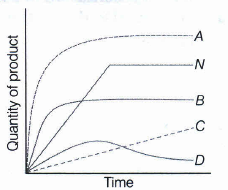
Which line A, B, C or D shows the rate of enzyme reaction at \(60°C\)?
3.
Enzymes are proteins. Proteins are long chains of amino acids linked to each other by peptide bonds. Amino acids have many functional groups in their structure.
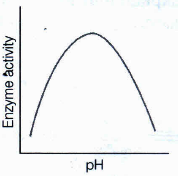
These functional groups are ionizable as they are weak acids and bases in chemical nature. This ionisation is influenced by the pH of the solution. For many enzymes, activity is influenced by surrounding pH. This is depicted in the curve given explain briefly.
4.
Without metabolism, the living state can not exist Justify.
5.
Proteins have primary structure. If you are given a method to know which amino acid is at either of the two termini (ends) of a protein, can you connect this information to purity or homogeneity of a protein?
1.
(i) Lipids
(ii) It is a common sterol and also the parent compound for steroid hormones.
(iii) Cholesterol exists in two forms, i.e., low density cholesterol which is harmful and high density cholesterol, which is essential for various physiological processes.
2.
Line B, will show the rate of reaction at \(60°C\) because the rate of reaction initially is more rapid, but then decreases as the enzyme becomes denatured by the high temperature.Thus, the quantity of product remains constant at a lower amount compared to line N.
3.
Enzymes, generally function in a narrow range of pH.Each enzyme shows its highest activity at a particular optimum pH.Activity declines both below and above the optimum value. The graph shows maximum enzyme activity at optimum pH.The rate of enzyme activity decreases above and below that optimum pH.
4.
The most important fact of biology systems is that all living organisms exist in a steady-state characterised by the concentration of each of the biomolecule. These biomolecules are in a metabolic flux. Any chemical or physical process moves spontaneously to equilibrium. Thus, the steady state is a non-equilibrium state.
As living organisms work continuously, they cannot afford to reach equilibrium. Hence, the living state is a non-equilibrium steady-state to be able to perform work. This is achieved by energy input. Metabolism provides a mechanism for the production of energy.
Hence, the living state and metabolism are synonymous. Without metabolism, there cannot be a living state.
5.
The sequence of amino acids, i.e., the positional configuration in a protein which is the first amino acid, which is second and so on is called the primary structure of a protein.
The first amino acid is also called as N-terminal amino acid. The last amino acid is called the C-terminal amino acid. Yes, we can connect this information to purity or homogeneity of a protein. Based on number of amino and carboxyl groups, these can be acidic (e.g., glutamic acid), basic (lysine) and neutral (valine) amino acids.

11th Standard CBSE Syllabus & Materials
11th Standard CBSE
CBSE 11th Business Studies Forms of Business Organisation Sample Question Papers Study Material - QB365 Set A
NEW11th Standard CBSE
CBSE 11th Business Studies Business, Trade and Commerce Sample Question Papers Study Material - QB365 Set A
NEW11th Standard CBSE
CBSE 11th Physics Waves Sample Question Papers Study Material - QB365 Set A
NEW11th Standard CBSE
CBSE 11th Physics Kinetic Theory Sample Question Papers Study Material - QB365 Set A



NCERT Books

Syllabus

Exam Pattern

Sample Question Papers

Previous year Question Papers

Important Notes

MCQ Practice test

NCERT Exemplers

Case study Questions

Image Based Questions

Passage based Questions

HOT Questions

Value Based Questions

Model Questions Papers
NCERT ( Book Back ) Questions

Assertion and Reason
Important Questions And Answers

CBSE 11th Standard CBSE Subjects
CBSE Standards








