
 100% FREE ACCESS
11th Standard CBSE Syllabus & Materials
11th Standard CBSE
CBSE 11th Economics PART-A - Presentation of Data - New Sample Question Papers Study Material - QB365 Set A
NEW11th Standard CBSE
CBSE 11th Economics PART-A - Organisation of Data - New Sample Question Papers Study Material - QB365 Set A
NEW11th Standard CBSE
CBSE 11th Economics PART-A - Collection of Data - New Sample Question Papers Study Material - QB365 Set A
NEW11th Standard CBSE
CBSE 11th Economics PART-A - Introduction to Economics and Statistics - New Sample Question Papers Study Material - QB365 Set A
NEW11th Standard CBSE
CBSE 11th Business Studies International Trade Sample Question Papers Study Material - QB365 Set A
NEW11th Standard CBSE
CBSE 11th Business Studies Evolution and Fundamentals of Business Sample Question Papers Study Material - QB365 Set A

Published on: 29/05/2021
QB365 Provides the HOT Question Papers for Class 11 Biology, and also provide the detail solution for each and every HOT Questions. HOT Questions will help to get more idea about question pattern in every exams and also will help to get more marks in Exams
Download CBSE Class 11th Standard CBSE Biology question papers, sample papers, important questions, and previous year solved papers in PDF format. Get free study materials, NCERT solutions, and exam preparation resources for Class 11th Standard CBSE Biology
Questions + Answers key
Take MCQ Biology Test1.
Indicate the blood vessel that transports hormones from the hypothalamus to the anterior pituitary.
2.
Name the following
a)The cup shaped bone in the hind limb.
b)Autoimmune disease that affects the neuromuscular junction
3.
Why is cartilage pliable, while bone is rigid?
4.
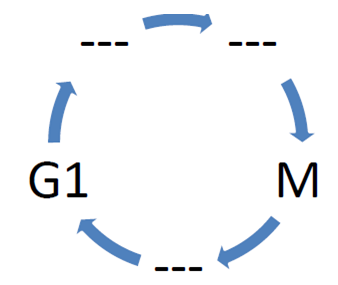
Complete the following figure for Cell Cycle.
5.
Why are echinoderms considered closer to chordates than any other phylum?
6.
The autonomic nervous system is considered as involuntary nervous system. Why?
7.
What will be the effect on the amount of urine released when water is abundant in the body tissues in case of vertebrates?
8.
What is the ratio of the concentrated filtrate to that of the initial filtrate?
9.
A student cultures a callus from the tobacco pith in a sterilised minimal nutritive medium, but adds more cytokinins than auxins. What would develop first from the callus the shoot buds or the roots?
10.
What happens if the meristematic cells ever cease to divide?
11.
Tomatoes, carrots and chillies are red in colour due to presence of one pigment. Name the pigment.It is a photosynthetic pigment?
12.
At the following stage of meiosis, the chromosomes appear to be beaded.Can you find out the stage?
13.
Can there be mitosis without DNA replication in ‘S’ phase?
14.
Why is cellulose is considered as a homopolymer?
15.
Which layer of cell envelope is sticky in nature? Also give another name for this layer.
16.
In earthworm, from which segment intestine starts and where it ends?
17.
Plasma protein acts as acid-base buffer in the blood . Explain
18.
How the secondary growth in dicot stems is achieved?
19.
Why are velamen tissues present in epiphytic roots?
20.
Why the heart of fishes is commonly called 'the venous heart'?
21.
HCI is secreted in stomach. Give the name of the cells that secrete it.
22.
If a person is suffering from reflux oesophagitis, which part of his alimentary canal is not functioning properly.
23.
Name the mechanism by which nutrients are absorbed in alimentary canal
24.
Deficiency of nitrogen in plants induces stems, petioles and lower leaf surface of plants to get purplish in appearance.Analyse the statement and the reason behind the fact.
25.
A gardener forgot to water a potted for a day during summer, what will happen to the plant? Do you think it reversible? If yes, how?
1.
The hypophyseal portal system is a system of blood vessels in the microcirculation at the base of the brain, connecting the hypothalamus with the anterior pituitary. Its main function is to quickly transport and exchange hormones between the hypothalamus arcuate nucleus and anterior pituitary gland.
2.
a-Patella.
b-Myasthenia gravis
3.
Matrix of the bone also contains calcium and magnesium salt which also add in building rigidity of the tissue. Cartilage is soft and pliable as its matrix has a flexible material, the chondrin. Matrix of the cartilage chiefly consists of chondroitin sulphate, that is capable of withstanding considerable pressure.
4.
G0 , S, G2
5.
Because like chordates they are also deuterostomes where the anal region develops earlier than the mouth part.
6.
This system transmits impulses from the CNS to the involuntary organs and smooth muscles of the body. So, it is also called involuntary nervous system.
7.
Vertebrates excrete large quantities of dilute urine when water is abundant in the body tissues and vice-versa.
8.
The concentrated urine(filtrate) is nearly four times concentrated than the initial filtrate formed.
9.
Hence, shoot would develop first from the callus.
10.
If meristematic cells cease to divide, the growth of the plant will be hindered and will undergo a period of dormancy depending upon the seasonal changes in the climate.
11.
Lycopene pigment, which is a chromoplast.It is a non-photosynthetic pigment.
12.
Chromosomes seem to be beaded during leptotene(prophase-I) of meiosis.
13.
Mitosis cannot occur without DNA replication in S-phase because the trigger for mitosis takes place due to the disturbance in nucleocytoplasmic ratio caused by DNA replication in S-phase.
14.
Since, cellulose is made of only one type of monomer (glucose), that is why it is considered as a homopolymer.
15.
The sticky layer of cell envelope is called glycocalyx. It is also known as mucilage sheath.
16.
In earthworm, intestine starts from the 15th segment onwards and continues till the last segment.
17.
plasma protein maintains the pH of the blood by neutralising the strong acids and bases so it acts as acid base buffers
18.
Secondary growth in dicot stems is achieved by the activity of fascicular , interfascicular cork cambium and the lateral meristems.
19.
The velamens atre spongy tissues, which help epiuphytic roots in absording atmospheric water vapours.
20.
This is because it supplies deoxygenated blood to gills for oxygenation
21.
()
Oxyntic cells (parietal cells) are present in the epithelial lining of stomach that secretes gastric acid, i.e., HCI.
22.
()
In a reflux oesophagitis, the esophagus does not function properly.
23.
()
Small nutrients are absorbed by active transport, some are absorbed by the facilitate transport and simple diffusion
24.
()
The appearance of purplish colour in different parts of plant occurs due to accumulation of anthocyanin.
25.
()
(i) The plant would show wilting.
(ii) Yes, it is reversible; when water is supplied, the roots absorb water and the cells regain their turgidity.

11th Standard CBSE Syllabus & Materials
11th Standard CBSE
CBSE 11th Business Studies Forms of Business Organisation Sample Question Papers Study Material - QB365 Set A
NEW11th Standard CBSE
CBSE 11th Business Studies Business, Trade and Commerce Sample Question Papers Study Material - QB365 Set A
NEW11th Standard CBSE
CBSE 11th Physics Waves Sample Question Papers Study Material - QB365 Set A
NEW11th Standard CBSE
CBSE 11th Physics Kinetic Theory Sample Question Papers Study Material - QB365 Set A



NCERT Books

Syllabus

Exam Pattern

Sample Question Papers

Previous year Question Papers

Important Notes

MCQ Practice test

NCERT Exemplers

Case study Questions

Image Based Questions

Passage based Questions

HOT Questions

Value Based Questions

Model Questions Papers
NCERT ( Book Back ) Questions

Assertion and Reason
Important Questions And Answers

CBSE 11th Standard CBSE Subjects
CBSE Standards








