
 100% FREE ACCESS
11th Standard CBSE Syllabus & Materials
11th Standard CBSE
CBSE 11th Economics PART-A - Presentation of Data - New Sample Question Papers Study Material - QB365 Set A
NEW11th Standard CBSE
CBSE 11th Economics PART-A - Organisation of Data - New Sample Question Papers Study Material - QB365 Set A
NEW11th Standard CBSE
CBSE 11th Economics PART-A - Collection of Data - New Sample Question Papers Study Material - QB365 Set A
NEW11th Standard CBSE
CBSE 11th Economics PART-A - Introduction to Economics and Statistics - New Sample Question Papers Study Material - QB365 Set A
NEW11th Standard CBSE
CBSE 11th Business Studies International Trade Sample Question Papers Study Material - QB365 Set A
NEW11th Standard CBSE
CBSE 11th Business Studies Evolution and Fundamentals of Business Sample Question Papers Study Material - QB365 Set A

Published on: 29/05/2021
QB365 Provides the HOT Question Papers for Class 11 Biology, and also provide the detail solution for each and every HOT Questions. HOT Questions will help to get more idea about question pattern in every exams and also will help to get more marks in Exams
Download CBSE Class 11th Standard CBSE Biology question papers, sample papers, important questions, and previous year solved papers in PDF format. Get free study materials, NCERT solutions, and exam preparation resources for Class 11th Standard CBSE Biology
Questions + Answers key
Take MCQ Biology Test1.
(i) Which bones of the skull are movable?
(ii) How many vertebrae are there in vertebral column?
(iii) Why is atlas vertebra called yes bone?
2.
Diffusion of gases occurs in the alveolar region only and not in the other parts of respiratory system. Why?
3.
What would happen if for some reason goblet cells become non-functional. Why are these important for digestive system?
4.
Would a defoliated plant respond to photoperiodic cycle? Why?
5.
Well-watered plants transpire more during sunny and windy days than in cool and calm mornings. Comment.
6.
Meiosis is advantageous than mitosis as it produces variations so plays important role in evolution. What are the stages during which chances of recombination of genes are increased during meiosis? Explain these events.
7.
The lines A to D below show how change in temperature can affect the rate of enzyme reaction.Line N shows the rate of reaction under optimum temperature.
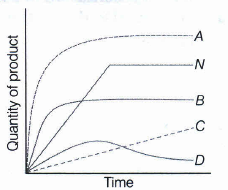
Which line A, B, C or D shows the rate of enzyme reaction at \(60°C\)?
8.
Enzymes are proteins. Proteins are long chains of amino acids linked to each other by peptide bonds. Amino acids have many functional groups in their structure.
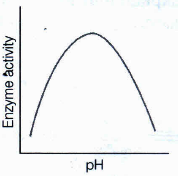
These functional groups are ionizable as they are weak acids and bases in chemical nature. This ionisation is influenced by the pH of the solution. For many enzymes, activity is influenced by surrounding pH. This is depicted in the curve given explain briefly.
9.
Living state and metabolisms are synonyms. Justify.
10.
Proteins have primary structure. If you are given a method to know which amino acid is at either of the two termini (ends) of a protein, can you connect this information to purity or homogeneity of a protein?
11.
Succinic dehydrogenase is an enzyme that causes the substrate, succinate, to break down into fumarate
Malonate is a substance that resembles succinate and inhibits the activity of succinic dehydrogenase
Explain how this type of inhibition affects the activity of the enzyme
12.
Which structures form gynoecium? How is placenta related to gynoecium? What are its types?
13.
How many species are present in class Amphibia?Make a list of its members.What may be the reason that they are partially successful although they can also live on land?
14.
Why the vascular plants dominated land?
15.
The two kingdom classification system placed bacteria, algae, blue-green algae, fungi, mosses, ferns, gymnosperm, and angiosperms, together under one single kingdom-Plantae. According to you, what could have been the basis of such classification?
16.
Justify at what extent the phylogenetic relationship is useful as a criterion for classification.
17.
There is a myth that immediately after heavy rains in forest, mushrooms appear in large number and make a very large ring or circle, which may be several metres in diameter. These are called 'fairy rings'. Can you explain the myth of fairy rings in biological terms?
18.
Why the members of class-Deuteromycetes are considered the fungi imperfecti?
19.
Justify the statement Euglena is a taxonomic puzzle.
20.
When did cyanobacteria evolved? Why are they referred as the earliest colonisers of barren areas?
21.
In which conditions human beings are difficult to define as living?
22.
Do you consider a person in coma, living or dead?
23.
Why reproduction is necessary? is it essential for survival? If a living organism does not reproduce, in which category it will belong, living or non-living? How is sexual reproduction different from asexual reproduction?
24.
Amoeba is a living matter and a sand particle is non-living matter.Explain.
25.
Could the number of eggs or young ones produced by an oviparous and viviparous mother be equal? Why?
1.
(i) Mandible and ear ossicles are the movable joints.
(ii) There are 33 vertebrae in vertebral column.
(iii) Atlas vertebra is also called 'yes' bone as it provides up and down movement to the skull.
2.
For efficient exchange of gases, respiratory surface must have certain characteristics such as
(i) it must be thin, moist and permeable to respiratory gases.
(ii) it must be large.
(iii) it must be highly vascular.
Only alveolar region has these characteristics. Thus, diffusion of gases occurs in this region only.
3.
If goblet cells are non-functional for some reason, this will adversely affect smooth movement of food down the intestine due to the absence of much.
These glands secrete mucus which along with succus entericus which helps in digestion and movement of food material in the alimentary canal.
4.
No, a defoliated plant would not respond to photoperiodic cycle because the site of perception of light, dark duration are the leaves.
There is a hormonal substance present in leaves which is responsible for flowering. This hormonal substance migrates from leaves to shoot apices for inducing flowering only when the plants are exposed to the necessary photoperiod.
5.
The leaf of the plants are heated by the temperature of the environment and also by the heat released during photosynthesis. Thus, transpiration provides a cooling mechanism for the plant to release excess heat in the leaves in order to maintain internal temperature necessary for biological and chemical processes. Transpiration tends to occur more quickly at higher temperature, i.e in suny ays due to increased evaporation. And on windy days the moisture present in the air is swept away from the leaf causing it to transpire more. Whereas on cool and calm days, the humidity rate can rise which in turn cause a decrease in transpiration.
6.
Stages during the recombination of genes occurs in meiosis are
(i) Crossing over is exchange of genes between the non-sister chromatids of homologous chromosomes. It occurs at recombination nodules during pacytene stage of prophase-I of meiosis-I and is regulated by recombinase enzyme.
(ii) Arrangement of bivalents at the equator of the spindle during metaphase-I of meiosis.
7.
Line B, will show the rate of reaction at \(60°C\) because the rate of reaction initially is more rapid, but then decreases as the enzyme becomes denatured by the high temperature.Thus, the quantity of product remains constant at a lower amount compared to line N.
8.
Enzymes, generally function in a narrow range of pH.Each enzyme shows its highest activity at a particular optimum pH.Activity declines both below and above the optimum value. The graph shows maximum enzyme activity at optimum pH.The rate of enzyme activity decreases above and below that optimum pH.
9.
The most important fact of biology systems is that all living organisms exist in a steady-state characterised by the concentration of each of the biomolecule. These biomolecules are in a metabolic flux. Any chemical or physical process moves spontaneously to equilibrium. Thus, the steady state is a non-equilibrium state.
As living organisms work continuously, they cannot afford to reach equilibrium. Hence, the living state is a non-equilibrium steady-state to be able to perform work. This is achieved by energy input. Metabolism provides a mechanism for the production of energy.
Hence, the living state and metabolism are synonymous. Without metabolism, there cannot be a living state.
10.
The sequence of amino acids, i.e., the positional configuration in a protein which is the first amino acid, which is second and so on is called the primary structure of a protein.
The first amino acid is also called as N-terminal amino acid. The last amino acid is called the C-terminal amino acid. Yes, we can connect this information to purity or homogeneity of a protein. Based on number of amino and carboxyl groups, these can be acidic (e.g., glutamic acid), basic (lysine) and neutral (valine) amino acids.
11.
The inhibitor competes with the substract for the active sites of enzyme molecules as it has a structure similar to the substract that allows it to combine with the active site, preventing any substract molecule from occupying that site.This reduces the rate of the reaction since, the subtract can only use the enzyme molecules that are not occupied by the inhibitor, resulting in the same quantity of product being formed at a slower rate
12.
Gynoecium is the female reproductive whorl of the flower. It is composed of one or more carpels. Each carpel is differentiated into three parts. i.e the ovary, style and stirma.
Placenta is the tissue on which ovule(s) develops in the ovary. The placentation in the ovary may be
(i) marginal
(ii) axile
(iii) parietal
(iv) basal
(v) free-central
13.
The class Amphibia includes about 6771 species. It includes animals like frogs, toads, salamanders and caecilians. They were the first group of vertebrates that have ventured to live on land from water. They were partially successful as the adults have to come back to water for reproduction.
14.
The vascular plants dominated land due to the following features (any two)
(i) Presence of deep, penetrating and widespread roots which anchor the plants and also absorb water and minerals.
(ii) Covering of aerial parts with waterproof material like cutin.
(iii) Mechanical tissues are present to allow them to rise to great heights.
15.
The two kingdom classification system was given by Linnaeus in 1758. Lesser number of organisms were known then in comparison to what the world knows today. He classified all the known living beings into two categories - Animalia and Plantae on the basis of the presence or absence of cell wall in their cells. As bacteria, blue-green algae, fungi, algae, mosses, ferns, gymnosperms, and angiosperms have their cells surrounded by cell walls, unlike animals, therefore, they were placed together under kingdom-Plantae.
16.
Phylogeny is the evolutionary history of an organism. It shows the true kinship of organism. Such relationships are not clear in all cases. Only fossil record can provide such relationship, but complete records are not available for such studies. Hence, the phylogenetic relationships are ascertained from morphology, cytology, genetics, physiology, and biochemistry for the correct classification of the organisms.
17.
The fairy rings form as the mycelium of the mushroom fungus spreads in the soil from a central point. It grows peripherally, so that the younger hyphae will appear that cause young fungal hyphae to form compact masses that grow into mushrooms. This is the reason, the mushrooms appear growing in a circle or ring
18.
Deuteromycetes is an artificial class of fungi which has been created to include all those fungi. Ther mycelium is usually septate. Coenocytic forms are not known. Clamp connections, typical of Basidiomycetes are absent. It is believed that most members of Deutromycetes are actually Ascomycetes in which sexual reproduction is either absent or yet to be discovered. Hence, are considered as fungi imperfecti.
19.
Euglena is a taxonomic puzzle since, it shows both plant and animal characters. Absence of cell wall is an animal feature and presence of chloroplast is a plant character of Euglena. It have mixotrophic nutrition. In the presence of sunlight it can photosynthesise its food and in the absence of sunlight, it behaves like a hetrerotroph by predating on other smaller organisms.
20.
Cyanobacteria are the most self contained photosynthetic organisms. They can, therefore, live under every type of environment and on every type of substrate. Because of this fact, they are one of the earliest colonizers of barren areas.
21.
A person lying in coma is not conscious of its surrounding environment. Thus, he/she is not capable of responding to the external environmental stimuli.The person is supported by machines for various functions of the body.The person is otherwise brain dead.Some of these patients never come back to normal life. They can neither be called living nor non-living or dead.
22.
A person lying in coma is not conscious of its surrounding environment. Thus, he/she is not capable of responding to the external environmental stimuli. The person is supported by machines for various functions of the body. The person is otherwise brain dead. Some of these patients never come back to normal life. They can neither be called living nor non-living or dead.
23.
Reproduction is required for the perpetuation of a population. It is not necessary for the survival of living organism. Many organisms, e.g., mules, sterile worker bees, infertile human couples are not able to reproduce, while they have all other defining properties of life, so they can be called as living.
Sexual reproduction involves the formation and fusion of two kinds of gametes to produce an offspring. In asexual reproduction, new individuals can arise by the specialised parts of body or without the fusion of gametes.
24.
Amoeba shows various characteristics such as growth, reproduction, metabolism, etc., that are specific to living organisms. On the other hand, a sand particle does not show any reproduction and metabolism therefore, it is considered as non-living matter. Though, the sand particle shows growth which is also a characteristic of living things, but in this the growth is only external due to aggregation of many sand particles and not internal. Therefore, Amoeba is a living matter while a sand particle is a non-living matter.
25.
Viviparous animals: Viviparous animals are those animals in which both the fertilization (i.e. the fusion of male and female gametes) of egg that results in zygote and development of embryo take place inside the body of the female in the mother's womb.
These animals give birth to young ones directly.
Examples – mammals such as cows, goats, dogs, humans, etc.
Oviparous animals: Oviparous animals are those animals in which both the process of development of embryos take place outside the body of the female.
a) In oviparous animals fertilization can occur inside the mother’s body or outside the mother’s body.
b) Oviparous animals lay eggs outside their body. Example – birds, hen, frogs, etc.
Number of eggs or young ones produced by the oviparous and viviparous can be equal or not:
a) No, the number of eggs or young ones produced by an oviparous and viviparous mother cannot be equal.
b) The number of eggs laid by the oviparous animals are always more in number than the young ones produced by viviparous animals.
c) This is because the events of fertilization or development of embryos takes place outside the mother’s body so there are more chances that the eggs will get damaged prior to fertilization or development. So, to ensure the complete development of at least one embryo, oviparous animals lay more numbers of eggs than viviparous animals.
d) On the other hand in viviparous animals fertilization and development of embryos both occur inside the body of the female so there are 100% of its development.

11th Standard CBSE Syllabus & Materials
11th Standard CBSE
CBSE 11th Business Studies Forms of Business Organisation Sample Question Papers Study Material - QB365 Set A
NEW11th Standard CBSE
CBSE 11th Business Studies Business, Trade and Commerce Sample Question Papers Study Material - QB365 Set A
NEW11th Standard CBSE
CBSE 11th Physics Waves Sample Question Papers Study Material - QB365 Set A
NEW11th Standard CBSE
CBSE 11th Physics Kinetic Theory Sample Question Papers Study Material - QB365 Set A



NCERT Books

Syllabus

Exam Pattern

Sample Question Papers

Previous year Question Papers

Important Notes

MCQ Practice test

NCERT Exemplers

Case study Questions

Image Based Questions

Passage based Questions

HOT Questions

Value Based Questions

Model Questions Papers
NCERT ( Book Back ) Questions

Assertion and Reason
Important Questions And Answers

CBSE 11th Standard CBSE Subjects
CBSE Standards








