
 100% FREE ACCESS
11th Standard CBSE Syllabus & Materials
11th Standard CBSE
CBSE 11th Economics PART-A - Presentation of Data - New Sample Question Papers Study Material - QB365 Set A
NEW11th Standard CBSE
CBSE 11th Economics PART-A - Organisation of Data - New Sample Question Papers Study Material - QB365 Set A
NEW11th Standard CBSE
CBSE 11th Economics PART-A - Collection of Data - New Sample Question Papers Study Material - QB365 Set A
NEW11th Standard CBSE
CBSE 11th Economics PART-A - Introduction to Economics and Statistics - New Sample Question Papers Study Material - QB365 Set A
NEW11th Standard CBSE
CBSE 11th Business Studies International Trade Sample Question Papers Study Material - QB365 Set A
NEW11th Standard CBSE
CBSE 11th Business Studies Evolution and Fundamentals of Business Sample Question Papers Study Material - QB365 Set A

Published on: 29/05/2021
QB365 Provides the HOT Question Papers for Class 11 Biology, and also provide the detail solution for each and every HOT Questions. HOT Questions will help to get more idea about question pattern in every exams and also will help to get more marks in Exams
Download CBSE Class 11th Standard CBSE Biology question papers, sample papers, important questions, and previous year solved papers in PDF format. Get free study materials, NCERT solutions, and exam preparation resources for Class 11th Standard CBSE Biology
Questions + Answers key
Take MCQ Biology Test1.
(i) Which bones of the skull are movable?
(ii) How many vertebrae are there in vertebral column?
(iii) Why is atlas vertebra called yes bone?
2.
(i) Name the excretory organs found in Aschelminthes and leeches.
(ii) Name the arterioles through which blood enters and leaves the glomerulus.
(iii) Name the vessel of peritubular capillaries that runs parallel to the loop of Henle.
3.
Name the two hormone of hypothalamus that influences’ the middle lobe of pituitary. Mention their functions.
4.
Photosynthesis needs constant supply of water. But transpiration can hamper this supply. How do plants of desert area manage to get sufficient water in spite of faster transpiration?
5.
Give the name of the layers through which the glomerular capillary blood pressure causes filtration.
6.
How can we say that artificial pacemaker is a life saving instrument?
7.
State the route of foul air from the lungs to outside. Also state whether TV increases or decreases during excitement and activity.
8.
Why is breathing of women regarded as thoracic, while that of male as abdominal? Also state who among the two has higher vital capacity.
9.
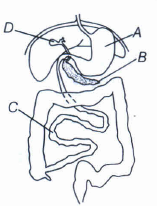
Out of the parts labelled as A, B, C and D of alimentary canal in the diagram below.Where is the enzyme responsible for the first stage of protein digestion produced?Label all parts, i.e., A-D.
10.
Why is the term short-day plants a misnomer?Give one example of short-days plants.
11.
Cyclic photophosphorylation results in the production of ATPs and not NADPH. Give reasons.
12.
Well-watered plants transpire more during sunny and windy days than in cool and calm mornings. Comment.
13.
Enzymes are proteins. Proteins are long chains of amino acids linked to each other by peptide bonds. Amino acids have many functional groups in their structure.
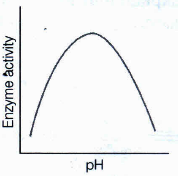
These functional groups are ionizable as they are weak acids and bases in chemical nature. This ionisation is influenced by the pH of the solution. For many enzymes, activity is influenced by surrounding pH. This is depicted in the curve given explain briefly.
14.
Without metabolism, the living state can not exist Justify.
15.
Proteins have primary structure. If you are given a method to know which amino acid is at either of the two termini (ends) of a protein, can you connect this information to purity or homogeneity of a protein?
16.
Succinic dehydrogenase is an enzyme that causes the substrate, succinate, to break down into fumarate
Malonate is a substance that resembles succinate and inhibits the activity of succinic dehydrogenase
(i) State the type of inhibition of succinic dehydrogenase by malonate
(ii) Explain how this type of inhibition affects the activity of the enzyme
17.
Which structures form gynoecium? How is placenta related to gynoecium? What are its types?
18.
Why molluscs are considered advanced over annelids?
19.
Why the blood vascular system of leeches is also called the haemocoelomic system? Write its details.
20.
Each plant or group of plants have some phylogenetic significance in relation to evolution. Cycas with any of the few living members of gymnosperms is called as 'relic of the past'. can you establish a phylogenetic relationship of Cycas with any other of plants that justifies the above statement?
21.
Justify the statement Euglena is a taxonomic puzzle.
22.
When did cyanobacteria evolved? Why are they referred as the earliest colonisers of barren areas?
23.
Do you consider a person in coma, living or dead?
24.
Why reproduction is necessary? is it essential for survival? If a living organism does not reproduce, in which category it will belong, living or non-living? How is sexual reproduction different from asexual reproduction?
25.
Could the number of eggs or young ones produced by an oviparous and viviparous mother be equal? Why?
1.
(i) Mandible and ear ossicles are the movable joints.
(ii) There are 33 vertebrae in vertebral column.
(iii) Atlas vertebra is also called 'yes' bone as it provides up and down movement to the skull.
2.
(i) Renette cells,metanephridia
(ii) Afferent arteriole and efferent arteriole.
(iii) Duct of Bellini.
3.
(1) Melanocytes stimulating –release hormone. Stimulate the function of MSH.
(2) Melanocyte stimulating-inhibiting hormone. It inhibits the release of MSH.
4.
Desert plants have a different mechanism of photosynthesis and it is called C4 pathways. The evolution of the C4 photosynthetic system is probably one of the strategies for maximising the availability of CO2 while minimising water loss. C4 plants are twice as efficient as C3 plants in terms of fixing carbon (making sugar). However, a C4 plant loses only half as much water as a C3 plant for the same amount of CO2 fixed.
5.
The layers through which the glomerular capillary blood pressure causes filtration are
i) The endothelium of glomerular blood vessels.
ii) The epithelium of Bowman's capsule.
iii) A basement membrane (present between these two above mentioned layers)
6.
It is an electronic device, which regularly sends a small amount of electrical charge for maintaining the rhythmicity of the heart. It is implanted subcutaneously in the upper thoracic region having a connection with the heart.
The artificial pacemaker is called a life-saving instrument because, it stimulates the heart electrically at regular intervals to maintain its beats. Thus, it replaces the SA node as the originator of the cardiac impluse. It is to be noted that some pacemakers stimulate the heart at a fixed rate, others sense when the natural heart rate falls below a predetermined value and then stimulates the heart.
7.
The foul air follows the route given below
Alveoli\(\rightarrow \)Alveolar ducts\(\rightarrow \)Bronchioles\(\rightarrow \)Bronchi\(\rightarrow \)Trachea\(\rightarrow \)Larynx\(\rightarrow \)Glottis\(\rightarrow \)Pharynx\(\rightarrow \)Internal nares\(\rightarrow \)Nasal chambers\(\rightarrow \)External nares\(\rightarrow \)Atmosphere.
The tidal volume increases 4-10 times during excitment and activity.
8.
In male, the lateral movements of thorax constitutes 25% of breathing, while the abdominal movement accounts for 75% breathing. Thus, it regarded as abdominal breathing.
In women, particular in pregnant women, the entire breathing is through lateral movements of the thorax. thus, breathing in women is regarded as thoracic.
The VC is higher in men than in women and in the young ones than in the old persons.
9.
In the labelled part A(i.e., the stomach,) the enzyme responsible for first stage of protein digestion is produced.A-stomac, B-pancrease,C-small intestine,D-gall bladder.
10.
The term short-day plants is actually a misnomer. When photoperiodism was discovered, the duration of the light period was thought to be critical for flowering. However, subsequently researchers found that when the long night period was interrupted in short-day plants, by a brief exposure to light, they failed to flower. In other words, the requirement is actually for a long night or a critical dark period rather than for a short day length. Thus, a short-day plant is more appropriately called as a long-night plant.
Common examples of short-day plants are Xanthium and Chrysanthemum.
11.
Cyclic phosphorylation occurs when 700 nm light is available and PS-I is functional. It occurs in the stroma lamellae where enzyme NADP reductase is absent and PS-II is also absent. Hence, electrons are passed on back to PS-I and not to NADP+. So, the cyclic flow results in the formation of ATP, but not NADPH.
12.
The leaf of the plants are heated by the temperature of the environment and also by the heat released during photosynthesis. Thus, transpiration provides a cooling mechanism for the plant to release excess heat in the leaves in order to maintain internal temperature necessary for biological and chemical processes. Transpiration tends to occur more quickly at higher temperature, i.e in suny ays due to increased evaporation. And on windy days the moisture present in the air is swept away from the leaf causing it to transpire more. Whereas on cool and calm days, the humidity rate can rise which in turn cause a decrease in transpiration.
13.
Enzymes, generally function in a narrow range of pH.Each enzyme shows its highest activity at a particular optimum pH.Activity declines both below and above the optimum value. The graph shows maximum enzyme activity at optimum pH.The rate of enzyme activity decreases above and below that optimum pH.
14.
The most important fact of biology systems is that all living organisms exist in a steady-state characterised by the concentration of each of the biomolecule. These biomolecules are in a metabolic flux. Any chemical or physical process moves spontaneously to equilibrium. Thus, the steady state is a non-equilibrium state.
As living organisms work continuously, they cannot afford to reach equilibrium. Hence, the living state is a non-equilibrium steady-state to be able to perform work. This is achieved by energy input. Metabolism provides a mechanism for the production of energy.
Hence, the living state and metabolism are synonymous. Without metabolism, there cannot be a living state.
15.
The sequence of amino acids, i.e., the positional configuration in a protein which is the first amino acid, which is second and so on is called the primary structure of a protein.
The first amino acid is also called as N-terminal amino acid. The last amino acid is called the C-terminal amino acid. Yes, we can connect this information to purity or homogeneity of a protein. Based on number of amino and carboxyl groups, these can be acidic (e.g., glutamic acid), basic (lysine) and neutral (valine) amino acids.
16.
(i) The type of inhibition of succinic dehydrogenase by malonate is competitive inhibition
(ii) The inhibitor competes with the substract for the active sites of enzyme molecules as it has a structure similar to the substract that allows it to combine with the active site, preventing any substract molecule from occupying that site.This reduces the rate of the reaction since, the subtract can only use the enzyme molecules that are not occupied by the inhibitor, resulting in the same quantity of product being formed at a slower rate.
17.
Gynoecium is the female reproductive whorl of the flower. It is composed of one or more carpels. Each carpel is differentiated into three parts. i.e the ovary, style and stirma.
Placenta is the tissue on which ovule(s) develops in the ovary. The placentation in the ovary may be
(i) marginal
(ii) axile
(iii) parietal
(iv) basal
(v) free-central
18.
The molluscs have advancement over annelids, as they have distinct head, better sense organs and gills or lungs for respiration.
19.
In leeches, there is no true blood vascular system, the coelomic space and fluid have been modified to form the circulatory system.Hence, it is called haemocoelomic system and the coelomic fluid is called haemocoelomic fluid.Blood is red due to the presence of respiratory pigment haemoglobin or erythrocyanin found dissolved in the plasma.Free amoeboid blood corpuscles are present, but there are no red blood corpuscles
20.
Cycas is called the 'relic of the past' It has following properties to justify this
i) Monoxylic wood through secondary growth started
ii) shedding of seed when embryo is still immature.
iii) The arrangement of microsporangia in all defined sori.
Phylogenetically, cycas is related to the pteridosperm (seed ferns) and through them to ferns from which it seems to have evolved. It can be ascertained by the presence of
i) lead-like megasporophyll
ii) persistence of leaf base.
21.
Euglena is a taxonomic puzzle since, it shows both plant and animal characters. Absence of cell wall is an animal feature and presence of chloroplast is a plant character of Euglena. It have mixotrophic nutrition. In the presence of sunlight it can photosynthesise its food and in the absence of sunlight, it behaves like a hetrerotroph by predating on other smaller organisms.
22.
Cyanobacteria are the most self contained photosynthetic organisms. They can, therefore, live under every type of environment and on every type of substrate. Because of this fact, they are one of the earliest colonizers of barren areas.
23.
A person lying in coma is not conscious of its surrounding environment. Thus, he/she is not capable of responding to the external environmental stimuli. The person is supported by machines for various functions of the body. The person is otherwise brain dead. Some of these patients never come back to normal life. They can neither be called living nor non-living or dead.
24.
Reproduction is required for the perpetuation of a population. It is not necessary for the survival of living organism. Many organisms, e.g., mules, sterile worker bees, infertile human couples are not able to reproduce, while they have all other defining properties of life, so they can be called as living.
Sexual reproduction involves the formation and fusion of two kinds of gametes to produce an offspring. In asexual reproduction, new individuals can arise by the specialised parts of body or without the fusion of gametes.
25.
Viviparous animals: Viviparous animals are those animals in which both the fertilization (i.e. the fusion of male and female gametes) of egg that results in zygote and development of embryo take place inside the body of the female in the mother's womb.
These animals give birth to young ones directly.
Examples – mammals such as cows, goats, dogs, humans, etc.
Oviparous animals: Oviparous animals are those animals in which both the process of development of embryos take place outside the body of the female.
a) In oviparous animals fertilization can occur inside the mother’s body or outside the mother’s body.
b) Oviparous animals lay eggs outside their body. Example – birds, hen, frogs, etc.
Number of eggs or young ones produced by the oviparous and viviparous can be equal or not:
a) No, the number of eggs or young ones produced by an oviparous and viviparous mother cannot be equal.
b) The number of eggs laid by the oviparous animals are always more in number than the young ones produced by viviparous animals.
c) This is because the events of fertilization or development of embryos takes place outside the mother’s body so there are more chances that the eggs will get damaged prior to fertilization or development. So, to ensure the complete development of at least one embryo, oviparous animals lay more numbers of eggs than viviparous animals.
d) On the other hand in viviparous animals fertilization and development of embryos both occur inside the body of the female so there are 100% of its development.

11th Standard CBSE Syllabus & Materials
11th Standard CBSE
CBSE 11th Business Studies Forms of Business Organisation Sample Question Papers Study Material - QB365 Set A
NEW11th Standard CBSE
CBSE 11th Business Studies Business, Trade and Commerce Sample Question Papers Study Material - QB365 Set A
NEW11th Standard CBSE
CBSE 11th Physics Waves Sample Question Papers Study Material - QB365 Set A
NEW11th Standard CBSE
CBSE 11th Physics Kinetic Theory Sample Question Papers Study Material - QB365 Set A



NCERT Books

Syllabus

Exam Pattern

Sample Question Papers

Previous year Question Papers

Important Notes

MCQ Practice test

NCERT Exemplers

Case study Questions

Image Based Questions

Passage based Questions

HOT Questions

Value Based Questions

Model Questions Papers
NCERT ( Book Back ) Questions

Assertion and Reason
Important Questions And Answers

CBSE 11th Standard CBSE Subjects
CBSE Standards








