
 100% FREE ACCESS
11th Standard CBSE Syllabus & Materials
11th Standard CBSE
CBSE 11th Economics PART-A - Presentation of Data - New Sample Question Papers Study Material - QB365 Set A
NEW11th Standard CBSE
CBSE 11th Economics PART-A - Organisation of Data - New Sample Question Papers Study Material - QB365 Set A
NEW11th Standard CBSE
CBSE 11th Economics PART-A - Collection of Data - New Sample Question Papers Study Material - QB365 Set A
NEW11th Standard CBSE
CBSE 11th Economics PART-A - Introduction to Economics and Statistics - New Sample Question Papers Study Material - QB365 Set A
NEW11th Standard CBSE
CBSE 11th Business Studies International Trade Sample Question Papers Study Material - QB365 Set A
NEW11th Standard CBSE
CBSE 11th Business Studies Evolution and Fundamentals of Business Sample Question Papers Study Material - QB365 Set A

Published on: 27/05/2021
QB365 Provides the NCERT Exemplar Question Papers for Class 11 Biology , and also provide the detail solution for each and every ncert exemplar papers. Ncert Exemplar papers will help to get more idea about question pattern in every exams and also will help to get more marks in Exams
Download CBSE Class 11th Standard CBSE Biology question papers, sample papers, important questions, and previous year solved papers in PDF format. Get free study materials, NCERT solutions, and exam preparation resources for Class 11th Standard CBSE Biology
Questions + Answers key
Take MCQ Biology Test1.
The cells of this tissue are living and show angular wall thickenings. They provide mechanical support. The tissue is______.
xylem
sclerenchyma
collenchyma
epidermis
2.
Which one of the following statement is correct?
Mesoglea is present in between ectoderm and endoderm in Obelia.
Radial Symmetry is found in Asterias
Fasciola is a pseudocoelomate animal.
Taenia is a triploblastic animal.
3.
A Prothallus is______.
a structure in pteridophyte formed before the thallus develops
a sporophytic free- living structure formed in pteridophyte
a gametophytic free - living structure formed in pteridophytes
a primitive structure formed after fertilisation in ptyeridophyte
4.
The term systematics refers to______.
identification and classification of plants and animals.
nomenclature and identification of plants and animals.
diversity of kinds of organisms and their relationship.
different kinds of organisms and their classification
5.
Give the name of the cells/tissues in human body which
(i) exhibit amoeboid movement.
(ii) exhibit ciliary movement.
6.
What is the pH of urine?
7.
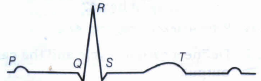
Given below is the diagrammatic representation of a standard ECG. Label its different peaks.
8.
Cigarette smoking causes emphysema.Give reason.
9.
Growth is one of the fundamental characteristics of all living organisms. Do unicellular organisms also grow? If so, what are the parameters?
10.
Succulents are known to keep their stomata closed during the day to check the rate of transpiration.How do they meet their photosynthetic CO2 requirements?
11.
Give the name of the chemicals, which are released at the synapyic junction.
12.
If a tissue has 1024 cells at a given time, how many cycles of mitosis had the original parental single cell undergone?
13.
What does'S' refer to, in 70 Sand 80 S ribosomes?
14.
Name the different cells junctions found in tissues.
15.
What is the present on the surface of the leaves which helps the plant prevent loss of water, but is absent in roots?
16.
Roots obtain oxygen from air present in the soil for respiration> In the absence or deficency of O2, root growth is constricted or cimpletely stopped. How do these plants growing in marshlands or swaps obtain their oxygen required for root respiration?
17.
What is the importance of pneumatic bones and air sacs in Aves?
18.
Give one example each for an animal possessing placoid scales and that with cycloid scales
19.
The plant body in higher plants is well - differentiated and well - developed. Roots are the organs used for the purpose of absorption. What is the equivalent of the roots in the less developed lower plants?
20.
In the five-kingdom system of Whittaker, how many kingdoms are eukaryotes?
21.
Are chemosynthetic bacteria autotrophic or heterotrophic?
22.
Which is the largest botanical garden in the world? Name a few well-known botanical gardens in India.
23.
The plant cell cytoplasm is surrounded by both cell wall and cell membrane. The specificity of transport of substances are mostly across the cell membrane, because __________________.
24.
Body cavity is the cavity present between the body wall and gut wall. In some animals, the body cavity is not lined by mesoderm, Such animals are called ______.
25.
Name an insectivorous angiosperm
1.
The collenchyma is a simple permanent tissue, which provides mechanical support
2.
Fasciola (liver fluke) is an acoelomate, i.e.,without coelom or body cavity.
3.
Gametophyte is a free - living, small thalloid structure called prothallus. In most ferns, the prothallus is green and autotrophic.
4.
Systematics refers to study of diversity of kinds of organisms and their relationship.
5.
(i) Macrophages.
(ii) Ciliated epithelium of trachea.
6.
It ranges from 4.5-8.2, average pH is 6.0
7.
The representation of a standard ECG diagram

8.
Cigarette smoking causes damages to the alveolar walls and reduces elasticity of the lungs, which leads to decreased respiratory surface for exchange of gases.Thus, causing emphysema.
9.
Yes,unicellular organisms also grow. Their cell size increases upto a certain fixed dimension only and then they divide. Their growth and reproduction is synchrosed. i.e. it goes hand in hand.
10.
Succulents (water-storing) plants such as cacti, fix CO2 into organic compound (malic acid) using PEP carboxylase at night when the stomata are open.
11.
Neurotransmitters are the chemicals which are present at sybnaptic junctions.
12.
Calculation of number of mitosis
Mitosis of one cell produces 2 cells. Similarly, 2 cells undergoing mitosis give rise to 4 cells and so on.
This can be generalised as:
2n = number of daughter cells, where n = number of cycles of mitotic cell division.
Since the tissue has 1024 cells
⇒ 1024 = 210 cycles
Hence, the original parental single cell has undergone 10 cycles of mitosis to give rise to 1024 cells.
Ten cycles of mitosis.
13.
'S' or Svedberg unit, refers to the sedimentation coefficient.
14.
(i) Gap Junction
(ii) Tight Junction
(iii) Adhering Junction
15.
Cuticle It is waxy coating covering the entire plant body surface. It is absent in roots, it prevents the loss of water through the surface of the plant body.
16.
They obtain oxygen by pneumatophores, from dissolved part in water and intercellular diffusion from aerial parts.
17.
(i) Pneumatic bones are light but strong, this feature helps birds in flight
(ii) Air sacs increase the efficiency of respiration and provide buoyancy to the animal
18.
Placoid scales - Scoliodon (dog fish)
Cycloid scales - Labeo ( rohu)
19.
Rhizoids: Bryophytes have rhizoids that have a root-like structure that helps in absorption of water and anchors the plant.
20.
In the five-kingdom classification system given by Whittaker, four kingdoms belong to eukaryotes, i.e., Protista, Fungi, Plantae, and Animalia. Only kingdom Monera belongs to prokaryotes.
21.
Chemosynthetic bacteria are autotrophs because they are able to synthesise their food from inorganic raw material with the help of energy obtained from chemical reaction.
22.
Largest botanical garden in the world is Royal Botanical Garden, Kew (London).
Some well-known botanical gardens in India are
(i) National Botanical Garden, Lucknow
(ii) Lloyed Botanical Garden, Darjeeling
(iii) Indian Botanical Garden, Sibpur, Kolkata
23.
()
Cell membrane is semipermeable.
24.
(a)
Pseudocoelomates.
25.
()
Nepenthes

11th Standard CBSE Syllabus & Materials
11th Standard CBSE
CBSE 11th Business Studies Forms of Business Organisation Sample Question Papers Study Material - QB365 Set A
NEW11th Standard CBSE
CBSE 11th Business Studies Business, Trade and Commerce Sample Question Papers Study Material - QB365 Set A
NEW11th Standard CBSE
CBSE 11th Physics Waves Sample Question Papers Study Material - QB365 Set A
NEW11th Standard CBSE
CBSE 11th Physics Kinetic Theory Sample Question Papers Study Material - QB365 Set A



NCERT Books

Syllabus

Exam Pattern

Sample Question Papers

Previous year Question Papers

Important Notes

MCQ Practice test

NCERT Exemplers

Case study Questions

Image Based Questions

Passage based Questions

HOT Questions

Value Based Questions

Model Questions Papers
NCERT ( Book Back ) Questions

Assertion and Reason
Important Questions And Answers

CBSE 11th Standard CBSE Subjects
CBSE Standards








