
 100% FREE ACCESS
11th Standard CBSE Syllabus & Materials
11th Standard CBSE
CBSE 11th Economics PART-A - Presentation of Data - New Sample Question Papers Study Material - QB365 Set A
NEW11th Standard CBSE
CBSE 11th Economics PART-A - Organisation of Data - New Sample Question Papers Study Material - QB365 Set A
NEW11th Standard CBSE
CBSE 11th Economics PART-A - Collection of Data - New Sample Question Papers Study Material - QB365 Set A
NEW11th Standard CBSE
CBSE 11th Economics PART-A - Introduction to Economics and Statistics - New Sample Question Papers Study Material - QB365 Set A
NEW11th Standard CBSE
CBSE 11th Business Studies International Trade Sample Question Papers Study Material - QB365 Set A
NEW11th Standard CBSE
CBSE 11th Business Studies Evolution and Fundamentals of Business Sample Question Papers Study Material - QB365 Set A

Published on: 27/05/2021
QB365 Provides the NCERT Exemplar Question Papers for Class 11 Biology , and also provide the detail solution for each and every ncert exemplar papers. Ncert Exemplar papers will help to get more idea about question pattern in every exams and also will help to get more marks in Exams
Download CBSE Class 11th Standard CBSE Biology question papers, sample papers, important questions, and previous year solved papers in PDF format. Get free study materials, NCERT solutions, and exam preparation resources for Class 11th Standard CBSE Biology
Questions + Answers key
Take MCQ Biology Test1.
Give the name of the cells/tissues in human body which
(i) exhibit amoeboid movement.
(ii) exhibit ciliary movement.
2.
How does a gap junction facilitate intercellular communication?
3.
A patient complains of constant thirst excessive passing of urine and low blood pressure. When the doctor checked the patient's blood glucose and blood insulin level, the level were normal or slightly low The doctor diagnosed the conditions as diabetes insipidus. But he decides to measure on more hormone in patient's blood Which hormone does the doctor intend to measure?
4.
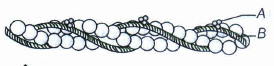
Label the different components of actinfilament in the diagram given below.
5.
What is the pH of urine?
6.
Which components of the respiratory system help in generation of pressure gradient for breathing?
7.
Growth is one of the fundamental characteristics of all living organisms. Do unicellular organisms also grow? If so, what are the parameters?
8.
Which range of wavelength(in nm) is called Photosynthetically Active Radiation (PAR)?
9.
Give the name of the chemicals, which are released at the synapyic junction.
10.
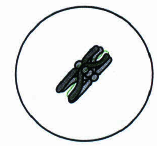
The diagram shows a bivalent at prophase-I of meiosis.Which of the four chromatids can cross over?
11.
Write the name of any one amino acid, sugar nucleotide and fatty acid.
12.
Where the sclerities are present in cockroach?
13.
What is the epidermal cell modification in plants which prevent water loss?
14.
In the five-kingdom system of Whittaker, how many kingdoms are eukaryotes?
15.
How dikaryon formed in fungi?
16.
Carolus Linnaeus is considered as father of taxonomy. Name two other botanists known for their contribution to the field of taxonomy.
17.
Define metabolism.
18.
Amoeba multiplies by mitotic cell division. Is this phenomenon growth or reproduction? Explain.
19.
Ther embryo sac of an angiosperm is made up of_______.
8 cells
7 cells and 8 nuclei
8 nuclei
7 cells and 7 nuclei
20.
Genus represents ______.
an individual plant or animal
a collection of plants or animals
a group of closely related species of plants or animals.
None of the above
21.
Add the missing floral organs of the given formula of Fabaceae,______.
22.
Body cavity is the cavity present between the body wall and gut wall. In some animals, the body cavity is not lined by mesoderm, Such animals are called ______.
23.
An association between roots of higher plants and fungi is called _____.
24.
What do we call the type of teeth attachment in which each tooth is embedded in a socket of jaw bones?
25.
Name the macronutrient which is component of all organic compounds, but is not obtained from soil.
1.
(i) Macrophages.
(ii) Ciliated epithelium of trachea.
2.
A gap junction facilitates the cells to communicate with each other by connecting the cytoplasm of the adjacent cells.
3.
It is also known as hyperglycaemia hormone, and its action is opposite to that of insulin Excess of glucose in blood suppress the secretion of glucose. whereas fall in glucose level starts glucose production (since, doctor fend the slight line level of blood glucose)
4.
A-Troponin
B-Tropomyosin
5.
It ranges from 4.5-8.2, average pH is 6.0
6.
The diaphragm and a specialised set of muscles called external and internal intercostals present in between the ribs help in generation of pressure gradient for breathing.
7.
Yes,unicellular organisms also grow. Their cell size increases upto a certain fixed dimension only and then they divide. Their growth and reproduction is synchrosed. i.e. it goes hand in hand.
8.
The light range between 400-700 nm of wavelength is called PAR.
9.
Neurotransmitters are the chemicals which are present at sybnaptic junctions.
10.
The non-sister chromatids of homologous pair of chromosomes undergo crossing over in pachytene stage of meiosis.
11.
Alanine is an amino acid, adenylic acid is a nucleotide and linolenic acid is a fatty acid.
12.
IN the exoskeleton, spread all over the body of cockroach.
13.
Cuticularised trichoblasts or epidermal hair which produce a stationary layer of air over the surface that reduces isolation and rate of transportation.
14.
In the five-kingdom classification system given by Whittaker, four kingdoms belong to eukaryotes, i.e., Protista, Fungi, Plantae, and Animalia. Only kingdom Monera belongs to prokaryotes.
15.
Plasmogamy produces a dikaryotic cell or a cell with a pair of nuclei called dikaryon.
16.
George Bentham and Joseph Dalton Hooker.
17.
The sum total of all chemical reactions occurring in an organism due to specific interactions amongst different types of molecules within the cells, is called metabolism.
18.
In unicellular organisms like Amoeba, growth is synonyms with reproduction and takes place by increase in number of cells by mitotic cell division.
19.
Embro sac of angiosperm develop upto 8 nucleate state prior to fertilization there is a 3 celled egg apparatus, 3 antipodal cells and 2 polar nuclei
20.
Genus represents a group of closely related species of plants or animals.
21.
()
Br \(\oplus \)\({ K }_{ (5) }{ C }_{ (1+2) }{ A }_{ (1+(9)) }{ G }_{ (1) }\)
22.
(a)
Pseudocoelomates.
23.
()
Mycorrhiza is a symbiotic association between a fungus and the root of a plant.
24.
()
The codont dentition.
25.
()
Carbon.

11th Standard CBSE Syllabus & Materials
11th Standard CBSE
CBSE 11th Business Studies Forms of Business Organisation Sample Question Papers Study Material - QB365 Set A
NEW11th Standard CBSE
CBSE 11th Business Studies Business, Trade and Commerce Sample Question Papers Study Material - QB365 Set A
NEW11th Standard CBSE
CBSE 11th Physics Waves Sample Question Papers Study Material - QB365 Set A
NEW11th Standard CBSE
CBSE 11th Physics Kinetic Theory Sample Question Papers Study Material - QB365 Set A



NCERT Books

Syllabus

Exam Pattern

Sample Question Papers

Previous year Question Papers

Important Notes

MCQ Practice test

NCERT Exemplers

Case study Questions

Image Based Questions

Passage based Questions

HOT Questions

Value Based Questions

Model Questions Papers
NCERT ( Book Back ) Questions

Assertion and Reason
Important Questions And Answers

CBSE 11th Standard CBSE Subjects
CBSE Standards








