
 100% FREE ACCESS
11th Standard CBSE Syllabus & Materials
11th Standard CBSE
CBSE 11th Economics PART-A - Presentation of Data - New Sample Question Papers Study Material - QB365 Set A
NEW11th Standard CBSE
CBSE 11th Economics PART-A - Organisation of Data - New Sample Question Papers Study Material - QB365 Set A
NEW11th Standard CBSE
CBSE 11th Economics PART-A - Collection of Data - New Sample Question Papers Study Material - QB365 Set A
NEW11th Standard CBSE
CBSE 11th Economics PART-A - Introduction to Economics and Statistics - New Sample Question Papers Study Material - QB365 Set A
NEW11th Standard CBSE
CBSE 11th Business Studies International Trade Sample Question Papers Study Material - QB365 Set A
NEW11th Standard CBSE
CBSE 11th Business Studies Evolution and Fundamentals of Business Sample Question Papers Study Material - QB365 Set A

Published on: 27/05/2021
QB365 Provides the NCERT Exemplar Question Papers for Class 11 Biology , and also provide the detail solution for each and every ncert exemplar papers. Ncert Exemplar papers will help to get more idea about question pattern in every exams and also will help to get more marks in Exams
Download CBSE Class 11th Standard CBSE Biology question papers, sample papers, important questions, and previous year solved papers in PDF format. Get free study materials, NCERT solutions, and exam preparation resources for Class 11th Standard CBSE Biology
Questions + Answers key
Take MCQ Biology Test1.
Correct the following statements by replacing the term underlined.
(i) Insulin is a steroid hormone.
(ii) TSH is secreted from the corpus luteum
(iii) Tetraiodothyronine is an emergency hormone.
(iv) The pineal gland is located on the anterior part of the kidney.
2.
Mention the difference between hypothyroidism and hyperthyroidism.
3.
Give the name of the organs of respiration in the following organisms.
(i) Flatworm
(ii) Birds
(iii) Frog
(iv) Cockroach
4.
State the volume of air remaining in the lungs after a normal breathing.
5.
If someone receives a blow on the back of neck, what would be the effect on the person's CNS?
6.
Nervous system and computers share certain common features. Comment in five lines. (Hint: CPU, input-output devices).
7.
Arrange the following terms based on their volumes in an ascending order.
(i) Tidal Volume (TV)
(ii) Residual Volume (RV)
(iii) Inspiratory Reserve Volume (IRV)
(iv) Expiratory Capacity (EC)
8.
Stomach is located in upper left portion of the abdominal cavity and has three major parts. Name these three parts.
9.
Some varieties of wheat are known as spring wheat, while others are called winter wheat. The former variety is sown and planted in spring and is harvested by the end of the same season. However,latter one if planted in spring, fails to flower or produce mature grains within a span of a flowering season. Explain Why?
10.
ATP produced during glycolysis is a result of substrate level phosphorylation. Explain
11.
Cyanobacteria and some other photosynthetic bacteria do not have chloroplasts.How do they conduct photosynthesis?
12.
Mycorrhiza is a mutualistic association. How do the organisms involved in this association gain from each other?
13.
The radio labelled carbon in carbon dioxide supplied to potato plants in an experiment. It was seen in the tuber eventually. Trace the movement of the labelled carbon dioxide.
14.
A cell having 32 chromosomes, undergoes mitotic divisions. What will be the chromosome number (n) during metaphase? What would be the DNA content (C) during anaphase?
15.
Glycine and alanine are different with respect to one substituent on the \(\alpha -\) carbon. What are the other common substituent groups?
16.
Multicellular organisms have division of labour. Explain.
17.
What are histones? What are their functions?
18.
Why are blood , bone and cartilage callde connective tissues?
19.
Tunics of some of the aged trees species appear to be composed of several fused trunks. Is it a physiological or anatomical abnormality? Expalin in detail.
20.
Reticulate venation is found in dicot leaves, while in monocot levaes venation is of parallel type. Biology being a science of exceptions, find out any exception to this generalisation.
21.
Diatoms are called as pearls of ocean. Why ? What is diatomaceous earth ?
22.
Rearrange the following hormones in column I so as to match with their chemical nature in Column II
| Column I | Column II |
| A. Oxytocin | 1.Amnio acid derivative |
| B. Epinephrine | 2.Steroid |
| C. Progesterone | 3.Protein |
| D. Growth hormone | 4.Peptide |
23.
Match the column I with columnII and choose the correct option.
| Column I | Column II |
| A.Porifera | Canal system |
| B.Aschelminthes | Muscular,pharynx,combplates |
| C.Annelida | Jointed appendages |
| D.Arthropoda | Metameres |
24.
Match the following
| A. Amphibia | 1. Air biadder |
| B. Mammals | 2. Cartilaginous notochord |
| C. Chondrichthyes | 3. Mammary gland |
| D. Osteichthyes | 4. Dual habitat |
25.
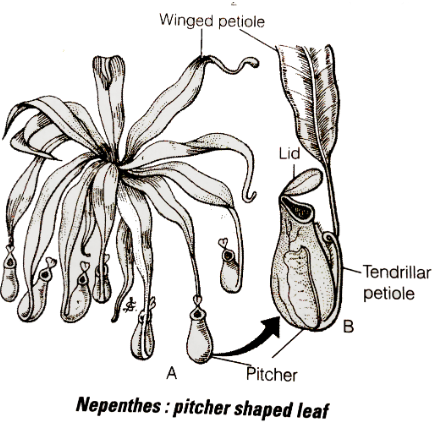
You have heard about several insectivorous plant that feed on insects. Nepenthes or the pitcher plant is one such example which usually grows in shallow water or in marsh lands. What part of the plant is modified into a 'pitcher'. How does this modification help the plant for food even though it can photosynthesisie like any other green plant?
1.
(i) Insulin is a proteinaceous hormone.
(ii) TSH is secreted from the thyroid glands.
(iii) Adrenaline is an emergency hormone.
(iv) The pineal gland is located on the dorsal side of the forebrain.
2.
Hypothyroidism is low secretion of thyroxine hormone. Hyperthyroidism is oversecretion of thyroid hormones. It occurs due to low or hyper activity of the thyroid gland.
3.
(i) Body surface
(ii) Lungs
(iii) Skin, buccopharyngeallining and lungs
(iv) Tracheae.
4.
Functional Residual Capacity (FRC). Volume of air that will remain in the lungs after a normal expiration. This includes ERV + RV.
ERV = 1000 to 1100 ml
RV = 1100 to 1200 ml
So, FRC = 2100 to 2300 ml
5.
If a person receives a blow on the back, it results in an impairment of cognitive abilities or physical functioning. It can also result in the disturbance of behavioural or emotional functioning. Cervical injuries often result in quadriplegia (tetraplegia)
6.
The brain might be compared to a computer as its memory banks. The spinal cord to the conducting cable for the computer's input and output and the nerves to a circuit supplying input information to the cable and transmitting the output to muscles and organs. The most important of these components is the Central Processing Unit (CPU) or microprocessor, which acts as the 'brain' of your computer.
7.
\(\underset { (500\quad mL) }{ Tidal\quad volume } \rightarrow \underset { (1100-1200mL) }{ ResidualVolume } \rightarrow \underset { (1500-1600mL) }{ ExpiratoryCapacity } \rightarrow \underset { (2500-3000mL) }{ IRV } \)
8.
The stomach has three major parts as follows
(i) A cardiac portion into Which the esophagus opens.
(ii) A fundic portion which is a middle region.
(iii) A pyloric portion which opens into the first part of small intestine.
9.
Winter varieties require an exposure to very cold temperature, a phenomenon, known as vernalisation; in the absence of this, plants do not flower to produce grains. So, they are sown in autumn; they germinate and remain as seedlings during winter.
They resume growth in spring and reproduce by the end of the season; they are harvested in the mid-summer.
10.
Substrate level phosphorylation is a type of metabolism that results in the formation and creation of Adenosine Triphosphate(ATP) or Guanosine Triphosphate (GTP) by the direct transfer and donation of a phosphoryl (PO3) group to Adenosine Diphosphate (ADP) or Guanosine Diphosphate (GDP) to form a phosphorylated reactive intermediate.
11.
Cyanobacteria and some other photosynthetic bacteria have photosynthetic lamellae (membranes) suspended freely in the cytoplasm.These carry bacteriochlorophyll to conduct photosynthesis.
12.
Mycorrhiza is a symbiotic association between roots of higher plants, i.e., conifers and fungi. Fungi being heterotrophic in their mode of nutrition depend upon higher plants for food requirements, whereas in turn provide water and mineral nutrients to the algae.
13.
If a leaf of potato plant is illuminated in the presence of radioactive 14C2 , it forms radioactive products of photosynthesis. These products with radioactivity are then transported to the stem and can be easily detected by autoradiography which proves that these substances are translocated through phloem and particularly through the sieve tubes.
14.
The number of chromosomes during metaphase will be 32. Also the DNA content during anaphase will be same as in the parent cell.
15.
There are four substituent groups occupying the four valency positions in an amino acid. These are hydrogen, carboxyl group, amino group and a variable group designated a R group. The R group in amino acid glycine is a hydrogen and a methyl group in case of amino acid alanine, etc.
16.
The body of a multicellular organism has cell as a basic structural unit. The cells are organised to form tissues such as blood, bone, etc. The tissue are organised to form organs such as heart, kidney, etc. The organs are then organised to form organ systems such as digestive system, reproductive system respiratory system, etc. The various organ system of organism gets arranged to form a complete individual.
17.
(a). Histones are the basic proteins found in the chromatin of eukaryotes.
(b). They help in packaging the long DNA molecules into nucleosomes on the chromosomes.
18.
Blood, Bone and cartilage are called connective tissue because
(i) they connect different tissues and organs
(ii) provide support to other structures of the animal body
19.
This is an anatomical abnormality.It occurs due to embedding of bases of stem branches in the tree trunk due to continuous secondary growth in the latter as well as secondary growth of bases of the branches.
20.
Dicot leaves have parallel venation e.g. Corymbium,Calophyllum,Eryngium Monocot leaves have reticulate venation e.g Smilax,Colocasia,Dioscorea.
21.
Pearl of ocean : Diatoms have a shinning silicified two valved covering or frustule. Because of their distinctive cell walls these are sometimes called the pearls of ocean.
Diatomaceous earth : It is pile of siliceous skeletons of diatoms which accumulates at the bottom of sea or oceans, being resistant to decay.
22.
| Column I | Column II |
| A. Oxytocin | 1.Peptide |
| B. Epinephrine | 2.Amnio acid derivative |
| C. Progesterone | 3.Steroid |
| D. Growth hormone | 4. Protein |
23.
| Column I | Column II |
| A.Porifera | Canal system |
| B.Aschelminthes | Muscular,pharynx,combplates |
| C.Annelida | Metameres |
| D.Arthropoda | Jointed appendages |
24.
| A. Amphibia | 1. Air biadder |
| B. Mammals | 2. Cartilaginous notochord |
| C. Chondrichthyes | 3. Mammary gland |
| D. Osteichthyes | 4. Dual habitat |
A - 4, B - 3, C - 2, D - 1
25.
In insectivorous plant e.g., Nepenthes, the leaf lamina gets modified in the form of pitcher and anterior part of petiole coils like tendril which keeps the pitcher in a vertical direction. Posterior part of the petiole remains flattened like a leaf. The apex of lamina forms a lid. Pitcher contains digestive enzyme which the trapped insects .
All these modifications and adaptation are developed to make up the nitrogen deficiency in the plant because these plants are found in N2 deficient soil, (marshy/swamp soils)

11th Standard CBSE Syllabus & Materials
11th Standard CBSE
CBSE 11th Business Studies Forms of Business Organisation Sample Question Papers Study Material - QB365 Set A
NEW11th Standard CBSE
CBSE 11th Business Studies Business, Trade and Commerce Sample Question Papers Study Material - QB365 Set A
NEW11th Standard CBSE
CBSE 11th Physics Waves Sample Question Papers Study Material - QB365 Set A
NEW11th Standard CBSE
CBSE 11th Physics Kinetic Theory Sample Question Papers Study Material - QB365 Set A



NCERT Books

Syllabus

Exam Pattern

Sample Question Papers

Previous year Question Papers

Important Notes

MCQ Practice test

NCERT Exemplers

Case study Questions

Image Based Questions

Passage based Questions

HOT Questions

Value Based Questions

Model Questions Papers
NCERT ( Book Back ) Questions

Assertion and Reason
Important Questions And Answers

CBSE 11th Standard CBSE Subjects
CBSE Standards








