
 100% FREE ACCESS
11th Standard CBSE Syllabus & Materials
11th Standard CBSE
CBSE 11th Economics PART-A - Presentation of Data - New Sample Question Papers Study Material - QB365 Set A
NEW11th Standard CBSE
CBSE 11th Economics PART-A - Organisation of Data - New Sample Question Papers Study Material - QB365 Set A
NEW11th Standard CBSE
CBSE 11th Economics PART-A - Collection of Data - New Sample Question Papers Study Material - QB365 Set A
NEW11th Standard CBSE
CBSE 11th Economics PART-A - Introduction to Economics and Statistics - New Sample Question Papers Study Material - QB365 Set A
NEW11th Standard CBSE
CBSE 11th Business Studies International Trade Sample Question Papers Study Material - QB365 Set A
NEW11th Standard CBSE
CBSE 11th Business Studies Evolution and Fundamentals of Business Sample Question Papers Study Material - QB365 Set A

Published on: 27/05/2021
QB365 Provides the NCERT Exemplar Question Papers for Class 11 Biology , and also provide the detail solution for each and every ncert exemplar papers. Ncert Exemplar papers will help to get more idea about question pattern in every exams and also will help to get more marks in Exams
Download CBSE Class 11th Standard CBSE Biology question papers, sample papers, important questions, and previous year solved papers in PDF format. Get free study materials, NCERT solutions, and exam preparation resources for Class 11th Standard CBSE Biology
Questions + Answers key
Take MCQ Biology Test1.
On an educational trip to uttarakhand, Ketki and her friends observed that many local. people were having swollen necks. Please help Ketki and her friends to find out the solutions to the following questions.
(i) Which probable disease are these people suffering from?
(ii) How is it caused?
(iii) What effects does this condition have on pregnancy?
2.
Respiration is an energy releasing and enzymatically controlled catabolic process, which involves a stepwise oxidative breakdown of organic substances inside living cells. In this statement about respiration explain the meaning of
(i) stepwise oxidative breakdown
(ii) organic substances (used as substrates).
3.
In old age, people often suffer from stiff and inflammed joints. What is this condition called? What are the possible reasons for these symptoms?
4.
Show the structure of a renal corpuscle with the help of a diagram
5.
An Rh- woman is carrying an Rh+ foetus for the second time. Describe the consequences of Rh- incompatibility in this case?
6.
For completion of respiration process, write the given steps in sequential manner
(i) Diffusion of gases (O2 and CO2 ) acroses alveolar membrane.
(ii) Transport of gases by blood.
(iii) Utilisation of O2 by the cells for catabolic reactions and resultant release of CO2.
(iv) Pulmonary ventilation by which atmospheric air is drawn in and CO2 rich alveolar air is released out.
(v) Diffusion of O2 and CO2 between blood and tissues.
7.
It is known that red muscle fibres in animals can work for longer periods of time continuously. How is this possible?
8.
What can we conclude from the statement that the action and absorption spectra of photosynthesis overlap? At which wavelength, do they show peaks?
9.
A farmer adds/supplies Na, Ca, Mg and Fe regularly to his field and yet he observes that the plants show deficiency of Ca, Mg and Fe. Give a valid reason and suggest a way to help the farmer to improve the growth of plants.
10.
How are the terms critical concentration and deficient different from each other in terms of concentration of an essential element in plants?Can you find the values of critical concentration and deficient minerals FE and Zn.
11.
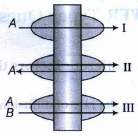
Identify the process occurring in I, II and III.
12.
Various types of transport mechanisms are needed to fulfil the mineral requirements of a plant. Why are they not fulfilled by diffusion alone?
13.
Both unicellular and multicellular organisms undergo mitosis. What are the differences if any observed in the process between the two?
14.
Enzymes are proteins. Proteins are long chains of amino acids linked to each other by peptide bonds. Amino acids have many functional groups in their structure.
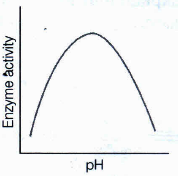
These functional groups are ionizable as they are weak acids and bases in chemical nature. This ionisation is influenced by the pH of the solution. For many enzymes, activity is influenced by surrounding pH. This is depicted in the curve given explain briefly.
15.
Give the biochemical composition of the plasma membrane.How are lipid molecules arranged in the membrane?
16.
Mention the special features of eye in cockroach.
17.
What are the plant whold show the folowing ?
(i)Radial vascular bundle
(ii)Ployarch xylem
(iii) well developed pith
18.
A typical angiospermic flower consists of four floral parts. Give the names of the floral parts and their arrangement sequentially.
19.
Sunflower is not a flower. Explain
20.
Differentiate between notochord and nerve cord
21.
Each plant or group of plants have some phylogenetic significance in relation to evolution. Cycas with any of the few living members of gymnosperms is called as 'relic of the past'. can you establish a phylogenetic relationship of Cycas with any other of plants that justifies the above statement?
22.
Cyanobateria and heterophic bacteria have been clubbed together in Eubacteria of Kindom-Monera as per the five kindom classification even though the two are vastly different from each other , Is this grouping of the tow types of taxa in the same kingdom justify ? If so, Why?
23.
How do you prepare your own herbarium sheets? What are different tools you carry with you while, collecting plants for the preparation of a herbarium? What information should a preserved plant material on the herbarium sheet provide for taxonomic studies?
24.
In which conditions human beings are difficult to define as living?
25.
Metabolism is a defining feature of all living organisms without exception. Isolated metabolic reactions in vitro are not living things, but surely living reactions.Comment.
1.
(i) The people are suffering from the goitre disease.
(ii) Goitre is caused by deficiency of iodine which leads to the hypothyroidism.
(iii) It leads to defective development of foetus and birth of child with cretinism.
2.
(i) Stepwise oxidative breakdown The series of reactions transfers the energy of glucose to ATP.
(ii) Organic substances (used as substrates) The organic substances, which are catabolised in the living cells to release energy are called as respiratory substrates. Though any food stuff, carbohydrate, fat or protein may act as a respiratory substrate, the common respiratory substrate is glucose because it can be oxidised easily and is present abundantly.
3.
This condition is called as arthritis.
The possible reasons can be
(i) inflammation of the synovial membrane,
(ii) progressive erosion of articular cartilage,
(iii) infection by a microorganism,
(iv) due to metabolic defect causing excess of uric acid and urate crystals.
4.
Representing the structure fo a renal corpuscle

5.
Rh-antigen is present on the surface of erythrocytes in about 80-85% of the human beings. The individuals, who possess this antigen are called Rh+ (Rh positive) and those, who do not have it are called Rh- (Rh negative). A person when exposed to Rh+ blood, develops anti Rh-antibodies. A pregnant women who is Rh-, if bears an Rh+ foetus, will develop anti-Rh-antibodies during the first delivery, when the foetal blood comes in contact with her blood. These antibodies linger in the blood for sufficiently longer periods. If she carries a second foetus, that is Rh+, the anti-Rh-antibodies in her blood enter the foetal circulation and cause damage to the foetal RBCs. This, could become fatal. This condition is called erythroblastosis foetalis.
6.
(i) Pulmonary ventilation by which atmospheric air is drawn in and CO2 rich alveolar air is released out.
(ii) Diffusion of gases (O2 and CO2 ) acroses alveolar membrane.
(iii) Transport of gases by blood to the farthest tissues in body.
(iv) Diffusion of O2 and CO2 between blood and tissues.
(v) Utilisation of O2 by the cells for catabolic reactions and resultant release of CO2 and energy.
7.
Red or dark muscles store myoglobin and hence, oxygen for meeting the gap between supply and consumption during continuous activity. Therefore, these muscles can continuously work and respire aerobically for long periods. High proportion of these muscles allow athletes to participitate in long duration events like cycling, swimming and distance running etc.
8.
The absorption spectrum is the graph plotted, with the amount of light absorbed as a function of wavelength.The action spectrum is the graph plotted with the rate of photosynthesis as a function of wavelength. Since, the amount of light absorbed and the rate of photosynthesis have a direct relationship, the two curves overlap.They show peaks around wavelengths 450 nm(blue region) and 650-680 nm (red region).
9.
It is important to know that manganese completes with iron and mahnesium for the uptake and with magnesium for binding with enzymes.Manganese also inhibites calcium translocation in shoot apex therefore,excess of mangganese may , infact, induces deficiency of iron, magnesium and calcium.
Thus, what appears as symptoms of manganes toxicity may actually be the deficiency symptoms of iron, magnesium and calcium.
The farmer should not add excess manganese in the soil to prevent manganese toxicity.
10.
The concentration of the essential element below which plant growth is retarded is termed as critical concentration.The element is said to be deficient when present below the critical concentration.
Yes , we can find the values of critical concentration and deficient for minerals Fe and Zn by absorbing the morphological changes.If the concentrations of these elements are present below the critical values, then it may eventually lead to the death of the plant.Morphological changes are indicative of certain element deficiencies and are called deficiency symptoms.
11.
I - Uniport transport
II - Antiport transport,
III - Symport transport.
12.
The organic solutes in plants have to move in various direction. e.g., the food substances synthesised in the leaves are translocated downwards towards the stem and roots. Similarly, the upward movement of solutes from the leaves to the developing buds, flowers and fruits take place. The food materials or minerals are also translocated radially from the cells of pith to those of cortex and epidermis. Thus, the various processes such as active diffusion, electrochemical potential and mass flow, etc., are needed in addition for the transport of minerals and organic solutes.
13.
Cell division id the first stage of growth in living organisms whereby cells divide to form new cells.
(i) In unicellular organisms, cell division is a process of asexual reproduction. It leads to an increase in the total number individuals.
(ii) In multicellular organism, the division of all cells, other than the reproductive cells is known as mitosis. It is a process of cell division related to growth and is accomplished by the cellular enlargement and differentiation.
14.
Enzymes, generally function in a narrow range of pH.Each enzyme shows its highest activity at a particular optimum pH.Activity declines both below and above the optimum value. The graph shows maximum enzyme activity at optimum pH.The rate of enzyme activity decreases above and below that optimum pH.
15.
(i) The plasma membrane is composed of proteins, lipids (phospho glycerides) and some carbohydrales.
(ii) The lipids are arranged in a bilayer within the membrane, with their polar head towards the out of surfaces and the hydrophopic tails towards the centre of the membrane.
16.
In cockroach, there are two types of eyes, i.e., apair of simple eye and a pair of compound eyes. A compound eye has upto 2000 hexagonbal units called ommatidia. These are responsible for producing mosaic vision. The adjacent ommatidia are separated internally by the pigment cells. An ommatidium has two parts
(i) Outer dioptoric or focussing part, which consisits of a corneal lens, two corneagen cells, a crystalline cone and four cone cells or vitrellae.
(ii) Inner receptive part has a spindle-shaped pigment contaning rhadome surrounded by eight retinulae which continue as nerve fibre.
17.
A well-developed pith is present in dicot stem and monocot roots.
18.
(i) Sepals It is the green leaf-like outermost whorl
(ii) Petals It is the second whorl (corolla) from below often brightly coloured floral parts.
(iii) Stamens Third whorl of knobbed thread-like male reproductive floral parts.
(iv) Carpels Central single whorl of female reproductive floral parts
19.
Sunflower is an inflorescence called capitulum or racemose head. It has a flat disc-shaped penducle called receptacle. It bears an involucre of bracts on the periphery and two types of small sessile flowers called florets. The flower is arrnged centripetally with youngest towards the periphery. They are ray florets which are sterile female of ligulate type on the outside. The rest of the flower structure contains discflorets which are fertile bisexual flowers of tubular type.
20.
Difference between notochord and nerve cord are as follows
| Notochord | Nerve cord |
| It is a solid ensheathed dorsal rod of large cartilaginous tissue | It is a bundle of nerve fibres with chains of ganglia, generally running ventrally |
| It occurs in chordates | It occurs in invertebrates |
| It provides support and point of attachment to muscles | It gives rise to peripheral nerves |
| In vertebrates, it forms the axial skeleton | It forms a major part of nervous system. |
21.
Cycas is called the 'relic of the past' It has following properties to justify this
i) Monoxylic wood through secondary growth started
ii) shedding of seed when embryo is still immature.
iii) The arrangement of microsporangia in all defined sori.
Phylogenetically, cycas is related to the pteridosperm (seed ferns) and through them to ferns from which it seems to have evolved. It can be ascertained by the presence of
i) lead-like megasporophyll
ii) persistence of leaf base.
22.
Although the two are vastly different from each other . THey still bear some common characters , on the basis of which they are introduced in Eubacteria of kingdom-Monera.
These character are follows
(i) Both the group do nait possess well defined nucleus,
(ii) Nucleus lacks nucleous and nuclear membrane.
(iii) DNA (genetic material) lies freely in the cytoplasm
(iv)They possess 70 S type of ribosomes
23.
For the preparation of herbarium sheets, a sheet of about 29 x 41 cm is cut from chart paper. Dried specimens are mounted on the sheets with the help of glue or cellotape. A label is pasted on sheets at lower right corner of the sheet.
Tools for collection are
(i) digger
(ii) pruning knife
(iii) scissors
(iv) vasculum
(v) polythene bags
(vi) old newspapers
(vii) blotting papers
(viii) plant press
(ix) field notebook
(x) magnifying glass
Information from herbarium sheets : The label of herbarium sheets has information like scientific name of plant, family, common and English name, local name, collector's name, place, time and date of collection.
24.
A person lying in coma is not conscious of its surrounding environment. Thus, he/she is not capable of responding to the external environmental stimuli.The person is supported by machines for various functions of the body.The person is otherwise brain dead.Some of these patients never come back to normal life. They can neither be called living nor non-living or dead.
25.
The living organisms are made up of molecules. These are of various sizes, classes, functions, etc. They need to change in some other biomolecules. These conversions are chemical reactions or metabolic reactions.
Metabolism is a defining feature of life, as living things depend on various biochemical reactions. These reactions can be demonstrated outside the body in cell-free systems, which are neither living nor non-living nor non-living, Isolated metabolic reactions in vitro are thus, not living things, but surely living reactions.

11th Standard CBSE Syllabus & Materials
11th Standard CBSE
CBSE 11th Business Studies Forms of Business Organisation Sample Question Papers Study Material - QB365 Set A
NEW11th Standard CBSE
CBSE 11th Business Studies Business, Trade and Commerce Sample Question Papers Study Material - QB365 Set A
NEW11th Standard CBSE
CBSE 11th Physics Waves Sample Question Papers Study Material - QB365 Set A
NEW11th Standard CBSE
CBSE 11th Physics Kinetic Theory Sample Question Papers Study Material - QB365 Set A



NCERT Books

Syllabus

Exam Pattern

Sample Question Papers

Previous year Question Papers

Important Notes

MCQ Practice test

NCERT Exemplers

Case study Questions

Image Based Questions

Passage based Questions

HOT Questions

Value Based Questions

Model Questions Papers
NCERT ( Book Back ) Questions

Assertion and Reason
Important Questions And Answers

CBSE 11th Standard CBSE Subjects
CBSE Standards








