
 100% FREE ACCESS
11th Standard CBSE Syllabus & Materials
11th Standard CBSE
CBSE 11th Economics PART-A - Presentation of Data - New Sample Question Papers Study Material - QB365 Set A
NEW11th Standard CBSE
CBSE 11th Economics PART-A - Organisation of Data - New Sample Question Papers Study Material - QB365 Set A
NEW11th Standard CBSE
CBSE 11th Economics PART-A - Collection of Data - New Sample Question Papers Study Material - QB365 Set A
NEW11th Standard CBSE
CBSE 11th Economics PART-A - Introduction to Economics and Statistics - New Sample Question Papers Study Material - QB365 Set A
NEW11th Standard CBSE
CBSE 11th Business Studies International Trade Sample Question Papers Study Material - QB365 Set A
NEW11th Standard CBSE
CBSE 11th Business Studies Evolution and Fundamentals of Business Sample Question Papers Study Material - QB365 Set A

Published on: 27/05/2021
QB365 Provides the NCERT Exemplar Question Papers for Class 11 Biology , and also provide the detail solution for each and every ncert exemplar papers. Ncert Exemplar papers will help to get more idea about question pattern in every exams and also will help to get more marks in Exams
Download CBSE Class 11th Standard CBSE Biology question papers, sample papers, important questions, and previous year solved papers in PDF format. Get free study materials, NCERT solutions, and exam preparation resources for Class 11th Standard CBSE Biology
Questions + Answers key
Take MCQ Biology Test1.
On an educational trip to uttarakhand, Ketki and her friends observed that many local. people were having swollen necks. Please help Ketki and her friends to find out the solutions to the following questions.
(i) Which probable disease are these people suffering from?
(ii) How is it caused?
(iii) What effects does this condition have on pregnancy?
2.
RuBP carboxylase, PEPase, pyruvate dehydrogenase, ATPase, cytochrome oxidase, hexokinase, lactate dehydrogenase. Select/ choose enzymes from the list above which are involved in
(i) photosynthesis
(ii) respiration.
3.
In old age, people often suffer from stiff and inflammed joints. What is this condition called? What are the possible reasons for these symptoms?
4.
Why is it necessary to check the Rh factor of the blood in a pregnant woman?
5.
For completion of respiration process, write the given steps in sequential manner
(i) Diffusion of gases (O2 and CO2 ) acroses alveolar membrane.
(ii) Transport of gases by blood.
(iii) Utilisation of O2 by the cells for catabolic reactions and resultant release of CO2.
(iv) Pulmonary ventilation by which atmospheric air is drawn in and CO2 rich alveolar air is released out.
(v) Diffusion of O2 and CO2 between blood and tissues.
6.
Both animals and plants grow. Why do we say that growth and differentiation in plants is open and not so in animals? Does this statement hold true for sponges also?
7.
The energy yield in terms of ATP is higher in aerobic respiration than during anaerobic respiration. Why is there anaerobic respiration even in organisms that live in aerobic condition like human beings and angiosperms?
8.
It is known that red muscle fibres in animals can work for longer periods of time continuously. How is this possible?
9.
Where is NADP reductase enzyme located in the chloroplasts? What is the role of this enzyme in proton gradient development?
10.
A farmer adds/supplies Na, Ca, Mg and Fe regularly to his field and yet he observes that the plants show deficiency of Ca, Mg and Fe. Give a valid reason and suggest a way to help the farmer to improve the growth of plants.
11.
How are the terms critical concentration and deficient different from each other in terms of concentration of an essential element in plants?Can you find the values of critical concentration and deficient minerals FE and Zn.
12.
Observe the diagram and answer the following.
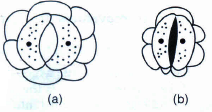
(a) Are these types of guard cells observed in monocot or in dicot plants?
(b) Which of these shows a higher water content?
(c) Which element plays an important role in the opening and closing of stomata?
13.
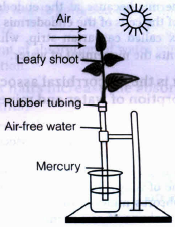
Comment on the experimental setup.
(i) What does the setup demonstrate?
(ii) What will happen to the level of water if a blower is placed close to setup?
(iii) Will the mercury level fluctuate (go up/down) if phenyl mercuric acetate is sprayed on leaves?
14.
Various types of transport mechanisms are needed to fulfil the mineral requirements of a plant. Why are they not fulfilled by diffusion alone?
15.
Comment on the statement 'telophase is reverse of prophase'.
16.
Is extra genomic DNA present in prokaryotes and eukaryotes?If yes, locate their position in both types of organisms.
17.
Give the biochemical composition of the plasma membrane.How are lipid molecules arranged in the membrane?
18.
Mention the special features of eye in cockroach.
19.
What is the difference between lenticels and stomata?
20.
What are the plant whold show the folowing ?
(i)Radial vascular bundle
(ii)Ployarch xylem
(iii) well developed pith
21.
A typical angiospermic flower consists of four floral parts. Give the names of the floral parts and their arrangement sequentially.
22.
Each plant or group of plants have some phylogenetic significance in relation to evolution. Cycas with any of the few living members of gymnosperms is called as 'relic of the past'. can you establish a phylogenetic relationship of Cycas with any other of plants that justifies the above statement?
23.
There is a myth that immediately after heavy rains in forest, mushrooms appear in large number and make a very large ring or circle, which may be several metres in diameter. These are called 'fairy rings'. Can you explain the myth of fairy rings in biological terms?
24.
How do you prepare your own herbarium sheets? What are different tools you carry with you while, collecting plants for the preparation of a herbarium? What information should a preserved plant material on the herbarium sheet provide for taxonomic studies?
25.
Metabolism is a defining feature of all living organisms without exception. Isolated metabolic reactions in vitro are not living things, but surely living reactions.Comment.
1.
(i) The people are suffering from the goitre disease.
(ii) Goitre is caused by deficiency of iodine which leads to the hypothyroidism.
(iii) It leads to defective development of foetus and birth of child with cretinism.
2.
(i) Photosynthesis RuBP carboxylase, hexokinase and cytochrome oxidase.
(ii) Respiration Pyruvate dehydrogenase, ATPase, lactate dehydrogenase and cytochrome oxidase.
3.
This condition is called as arthritis.
The possible reasons can be
(i) inflammation of the synovial membrane,
(ii) progressive erosion of articular cartilage,
(iii) infection by a microorganism,
(iv) due to metabolic defect causing excess of uric acid and urate crystals.
4.
Rh-antigen is present on the surface of erythrocytes in about 80-85% of the human beings. The individuals, who possess this antigen are called Rh+ (Rh positive) and those, who do not have it are called Rh- ( Rh negative ). A person when exposed to Rh+ blood, develops anti Rh-antibodies. A pregnant women who is Rh-, if bears an Rh+ foetus, will develop anti-Rh-antibodies during the first delivery, when the foetal blood comes in contact with her blood. These antibodies linger in the blood for sufficiently longer periods. If she carries a second foetus, that is Rh+, the anti-Rh-antibodies in her blood enter the foetal circulation and cause damage to the foetal RBCs. This, could become fatal. This condition is called erythroblastosis foetalis.
5.
(i) Pulmonary ventilation by which atmospheric air is drawn in and CO2 rich alveolar air is released out.
(ii) Diffusion of gases (O2 and CO2 ) acroses alveolar membrane.
(iii) Transport of gases by blood to the farthest tissues in body.
(iv) Diffusion of O2 and CO2 between blood and tissues.
(v) Utilisation of O2 by the cells for catabolic reactions and resultant release of CO2 and energy.
6.
Plants growth is a unique phenomenon because plants retain the capacity for unlimited growth throughout their life. This ability of the plants is due to the presence of meristems at certain locations in their body. The cells of meristems have the capacity to divide and self-perpetuate.
The cells thus produced, however, soon loses the capacity to divide and such cells make up the plant body. This form of growth wherein new cells are always being added to the plant body by the activity of the meristem is called the open form of growth. Yes,this statement holds true for sponges also.
7.
(i) The anaerobic respiration occurs even in organisms that live in aerobic condition like human beings and angiosperms under conditions of oxygen scarcity that happens in the muscle tissue. Under intense use, muscles demand too much energy (ATP) and consume much more oxygen to produce that energy.
(ii) This high consumption leads to oxygen scarcity and the muscle cells begin to make lactic acid by anaerobic respiration trying to fulfill their energetic needs.
(iii) Similarly, yeast cells under deficient conditions carry out anaerobic respiration.
8.
Red or dark muscles store myoglobin and hence, oxygen for meeting the gap between supply and consumption during continuous activity. Therefore, these muscles can continuously work and respire aerobically for long periods. High proportion of these muscles allow athletes to participitate in long duration events like cycling, swimming and distance running etc.
9.
NADP reductase enzyme is located on the outer/stroma side of the thylakoid membrane. Along with the electrons from the primary acceptor of PS-I, it uses the protons of stroma for the reduction of NADP+ to NADPH; this removal of protons from the stroma causes a proton gradient between the lumen of thylakoids and the stroma.
10.
It is important to know that manganese completes with iron and mahnesium for the uptake and with magnesium for binding with enzymes.Manganese also inhibites calcium translocation in shoot apex therefore,excess of mangganese may , infact, induces deficiency of iron, magnesium and calcium.
Thus, what appears as symptoms of manganes toxicity may actually be the deficiency symptoms of iron, magnesium and calcium.
The farmer should not add excess manganese in the soil to prevent manganese toxicity.
11.
The concentration of the essential element below which plant growth is retarded is termed as critical concentration.The element is said to be deficient when present below the critical concentration.
Yes , we can find the values of critical concentration and deficient for minerals Fe and Zn by absorbing the morphological changes.If the concentrations of these elements are present below the critical values, then it may eventually lead to the death of the plant.Morphological changes are indicative of certain element deficiencies and are called deficiency symptoms.
12.
(a) In dicot plants.
(b) (i) Shows higher water content.
(c) Potassium.
13.
(i) This setup demonstrates transpiration pull.
ii) Water will rise up due to activity of blowers the rate of transpiration increases.
(iii) The mercury level goes down, if phenyl mercuric acetate is sprayed on the leaves.
When mercuric acid is sprayed on the leaves the stomata get blocked and rate of transpiration decreases.
14.
The organic solutes in plants have to move in various direction. e.g., the food substances synthesised in the leaves are translocated downwards towards the stem and roots. Similarly, the upward movement of solutes from the leaves to the developing buds, flowers and fruits take place. The food materials or minerals are also translocated radially from the cells of pith to those of cortex and epidermis. Thus, the various processes such as active diffusion, electrochemical potential and mass flow, etc., are needed in addition for the transport of minerals and organic solutes.
15.
In prophase, the chromatin network begins to coil and appears as a long thread-like structures called chromosomes. Each chromosomes consists of two chromatids that disappears from early prophase to late prophase. The nuclear membrane also starts disappearing in late prophase. In telophase opposite poles of the chromosomes lose their identity and nuclear membranes is formed around the daughter nuclei. Nucleolus also reappears. So, it reverse of prophase.
16.
Yes, extra genomic DNA is present in both prokaryotes and eukaryotes.
In the case of eukaryotes, extragenomic DNA is present in two organelles e.g. Plastids and mitochondria. Both these organelles with the help of their own DNA, synthesise some of their proteins. Thus, these organelles are known as semiautonomous organelles.
In the case of prokaryotic cells, the extragenomic DNA is present in the form of plasmids. The plasmids are circular DNA molecules, which confer certain unique phenotypic characters to such bacteria. One such character is resistance to bacteria. This plasmid DNA is also used to monitor bacteria transformation with foreign DNA.
17.
(i) The plasma membrane is composed of proteins, lipids (phospho glycerides) and some carbohydrales.
(ii) The lipids are arranged in a bilayer within the membrane, with their polar head towards the out of surfaces and the hydrophopic tails towards the centre of the membrane.
18.
In cockroach, there are two types of eyes, i.e., apair of simple eye and a pair of compound eyes. A compound eye has upto 2000 hexagonbal units called ommatidia. These are responsible for producing mosaic vision. The adjacent ommatidia are separated internally by the pigment cells. An ommatidium has two parts
(i) Outer dioptoric or focussing part, which consisits of a corneal lens, two corneagen cells, a crystalline cone and four cone cells or vitrellae.
(ii) Inner receptive part has a spindle-shaped pigment contaning rhadome surrounded by eight retinulae which continue as nerve fibre.
19.
Difference between lenticels and stomata are
| Lenticles | Stomata |
| These are present in old stems and roots. | they are found in young stems and leaves. |
| These are found in cork tissues. | Stomata are found in the epidermis. |
| These contain a number of complementary cells. | A stomata has two guard cells. |
| They remain open permanently. | They open and close in response to turgidity to their guard cells. |
20.
A well-developed pith is present in dicot stem and monocot roots.
21.
(i) Sepals It is the green leaf-like outermost whorl
(ii) Petals It is the second whorl (corolla) from below often brightly coloured floral parts.
(iii) Stamens Third whorl of knobbed thread-like male reproductive floral parts.
(iv) Carpels Central single whorl of female reproductive floral parts
22.
Cycas is called the 'relic of the past' It has following properties to justify this
i) Monoxylic wood through secondary growth started
ii) shedding of seed when embryo is still immature.
iii) The arrangement of microsporangia in all defined sori.
Phylogenetically, cycas is related to the pteridosperm (seed ferns) and through them to ferns from which it seems to have evolved. It can be ascertained by the presence of
i) lead-like megasporophyll
ii) persistence of leaf base.
23.
The fairy rings form as the mycelium of the mushroom fungus spreads in the soil from a central point. It grows peripherally, so that the younger hyphae will appear that cause young fungal hyphae to form compact masses that grow into mushrooms. This is the reason, the mushrooms appear growing in a circle or ring
24.
For the preparation of herbarium sheets, a sheet of about 29 x 41 cm is cut from chart paper. Dried specimens are mounted on the sheets with the help of glue or cellotape. A label is pasted on sheets at lower right corner of the sheet.
Tools for collection are
(i) digger
(ii) pruning knife
(iii) scissors
(iv) vasculum
(v) polythene bags
(vi) old newspapers
(vii) blotting papers
(viii) plant press
(ix) field notebook
(x) magnifying glass
Information from herbarium sheets : The label of herbarium sheets has information like scientific name of plant, family, common and English name, local name, collector's name, place, time and date of collection.
25.
The living organisms are made up of molecules. These are of various sizes, classes, functions, etc. They need to change in some other biomolecules. These conversions are chemical reactions or metabolic reactions.
Metabolism is a defining feature of life, as living things depend on various biochemical reactions. These reactions can be demonstrated outside the body in cell-free systems, which are neither living nor non-living nor non-living, Isolated metabolic reactions in vitro are thus, not living things, but surely living reactions.

11th Standard CBSE Syllabus & Materials
11th Standard CBSE
CBSE 11th Business Studies Forms of Business Organisation Sample Question Papers Study Material - QB365 Set A
NEW11th Standard CBSE
CBSE 11th Business Studies Business, Trade and Commerce Sample Question Papers Study Material - QB365 Set A
NEW11th Standard CBSE
CBSE 11th Physics Waves Sample Question Papers Study Material - QB365 Set A
NEW11th Standard CBSE
CBSE 11th Physics Kinetic Theory Sample Question Papers Study Material - QB365 Set A



NCERT Books

Syllabus

Exam Pattern

Sample Question Papers

Previous year Question Papers

Important Notes

MCQ Practice test

NCERT Exemplers

Case study Questions

Image Based Questions

Passage based Questions

HOT Questions

Value Based Questions

Model Questions Papers
NCERT ( Book Back ) Questions

Assertion and Reason
Important Questions And Answers

CBSE 11th Standard CBSE Subjects
CBSE Standards








