
 100% FREE ACCESS
11th Standard CBSE Syllabus & Materials
11th Standard CBSE
CBSE 11th Economics PART-A - Presentation of Data - New Sample Question Papers Study Material - QB365 Set A
NEW11th Standard CBSE
CBSE 11th Economics PART-A - Organisation of Data - New Sample Question Papers Study Material - QB365 Set A
NEW11th Standard CBSE
CBSE 11th Economics PART-A - Collection of Data - New Sample Question Papers Study Material - QB365 Set A
NEW11th Standard CBSE
CBSE 11th Economics PART-A - Introduction to Economics and Statistics - New Sample Question Papers Study Material - QB365 Set A
NEW11th Standard CBSE
CBSE 11th Business Studies International Trade Sample Question Papers Study Material - QB365 Set A
NEW11th Standard CBSE
CBSE 11th Business Studies Evolution and Fundamentals of Business Sample Question Papers Study Material - QB365 Set A

Published on: 27/05/2021
QB365 Provides the NCERT Exemplar Question Papers for Class 11 Biology , and also provide the detail solution for each and every ncert exemplar papers. Ncert Exemplar papers will help to get more idea about question pattern in every exams and also will help to get more marks in Exams
Download CBSE Class 11th Standard CBSE Biology question papers, sample papers, important questions, and previous year solved papers in PDF format. Get free study materials, NCERT solutions, and exam preparation resources for Class 11th Standard CBSE Biology
Questions + Answers key
Take MCQ Biology Test1.
A sample of urine was diagnosed to contain high content of glucose and ketone bodies. Based on this observation, answer the following.
(i) Which endocrine gland and hormone is related to this condition?
(ii) Name the cells on which this hormone acts.
(iii) What is the condition called and how can it be rectified?
2.
A person had roti and dal in his lunch. Trace the changes that will take place during its complete passage through the alimentary canal.
3.
We find that Rhizobium forms nodules on the roots of leguminous plants. Also Frankia, another microbe forms nitrogen-fixing nodules on the roots of non-leguminous plant Alnus.
(i) Can we artificially induce the property of nitrogen fixation in a plant, leguminous or non-leguminous?
(ii) What kind of relationship is observed between mycorrhiza and pine trees?
(iii) Is it necessary for a microbe to be in close association with a plant to provide mineral nutrition?Explain with the help of one example.
4.
Suppose Euphorbia and maize are grown in the tropical area.
(i) Which one of them do you think will be able to survive under such conditions?
(ii) Which one of them is more efficient in terms of photosynthetic activity?
(iii) What differences do you think are there in their leaf anatomy?
5.
Is there a species or region specific type of plastids? How does one distinguish one from the other?
6.
Distinguish between following
(i) Exarch and endarch condition of protoxylem
(ii) Stele and vascular bundles
(iii) Protoxylem and metaxylem
(iv) Interfascicular cambium and intrafascicular cambium
(v) Open and closed vascular bundles
(vi) Stem hairs and root hairs.
7.
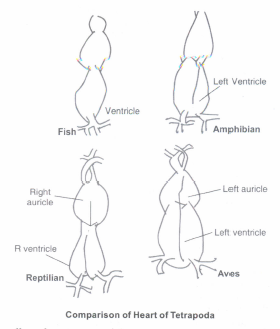
Describe the evolutionary change in the pattern of heart among the vertebrates.
8.
Calcium plays a very important role in the formation of bones. Write about the role of endocrine glands and hormones responsible for maintaining calcium homoeostasis.
9.
Differentiate between pectoral and pelvic girdle
10.
The glomerular filtrate in the loop of Henle gets concentrated in the descending and then gets diluted in the ascending limbs.Explain
11.
Explain different types of blood groups and donor compatibility making a table.
12.
Why are neurons called excitable cells ? Mention thge special features of the membrane of the neuron?
13.
Stratified epithelial cells have limited role in secreation . Justify their role in our skin
14.
Explain the process of secondary growth in the stems of woody angiosperms. What is its significance?
15.
Stolon,offset and rhizome are different forms of stem modification. How can these modifiedforms of stem be distinguished from each other?
16.
Differentiate between polyp and medusa
17.
Biological classification is a dynamic and ever-evolving phenomenon which keeps changing with our understanding of life forms. Justify the statements by taking any two examples.
18.
A scientist came across a plant, which he feels is a new species. How will he proceed towards its identification, classification and nomenclature?
19.
Brassica campestris Linn
(i) Give the common name of the plant.
(ii) What do the first two parts of the name denote?
(iii) Why are they written in italics?
(iv) What is the meaning of Linn written at the end of the name?
20.
Some of the properties of tissues are not the properties of constituents of its cells. Give three examples to support the statement.
1.
(i) Pancreas gland and insulin hormone is related to this condition.
(ii) The cells of islets of Langerhans of pancreas.
(iii) Prolonged hyperglycaemia leads to a complex disorder, called diabetes mellitus, which is associated with loss of glucose through urine and formation of harmful compounds known as ketone bodies. Diabetic patients are successfully treated with insulin therapy.
2.
Changes that will take place in food (roti and dal) through the passage of alimentary canal are
(i) The food substances are first masticated by the teeth in the mouth, where carbohydrate part of the food is digested by the action of salivary amylase enzyme secreted by the salivary glands.
(ii) This partially digested food reaches the stomach, where it receives acidic HCI and mainly the protein part of the food is digested by the action of proteolytic enzymes.
(iii) The lipid part of the food is digested by the bile secreted by the gall bladder.
(iv) In the small intestine, particularly in the duodenum this semi-digested food is finally digested by the digestive enzymes present in the intestinal and pancreatic juices.
(v) After digestion, the broken down products of food, i.e., amino acids, glycerol, starch, etc., are absorbed mainly in the small intestine.
(vi) The undigested remains of food will finally pass through the anus in the form of feces.
3.
(i) Yes, we can artificially induce the property of nitrogen-fixation in a plant, leguminous or non-leguminous by genetic engineering. It involves the introduction of nif genes that cause the synthesis of nitrogenase enzyme by some vector in the plant in which we have to induce symbiosis.
(ii) Symbiotic association
(iii) Yes, it is necessary for a microbe to be in close association with a plant to provide mineral nutrition. For example, plants that contribute to nitrogen-fixation .include the legume farnily-Fabaceae or Leguminosae, such as clover, soyabeans, alfalfa, lupines and peanuts. They contain symbiotic bacteria called Rhizobium within nodules in their root systems, producing nitrogen compounds that help the plant to grow and compete with other plants.
4.
(i) Euphorbia will be able to survive under such conditions.
(ii) Maize is more efficient in terms of photosynthetic activity.
(iii) The maize is a C4 -plant having Kranz anatomy type of leaf anatomy. The bundle sheath cells are characterised by having a large number of chloroplasts, thick walls impervious to gaseous exchange and no intercellular spaces. While, Euphorbia, which undergoes CAM (Crassulacean Acid Metabolism) both pathways occur in mesophyll cells only they do not have Kranz anatomy. And also their stomata remain closed during the day.
5.
Plastids are both region or species specific. These are as follows
(i) Proplastids These are colourless, rounded but amoeboid plastid precursors, found in meristematic and newly formed cells of plants. It has a double membrane envelope that surrounds a colourless matrix, containing DNA, ribosomes and reserve food. A few vesicles and lamellae also occur in the matrix.
(ii) Leucoplasts These are colourless plastids that occur in nop-green plant cells commonly near the nucleus. They are as follows
(a) Amyloplasts These leucoplasts store starch, e.g., tuber of potato, grain of rice and wheat.
(b) Elaioplasts These store fats, e.g., rose.
(c) Aleuroplasts They are protein storing plastids, e.g., castor endosperm.
(iii) Chromoplasts These are non-photosynthetic coloured plastids which synthesise and store carotenoid pigments. They appear, orange, red or yellow in colour. These mostly occur in ripe fruits (tomato and chillies) carrot roots, etc.
(iv) Chloroplasts These are photosynthetic plastids, which are green in colour and found in the leaves of all green plants. They have lamellae organised in the form of grana.
6.
(i) In exarch condition Protoxylem towards the periphery. In endarch condition Protoxylem towards the centre.
(ii) Stele is the arrangement of vascular tissues and vascular bundle is a group of xylem and phloem.
(iii) Protoxylem is an early formed xylem and metaxylem is lately formed xylem.
(iv) Interfascicular cambium is formed by permanent tissues. Intrafascicular cambium is present in between the primary xylem and primary phloem of a vascular bundle.
(v) Open vascular bundles have intrafascicular cambium and show secondary growth. Closed vascular bundles do not have intrafascicular cambium.
(vi) Stem hairs are multicellular, whereas root hairs are unicellular.
7.
As is clear from the following diagram the heart of fish has two chambers. This means there is no separate circulation for oxygenated and deoxygenated blood. There is separation of two chambers in the atrium of amphibians. This has further evolved to partial separation of ventricle as well in reptiles. Finally, in birds, there is complete separation of oxygenated and deoxygenated blood circulation with advent of four chambers in the heart. Mammal heart is the most developed having the most efficient double circulatory system.
8.
The endocrine glands and hormones that are responsible for maintaining calcium homeostasis, are thyroid and parathyroid glands and their associated hormones an calcitonin and Parathyroid Hormone (PTH).
(i) Parathyroid glands are the glands developed from the endoderm of the embryo The cells of parathyroid glands are of two types, i.e., chief cells and oxyphil cells. Thr chief cells of the parathyroid glands secrete parathyroid hormone (PTH).
This hormone (PTH) is involved in regulating calcium and phosphate balance betweer the blood and other tissue. It mobilises the release of calcium into the blood from bones. PTH increases calcium reabsorption by the body organs like intestine anc kidneys.
(ii) Thyroid gland is the largest endocrine gland located anterior to the thyroid cartilage o. the larynx in the neck. This gland plays a vital role in maintaining calcium homeostasis It releases thyroculcitonin hormone produced by the parafollicular cells, also called 'C cells.
This hormone is secreted when the calcium level in blood gets high. It is a 32 aminc acid peptide hormone that lowers the calcium level by suppressing release of catciurr ions from the bones. Thus, calcitonin has an action opposite to that of the parathyroic hormone on calcium homeostasis.

9.
Pectoral and pelvic girdle help in the articulation of upper and lower limbs, respectively. Each girdle is made of two equal halves.
Each half of a pectoral girdle consists of clavicle and scapula. Scapula is a large triangular flat bone. There is glenoid cavity at the joint of scapula, clavicle and acromian process, which articulates with the head of humerus to form the shoulder joint.
Each half of pelvic girdle is formed by three bones, i.e., ilium, ischium and pubis. At the point of their fusion, there is a cavity called acetabulum to which the head of femur articulates.
10.
The gradient of increasing hyperosmolarity of medullary interstitium is maintained by a counter current mechanism and the proximity between the Henle's loop and vasa recta.
This gradient is mainly caused by NaCl and urea.The transport of these substances facilitated by the special arrangement of Henle's loop and vasa recta is called the counter current mechanism.
NaCl is transported by the ascending limb of Henle's loop, which is exchanged with the descending limb of vasa recta.NaCl is returned to the medullary interstitium by the ascending part of the vasa recta.
But,contrarily, the water diffuses into the blood of ascending limb of vasa recta and is carried away into the general blood circulation.
Permeability to urea is found only in the deeper parts of thin ascending limbs of Henle's loops and collecting ducts.Urea diffuses out of the collecting ducts and enters into the thin.
11.
Two groupings, i.e., the ABO and Rh- are widely used all over the world. ABO grouping is based on the presence or absence of two surface antigens (chemicals that can induce immune response) on the RBCs, i.e., A and B. Similarly, the plasma of different individuals contain two natural antibodies (proteins produced in response to antigens).
Blood Groups and Donor Compatibility
| Blood Group | Antigen on RCBs | Antibody in Plasma | Donor's Group |
| A | A | Anti-B | A, O |
| B | B | Anti-A | B, O |
| AB | A, B | Nil | AB, A, B, O |
| O | Nil | Anti- A, B | O |
From the above-mentioned table, it is evident that group 'O' blood can be donated to persons with any other blood group and hence 'O' group individuals are called 'universal donors'. Persons with 'AB' group can accept blood from persons with AB as well as the other groups of blood. Therefore, such persons are called 'universal recipients'.
12.
a. Excitability: Neurons are specialised cells that generate an electrical impulse and transmit them upon receiving a stimulus.When there is no stimulus, the membrane of the neuron is in a polarised state and the potential difference across the membrane is called resting potential.
Upon receiving the stimulus, the polarity changes and the membrane becomes depolarised. The potential difference in the depolarised state is called action potential. Thus neurons are excitable cells, as they can change the polarity upon receiving stimulus.
b. Features:
The special features of the neuronal membrane are-
1. Selectively permeable: The membrane is highly permeable to K+ and slightly permeable to Cl− and Na+ . As a result there is more K+ inside the cell than outside causing a resting membrane potential difference.
2. Presence of ion channels- Mostly lipid and hydrophobic in nature, these membranes have hydrophilic channels that allow sodium and potassium ions to pass through. The resting membrane potential depends upon the movement of K+ through the channel.
3. Presence of the sodium-potassium pump- It is a transmembrane protein that uses ATP to stabilize the resting membrane potential of the neuron thus creating conditions necessary in the firing of action potentials.
13.
Features: Stratified epithelium is made up of many layers of cells. In the skin the innermost layers are made of cuboidal or squamous cells. The outer layers are made of keratinised epithelium. Keratinised epithelium cells have lost their nucleus and contain a lot of keratin that help in protection.
Role in the skin:
Keratinised stratified epithelium is found in the skin because-
1. This epithelium contains dead cells with a lot of insoluble protein called keratin therefore providing the epidermis of the skin with protection against germs and desiccation.
2. They have a minimum role in secretions in the skin.
3. The secretions in the skin are due to glandular epithelium and not by the keratinised stratified epithelium.

14.
Secondary growthg in stems of woody angiosperms occurs by two types of cambia, i.e., vascular cambium and cork cambium
(i) Vascular Cambium Ceratin cdells of medullary rays become meristematic to form interfasicular cambium.The fascicular cambium and the interfasicular join to form a complete ring called cambial ring. The cells of the cambial ring undergo mitotic divisions and produce secondary phloem on its outer side and secondary xylem on its inner side.
At places , vascular cambium possess ray intials.They form vascular rays, phloem rays in seconadry phloem and wood rays in secondary xylem.
As new secondary phloem becomes functional , the previous older phloem gets crushed. Secondary xylem or wood persists.As a result wood grows with age in the form of annual rings.
In each annual ring , there is wide or broader spring or early wood or spring wood and narrow autumn or late wood.
In old stems, the central part of wood becomes non-functional and dark coloured due to presenceof tyloses and deposition of resins , gums, and tannins.It is called duramen or heartwood.The outer functional wood is called sapwood .
(ii) Cork Cambium As the stem continues to increase in grith due to the activity of vascular cambium the ouiter cortical and epidermal layers get broken and need to be replaced to provide new protective cell layers.In this way , cork cambium or phellogen develops in the cortex region .Phellogen cuts of cells on both sides.
The outer cells differentiate into cork or phellem while, the inner cells differentiate into cork or phellem while , the inner cells differentiate into secondary cortex or phelloderm.Due to activity of cork cambium, pressure builds up on the remaining layers peripheral to phellogen and dultimately these layers peripheral to phellogen nad ultimately these layers die and sloghed off.
At places , aerating pores called lenticules develop, which have loosely arranged complementary cells.
Significance of secondary Growth
(i) It repalces old non-functional tissues.
(ii) It provides fireproof, insect proof and insulating cover around the older plant parts.
(iii) Commercail cork is a product of secondary growth .
(iv) Wood is the product of secondary growth.
15.
These can be distinguished as follows
| Stolon | Offset | Rhizome |
| It is more than one internode long arched horizontal stem branch |
It is one internode long horizontal stem branch. | It represents the main axis. |
| It is subaerial. | It is subaerial. | It is underground |
| It does not store | It does not sore food. | it stores food for new growth. |
| It is generally green | It is green | It is non-green |
| e.g., strawberry | e.g., Pistia | e.g., ginger |
16.
Differences between poly and medusa are
| Ployp | Medusa |
| a.It is fixed zooid. | a.It is free-swimming. |
| b.It is asexual | b.It is sexual. |
| c.It is cylindrical in outline | c.Medusa is umbrella-shaped. |
| d.Tentacles found at upper end of manubrium. | d.Tentacles occur along the margin of umbrella. |
| e.Mouth is circular and terminal over upright manubrium. | e.Mouth is four sided,lies at the lower end of hanging manubrium. |
| f.Velum and sense organs are absent. | f.Medusa have a circular velum and eight sense organs or statocysts. |
17.
Biological classification keeps with our understanding of life forms, Initially, new characters were taken by Aristotle, Theophrastus, John Ray and Linnaeus. Linnaeus divided plants on the basis of sex organs only.
As more and more knowledge gathered for delimitation of taxa, the ways for natural system of classification became clear.
This can be understood by following examples :
(i) Two kingdom classification was replaced by three kingdom classification when Haeckel (1866) proposed the kingdom of Protista.
(ii) It was converted into four-kingdom classification by Copeland when he proposed the kingdom-Monera.
(iii) Whittaker in 1969 proposed five kingdom classification
(iv) As the information about biochemistry of archaebacteria gathered, Carl Woese in 1990 raised another kingdom - Archaea.
18.
The scientist will first identify the family to which the plant belongs
He will further follow the given steps
(i) Using genus key, the genus is identified.
(ii) Using species key, identification is carried out
(iii) As the genus is known, the species is provided now with a latinised name as per guidelines.
(iv) Type specimen or holotype is placed in a recognised herbarium or museum.
(v) Name, description and report of the discovery is published in a reputed scientific journal.
19.
(i) Common name: Mustard.
(ii) Parts of the name: First part represents the genus or generic name, while the second part represents the specific name.
(iii) They are written in Italics in order to highlight their Latin origin.
(iv) Linn written at the end of the name, is the abbreviation of the name of scientist Linnaeus, who gave the name to the plant.
20.
A living thing has multiple levels of organisation. Each lavel of organisation has its own properties, which are not found in its constituents.
Examples of three tissues supporting the statements are
(i) Cardiac Muscle Tissue : It is contractile tissue present only in heart. Cell junctions fuse the plasma membrane of cardiac muscle cells and make them stick together. When one cell receives a signal to contract. It means a single cell cannot contract, while there are some fusion points, which allow the cells to contract as a unit.
(ii) Blood : It is a fluid connective tissue. The individual components of blood, i.e., RBCs, WBCs and platelets have different properties but as a unit they make the blood, a tissue serving many functions.
(iii) Bone : It is a hard connective tissue that forms the framework of the body. The individual cells inside the bone do not have this property.

11th Standard CBSE Syllabus & Materials
11th Standard CBSE
CBSE 11th Business Studies Forms of Business Organisation Sample Question Papers Study Material - QB365 Set A
NEW11th Standard CBSE
CBSE 11th Business Studies Business, Trade and Commerce Sample Question Papers Study Material - QB365 Set A
NEW11th Standard CBSE
CBSE 11th Physics Waves Sample Question Papers Study Material - QB365 Set A
NEW11th Standard CBSE
CBSE 11th Physics Kinetic Theory Sample Question Papers Study Material - QB365 Set A



NCERT Books

Syllabus

Exam Pattern

Sample Question Papers

Previous year Question Papers

Important Notes

MCQ Practice test

NCERT Exemplers

Case study Questions

Image Based Questions

Passage based Questions

HOT Questions

Value Based Questions

Model Questions Papers
NCERT ( Book Back ) Questions

Assertion and Reason
Important Questions And Answers

CBSE 11th Standard CBSE Subjects
CBSE Standards








