
 100% FREE ACCESS
11th Standard CBSE Syllabus & Materials
11th Standard CBSE
CBSE 11th Economics PART-A - Presentation of Data - New Sample Question Papers Study Material - QB365 Set A
NEW11th Standard CBSE
CBSE 11th Economics PART-A - Organisation of Data - New Sample Question Papers Study Material - QB365 Set A
NEW11th Standard CBSE
CBSE 11th Economics PART-A - Collection of Data - New Sample Question Papers Study Material - QB365 Set A
NEW11th Standard CBSE
CBSE 11th Economics PART-A - Introduction to Economics and Statistics - New Sample Question Papers Study Material - QB365 Set A
NEW11th Standard CBSE
CBSE 11th Business Studies International Trade Sample Question Papers Study Material - QB365 Set A
NEW11th Standard CBSE
CBSE 11th Business Studies Evolution and Fundamentals of Business Sample Question Papers Study Material - QB365 Set A

Published on: 04/10/2019
International Business - I
Download CBSE Class 11th Standard CBSE Business Studies question papers, sample papers, important questions, and previous year solved papers in PDF format. Get free study materials, NCERT solutions, and exam preparation resources for Class 11th Standard CBSE Business Studies
Questions + Answers key
Take MCQ Business Studies Test
1.
How is home trade different from external trade?
2.
State the important changes being observed in composition of India's external trade since 2007-08.
3.
Discuss meaning, merits and demerits of contract manufacturing.
4.
Discuss the scope of international business.
5.
Discuss the benefits of international business.
6.
What is invisible trade? Discuss salient aspects of India's trade in services.
7.
Discuss the major trends in India's foreign trade. Also list the major products that India trades with other countries.
8.
Discuss briefly the factors that govern the choice of mode of entry into international business.
9.
What benefits do firms derive by entering into international business?
10.
"International business is more than international trade". Comment.
1.
Internal trade takes place between the geographical boundaries of a nation, whereas international trade takes place between different nations.
1. In the trade of any nation, the volume of its internal trade will be more than that of external trade. Internal trade accounts for about 95% of the total volume of the trade of a country, whereas foreign trade accounts for only about 5% of the total volume of the trade of a country.
2. Though both internal trade and international trade are based on the principle of specialization or division of labour, regional specialization within a country leads to internal trade or inter-regional trade, whereas country wise specialization leads to international trade.
3. In the case of home trade, there is much scope for the operation of forces of demand and supply. But, in the case of foreign trade, there is not much scope for the full operation of the forces of demand and supply.
4. The number of documents of trade required for home trade is less than the required for foreign trade.
5. Home trade is subject to regulations and laws of only one country, whereas foreign trade is subject to regulations and laws of two or more countries.
6. Home trade is, generally, free from restrictions, whereas foreign trade is subject to a number of restrictions.
7. The cost of transport in home trade is much less than that in foreign trade.
8. The interval between the dispatch of goods by the seller and the receipt of the same by the buyer in home trade is not much.
9. Goods are subject to greater risk in foreign trade than in home trade.
10. As goods are subject to more risks in foreign trade, in the case of international trader, goods are, generally, insured against the risks.
11. Home trade involves the currency of only one country whereas foreign trade involves the currencies of two or more countries.
2.
Till 1980's exports were mainly of primary goods, viz. agricultural commodities and raw materials, such as minerals. Over time, the role of manufactures including engineering goods has been increasing. Share of manufactured goods is 66 %of total exports, of which engineering goods contribute 27 % of the value of goods exported. Composition of India's external trade since 2007-08 is shown below:
India's Exports and Imports (US$ billion).
| 2007-08 | % share | 2010-11 | % share | |
| Exports | ||||
| (1) Primary Products | 27.55 | 16.91 | 35.35 | 13.89 |
| (a) Agricultural and allied | 18.43 | 11.31 | 24.69 | 9.70 |
| (b) Ores and minerals | 9.11 | 5.59 | 10.66 | 4.19 |
| (2) Manufactured Goods | 102.97 | 63.21 | 168.09 | 66.07 |
| (a) Leather and Manufactures | 3.50 | 21.48 | 3.78 | 1.48 |
| (b) Chemicals and related items | 21.19 | 13.00 | 28.79 | 11.31 |
| (c) Engineering goods | 19.42 | 11.92 | 23.31 | 9.16 |
| (d) Textiles and products | 19.42 | 11.92 | 23.31 | 9.16 |
| (e) Gems and jewellery | 19.67 | 12.07 | 40.79 | 16.03 |
| (f) Handicrafts | 0.50 | 0.30 | 0.23 | 0.09 |
| (3) Petroleum products | 28.36 | 17.40 | 41.91 | 16.47 |
| Total exports Imports | 162.90 | 254.40 | ||
| (1) Bulk imports | 112.74 | 44.83 | 150.48 | 42.60 |
| (a) Petroleum | 79.64 | 31.67 | 106.06 | 30.08 |
| (2) Non-bulk Imports | 138.69 | 55.16 | 202.08 | 57.31 |
| (a) Capital goods | 70.11 | 27.88 | 71.62 | 20.31 |
| (b) Mainly export-related | 20.76 | 8.25 | 49.63 | 14.07 |
| Total Imports | 251.43 | 352.57 |
3.
Contract manufacturing refers to type of international business where a firm enters into contract with some local manufactures in foreign countries to get certain components of goods produced as per their specifications. It is also called outsourcing. It can take three forms: Getting produced certain parts of final products which will be used for the production of final products later; assembly of components into final products; and complete manufacture of the products like garments.
Merits of Contract manufacturing
1. Less investment:
It helps international firms in production of goods at massive scale without making any investment in setting up production facilities. Therefore, it is more suitable for small and medium size manufacturers who can't undertake 100 % or even 50 % investment.
2. Less risky:
It is less risky as there is little investment involved. Moreover, local manufacturers who have been given specific product design and quality standards do not deviate from them.
3. Low cost:
If goods are contracted in low labour and material cost country, then it also gives benefit of low cost. For example, in India labour is very cheap and therefore it has become a favorite destination for contract manufacturing.
4. Better capacity utilization:
Local producers benefit get from contract manufacturing because it allows them to make better use of their idle production capacity.
5. An opportunity for local producers to become international:
Local producer also gets an opportunity to get involved in international business.
Disadvantages of Contract Manufacturing
1. Deviations from Product design and quality Specifications:
Local firms might not follow product design and quality standards causing serious product quality problems for international firm.
2. Loses control over Manufacturing Process:
Local manufacturer in the foreign country loses control over manufacturing process.
3. No authority to sell output:
The local firm cannot sell the output according to his will. It has to sell the goods to international firm at pre-determined prices.
4.
There are many ways in which the firm's operate international major forms of business operations which constitute international business are given below:
(a) Merchandise exports and imports:
Merchandise means which are tangible. That can be seen and touched. It is also known as trading goods. It excludes trading services.
(b) Exports and Imports of Services:
Service exports and imports involve trade in intangibles. It is because of the intangible aspect of services that trade in services is termed as intangible trade.
(c) Licensing and Franchising:
Permitting another party in a foreign country to produce and sell goods under a firm's trademarks, patents or copyright for which a payment is made which is called royalty is another way of entering into international business. For example, McDonald's'.
(d) Foreign Investments:
Foreign investment is another way to operate internationally. It involves investment of funds abroad in exchange for financial return. It may take two forms:
(i) Direct Investment: It takes place when a company directly invests in property like plant and machinery in foreign countries with a view to undertaking production and marketing of goods and services in these companies.
(ii) Portfolio Investment: It is an investment that a company makes into another company by way of acquiring shares or providing loans to the latter.
5.
The benefits of international business to nations are as follows:
(a) Earning of Foreign exchange:
International business helps a country to earn foreign exchange. It can use it for meeting its payments abroad.
(b) Better utilization of resources:
It is based on the principle of comparative cost advantage. It implies that produces what your country can produce more efficiently, and trade the surplus production so generated with other countries to procure what they can produce more efficiently. When countries produce on these principles, it increases their resource utilization.
(c) Improving Growth Prospects and Employment Potentials:
Producing solely for the purpose of domestic consumption severely restricts a country's prospects for growth and employment.
(d) Increased Standard of Living:
In the absence of international trade of goods and services, it would not have been possible to enjoy the standard of living it is enjoying now.
The benefits of international business to firms are as follows:
(a) Prospects for higher profits:
International business proves more profitable as compared to domestic business. When prices in domestic market are lower, business firms can earn higher profits by selling their products in foreign countries.
(b) Increased Capacity Utilization:
Many firms set up production capacities for their products which are in excess of demand in the domestic market by planning overseas expansion and procuring orders from foreign customers. It allows them to make better use of their surplus capacity.
(c) Prospects for growth:
Business firms find it very irritating when there is fall in demand or saturation point comes in domestic market. Such firms can grow considerable prospects of their growth by entering into international business.
(d) Way out to intense competition in domestic market:
When competition in domestic market is very intense, internationalization seems to be the only way for significant growth. Highly competitive domestic market motivates many firms to enter into international business.
(e) Improved Business Vision:
The growth of international business of many companies is important for their survival and goodwill. Vision to become international is expression of urge to grow and the need to diversify and to take benefit of strategic advantages of internationalisation.
6.
Trade in services is called invisible trade. Since services are invisible, export and import of services has been named as invisible trade. In absolute terms, there has been significant increase in India's foreign trade in services. Export and import of foreign travel, transportation and insurance has largely increased during last four decades. There has been a change in composition of services exports. Software and other miscellaneous services have emerged as the main categories of India's export of services. Share of travel and transportation has declined to 29.6 % in 2003-04 from 64.3 % in 1995 - 96 while the share of software exports has increased from 10.2 % in 1995-96 to 49 % in 2003 - 04.
Table showing Percentage share of major services to total services exports
| Sector/Year | 1995 - 96 | 2000 - 01 | 2001 - 02 | 2002 - 03 | 2003 - 04 |
|---|---|---|---|---|---|
| Travel | 36.9 | 21.5 | 18.3 | 16.0 | 16.5 |
| Transportation | 27.4 | 12.6 | 12.6 | 12.2 | 13.1 |
| Software | 10.2 | 39.0 | 44.1 | 46.2 | 48.9 |
| Miscellaneous | 22.9 | 21.3 | 20.3 | 22.4 | 18.7 |
The composition of India's external trade has been changing. During 1950s and 60s exports were mainly of primary goods. Over time, the role of engineering goods has been increasing. Overall manufactured goods constitute 66 % of total exports, of which engineering goods are 27%. Textiles and textile products, garments and leather products make around 10 % of India's exports.
In nutshell, we can say that the role of the external or internationally traded goods sector has been growing steadily in Indian economy. At present imports and exports together account for upto 49 %of India's GDP which was 18 % in 1990s. In India there is greater share of exports of services which are IT software services, called ITenabled services CITES). It contributed more than 20 % of India's export earnings. India accounts for about 45 % of the world's BPO services. The major Indian IT companies, TCS, Infosys and Wipro, initiated and perfected the Global Services Delivery (GSD) model. It is because India has a vast pool of software engineers and an even bigger pool of English-knowing staff. With growing competition in the market for such services, Indian companies have moved from BPO to Knowledge Process Outsourcing (KPO), which involves providing services for R and D and to high-end consulting.
7.
India is 10th largest economy in the world. It is the second fastest growing economy, next only to China. But India's performance in international business is not very good. India's share in world trade in 2003 was just 0.8%. In absolute terms, there has been significant increase in imports as well as exports. Total exports have increased from 606 crores in 1950-51 to Rs. 2, 93,367 crores in 2003-04 while imports have increased from 608 crores in 1950-51 to 3, 59,108 crores in 2003-04. Exports increased 480 times while imports increased 590 times indicating that there is adverse balance of trade. India's major trading partners are USA, UK, Germany, Japan, Belgium, Hong Kong, UAE, China, Switzerland, Singapore and Malaysia.
India's major items of exports include:
Textiles, garments, gems and jewellery, engineering products and chemicals, agriculture and allied products.
India's major items of imports include:
Crude oil and petroleum products, capital goods, electronic goods, pearls, precious and semi precious stones, gold, silver and chemicals.
Before 1991, promotion of import substitution and discouraging of exports was government strategy. Imports consisted of machinery, equipment and intermediates in production, petroleum and petroleum products. After green revolution, imports of fertilizer too increased.
Before 1991, India's exports consisted of agricultural products like tea, raw cotton with the diversifying industrial structure, promoted by import substitution, exports of manufactures were growing. During 1986-91, external trade formed only 13.40 % of the GDP. During the 1990-2000, this share is rising continuously.
India's foreign trade has grown to exports of dollar 250 billion and imports of dollar 380 billion in 2010-11. The ratio of exports plus imports to GDP has grown from 13.40 % during 1985-90 to almost three times that, being 37.7 % in 2010-11. On adding services it becomes from 22.9 % in the 1990s to 49.0 % in 2010-11.
Leading role has been played by 'invisible' which includes both services, mainly software services, export of which has grown to dollar 59 billion in 2010-11. It has decreased the current account deficit from dollar 130 billion to dollar 44. This deficit was compensated by capital account surplus of dollar 59 billion in that year.
But it is only because of IT services and we are still lacking in manufacturing exports which can generate a large volume of employment. We have not done as well as China and Malaysia have done.
8.
Following factors govern the choice of mode of entry into international business.
(a) Ease of entry:
First and foremost factor that determines the choice of mode of entry into international business is ease of entry. A businessman wants to adopt such mode of entry into international business which is easy and less formalities requiring. Exporting, importing, licensing and franchising are better ways from this perspective.
(b) Cost:
Second determining factor is cost involved. For example, very less cost is involved in exporting, importing, licensing, franchising and contract manufacturing as compared to joint ventures and setting wholly owned subsidiaries.
(c) Control over production:
If the foreign company or producer wants full control over production activities in local country, he will prefer franchising, wholly owned subsidiary or joint venture with majority share holding. If it is not so important, he will prefer exporting, importing, contract manufacturing licensing etc.
(d) Sharing of Technology:
If the company has no problem in sharing of technology then it may choose joint venture or franchising. But if it does not want to share its technology and trade secrets, it will prefer wholly owned subsidiary or exporting.
(e) Risk Involved:
If a firm is ready to take risk, it may choose wholly owned subsidiary or joint ventures but if it is willing to minimize its loss then it should choose exporting, licensing, franchising or contract manufacturing.
9.
The trade between two or more nations is termed as foreign trade or international trade. It involves exchange of goods and services between the trades of two countries. Foreign trade consists of import trade, export trade and -entrepot trade. In the early stages of human civilization, production was confined as per consumption. Human wants were limited. Nowadays, human wants are increasing and as such no man was considered to be self-dependant. Like this no country can live in isolation and claimed the status to be self-sufficient. Because of this reason countries have trade relationships with each other. The primary objective of foreign trade is to increase foreign trade and increase the standard of living of its people.
There is an increasing demand for foreign trade because of the following reasons:
(a) The natural resources are unevenly distributed.
(b) The presence of specialisation and division of labour.
(c) Different countries have difference in economic growth rate.
(d) The presence of the theory of comparative cost.
The following are some of the advantages of foreign trade:
1. Optimum use of Resources:
Foreign trade helps in the optimum use of natural resources and avoids wastages of resources.
2. Stable Price:
It ensures the presence of stable price by avoiding wide fluctuations in prices. It tries to equalise the world price.
3. Availability of all types of goods:
It enables a country to import those goods which it cannot produce.
4. Increased Standard of living:
It ensures more production to meet the demand of the people of different countries. By increased production, it becomes possible to increase income and the standard of living of its people. It also increases the standard of living by increasing more employment opportunities.
5. Large Scale production:
It ensures large production because the prouction is carried on to meet the demand of its people as well as world market. Large scale production also ensures a great deal of internal economies which reduces the cost of production.
10.
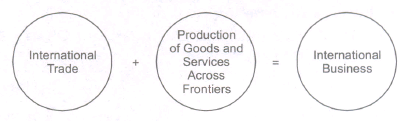
It is rightly said that international business is more than international trade. The scope of international business is much wider than international trade. International trade means exports and imports of goods which is an important component of international business but international business includes much more than this. International trade in services like travel and tourism, transportation, communication, banking, warehousing, distribution and advertising is a part of international business. International business also includes foreign direct investments, contract manufacturing, and setting up wholly owned subsidiaries etc. which are not included in international trade. It is clear from the diagram given below:

11th Standard CBSE Syllabus & Materials
11th Standard CBSE
CBSE 11th Business Studies Forms of Business Organisation Sample Question Papers Study Material - QB365 Set A
NEW11th Standard CBSE
CBSE 11th Business Studies Business, Trade and Commerce Sample Question Papers Study Material - QB365 Set A
NEW11th Standard CBSE
CBSE 11th Physics Waves Sample Question Papers Study Material - QB365 Set A
NEW11th Standard CBSE
CBSE 11th Physics Kinetic Theory Sample Question Papers Study Material - QB365 Set A



CBSE 11th Standard CBSE Subjects
CBSE Standards









