
 100% FREE ACCESS
11th Standard CBSE Syllabus & Materials
11th Standard CBSE
CBSE 11th Economics PART-A - Presentation of Data - New Sample Question Papers Study Material - QB365 Set A
NEW11th Standard CBSE
CBSE 11th Economics PART-A - Organisation of Data - New Sample Question Papers Study Material - QB365 Set A
NEW11th Standard CBSE
CBSE 11th Economics PART-A - Collection of Data - New Sample Question Papers Study Material - QB365 Set A
NEW11th Standard CBSE
CBSE 11th Economics PART-A - Introduction to Economics and Statistics - New Sample Question Papers Study Material - QB365 Set A
NEW11th Standard CBSE
CBSE 11th Business Studies International Trade Sample Question Papers Study Material - QB365 Set A
NEW11th Standard CBSE
CBSE 11th Business Studies Evolution and Fundamentals of Business Sample Question Papers Study Material - QB365 Set A

Published on: 11/10/2019
Organic Chemistry: Some Basic Principles and Techniques
Download CBSE Class 11th Standard CBSE Chemistry question papers, sample papers, important questions, and previous year solved papers in PDF format. Get free study materials, NCERT solutions, and exam preparation resources for Class 11th Standard CBSE Chemistry
Questions + Answers key
Take MCQ Chemistry Test
1.
Give condensed and bond line structural formulas and identify the functional group(s) present, if any, for :
(a) 2,2,4-Trimethylpentane
(b) 2-Hydroxy-1,2,3-propanetricarboxylic acid
(c) Hexanedial
2.
Explain why \({ \left( { CH }_{ 3 } \right) }_{ 3 }\overset { + }{ C } \) is more stable than \({ CH }_{ 3 }\overset { + }{ C } { H }_{ 2 }\) and \(\overset { + }{ C } { H }_{ 3 }\)is the least stable cation.
3.
(a) What is Lassaigne's extract? Will NaCN give a positive Lassaigne's test for nitrogen?
(b) Which colour will appear in the Lassaigne's test if the compound contains both nitrogen and sulphur.
(c) Why is Lassaigne's extract prepared in distilled water? Can we detect oxygen in a compound by Lassaigne's test?
4.
(a) Wfult is the basic principle involved in the estimation of nitrogen by Dumas method.
(b) In a Dumas nitrogen estimation method, 0.30 g of an organic compound gave 50 cm3 of N2 collected at 300 K and 715 mm Hg pressure. Calculate the percentage composition of nitrogen in the compound. (Vapour pressure of water at 300 K is 15 mm Hg)
5.
Explain hyperconjugation effect. How does hyperconjugation effect explain the stability of alkenes?
6.
0.50 g of an organic compound was Kjeldahlished. The ammonia evolved was passed in 50cm3 of 1N H2SO4 . The residual acid required 60 cm3 of N/2 NaOH solution. Calculate the percentage of nitrogen in the compound.
7.
An organic compound contains 69% carbon and 4.8% hydrogen, the remainder being oxygen. Calculate the masses of carbon dioxide and water produced when 0.20 g of this substance is subjected to complete combustion.
8.
Discuss the principle of estimation of halogens, sulphur and phosphorus present in an organic compound.
9.
Explain the terms inductive and electromeric effects. Which electron displacement effect explain the following correct orders of acidity of the carboxylic acids?
(a) Cl3CCOOH > Cl2CHCOOH > ClCH2COOH
(b) CH3CH2COOH > (CH3)2CHCOOH > (CH3)3C.COOH
1.
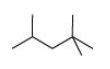
(a) 2, 2, 4-trimethylpentane
Condensed formula: (CH3)2CHCH2C (CH3)3
Bond line formula:
(b) 2-hydroxy-1, 2, 3-propanetricarboxylic acid
Condensed Formula: (COOH)CH2C(OH) (COOH)CH2(COOH)
Bond line formula:
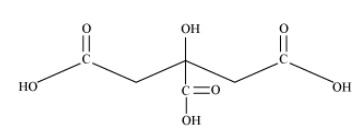
The functional groups present in the given compound are carboxylic acid (-COOH) and alcoholic (-OH) groups.
(c) Hexanedial Condensed Formula: (CHO) (CH2)4 (CHO)
Bond line Formula:

The functional group present in the given compound is aldehyde (-CHO).
2.
Hyperconjugation interaction in \({ \left( { CH }_{ 3 } \right) }_{ 3 }\overset { + }{ C } \) is greater than in \({ CH }_{ 3 }\overset { + }{ C } { H }_{ 2 }\) as the \({ \left( { CH }_{ 3 } \right) }_{ 3 }\overset { + }{ C } \) has nine C-H bonds. In \(\overset { + }{ C } { H }_{ 3 }\), vacant p orbital is perpendicular to the plane in which C-H bonds lie; hence cannot overlap with it. Thus, \({ CH }_{ 3 }^{ + }\) lacks hyperconjugative stability.
3.
(a) When organic compound is fused with sodium metal and then extracted by water, it is called Lassaigne's extract. Yes.
(b) Blood red colour.
(c) Lassaigne's extract is prepared in distilled water since tap water contains Cl- ions. No, oxygen cannot be detected by Lassaigne's test.
4.
(a) This method is based upon the fact that nitrogenous compound is heated with copper oxide in an atmosphere of carbon dioxide yield free nitrogen.

(b) P1 = 715 -15 = 700 mm Hg, P2 = 760 mm Hg
\(\frac{P_1V_1}{T_1}=\frac{P_2V_2}{T_2}\)
T1 = 300 K, T2 = 273 K
V1 = 50 crrr', V2 = ?
\(V_2=\frac{700\times50\times273}{300\times760}\)
= 41.9 cm3
\(\%\ of\ N=\frac{28}{22400}\times41.9\times\frac{100}{W}\)
= 17.46%
5.
Hyperconjugation: The relative stability of various classes of carbonium ions may be explained by the number of no-bond resonance structures that can be written for them. Such structures are arrived by shifting the bonding electrons from an adjacent C-H bond to the electron-deficient carbon. In this way, the positive charge originally on carbon is dispersed to the hydrogen. This manner of electron release by assuming no-bond character in the adjacent C-H bond is called Hyperconjugation or No-Bond Resonance. The greater the hyperconjugation, the greater will be 'the stability of the compound. The increasing order of stability can be shown as.

6.
Step I. Calculation of volume of unused acid
Volume of NaOH solution required = 60 cm3
Normality of NaOH solution = 1/2 N
Normality of H2SO4 solution = l/N
Volume of unused acid can be calculated by applying normality equation
\(\underbrace { N_{ 1 }{ V }_{ 1 } }_{ Acid } =\underbrace { { N }_{ 1 }{ V }_{ 1 } }_{ Base } \)
\(1\times V=\frac{1}{2}\times 60=30cm^3\)
Step II. Calculation of volume of acid used
Volume of acid added = 50 cm3
Volume of unused acid = 30 cm3
Volume of acid used = (50 - 30) = 20 cm3
Step III. Calculation of percentage of nitrogen
Mass of compound = 0.50 g
Volume of acid used = 20 cm3
Normality of acid used = 1N
Percentage of N =\(\frac{1.4\times Volume\ of\ acid\ used\times Normality\ of\ acid\ used}{Mass\ of\ the\ compound}\)
\(=\frac{1.4\times20\times1}{0.50}=56\%\)
7.
Step I. Calculation of mass of CO2 produced
Mass of compound 0.20 g
Percentage of carbon = 69%
Percentage of carbon \(=\frac{12}{44}\times\frac{Mass\ of\ varbon\ dioxide\ formed}{Mass\ of\ compound}\)
\(69=\frac{12}{44}\times\frac{Mass\ of\ carbon\ dioxide\ formed}{(0.20g)}\)
\(\therefore \) Mass of CO2 formed \(=\frac{69\times44\times(0.20g)}{12\times100}=\)0.506 g
Step II. Calculation of mass of H2O produced
Mass of compound = 0.20 g
Percentage of hydrogen = 4.8 %
Percentage of hydrogen \(=\frac{2}{18}\times\frac{Mass\ of\ water\ formed}{Mass\ of\ compound}\times100\)
\(4.8=\frac{2}{18}\times\frac{Mass\ of\ formed}{(0.20 g)}\times 100\)
\(\therefore\) Mass of H2O formed \(=\frac{4.8\times18\times(0.20g)}{2\times100}=\) 0.0864 g
8.
Estimation of halogens: It involves oxidising the organic substance with fuming nitric acid in the presence of silver nitrate. The halogen of the substance is thus converted to silver halide which is separated and weighed:
Weight of organic compound = W gm
weight of silver halide = x g.
% of halogen = \(\frac{\text{At.wt.of halogen}\times100x}{\text{Mol.wt of silver halide}\times w}\)
Estimation of sulphur: The organic substance is heated with fuming nitric acid but no silver nitrate is added. The sulphur of the substance is oxidised to sulphuric acid which is then precipitated as barium sulphate by adding excess of barium chloride solution. From the weight of BaS04 so obtained the percentage of sulphur can be calculated.
% of sulphur = \(\frac{32(At.weight\ of\ S)}{233(mol\ weight\ of\ BaSO_4)}\times\frac{weight\ of\times100\ BaSO_4}{weight\ of\ organic\ compound}\)
Estimation of phosphorous: The organic substance is heated with fuming nitric acid whereupon phosphorous is oxidised to phosphoric acid. The phoshoric acid is
precipitated as ammonium phosphomolybdate, (NH4)3 PO4·12MoO3, by the addition of ammonia and ammonium molybdate solution which is then separated, dried and weighed.
% of P = \(\frac{31\times w_1\times 100}{1877\times w}\)
where Molar mass of (NH4)3 PO4.12MoO3 = 1877 g
If phosphorous is estimated as Mg2P2O7
% of P = \(\frac{62\times w_1\times100}{222\times w}\)
9.
Inductive Effect: The inductive effect refers to the polarity produced in a molecule as a result of higher electronegativity of one atom compared to another. Atoms or groups which lose electron towards a carbon atom are said to have + I Effect.
Those atoms or groups which draw electron away from a carbon atom are said to have -I Effect.
Common examples of -I effect are:
NO2, F, Cl, Br, I, OH etc.
Examples of +1 effect are (Electron releasing)
(CH3)2C-, (CH3)2CH-, CH3CH2-, CH3- etc.
Electromeric effect: The electromeric effect refers to the polarity produced in a multiple bonded compound as it is approached by a reagent.
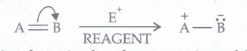
The atom A has lost its share in the electron pair and B has gained this share. As a result A acquires a positive charge and B a negative charge. It is a temporary effect and takes place only in the presence of a reagent.
(a) -I-effect as shown below:
As the number of halogen atoms decreases, the overall -1- effect decreases and the acid strength decreases accordingly.

(b) +I-effect as shown below:
As the number of alkyl groups increases, the +I-effect increases and the acid strength decreases accordingly.


11th Standard CBSE Syllabus & Materials
11th Standard CBSE
CBSE 11th Business Studies Forms of Business Organisation Sample Question Papers Study Material - QB365 Set A
NEW11th Standard CBSE
CBSE 11th Business Studies Business, Trade and Commerce Sample Question Papers Study Material - QB365 Set A
NEW11th Standard CBSE
CBSE 11th Physics Waves Sample Question Papers Study Material - QB365 Set A
NEW11th Standard CBSE
CBSE 11th Physics Kinetic Theory Sample Question Papers Study Material - QB365 Set A



CBSE 11th Standard CBSE Subjects
CBSE Standards









