
 100% FREE ACCESS
11th Standard CBSE Syllabus & Materials
11th Standard CBSE
CBSE 11th Economics PART-A - Presentation of Data - New Sample Question Papers Study Material - QB365 Set A
NEW11th Standard CBSE
CBSE 11th Economics PART-A - Organisation of Data - New Sample Question Papers Study Material - QB365 Set A
NEW11th Standard CBSE
CBSE 11th Economics PART-A - Collection of Data - New Sample Question Papers Study Material - QB365 Set A
NEW11th Standard CBSE
CBSE 11th Economics PART-A - Introduction to Economics and Statistics - New Sample Question Papers Study Material - QB365 Set A
NEW11th Standard CBSE
CBSE 11th Business Studies International Trade Sample Question Papers Study Material - QB365 Set A
NEW11th Standard CBSE
CBSE 11th Business Studies Evolution and Fundamentals of Business Sample Question Papers Study Material - QB365 Set A

Published on: 27/05/2021
QB365 Provides the updated NCERT Exemplar Questions for Class
11, and also provide the detail solution for each and every NCERT
Exemplar questions. NCERT Exemplar questions are latest updated
question pattern from NCERT, QB365 will helps to get more marks in Exams
Download CBSE Class 11th Standard CBSE Chemistry question papers, sample papers, important questions, and previous year solved papers in PDF format. Get free study materials, NCERT solutions, and exam preparation resources for Class 11th Standard CBSE Chemistry
Questions + Answers key
Take MCQ Chemistry Test
1.
Compare the structure of H2O and H2O2.
2.
Do you expect different products in solution when aluminium (III) chloride and pottassium chloride are treated separately with
(i) normal water
(ii) acidified water, and
(iii) alkaline water? Write equations whatever necessary.
3.
Comment on the reactions of dihydrogen with copper(II) oxide
4.
Describe the usefulness of water in biosphere and biological system.
5.
Comment on the reactions of dihydrogen with chlorine.
1.
In water, oxygen is sp3 -hybridised. Due to stronger lone pair-lone pair repulsions than bond pair-bond pair repulsion, the HOH bond angle decreases from 109.5o to 104.5o. Thus, water is a bent molecule as shown in figure.

It is a highly polar molecule. Hydrogen peroxide has a non-planar structure. Dipole moment value of H2O2 suggests that all the four atoms in H2O2 do not lie in a plane. The structure of H2O2 in gas phase, can be compared with a book open at angle 111.5o.The H-O-O bind angle is 94.8o.
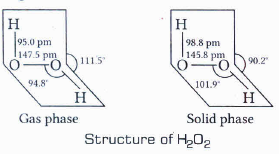
2.
AlCl3 is a salt of weak base, Al(OH)3 and a strong acid, HCl. Therefore , in normal water, it undergoes hydrolysis.
\(Alcl_{ 3 }(s)+3H_{ 2 }O(l)\rightarrow Al(OH)_{ 3 }(s)+3H^{ + }(aq)+3Cl^{ - }(aq)\quad \)
Its aqueous solution is acidic in nature. In acidified water, H+ ions reacts with Al(OH)3 to produce Al3 (aq) ions and Al3+(aq) and C-1
(aq) ions.
In alkaline water AlCl3 yields following products
\(Alcl_{ 3 }(s)+3H_{ 2 }O(l)\rightarrow Al(OH)_{ 3 }(s)+3H^{ + }(aq)+3Cl^{ - }(aq)\)
\(Al\left[ OH \right] ^{ - }_{ 4 }\rightarrow AlO^{ - }_{ 2 }(aq)+2H_{ 2 }O(l)\)
KCl is the salt of a strong acid and a strong base, It does not undergo hydrolysis in normal water. It only dissociates in eater to give K+ (aq)+Cl-(aq)
Aqueous solution of KCl is neutral. Hence, in acidifield water or in alkaline water, the ions do not react further.
3.
Reaction with copper (II) oxide Dihydrogen reduces the copper (II) oxide to metallic copper and itself gets oxidised to water (H2O).
\({ Cu }_{ 2 }O(s)+{ H }_{ 2 }(g)\rightarrow 2Cu(s)+{ H }_{ 2 }O(l)\)
In Cu2O the oxidation state of Cu is +2 but in Cu it is present in 0 oxidation state, i.e. dihydrogen reduces Cu from +2 to 0 state.
4.
A major part of all living organisms is made up of water. Human body has about 65% water and some plants have as much as 95% water. It is an essential compound for the survial of all life forms. Iin comparison to other liquids, water has a high specific heat, thermal conductivity, surface tension, dipole moment , dielectric constant etc. These properties allow water to play a key role in biosphere. The high heat of vaporisation and heat capacity are responsible for moderation of the climate any body temprature of living beings. It is an excellent solvent for transportation of minerals and other nutrients for plant and animal metabolism. Water is also required for photosynthesis in plants which releases O2 into the atmosphere.
\(6CO_{ 2 }(g)+6H_{ 2 }O(l)\xrightarrow [ (hv,chlorophyll) ]{ photosynthesis } C_{ 6 }H_{ 12 }O_{ 6 }+60_{ 2 }\)
5.
Reaction with chlorine when dihydrogen combines with chlorine, it reduces it to the chloride ion (Cl-) and itself get oxidised to H+ ion, to give hydrogen chloride, a covalent compound formed by sharing of a pair of electrons between H and Cl.
\({ H }_{ 2 }(g)+{ Cl }_{ 2 }(g)\rightarrow 2HCl(g)\)

11th Standard CBSE Syllabus & Materials
11th Standard CBSE
CBSE 11th Business Studies Forms of Business Organisation Sample Question Papers Study Material - QB365 Set A
NEW11th Standard CBSE
CBSE 11th Business Studies Business, Trade and Commerce Sample Question Papers Study Material - QB365 Set A
NEW11th Standard CBSE
CBSE 11th Physics Waves Sample Question Papers Study Material - QB365 Set A
NEW11th Standard CBSE
CBSE 11th Physics Kinetic Theory Sample Question Papers Study Material - QB365 Set A



NCERT Books

Syllabus

Exam Pattern

Sample Question Papers

Previous year Question Papers

Important Notes

MCQ Practice test

NCERT Exemplers

Case study Questions

Image Based Questions

Passage based Questions

HOT Questions

Value Based Questions

Model Questions Papers
NCERT ( Book Back ) Questions

Assertion and Reason
Important Questions And Answers

CBSE 11th Standard CBSE Subjects
CBSE Standards







