
 100% FREE ACCESS
11th Standard CBSE Syllabus & Materials
11th Standard CBSE
CBSE 11th Economics PART-A - Presentation of Data - New Sample Question Papers Study Material - QB365 Set A
NEW11th Standard CBSE
CBSE 11th Economics PART-A - Organisation of Data - New Sample Question Papers Study Material - QB365 Set A
NEW11th Standard CBSE
CBSE 11th Economics PART-A - Collection of Data - New Sample Question Papers Study Material - QB365 Set A
NEW11th Standard CBSE
CBSE 11th Economics PART-A - Introduction to Economics and Statistics - New Sample Question Papers Study Material - QB365 Set A
NEW11th Standard CBSE
CBSE 11th Business Studies International Trade Sample Question Papers Study Material - QB365 Set A
NEW11th Standard CBSE
CBSE 11th Business Studies Evolution and Fundamentals of Business Sample Question Papers Study Material - QB365 Set A

Published on: 26/05/2021
QB365 Provides the updated NCERT Exemplar Questions for Class
11, and also provide the detail solution for each and every NCERT
Exemplar questions. NCERT Exemplar questions are latest updated
question pattern from NCERT, QB365 will helps to get more marks in Exams
Download CBSE Class 11th Standard CBSE Chemistry question papers, sample papers, important questions, and previous year solved papers in PDF format. Get free study materials, NCERT solutions, and exam preparation resources for Class 11th Standard CBSE Chemistry
Questions + Answers key
Take MCQ Chemistry Test
1.
If a liquid compound decomposes at its boiling point, which method(s) can you choose for its purification. It is known that the compound is stable at low pressure, steam volatile and insoluble in water.
2.
BF3 does not have proton but still acts as an acid reacts with NH3.Why is it so? What type of bond is formed between the two?
3.
The enthalpy of atomisation for the reaction,
\({ CH }_{ 4 }\left( g \right) \longrightarrow C\left( g \right) +4H\left( g \right) \)
is 1665 KJ mol-1. What is the bond energy of C-H bond ?
4.
Why does the type of overlap given in the following figure not result in bond formation
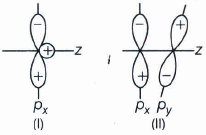
5.
Which of the following orbitals are degenerate?
6.
Volume of a solution changes with change in temparature, then will the molality of the solution be affected by temparature? Give reason for your answer.
7.
Green house effect leads to global warming.Which substances are reaponsible for green house effect?
8.
PbO2 is a stronger oxidising agent than SnO2
9.
Why is hydrogen peroxide stored in wax lined bottles?
1.
If a compound decomposes at its boiling point but is steam volatile, water-insoluble and stable at low pressure, steam distillation can be used for its purification. This technique is applied to separate substances which are steam volatile and immiscible with water.
2.
BF3 is an electron deficient compound and hence acts as Lewis acid.NH3 has one lone pair which it can donate to BF3 and form a coordinate bond. Hence, NH3 acts as lewis base.
H3N:→BF3
3.
In CH4 there are four C-H bonds. The enthalpy of atomisation of 1 mole of CH4 means dissociation of four moles of C-H bond.
∴ C-H bond energy per mol \(=\frac{ 1665 KJ}{4 mol }\)= 416.25 KJ mol-1.
4.
In the figure I are of ++ overlap is equal to +- overlap,so net overlap is zero,while in the figure II there is no overlap due to different symmetry.
5.
The orbitals which belong to same subshell and same shell are called degenerate orbitals.(3dxy,3dz2,3dyz) and (4 dxy,4 dzy,4 dz2) are the two sets of degenerate orbitals
6.
No, molality of solution does not change with temperature since mass remains unaffected with temperature.
7.
()
Green house namely carbon dioxide,methane,nitrous oxide(N2,O),ozone and chloroflurocarbons(CFS's) are reponsible for green house effect,i.e for maintaining temperature of the earth as these absorb the outgoing radiations from the earth's surface
8.
()
2In PbO2 and SnO2 , both lead and tin are present in +4 oxidation state, But due to stronger inert pair effect, Pb2+ ion is more stable than Sn2+ ion. In other words Pb4+ ions i.e. PbO2 is more easily reduced to Pb+2 ions than Sn4+ ions reduced to Sn2+ ions. Thus, PbO2 acts as a stronger oxidising agent than SnO2
9.
()
Hydrogen peroxide is decomposed by rough surfaces of glass, alkali oxides present in it and light to form
\({ H }_{ 2 }O \ and \ { O }_{ 2 } \ { 2H }_{ 2 }{ O }_{ 2 }\rightarrow { 2H }_{ 2 }O+{ O }_{ 2 }\)
To prevent this decomposition, \({ H }_{ 2 }{ O }_{ 2 }\)is usually stored in coloured paraffin wax coated plastic or teflon bottles.

11th Standard CBSE Syllabus & Materials
11th Standard CBSE
CBSE 11th Business Studies Forms of Business Organisation Sample Question Papers Study Material - QB365 Set A
NEW11th Standard CBSE
CBSE 11th Business Studies Business, Trade and Commerce Sample Question Papers Study Material - QB365 Set A
NEW11th Standard CBSE
CBSE 11th Physics Waves Sample Question Papers Study Material - QB365 Set A
NEW11th Standard CBSE
CBSE 11th Physics Kinetic Theory Sample Question Papers Study Material - QB365 Set A



NCERT Books

Syllabus

Exam Pattern

Sample Question Papers

Previous year Question Papers

Important Notes

MCQ Practice test

NCERT Exemplers

Case study Questions

Image Based Questions

Passage based Questions

HOT Questions

Value Based Questions

Model Questions Papers
NCERT ( Book Back ) Questions

Assertion and Reason
Important Questions And Answers

CBSE 11th Standard CBSE Subjects
CBSE Standards







