
 100% FREE ACCESS
11th Standard CBSE Syllabus & Materials
11th Standard CBSE
CBSE 11th Economics PART-A - Presentation of Data - New Sample Question Papers Study Material - QB365 Set A
NEW11th Standard CBSE
CBSE 11th Economics PART-A - Organisation of Data - New Sample Question Papers Study Material - QB365 Set A
NEW11th Standard CBSE
CBSE 11th Economics PART-A - Collection of Data - New Sample Question Papers Study Material - QB365 Set A
NEW11th Standard CBSE
CBSE 11th Economics PART-A - Introduction to Economics and Statistics - New Sample Question Papers Study Material - QB365 Set A
NEW11th Standard CBSE
CBSE 11th Business Studies International Trade Sample Question Papers Study Material - QB365 Set A
NEW11th Standard CBSE
CBSE 11th Business Studies Evolution and Fundamentals of Business Sample Question Papers Study Material - QB365 Set A

Published on: 26/05/2021
QB365 Provides the updated NCERT Exemplar Questions for Class
11, and also provide the detail solution for each and every NCERT
Exemplar questions. NCERT Exemplar questions are latest updated
question pattern from NCERT, QB365 will helps to get more marks in Exams
Download CBSE Class 11th Standard CBSE Chemistry question papers, sample papers, important questions, and previous year solved papers in PDF format. Get free study materials, NCERT solutions, and exam preparation resources for Class 11th Standard CBSE Chemistry
Questions + Answers key
Take MCQ Chemistry Test
1.
Draw the resonance structures for the following compounds. Show the electron shift using curved-arrow notation.CH3CH = CHCH2
2.
What do you mean by significant figures?
3.
Calculate the oxidation number of phosphorus in the following species.
\({ HPO }_{ 3 }^{ 2- }\)
4.
The value of \({ \Delta }_{ f }{ H }^{ \Theta }\) for NH3 is -91.8 kJ mol-1. Calculate enthalpy change for the following reaction.
\(2{ NH }_{ 3 } \ (g)\longrightarrow { N }_{ 2 }(g) \ + \ { 3H }_{ 2 }(g)\)
5.
Name the energy which arises due to motion of atoms or molecules in a body. How is this energy affected when the temperature is increased?
6.
Group the given molecules as linear and non-linear molecules.
7.
Describe the change in hybridisation (if any) of the Al atom in the following reaction.
\({ AlCl }_{ 3 }+{ Cl }^{ - }\longrightarrow { AlCl }_{ 4 }^{ - }\)
8.
The electronic configuration of valence shell of Cu is \(3d^{10}4s^{1} and\ 3d^{9}4s^{2}\) How is this configuration explained?
9.
Yellow light emitted from a sodium lamp has a wavelength (λ) of 580 nm. Calculate the frequency (ν) and wavenumber (\(\bar { v } \)) of the yellow light.
10.
The reactant which is entirely consumed in reaction is known as limiting reagent. In the reaction 2A + 4B \(\Rightarrow\) 3C + 4D, when 5 moles of A react with 6 moles of B, then calculate the amount of C formed?
1.

2.
The digits in a properly recorded measurement are known as significant figures. It is also defined as follows. The total numbers of figures in a number including the last digit whose value is uncertain is called number of significant figures.
3.
Suppose that the oxidation number of P in \({ HPO }_{ 3 }^{ 2- }\) be x.
Theb, 1 + x + 3 (-2) = -2
or x + 1 - 6 = -2 or x = +3
4.
Given, \(\frac { 1 }{ 2 } { N }_{ 2 }(g)+{ \frac { 3 }{ 2 } }{ H }_{ 2 }(g)\longrightarrow { NH }_{ 3 }(g);\)
\({ \Delta }_{ f }{ H }^{ \Theta }=-91.8 \ kJ \ { mol }^{ -1 }\)
(\({ \Delta }_{ f }{ H }^{ \Theta }\) means enthalpy of formation of 1 mole of NH3)
\(\therefore\) Enthalpy change for the formation of 2 moles of NH3
\({ N }_{ 2 }(g)+{ 3H }_{ 2 }(g)\rightarrow { 2NH }_{ 3 }(g);\)
\({ \Delta }_{ f }{ H }^{ \Theta }=2\times -91.8=-183.6 \ kJ \ { mol }^{ -1 }\)
And for the reverse reaction. \(2{ NH }_{ 3 }(g)\longrightarrow { N }_{ 2 }(g)+{ 3H }_{ 2 }(g);{ \Delta }_{ f }{ H }^{ \Theta }=+183.6 \ kJ \ { mol }^{ -1 }\) Hence, the value of \({ \Delta }_{ f }{ H }^{ \Theta }\) for NH3 is +183.6 kJ mol-1
5.
The energy which arises due to motion of atoms or molecules in a body is known as thermal energy.It is a measure of average kinetic energy of the particles.It increases with increases with increase in temperature.
6.
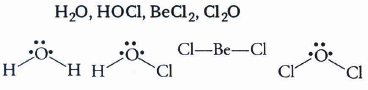
Therefore, only BeCl2 is linear and rest of the molecules are non-linear.
7.
Electronic configuration of Al
In ground state \({ _{ 13 }{ Al } }={ 1s }^{ 2 },{ 2s }^{ 2 },{ 2p }^{ 6 },{ 3s }^{ 2 },{ 3p }_{ x }^{ 1 }\)
In excited state = \({ 1s }^{ 2 },{ 2s }^{ 2 },{ 2 }p^{ 6 },{ 3s }^{ 1 },{ 3p }_{ x }^{ 1 },{ 3p }_{ y }^{ 1 }\)
In the formation of AlCl3,Al undergoes sp2 hybridisation and it is original planar in shape. While in the formation of \({ AlCl }_{ 4 }^{ - }\) , Al undergose sp3 hybridisation.
It means empty 3pz orbital also involced in hybridisation. Thus, the shape of \({ AlCl }_{ 4 }^{ - }\) ion is tetrahedral.
8.
Configurations with completely filled and half-filled orbitals have extra stability. In, d-orbitals are completely filled and s-orbital is half-filled. Hence it is a more stable configuration for Cu compare to \(3d^{9}4s^{2}.\)
9.
Frequency, \(v=\frac { c }{ \lambda } \)
\(\because \) 1 nm = 10-9m
\(\therefore \) 580nm = 580 x 10-9 m = 580 x 10-7cm
\(v=\frac { 3.0\times 10^{ 8 }{ ms }^{ -1 } }{ 580\times { 10 }^{ -9 }m } =5.17\times { 10 }^{ 14 }{ s }^{ -1 }\)
\( [Velocity \ of \ light=3\times { 10 }^{ 8 }{ ms }^{ -1 }]\)
Wave number,
\(\bar { v } =\frac { 1 }{ \lambda } =\frac { 1 }{ 580\times 10^{ -7 }cm } \)
\( =1.724\times { 10 }^{ 4 }cm^{ -1 }\)
10.
\(2A+4B\longrightarrow 3C+4D\)
According to the given reaction, 2 moles of A rect with 4 moles of B.
Hence, 5 moles of A will react with 10 moles of
\(b\left( \frac { 5\times 4 }{ 2 } =10moles \right) \)
Limiting reagent decide the amount of product produced. According to the reaction, 4 moles of B produces 3 moles of C.
6 moles of B will produce\(\frac { 3\times 6 }{ 4 } =4.5\) moles of C.

11th Standard CBSE Syllabus & Materials
11th Standard CBSE
CBSE 11th Business Studies Forms of Business Organisation Sample Question Papers Study Material - QB365 Set A
NEW11th Standard CBSE
CBSE 11th Business Studies Business, Trade and Commerce Sample Question Papers Study Material - QB365 Set A
NEW11th Standard CBSE
CBSE 11th Physics Waves Sample Question Papers Study Material - QB365 Set A
NEW11th Standard CBSE
CBSE 11th Physics Kinetic Theory Sample Question Papers Study Material - QB365 Set A



NCERT Books

Syllabus

Exam Pattern

Sample Question Papers

Previous year Question Papers

Important Notes

MCQ Practice test

NCERT Exemplers

Case study Questions

Image Based Questions

Passage based Questions

HOT Questions

Value Based Questions

Model Questions Papers
NCERT ( Book Back ) Questions

Assertion and Reason
Important Questions And Answers

CBSE 11th Standard CBSE Subjects
CBSE Standards







