
 100% FREE ACCESS
11th Standard CBSE Syllabus & Materials
11th Standard CBSE
CBSE 11th Economics PART-A - Presentation of Data - New Sample Question Papers Study Material - QB365 Set A
NEW11th Standard CBSE
CBSE 11th Economics PART-A - Organisation of Data - New Sample Question Papers Study Material - QB365 Set A
NEW11th Standard CBSE
CBSE 11th Economics PART-A - Collection of Data - New Sample Question Papers Study Material - QB365 Set A
NEW11th Standard CBSE
CBSE 11th Economics PART-A - Introduction to Economics and Statistics - New Sample Question Papers Study Material - QB365 Set A
NEW11th Standard CBSE
CBSE 11th Business Studies International Trade Sample Question Papers Study Material - QB365 Set A
NEW11th Standard CBSE
CBSE 11th Business Studies Evolution and Fundamentals of Business Sample Question Papers Study Material - QB365 Set A

Published on: 26/05/2021
QB365 Provides the updated NCERT Exemplar Questions for Class
11, and also provide the detail solution for each and every NCERT
Exemplar questions. NCERT Exemplar questions are latest updated
question pattern from NCERT, QB365 will helps to get more marks in Exams
Download CBSE Class 11th Standard CBSE Chemistry question papers, sample papers, important questions, and previous year solved papers in PDF format. Get free study materials, NCERT solutions, and exam preparation resources for Class 11th Standard CBSE Chemistry
Questions + Answers key
Take MCQ Chemistry Test
1.
Draw the resonance structures for the following compounds. Show the electron shift using curved-arrow notation.C6H5-CHO
2.
For dry cleaning in the place of tetrachloroethene, liquefied carbon dioxide with suitable detergent is an alternative solvent. What type of harm to the environment will be prevented by stopping use of tetrachloroethene? Will use of liquefied carbon dioxide with detergent be completely safe from the point of view of pollution. Explain.
3.
Why do you alkenes prefer to undergo electrophilic addition reaction while arenes prefer electrophilic substitution reactions? Explain.
4.
Which of the following compounds will not exist as resonance hybrid. Give reason for your answer.
(a) CH3OH
(b) CH3CH = CHCH2NH2
5.
Explain Silicon forms SiF62- ion whereas corresponding chloro molecule is a resonance of carbon is not known.
6.
Complete the following reactions.
\({ O }_{ 2 }^{ 2- }\) + H2 O \(\longrightarrow \)
7.
Hydrogen generally forms covalent compounds. Give reason?
8.
18.0 g water completely vaporises at 100 oC and 1 bar pressure and the enthalpy change in the process is 40.79 KJ mol-1. What will be the enthalpy change for vaporising two moles of water under the same conditions? What is the standard enthalpy of vaporisation for water?
9.
Yellow light emitted from a sodium lamp has a wavelength (λ) of 580 nm. Calculate the frequency (ν) and wavenumber (\(\bar { v } \)) of the yellow light.
10.
Wavelengths of different radiations are given below.
\(\lambda (A)=300\ nm,\ \lambda (B)=300\ \mu m,\ \lambda (C)=\ 3\ nm,\lambda (D)=30\overset { \circ }{ A } \)
Arrange these radiations in the increasing order of their energies.
1.
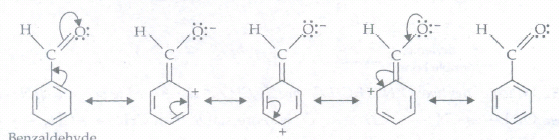
2.
(i) Tetrachloroethene, CI2C = CCI2 is suspected to be carcinogenic and also contaminates the ground water. This harmful effect will be prevented by using liquefied CO2 along with suitable detergent
(ii) Use of liquefied CO2 along with detergent will not be completely safe because most of the detergents are non-biodegradable and they cause water pollution. Moreover, liquefied CO2 will ultimately enter into the atmosphere and contribute to the green house effect.
3.
Alkenes are rich source of loosely held \(\pi \) electrons, due to which they show electrophilic addition reaction. Electrophilic addition reactions of alkenes are accompanied by large energy changes so these are energetically favourable than that of Electrophilic substitution reactions.
In special conditions alkenes also undergo free radical substitution reactions.
In arenes during electrophilic addition reactions aromatic character of benzene ring is destroyed while during electrophilic substitution reactions of areans are enegetically more favourable than that of electrophilic addition reaction.
That's why alkenes prefer to undergo electrophilic addition reaction while arenes prefer electrophilic substitution reactions.
4.
(a) CH3OH as it lacks \(\pi \) -electrons hence it will not exist as resonance hybrid.
(b) CH3CH = CHCH2NH2 As the lone pair of electrons on the N-atom is not conjugated with the -electrons of the double bond, thus, resonance is not possible and hence no resonance hybrid will exist.
5.
In silicon, vacant 3d orbitals are available due to which it can accomodate electrons from six fluorine atoms, there by forming [SiF6]2- ion.However in case of C only 2p2 filled orbitals are available thus, it cannot expand their covalency more than 4. That why.[CF6]2- is not known.
6.
Peroxide ions react with water to form H2O2,
\({ O }_{ 2 }^{ 2- }\) + 2 H2 O \(\longrightarrow \) 2OH- + H2O2
7.
Hydrogen because of the presence of only one electron in the valence shell can either lose or gain or share it to acquire noble gas, i.e. helium gas, configuration. Therefore, in principle, it can form either ionic or covalent bonds. But the ionisation enthalpy of His very high (1312 kJmol-1) and its electron gain enthalpy is only slightly negative (-73 kJmol-1). As a result, it does not have a high tendency to form ionic bonds but rather prefers to form only covalent bonds.
8.
18.0 g H2O = 1 mol H2O
Enthalpy change for vaporising 1 mole of H2O = 40.79 KJ
\(\therefore \) Enthalpy change for vaporising 2 moles of
H2O = 2 x 40.79 KJ = 81.58 KJ
Standard enthalpy of vaporisation at 100oC and 1 bar pressure,
\({ \triangle }_{ vap }{ H }^{ \circ }=+40.79 \ KJ \ { mol }^{ -1 }\)
9.
Frequency, \(v=\frac { c }{ \lambda } \)
\(\because \) 1 nm = 10-9m
\(\therefore \) 580nm = 580 x 10-9 m = 580 x 10-7cm
\(v=\frac { 3.0\times 10^{ 8 }{ ms }^{ -1 } }{ 580\times { 10 }^{ -9 }m } =5.17\times { 10 }^{ 14 }{ s }^{ -1 }\)
\( [Velocity \ of \ light=3\times { 10 }^{ 8 }{ ms }^{ -1 }]\)
Wave number,
\(\bar { v } =\frac { 1 }{ \lambda } =\frac { 1 }{ 580\times 10^{ -7 }cm } \)
\( =1.724\times { 10 }^{ 4 }cm^{ -1 }\)
10.
(A) \(\lambda =300nm=300\times { 10 }^{ -9 }m\)
(B) \(\lambda =300\mu m=300\times { 10 }^{ -6 }m\)
(C) \(\lambda =3nm=3\times { 10 }^{ -9 }m\)
(D) \(\lambda =30\overset { \circ }{ A } =30\times { 10 }^{ -9 }m=3\times { 10 }^{ -9 }m\)
\(\because \) Energy, \(E=\frac { hc }{ \lambda } orE\propto \frac { 1 }{ \lambda } \)
\(\therefore \) Increasing order of energy is B

11th Standard CBSE Syllabus & Materials
11th Standard CBSE
CBSE 11th Business Studies Forms of Business Organisation Sample Question Papers Study Material - QB365 Set A
NEW11th Standard CBSE
CBSE 11th Business Studies Business, Trade and Commerce Sample Question Papers Study Material - QB365 Set A
NEW11th Standard CBSE
CBSE 11th Physics Waves Sample Question Papers Study Material - QB365 Set A
NEW11th Standard CBSE
CBSE 11th Physics Kinetic Theory Sample Question Papers Study Material - QB365 Set A



NCERT Books

Syllabus

Exam Pattern

Sample Question Papers

Previous year Question Papers

Important Notes

MCQ Practice test

NCERT Exemplers

Case study Questions

Image Based Questions

Passage based Questions

HOT Questions

Value Based Questions

Model Questions Papers
NCERT ( Book Back ) Questions

Assertion and Reason
Important Questions And Answers

CBSE 11th Standard CBSE Subjects
CBSE Standards







