
 100% FREE ACCESS
11th Standard CBSE Syllabus & Materials
11th Standard CBSE
CBSE 11th Economics PART-A - Presentation of Data - New Sample Question Papers Study Material - QB365 Set A
NEW11th Standard CBSE
CBSE 11th Economics PART-A - Organisation of Data - New Sample Question Papers Study Material - QB365 Set A
NEW11th Standard CBSE
CBSE 11th Economics PART-A - Collection of Data - New Sample Question Papers Study Material - QB365 Set A
NEW11th Standard CBSE
CBSE 11th Economics PART-A - Introduction to Economics and Statistics - New Sample Question Papers Study Material - QB365 Set A
NEW11th Standard CBSE
CBSE 11th Business Studies International Trade Sample Question Papers Study Material - QB365 Set A
NEW11th Standard CBSE
CBSE 11th Business Studies Evolution and Fundamentals of Business Sample Question Papers Study Material - QB365 Set A

Published on: 26/05/2021
QB365 Provides the updated NCERT Exemplar Questions for Class
11, and also provide the detail solution for each and every NCERT
Exemplar questions. NCERT Exemplar questions are latest updated
question pattern from NCERT, QB365 will helps to get more marks in Exams
Download CBSE Class 11th Standard CBSE Chemistry question papers, sample papers, important questions, and previous year solved papers in PDF format. Get free study materials, NCERT solutions, and exam preparation resources for Class 11th Standard CBSE Chemistry
Questions + Answers key
Take MCQ Chemistry Test
1.
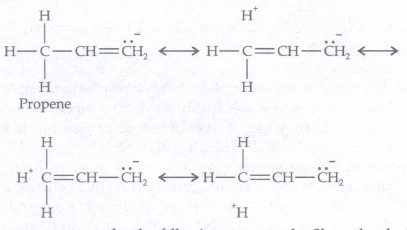
Explain why alkyl groups act as electron donors when attached to a π system.
2.
The concentration of hydrogen ion in a sample of soft drink is 3.8 × 10⁻³M. what is its pH ?
3.
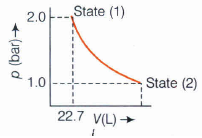
1.0 mole of a monoatomic ideal gas is expanded from state (1) to state (2) as shown in figure. Calculate the work done for the expansion of gas from state(1) to state (2) at 298 K.
4.
Calculate the total pressure in a mixture of 8 g of dioxygen and 4 g of dihydrogen confined in a vessel of 1 dm3 at 27\(^{o}\)C. (R = 0.083 bar dm3 K-1 mol-1)
5.
Write the resonance structures for NO2
6.
How does the metallic and non-metallic character vary on moving from left to right in a period?
7.
The arrangement of orbitals on the basis of energy is based upon their (n + 1), lower is the energy. For orbitals having same values of (n + l), the orbitals with lower value of n will have lower energy.
Based upon the above information, arrange the following orbitals in the increasing order of energy.
a) 1s 2s, 3s, 2p
b) 4s, 3s, 3p, 4d
c) 5p, 4d, 5d, 4f, 6s
d) 5f, 6d, 7s, 6p
8.
A measured temperature on Fahrenheit scale is 200o F. What will this reading be on Celsius scale?
9.
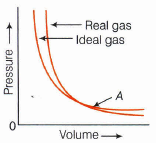
Pressure versus volume graph for a real gas and an ideal gas are shown in figure. Answer the following questions on the basis of the graph.
Interpret the behaviour of real gas with respect to ideal gas at high pressure.
1.
Due to hyperconjugation, alkyl groups act as electron donors when attached to a \(\pi\)-system as shown below:
2.
pH = -log[H+] = -log [3.8\(\times \)10-3]
= - [log[3.8] + log[10-3]
= - [(0.58) + (-3.0)] = - [-2.42] = 2.42
Therefore, the pH of the soft drink is 2.42 and it can be inferred that it is acidic.
3.
The given diagram represents that the represents is carried out in infinite steps, hence, it is isothermal reversible expansion of the ideal gas from pressure 2.0 atm to 1.0 atm at 298 K.
\(W=-2.303 \ nRT \ log\frac { { p }_{ 1 } }{ { p }_{ 2 } }\)
\( W=-2.303\times 1 \ mol\times 8.314 \ { JK }^{ -1 }{ mol }^{ -1 }\times 298 \ K \ log \ 2 \ \ \left( \because \frac { { p }_{ 1 } }{ { p }_{ 2 } } =\frac { 2 }{ 1 } \right)\)
\(w=-1717.63 \ J\)
4.
Moles of O2, nO2 = \(\cfrac{mass}{mol.wt.}=\cfrac{8}{32}=0.25mol\)
[mol.wt. of O2 = 16\(\times\)2 = 32]
Moles of H2, nH2 = \(\cfrac{4}{2}=2.0mol\)
[mol.wt. of H2 = 1 \(\times\)2 = 2 ]
Total number of moles = 0.25 + 2.0 = 2.25mol
Pressure, p = \(\cfrac{nRT}{V}\)
\(\cfrac { 2.25mol\times 0.083bar \ dm^{ 3 }K^{ -1 }mol^{ -1 }\times 300K) }{ (1 \ dm^{ 3 }) } \)
p = 56.025 bar
5.
Nitrogen dioxide, NO2

6.
As we move from left to right in period, the number of valence electrons increases by one at each succeeding element but the number of shells remains same. Due to this, effective nuclear charge ivcreases.
More is the effective nuclear charge, more is the attraction between nuclei and electron.
Hence, the tendency of the element to lose electrons decreases, this results in decrease in metallic character.
Furthermore, the tendency of an element to gain electrons increases with increase in effective nuclear charge, so non-metallic character increases on moving from left to right in a period.
7.
a) (n + 1) values are
1s = 1 + 0 = 1, 2s = 2+ 0 = 2, 3s = 3 + 0 = 3, 2p = 2 + 1 = 3
Hence, increasing order of their energy is 1s < 2s < 2p < 3s.
b) 4s = 4 + 0 =4, 3s = 3 + 0 = 3, 3p = 3 + 1 = 4, 4d = 4 + 2 = 6.
Hence 3s < 3p < 4s < 4d.
c) 5p = 5 + 1 = 6, 4d = 4 + 2 = 6, 5d = 5 + 2 = 7, 4f = 4 + 3 = 7, 6s = 6 + 0 = 6.
Hence, 4d < 5p < 6s < 4f < 5d.
d) 5f = 5 + 3 = 8, 6d = 6 + 2 = 8, 7s = 7 + 0 = 7, 7p = 7 + 1 = 8.
Hence, 7s < 5f < 6d < 7p.
8.
There are three common scales to measure temperature oC (degree celsius), oF(degree Fahrenheit) and K (kelvin). The K is the SI unit.
The temperature on two scales are related to each other by the following relationship \(^{ 0 }F=\frac { 9 }{ 5 } t^{ 0 }C+32\)
Putting the values in above equation.
\(200-32=\frac { 9 }{ 5 } t^{ 0 }C\Rightarrow \frac { 9 }{ 5 } t^{ 0 }C=168\)
\(\Rightarrow \ t^{ 0 }C=\frac { 168\times 5 }{ 9 } =93.3^{ 0 }C\)
9.
At high pressure, the real gas shows large deviations from ideal behaviour as the curves are far apart.

11th Standard CBSE Syllabus & Materials
11th Standard CBSE
CBSE 11th Business Studies Forms of Business Organisation Sample Question Papers Study Material - QB365 Set A
NEW11th Standard CBSE
CBSE 11th Business Studies Business, Trade and Commerce Sample Question Papers Study Material - QB365 Set A
NEW11th Standard CBSE
CBSE 11th Physics Waves Sample Question Papers Study Material - QB365 Set A
NEW11th Standard CBSE
CBSE 11th Physics Kinetic Theory Sample Question Papers Study Material - QB365 Set A



NCERT Books

Syllabus

Exam Pattern

Sample Question Papers

Previous year Question Papers

Important Notes

MCQ Practice test

NCERT Exemplers

Case study Questions

Image Based Questions

Passage based Questions

HOT Questions

Value Based Questions

Model Questions Papers
NCERT ( Book Back ) Questions

Assertion and Reason
Important Questions And Answers

CBSE 11th Standard CBSE Subjects
CBSE Standards







