
 100% FREE ACCESS
11th Standard CBSE Syllabus & Materials
11th Standard CBSE
CBSE 11th Economics PART-A - Presentation of Data - New Sample Question Papers Study Material - QB365 Set A
NEW11th Standard CBSE
CBSE 11th Economics PART-A - Organisation of Data - New Sample Question Papers Study Material - QB365 Set A
NEW11th Standard CBSE
CBSE 11th Economics PART-A - Collection of Data - New Sample Question Papers Study Material - QB365 Set A
NEW11th Standard CBSE
CBSE 11th Economics PART-A - Introduction to Economics and Statistics - New Sample Question Papers Study Material - QB365 Set A
NEW11th Standard CBSE
CBSE 11th Business Studies International Trade Sample Question Papers Study Material - QB365 Set A
NEW11th Standard CBSE
CBSE 11th Business Studies Evolution and Fundamentals of Business Sample Question Papers Study Material - QB365 Set A

Published on: 26/05/2021
QB365 Provides the updated NCERT Exemplar Questions for Class
11, and also provide the detail solution for each and every NCERT
Exemplar questions. NCERT Exemplar questions are latest updated
question pattern from NCERT, QB365 will helps to get more marks in Exams
Download CBSE Class 11th Standard CBSE Chemistry question papers, sample papers, important questions, and previous year solved papers in PDF format. Get free study materials, NCERT solutions, and exam preparation resources for Class 11th Standard CBSE Chemistry
Questions + Answers key
Take MCQ Chemistry Test
1.
Some time ago formation of polar stratospheric clouds was reported over Antarctica. Why were these formed? What happens when such clouds break up by the warmth of sunlight?
2.
In the presence of peroxide, addition of HBr to propene takes place according to anti-Markownikoff's rule but peroxide effect is not seen in the case of HCl and HI. Explain.
3.
Consider structure I to VII and answer the following questions (i) and (ii).
I. \({ CH }_{ 3 }-{ CH }_{ 2 }-{ CH }_{ 2 }-{ CH }_{ 2 }-{ OH }\)
II. \({ CH }_{ 3 }-{ CH }_{ 2 }-{ CH }-{ CH }_{ 3 }\\ \quad \quad \quad \quad \quad \quad \quad |\\ \quad \quad \quad \quad \quad \quad \quad { OH }\)
III. \({ \quad \quad \quad \quad CH }_{ 3 }\\ \quad \quad \quad \quad |\\ { { CH }_{ 3 } }-{ C }-{ CH }_{ 3 }\\ \quad \quad \quad \quad |\\ \quad \quad \quad \quad { OH }\)
IV. \({ CH }_{ 3 }-{ CH }-{ CH_{ 2 } }-{ OH }\\ \quad \quad \quad \quad |\\ \quad \quad \quad \quad { CH }_{ 3 }\)
V. \({ CH }_{ 2 }-{ CH }_{ 2 }-{ O }-{ CH }_{ 2 }-{ CH }_{ 3 }\)
VI. \({ CH }_{ 2 }-{ O }-{ CH }_{ 2 }-{ CH }_{ 2 }-{ CH }_{ 3 }\)
VII. \({ CH }_{ 3 }-{ O }-{ CH }-{ CH }_{ 3 }\\ \quad \quad \quad \quad \quad \quad |\\ \quad \quad \quad \quad \quad \quad { CH }_{ 3 }\)
Identify the pairs of compounds that represent position isomerism.
4.
Three pairs of compounds are given below, Identify that compound in each of the pairs which has group 13 element in more stable oxidation state. Give reason for your choice. State the nature of bonding also.
TlCl3, TlCl
5.
Present a comparative account of the alkali and akaline earth metals with respect to the following characteristics.
Nature of oxides and their solubility in water
6.
Give reasons why hydrogen resembles alkali metals?
7.
Write lewis structure of the following compounds and show formal charge each atom.
8.
The variation of the vapour pressure of different liquids with temperature is shown in the figure below.
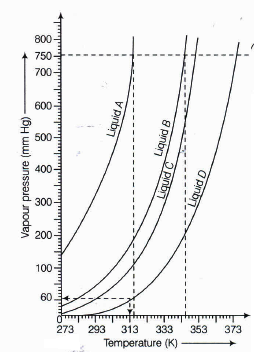
At high altitude, atmospheric pressure is low (say 60 mm Hg). At what temperature will liquid D boil?
1.
In the summer season, nitrogen dioxide and methane react with chlorine monoxide and chlorine free radicals forming chlorine sinks, preventing much ozone depletion, whereas in winters, special type of clouds, called the polar stratospheric clouds are formed over Antarctica.
These polar stratospheric clouds provide the surface on which chlorine nitrate gets hydrolysed to form hypochlorous acid.It also reacts with hydrogen chloride to give molecular chlorine.
\({ CIO }^{ . }\left( g \right) +N{ O }_{ 2 }\left( g \right) \longrightarrow { CIONO }_{ 2 }\left( g \right) \)
\({ Cl }^{ . }\left( g \right) +{ CH }_{ 4 }\left( g \right) \longrightarrow { CH }_{ 3 }\left( g \right) +HCI\left( g \right) \)
\( { CIONO }_{ 2 }\left( g \right) +{ H }_{ 2 }O\left( g \right) \longrightarrow HOCI\left( g \right) +HN{ O }_{ 3 }\left( g \right) \)
\( { CIONO }_{ 2 }\left( g \right) +HCI\left( g \right) \longrightarrow { CI }_{ 2 }\left( g \right) +HN{ O }_{ 3 }\left( g \right) \)
When sunlight returns to the Antarctica in the spring, the Sun's warmth breaks up the clouds and HOCI and CI2 are photolysed by sunlight.
\(
\mathrm{HOCl}(g) \stackrel{h \mathrm{v}}{\longrightarrow} \dot{\mathrm{O}} \cdot \mathrm{H}(g)+\dot{\mathrm{Cl}}(\mathrm{g}) \)
\(\mathrm{Cl}_{2}(g) \stackrel{h \mathrm{v}}{\longrightarrow} 2 \overline{\mathrm{C}} \mathrm{l}(\mathrm{g})
\)
The chlorine radicals thus formed, initiate the chain for ozone depletion.
2.
Peroxide effect is not observed in addition of HCl and HI. This is due to fact that the H__Cl bond being stronger (430.5 kJ mol-1) than H__Br bond (363.7 kJ mol-1) is not cleaved by the free radical whreas the H___I bond is weaker (296.8 kJ mol-1) and iodine free radicals combine to form iodine molecules instead of adding to the double bond.
3.
I and II, III and IV and, VI and VII represent position isomerism.
4.
Due to strong inert pair effect, +1 oxidation state of Tl is more stable than +3. since, compounds in lower oxidation state are ionic but covalent in higher oxidation state, therefore TlCl3 is less stable and covalent in nature but TlCl is more stable and is ionic in nature.
5.
| Alkali metals | Alkaline earth metals |
| The solubility of oxides of alkali metals increase down the group | The solubility of oxides of Mg, Ca, Sr and Ba. BeO, however, is covalent and insoluble in water |
6.
Hydrogen resembles alkali metals, i.e. Li, Na, K, Rb, Cs and Fr of group I of the periodic table in the following respects.
(i) Like alkali metals, hydrogen also contain one electron in its outermost (valence) shell and exhibit +1 oxidation state.
(ii) Like alkali metals, hydrogen also loses its only electron to form hydrogen ion, i.e.H+ (proton).
(iii) Like alkali metals, hydrogen combines with electronegative elements (non-metals) such as oxygen, halogens and sulphides respectively.
(iv) Like alkali metals, hydrogen also acts as a strong reducing agent.
7.
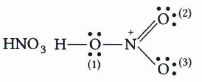
Formal charge on an atom in a Lewis structure
= [total number of valence electrons in free atom]
- [total number of non-bonding (lone pairs) electrons]
- \(\frac { 1 }{ 2 } \)[total number of bonding or shared electron]
Formal charge on H = 1 - 0 x 2 = 0
Formal charge on N = 5 - 0 x 8 = 1
Formal charge on O (1) = 6 - 4 - x 4 = 0
Formal charge on O (2) = 6 - 4 - x 4 = 0
Formal charge on O (3) = 6 - 6 - x 2 = -1
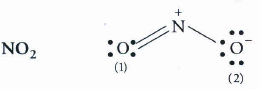
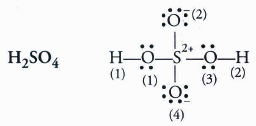
On solving we get, formal charges on O(1), N and O(2) as 0, +1 and -1 respectively.
Similarly, on solving we get formal charge on H(1), H(2), O(2), O(3), O(4) ans S, as 0, 0, 0, -1 , 0, -1 and +2 respectively.
8.
Temperature corresponding to 60 mm \(\simeq \) 313 K.

11th Standard CBSE Syllabus & Materials
11th Standard CBSE
CBSE 11th Business Studies Forms of Business Organisation Sample Question Papers Study Material - QB365 Set A
NEW11th Standard CBSE
CBSE 11th Business Studies Business, Trade and Commerce Sample Question Papers Study Material - QB365 Set A
NEW11th Standard CBSE
CBSE 11th Physics Waves Sample Question Papers Study Material - QB365 Set A
NEW11th Standard CBSE
CBSE 11th Physics Kinetic Theory Sample Question Papers Study Material - QB365 Set A



NCERT Books

Syllabus

Exam Pattern

Sample Question Papers

Previous year Question Papers

Important Notes

MCQ Practice test

NCERT Exemplers

Case study Questions

Image Based Questions

Passage based Questions

HOT Questions

Value Based Questions

Model Questions Papers
NCERT ( Book Back ) Questions

Assertion and Reason
Important Questions And Answers

CBSE 11th Standard CBSE Subjects
CBSE Standards







