
 100% FREE ACCESS
11th Standard CBSE Syllabus & Materials
11th Standard CBSE
CBSE 11th Economics PART-A - Presentation of Data - New Sample Question Papers Study Material - QB365 Set A
NEW11th Standard CBSE
CBSE 11th Economics PART-A - Organisation of Data - New Sample Question Papers Study Material - QB365 Set A
NEW11th Standard CBSE
CBSE 11th Economics PART-A - Collection of Data - New Sample Question Papers Study Material - QB365 Set A
NEW11th Standard CBSE
CBSE 11th Economics PART-A - Introduction to Economics and Statistics - New Sample Question Papers Study Material - QB365 Set A
NEW11th Standard CBSE
CBSE 11th Business Studies International Trade Sample Question Papers Study Material - QB365 Set A
NEW11th Standard CBSE
CBSE 11th Business Studies Evolution and Fundamentals of Business Sample Question Papers Study Material - QB365 Set A

Published on: 26/05/2021
QB365 Provides the updated NCERT Exemplar Questions for Class
11, and also provide the detail solution for each and every NCERT
Exemplar questions. NCERT Exemplar questions are latest updated
question pattern from NCERT, QB365 will helps to get more marks in Exams
Download CBSE Class 11th Standard CBSE Chemistry question papers, sample papers, important questions, and previous year solved papers in PDF format. Get free study materials, NCERT solutions, and exam preparation resources for Class 11th Standard CBSE Chemistry
Questions + Answers key
Take MCQ Chemistry Test
1.
Consider structure I to VII and answer the following questions (i) and (ii).
I. \({ CH }_{ 3 }-{ CH }_{ 2 }-{ CH }_{ 2 }-{ CH }_{ 2 }-{ OH }\)
II.
\({ CH }_{ 3 }-{ CH }_{ 2 }-{ CH }-{ CH }_{ 3 }\\ \quad \quad \quad \quad \quad \quad \quad |\\ \quad \quad \quad \quad \quad \quad \quad { OH }\)
III.
\({ \quad \quad \quad \quad CH }_{ 3 }\\ \quad \quad \quad \quad |\\ { { CH }_{ 3 } }-{ C }-{ CH }_{ 3 }\\ \quad \quad \quad \quad |\\ \quad \quad \quad \quad { OH }\)
IV.
\({ CH }_{ 3 }-{ CH }-{ CH_{ 2 } }-{ OH }\\ \quad \quad \quad \quad |\\ \quad \quad \quad \quad { CH }_{ 3 }\)
V. \({ CH }_{ 2 }-{ CH }_{ 2 }-{ O }-{ CH }_{ 2 }-{ CH }_{ 3 }\)
VI.
\({ CH }_{ 2 }-{ O }-{ CH }_{ 2 }-{ CH }_{ 2 }-{ CH }_{ 3 }\)
VII.
\({ CH }_{ 3 }-{ O }-{ CH }-{ CH }_{ 3 }\\ \quad \quad \quad \quad \quad \quad |\\ \quad \quad \quad \quad \quad \quad { CH }_{ 3 }\)
Identify the pairs of compounds that represent chain isomerism.
2.
Present a comparative account of the alkali and akaline earth metals with respect to the following characteristics.
Thermal stability of oxosalts
3.
Rohan heard that instructions were given to the laboratory attendent to store particular chemical, i.e. keep it in the dark room, add some urea in it, and keep it away from dust. This chemical acts as an oxidising as well as a reducing agent in both acidic and alkaline media.This chemical is important for use in the pollution control treatment of domestic and industrial effluents.
Explain why such precautions are taken for storing this chemical.
4.
Give reasons for the following.
Water molecule has bent structure whereas carbon dioxide molecule is linear.
5.
Arrange the elements N, P, O, and S in the order of increasing first ionization enthalpy. Give the reason for the arrangement assigned.
6.
An element with mass number 81 contains 31.7% more neutrons as compared to protons. Assign the atomic symbol.
7.
Why was the change in the Bohr model of atom is required, due to which important development(s), concept of movement of an electron in an orbit was replaced by the concept of probability of finding an electron in an orbital?What is the name given to the changed model of an atom?
8.
The variation of the vapour pressure of different liquids with temperature is shown in the figure below.
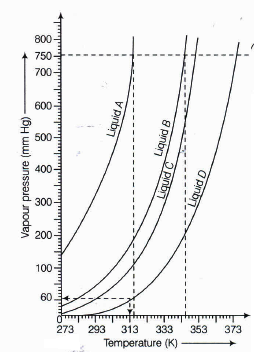
At high altitude, atmospheric pressure is low (say 60 mm Hg). At what temperature will liquid D boil?
1.
I and III, I and IV, II and III and II and IV represent chain isomerism.
a) \({ CH }_{ 3 }CO{ CH }_{ 3 }\)
b) \(H-CH={ CH }_{ 2 }\).
2.
| Alkali metals | Alkaline earth metals |
| carbonate and sulphates of Li decompose on heating while the stability of carbonates and sulphates of other metals increases down the group. | The carbonates and sulphates of alkaline earth metals decompose on heating but the temperature of their decomposition increases down the group, i.e. their thermal stability increase. |
3.
\({ H }_{ 2 }O_{ 2 }\) decomposes slowly on exposure to light and dust particles. In the presence of metal surfaces or traces of alkali present in glass containers, the traces of alkali present in glass containers, the decomposition of \({ H }_{ 2 }O_{ 2 }\) is catalysed. It is, therefore, stored in wax lined glass or plastic vessels in dark. Urea is added as a negative catalyst or stabiliser to check its decomposition.
\({ 2H }_{ 2 }O_{ 2 }(l)\overset { hv }{ \rightarrow } { 2H }_{ 2 }O(l)+{ O }_{ 2 }(g)\)
4.
In H2O, oxygen atom is sp3 hybridised with two lone pairs. The four sp3 hybridised orbitals acquire a tetrahedral geometry with two corners occupied by hydrogen atoms while other two by the lone pairs.
The bond angle is reduced to 104.5o due to greater repulsive forces between lp - lp and the molecule thus acquires a V-shape or bent structure (angular structure).

In CO2 molecule, carbon atom is sp-hybridised. The two sp hybrid are oriented in opposite direction forming an angle of 180o \(O\overset { \pi }{ = } C\overset { \pi }{ = } O\\ \quad \quad \sigma \quad \quad \sigma \)
That's why H2O molecule has bent structure whereas CO2 molecule is linear.
5.
| Group 15 | Group 16 | |
| 2nd period | N | 0 |
| 3rd period | P | S |
ionization\(({ _{ 7 }N }={ 1s }^{ 2 },{ 2s }^{ 2 },{ 2p }^{ 3 }),\) enthalpy of nitrogen is greater than oxygen \(({ _{ 8 }O }={ 1s }^{ 2 },{ 2s }^{ 2 },{ 2p }^{ 4 }),\)due to extra stable half-filled 2p-orbitals. Similarly, ionization enthalpy of phosphorus is \(({ { _{ 15 }{ P } } }={ 1s }^{ 2 },{ 2s }^{ 2 },{ 2 }p^{ 6 },{ 3s }^{ 2 },{ 3p }^{ 3 })\) greater than sulfur on\(({ { _{ 16 }{ S } } }={ 1s }^{ 2 },{ 2s }^{ 2 },{ 2 }p^{ 6 },{ 3s }^{ 2 },{ 3p }^{ 4 })\) moving down the group, ionization enthalpy decreases with increasing atomic size. so, the increasing order of first ionization enthalpy is S.
6.
We know that mass number of the element,
A = p + n = 81 .....(i)
Let the number of protons, p = x
Then, number of neutrons,
\(n=x+\frac { 31.7 }{ 100 } x=1.317x\)
(As number of neutrons are 31.7% more than the protons.)
Hence, from Eq.(i)
\(x+1.317x=81\)
or \(2.317x=81=\frac { 81 }{ 2.317 } =34.958\approx 35\)
Therefore, number of protons = 35 and the symbol is. \(_{ 35 }^{ 81 }{ Br }\) (Number of protons = atomic number)
7.
In Bohr model, an electron is regarded as a charged particle moving in well defined circular orbits about the nucleus. An orbit can completely be defined only if both the position and the velocity of the electron are known exactly at the same time. This is not possible according to the Heisenberg uncertainty principle. Further more, the wave character of the electron is not considered in Bohr model.
Therefore, concept of movement of an electron in an orbit was replaced by the concept of probability of finding electron in an orbital due to de-Broglie concept of dual nature of electron and Heisenberg's uncertainty principle. the changed model is called quantum mechanical model of the atom.
8.
Temperature corresponding to 60 mm \(\simeq \) 313 K.

11th Standard CBSE Syllabus & Materials
11th Standard CBSE
CBSE 11th Business Studies Forms of Business Organisation Sample Question Papers Study Material - QB365 Set A
NEW11th Standard CBSE
CBSE 11th Business Studies Business, Trade and Commerce Sample Question Papers Study Material - QB365 Set A
NEW11th Standard CBSE
CBSE 11th Physics Waves Sample Question Papers Study Material - QB365 Set A
NEW11th Standard CBSE
CBSE 11th Physics Kinetic Theory Sample Question Papers Study Material - QB365 Set A



NCERT Books

Syllabus

Exam Pattern

Sample Question Papers

Previous year Question Papers

Important Notes

MCQ Practice test

NCERT Exemplers

Case study Questions

Image Based Questions

Passage based Questions

HOT Questions

Value Based Questions

Model Questions Papers
NCERT ( Book Back ) Questions

Assertion and Reason
Important Questions And Answers

CBSE 11th Standard CBSE Subjects
CBSE Standards







