
 100% FREE ACCESS
11th Standard CBSE Syllabus & Materials
11th Standard CBSE
CBSE 11th Economics PART-A - Presentation of Data - New Sample Question Papers Study Material - QB365 Set A
NEW11th Standard CBSE
CBSE 11th Economics PART-A - Organisation of Data - New Sample Question Papers Study Material - QB365 Set A
NEW11th Standard CBSE
CBSE 11th Economics PART-A - Collection of Data - New Sample Question Papers Study Material - QB365 Set A
NEW11th Standard CBSE
CBSE 11th Economics PART-A - Introduction to Economics and Statistics - New Sample Question Papers Study Material - QB365 Set A
NEW11th Standard CBSE
CBSE 11th Business Studies International Trade Sample Question Papers Study Material - QB365 Set A
NEW11th Standard CBSE
CBSE 11th Business Studies Evolution and Fundamentals of Business Sample Question Papers Study Material - QB365 Set A

Published on: 26/05/2021
QB365 Provides the updated NCERT Exemplar Questions for Class
11, and also provide the detail solution for each and every NCERT
Exemplar questions. NCERT Exemplar questions are latest updated
question pattern from NCERT, QB365 will helps to get more marks in Exams
Download CBSE Class 11th Standard CBSE Chemistry question papers, sample papers, important questions, and previous year solved papers in PDF format. Get free study materials, NCERT solutions, and exam preparation resources for Class 11th Standard CBSE Chemistry
Questions + Answers key
Take MCQ Chemistry Test
1.
When an electric discharge is passed through hydrogen gas, the hydrogen molecules dissociated to produce excited hydrogen atoms. These excited atoms emit electromagnetic radiation of discrete frequencies which can be given by the general formula
\(\bar{v}=109677\left[\frac{1}{n_{i}^{2}}-\frac{1}{n_{f}^{2}}\right]\)
What points of Bohr's model of an atom can be used to arrive at this formula? Based on these points derive the above formula giving description of each step and each term.
2.
Calculate the mass of oxygen which will be liberated by the decomposition of 200mL of this solution.
3.
An ionic hydride of an alkali metal has significant covalent character and is almost unreactive towards oxygen and chlorine. This is used in the synthesis of other useful hydrides. Write its reaction with \({ Al }_{ 2 }{ Cl }_{ 6 }\)
4.
PCl5,PCl3, and Cl2 are at equilibrium at 500 k in a closed container and their concentrations are \(0.8\times { 10 }^{ -3 }\)mol L-1,\(1.2\times { 10 }^{ -3 }\)mol L-1 and \(1.2\times { 10 }^{ -3 }\) , mol L-1, respectively. Calculate the value of Kc for the reaction \({ PCl }_{ 5 }(g)\rightleftharpoons { PCl }_{ 3 }(g)+{ Cl }_{ 2 }(g)\) will be
5.
At 60°C, dinitrogen tetroxide is 50 per cent dissociated. Calculate the standard free energy change at this temperature and at one atmosphere.
6.
What is an ionic bond? With two suitable examples the difference between an ionic and a covalent bond?
7.
Write the significance/applications of dipole moment.
8.
Justify the given statement with suitable examples "the properties of the elements are a periodic function of their atomic number".
9.
Hydrogen gas is prepared in the laboratory by reacting dilute HCL with granulated zinc. Following reaction takes place.\(Zn+2HCL\rightarrow { ZnCL }_{ 2 }+{ H }_{ 2 }\)
Calculate the volume of hydrogen gas liberated at STP when 32.65 g of zinc reacts with HCL. 1 mole of a gas occupies 22.7 L volume at STP; atomic mass of Zn = 65.3\(\mu\)
1.
The two important points of Bohr's model can be used to derive the given formula are as follows.
(i) Electrons revolve around the nucleus in a circular path of fixed radius and energy. These paths are called orbits, stationary states or allowed energy states.
(ii) Energy is emitted or absorbed when an electron moves from higher stationary state to lower stationary state or from lower stationary state to higher stationary state respectively.
2.
0.2 L(or 200 mL) of 5M solution will contain
\(\frac { 340\times0.2 }{ 2 } =34g{ H }_{ 2 }{ O }_{ 2 }\)
\(\underset { 2\times 34=68g }{ { 2H }_{ 2 }O_{ 2 } } \rightarrow { 2H }_{ 2 }O+\underset { 2\times 16=32g }{ { O }_{ 2 } } \)
\(\because \ 68g \ { H }_{ 2 }O_{ 2 }\) on decomposition will give 32g\(O_{ 2 }\)
\(\therefore \ 34g \ { H }_{ 2 }O_{ 2 }\) on decomposition will give
\(\frac { 32\times 34 }{ 68 } =16g{ O }_{ 2 }\)
3.
It is LiH because it has significant covalent character due to the smallest alkali metal Li. LiH is very stable. It is almost unreactive towards oxygen and chlorine.
It reacts with \({ Al }_{ 2 }{ Cl }_{ 6 }\) to form lithium aluminium hydride.
\(8LiH+{ Al }_{ 2 }{ Cl }_{ 6 }\longrightarrow 2LiAl{ H }_{ 4 }+6LiCl\)
4.
For the reaction, \({ PCl }_{ 5 }(g)\rightleftharpoons { PCl }_{ 3 }(g)+{ Cl }_{ 2 }(g)\)
At 500 K in a closed container,
\(\left[ { PCl }_{ 5 } \right] =0.8\times { 10 }^{ -3 } \ mol \ { L }^{ -1 }\)
\( \left[ { PCl }_{ 5 } \right] =1.2\times { 10 }^{ -3 } \ mol \ { L }^{ -1 }\)
\(\left[ { Cl }_{ 2 } \right] \ =1.2\times { 10 }^{ -3 } \ mol \ { L }^{ -1 }\)
\( { K }_{ c } \ =\frac { \left[ { PCl }_{ 3 } \right] \left[ { Cl }_{ 2 } \right] }{ \left[ { { PCl }_{ 5 } } \right] }\)
\( =\frac { (1.2\times { 10 }^{ -3 })\times (1.2\times { 10 }^{ -3 }) }{ (0.8\times { 10 }^{ -3 }) } =1.8\times { 10 }^{ -3 }\)
5.
\(N_{ 2 }{ O }_{ 4 }(g)\leftrightharpoons 2NO_{ 2 }(g)\)
If N2O4 is 50% dissociated,d, the mole fraction of both the substances is given by
\(x_{ N_{ 2 }O_{ 4 } }=\frac { 1-0.5 }{ 1+0.5 } \Rightarrow x_{ NO_{ 2 } }=\frac { 2\times 0.5 }{ 1+0.5 }\)
\( p_{ N_{ 2 }O_{ 4 } }=\frac { 0.5 }{ 1.5 } \times 1atm,\ p_{ NO_{ 2 } }=\frac { 1 }{ 1.5 } \times 1atm\)
The equilibrium constant Kp is given by
\(K_{ p }=\frac { (p_{ NO_{ 2 } })^{ 2 } }{ p_{ { N }_{ 2 }{ O }_{ 4 } } } =\frac { 1.5 }{ (1.5)^{ 2 }(0.5) } =1.33atm\)
Since,
\(\Delta _{ r }G^{ \circ }=-RT \ ln \ K_{ p }\)
\( \Delta _{ r }G^{ \circ }=(-8.314 \ JK^{ - } \ mol^{ - })\times (333K)\times (2.303)\times (0.1239)\)
\( =-763.8 \ kJmol^{ -1 }\)
6.
Ionic bond The bond formed, as a result of the electrostatic between the positive and negative ions was termed as the electrovalent bond or ionic bond. e.g. the formation of NaCL from sodium and chlorine can be explained as
\(Na\longrightarrow { Na }^{ + }+{ e }^{ - }\)
\(\left[ Ne \right] { 3s }^{ 1 } \ \left[ Ne \right] \)
\(Cl \ + { e }^{ - }\longrightarrow { Cl }^{ - }\)
\(\\ \left[ Ne \right] { 3s }^{ 2 }{ 3p }^{ 5 } \left[ Ne \right] { 3s }^{ 2 }{ 3p }^{ 6 }or\left[ Ar \right] \)
\({ Na }^{ + }+{ Cl }^{ - }\longrightarrow NaCl \ or \ { Na }^{ + }{ Cl }^{ - }\)
Similarly, the formation of CaF2 may be shown as
\( Ca \longrightarrow { Ca }^{ 2+ } +{ 2e }^{ - }\)
\(\left[ Ar \right] { 4s }^{ 2 } \left[ Ar \right] \)
\(F \ +\ { e }^{ - }\longrightarrow \ { F }^{ - }\)
\(\\ \left[ He \right] { 2s }^{ 2 }2p^{ 5 } \left[ He \right] { 2s }^{ 2 }2p^{ 6 }or \ \left[ Ne \right] \)
\({ Ca }^{ 2+ }+{ 2F }^{ - }\longrightarrow Ca{ F }_{ 2 } \ or \ { Ca }^{ 2+ }{ 2F }^{ - } \)
Covalent bond The bond formed between the two atoms by mutual sharing of electrons between them is called covalent bond. e.g. the formation of chlorine molecules can be explained
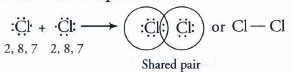
Similarly, in the formation of HCl

7.
The applications of dipole moment are
(a) The dipole moment helps to predict whether a molecule is polar or non-polar. As μ = q × d greater is the magnitude of dipole moment, higher will be the polarity of the bond. For non-polar molecules, the dipole moment is zero.
(b) The percentage of ionic character can be calculated as Percentage of ionic character \(=\frac { { \mu }_{ observed } }{ { \mu }_{ ionic } } \times 100\)
(c) Symmetrical molecules have zero dipole moment although they have two or more polar bonds.
(d) It helps to distinguish between cis and trans-isomers. Usually cis-isomer has higher dipole moment than trans-isomer.
(e) It helps to distinguish between ortho, meta and para-isomers. Dipole moment of para-isomer is zero. Dipole moment of ortho-isomer is greater than that of.
8.
There are numerous physical properties of elements such as melting points, boiling points, heats of fusion and vaporisation, energy of atomisation, etc., which show periodic variations. The cause of periodicity in properties is the repetition of similar outer electronic configuration after certain regular intervals. e.g. all the elements of 1s group (alkali metals) have similar outer electronic configuration, i.e. ns1.
3Li = 1s2, 2s1
11Na = 1s2, 2s2, 2p6 , 3s1
19K = 1s2, 2s2, 2p6 , 3s2, 3p6, 4s1
Therefore, due to similar outermost shell electronic configuration all alkali metals have similar properties. e.g., sodium and potassium both are soft and reactive metals. They all form basic oxides and their basic character increases down the group. They all form unipositive ion by the loss of one electron. Similarly, all the elements of 17th group (halogens) have similar outermost shell electronic configuration, i.e. ns2 np5 and thus possess similar properties.
9F = 1s2, 2s1 , 2p5
17Cl = 1s2, 2s2, 2p6 , 3s2 , 3p5
35Br = 1s2, 2s2, 2p6 , 3s2, 3p6, 3d10, 4s2 , 4p5
9.
Given that, mass of Zn = 32.65 g
1 mole of gas occupies =22.7 L volume at STP
Atomic mass of Zn = 65.3\(\mu\)
The given equation is
\(\underset { 65.3 \ g }{ Zn } +2HCL\rightarrow { ZnCL }_{ 2 }+\underset { 1mol=22.7 \ L \ at \ STP }{ H_{ 2 } } \)
From the above equation, it is clear that 65.3 gZn, when reacts with HCL, produces = 22.7 of \(H_{ 2 }\) at STP
\(\therefore\) 32.65 g Zn, when reacts with HCL, will produce
\(=\frac { 22.7\times 32.65 }{ 65.3 } =11.35 \ L \ of \ { H }_{ 2 } \ at \ STP\)

11th Standard CBSE Syllabus & Materials
11th Standard CBSE
CBSE 11th Business Studies Forms of Business Organisation Sample Question Papers Study Material - QB365 Set A
NEW11th Standard CBSE
CBSE 11th Business Studies Business, Trade and Commerce Sample Question Papers Study Material - QB365 Set A
NEW11th Standard CBSE
CBSE 11th Physics Waves Sample Question Papers Study Material - QB365 Set A
NEW11th Standard CBSE
CBSE 11th Physics Kinetic Theory Sample Question Papers Study Material - QB365 Set A



NCERT Books

Syllabus

Exam Pattern

Sample Question Papers

Previous year Question Papers

Important Notes

MCQ Practice test

NCERT Exemplers

Case study Questions

Image Based Questions

Passage based Questions

HOT Questions

Value Based Questions

Model Questions Papers
NCERT ( Book Back ) Questions

Assertion and Reason
Important Questions And Answers

CBSE 11th Standard CBSE Subjects
CBSE Standards







