
 100% FREE ACCESS
11th Standard CBSE Syllabus & Materials
11th Standard CBSE
CBSE 11th Economics PART-A - Presentation of Data - New Sample Question Papers Study Material - QB365 Set A
NEW11th Standard CBSE
CBSE 11th Economics PART-A - Organisation of Data - New Sample Question Papers Study Material - QB365 Set A
NEW11th Standard CBSE
CBSE 11th Economics PART-A - Collection of Data - New Sample Question Papers Study Material - QB365 Set A
NEW11th Standard CBSE
CBSE 11th Economics PART-A - Introduction to Economics and Statistics - New Sample Question Papers Study Material - QB365 Set A
NEW11th Standard CBSE
CBSE 11th Business Studies International Trade Sample Question Papers Study Material - QB365 Set A
NEW11th Standard CBSE
CBSE 11th Business Studies Evolution and Fundamentals of Business Sample Question Papers Study Material - QB365 Set A

Published on: 26/05/2021
QB365 Provides the updated NCERT Exemplar Questions for Class
11, and also provide the detail solution for each and every NCERT
Exemplar questions. NCERT Exemplar questions are latest updated
question pattern from NCERT, QB365 will helps to get more marks in Exams
Download CBSE Class 11th Standard CBSE Chemistry question papers, sample papers, important questions, and previous year solved papers in PDF format. Get free study materials, NCERT solutions, and exam preparation resources for Class 11th Standard CBSE Chemistry
Questions + Answers key
Take MCQ Chemistry Test
1.
Pay load is defined as the difference between the mass of the displaced air and the mass of the balloon. Calculate the pay load when a balloon of radius 10 m, mass 100 kg is filled with helium at 1.66 bar at 27oC (Density of air = 1.2 kg m-3 and R = 0.083 bar dm3 K-1 mol-1).
2.
How can you apply green chemistry for the following?
(i) To control photochemical smog
(ii) To avoid use of halogenated solvents in dry
(iii) To reduce use of synthetic detergents
(iv) To reduce the consumption of petrol and diesel
3.
A colourless liquid A contains H and O elements only. It decomposes slowly one exposure to light. It is stabilised by mixing urea to store in the presence of light.
(i) Suggest possible structure of A
(ii) Write chemical equations for its decomposition reaction in the light.
4.
Identify the redox reaction out of the following reactions and identify the oxidising and reducing in them.
(i) 3HCl(aq) + HNO3(aq) \(\longrightarrow \) Cl2(g) +NOCl(g) + 2H2O(l)
(ii) \({ Hgcl }_{ 2 }(aq)+2KI(aq)\longrightarrow { HgI }_{ 2 }(s)+{ 2KCl(aq) }\)
(iii) Fe2O3 (s) + 3CO(g) \(\overset { \Delta }{ \longrightarrow } \)2Fe(s) +3CO2(g)
(iv) PCl3(l)+3H2O(l)⟶3HCl(aq)+H2PO3(aq)
(v) 4NH3(aq) + 3O2(g) \(\longrightarrow \) 2N2(g) + 6H2O(g)
5.
For the equilibrium, \(2NOCl\left( g \right) \rightleftharpoons 2NO\left( g \right) +{ Cl }_{ 2 }\left( g \right) \) the value of the equilibrium constant, Kc is 3.75 × 10⁻⁶ at 1069 K. Calculate the Kp for the reaction at this temperature?
6.
PCl5,PCl3, and Cl2 are at equilibrium at 500 k in a closed container and their concentrations are \(0.8\times { 10 }^{ -3 }\)mol L-1,\(1.2\times { 10 }^{ -3 }\)mol L-1 and \(1.2\times { 10 }^{ -3 }\) , mol L-1, respectively. Calculate the value of Kc for the reaction \({ PCl }_{ 5 }(g)\rightleftharpoons { PCl }_{ 3 }(g)+{ Cl }_{ 2 }(g)\) will be
7.
Represent diagrammatically the bond moments and the resultant dipole moment in CO2, NF and CHCL3.
8.
Write the significance/applications of dipole moment.
9.
In p-block elements form acidic, basic and amphoteric oxides. Explain each property by giving two examples and also write the reactions of these oxides with water.
10.
Hydrogen gas is prepared in the laboratory by reacting dilute HCL with granulated zinc. Following reaction takes place.\(Zn+2HCL\rightarrow { ZnCL }_{ 2 }+{ H }_{ 2 }\)
Calculate the volume of hydrogen gas liberated at STP when 32.65 g of zinc reacts with HCL. 1 mole of a gas occupies 22.7 L volume at STP; atomic mass of Zn = 65.3\(\mu\)
1.
Radius of the balloon = 10 m
\(\therefore\)Volume of the balloon = \(\frac{4}{3}\pi\)r2 = \(\frac{4}{3}\times\frac{22}{7}\times\)(10m)3 = 4190.5 m3
Volume of He filled at 1.66 bar and 27°C = 4190.5 m3
Calculation of mass of He
PV = nRT = \(\frac { w }{ M } \)RT
or \(w\) = \(\frac{MPV}{RT}\) = \(\frac { (4\times { 10 }^{ -3 }kgmol^{ -1 })(1.66bar)(4190.5\times 103dm^{ 3 }) }{ (0.083bardm^{ 3 }K^{ -1 }mol^{ -1 })(300K) } \)
= 1117.5 kg
Total mass of the balloon along with He = 100 + 1117.5 = 1217.5 kg
Maximum mass of the air that can be displaced by balloon to go up = Volume x Density
= 4190.5 m3 x 1.2 kg m-3 = 5028.6 kg
\(\therefore\) Pay load = 5028.6 - 1217.5 kg = 3811.1 kg
2.
(i) Certain plants, e.g. Pinus, Juniparus, Quercus, Pyrus and Vitis can metabolise nitrogen oxide (NO) and therefore, their plantation could help in reducing photochemical smog.
(ii) Liquefied CO2 with a suitable detergent is used for dry cleaning and H2O2 is used for the better results and makes use of lesser amount of water.
(iii) Soaps are 100% biodegradable so they should be used in place of detergents. Now-a-days biodegradable detergents are available. Therefore, they should be used in place of non-biodegradable hard detergents.
(iv) CNG should be used as it causes much less pollution. Moreover, electrical vehicles should be used to reduce the consumption of petrol and diesel
3.
Since, a colourless liquid A contains only H and O and decomposes slowly on exposure to light but is stabilised by additions of urea, therefore, liquid A may be hydrogen peroxide.
(ii) \(2{ H }_{ 2 }{ O }_{ 2 }\left( l \right) \underrightarrow { hv } 2{ H }_{ 2 }O\left( l \right) +{ O }_{ 2 }\left( g \right) \)
4.
(a) Writing the On on each atom above its symbol, then
\(3\overset { +1 }{ H } \overset { -1 }{ Cl } (aq)+\overset { +1 }{ H } \overset { +5 }{ N } \overset { -2 }{ { O }_{ 3 } } (aq)\longrightarrow \overset { 0 }{ { Cl }_{ 2 }(g)+ } \overset { +3 }{ N } \overset { -2 }{ O } \overset { -1 }{ Cl(g)+ } \overset { +1 }{ { 2H }_{ 2 } } \overset { -2 }{ O } (l)\)
Here, the On of Cl increases from -1 in HCl to O in Cl2 , therefore, Cl- is oxidised and hence, HCl acts as the reducing agent. The ON of N decreases from +5 in HNO3 to +3 in NOCL, therefore, HNO3 acts as the oxidising agent. Thus this reaction is a redox reaction.
(b) Writing the ON of each atom above its symbol, we have,
\(\overset { +2 }{ Hg } \overset { -1 }{ { Cl }_{ 2 } } (aq)+\overset { +1 }{ 2K } \overset { -1 }{ I } (aq)\longrightarrow \overset { +2 }{ Hg } { \overset { -1 }{ I } }_{ 2 }(s)+2\overset { +1 }{ K } \overset { -1 }{ { Cl }^{ - }(aq) } \)
Here, the On of none of the atoms undergo a change, therefore, this reaction is not a redox reaction.
(c) \(\overset { +3 }{ { Fe }_{ 2 } } { \overset { -2 }{ O } }_{ 3 }(s)+3\overset { +2 }{ C } \overset { -2 }{ O } (g)\ \overset { \Delta }{ \longrightarrow } \ 2\overset { 0 }{ Fe } (s)+3\overset { +4 }{ C } \overset { -2 }{ { O }_{ 2 } } (g)\)
Here, On of decreases from +3 in Fe2O3 to 0 in Fe, therefore, Fe2O3 acts as an oxidising agent. Further, On of C increases from +2 in CO to +4 in CO2, therefore, CO acts as a reducing agent. Thus, this reaction is an example of redox reaction.
(d) Writing the ON of each atom above its symbol, then
\(\overset { +3 }{ P } { \overset { -1 }{ Cl } }_{ 3 }(l)+3\overset { +1 }{ { H }_{ 2 } } \overset { -2 }{ O } (l)\quad \longrightarrow \quad 3\overset { +1 }{ H } \overset { -1 }{ Cl } (aq)+\overset { +1 }{ { H }_{ 3 } } \overset { +3 }{ P } \overset { -2 }{ { O }_{ 3 } } (aq)\)
Here, On of none of the atoms undergo a change, therefore, this reaction is not a redox reaction.
(e) Writing the ON of each atom above its symbol, then
\(4\overset { -3 }{ N } \overset { +1 }{ { H }_{ 3 } } (aq)+3\overset { 0 }{ { O }_{ 2 } } (g)\quad \longrightarrow \quad 2\overset { 0 }{ { N }_{ 2 } } (g)+6\overset { +1 }{ { H }_{ 2 } } \overset { -2 }{ O } (l)\)
5.
We know that, \({ K }_{ p }={ K }_{ c }{ \left( RT \right) }^{ \triangle ng }\)
For the above reaction,
\(\triangle ng=\left( 2+1 \right) -2=1\)
\({ K }_{ p }=3.75\times { 10 }^{ -6 }\left( 0.0831\times 1069 \right) \)
Kp = 0.033
6.
For the reaction, \({ PCl }_{ 5 }(g)\rightleftharpoons { PCl }_{ 3 }(g)+{ Cl }_{ 2 }(g)\)
At 500 K in a closed container,
\(\left[ { PCl }_{ 5 } \right] =0.8\times { 10 }^{ -3 } \ mol \ { L }^{ -1 }\)
\( \left[ { PCl }_{ 5 } \right] =1.2\times { 10 }^{ -3 } \ mol \ { L }^{ -1 }\)
\(\left[ { Cl }_{ 2 } \right] \ =1.2\times { 10 }^{ -3 } \ mol \ { L }^{ -1 }\)
\( { K }_{ c } \ =\frac { \left[ { PCl }_{ 3 } \right] \left[ { Cl }_{ 2 } \right] }{ \left[ { { PCl }_{ 5 } } \right] }\)
\( =\frac { (1.2\times { 10 }^{ -3 })\times (1.2\times { 10 }^{ -3 }) }{ (0.8\times { 10 }^{ -3 }) } =1.8\times { 10 }^{ -3 }\)
7.
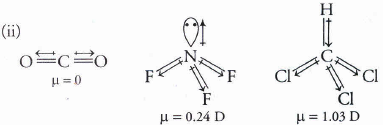
8.
The applications of dipole moment are
(a) The dipole moment helps to predict whether a molecule is polar or non-polar. As μ = q × d greater is the magnitude of dipole moment, higher will be the polarity of the bond. For non-polar molecules, the dipole moment is zero.
(b) The percentage of ionic character can be calculated as Percentage of ionic character \(=\frac { { \mu }_{ observed } }{ { \mu }_{ ionic } } \times 100\)
(c) Symmetrical molecules have zero dipole moment although they have two or more polar bonds.
(d) It helps to distinguish between cis and trans-isomers. Usually cis-isomer has higher dipole moment than trans-isomer.
(e) It helps to distinguish between ortho, meta and para-isomers. Dipole moment of para-isomer is zero. Dipole moment of ortho-isomer is greater than that of.
9.
In p -block, when we move from left to right in a period, the acidic character of the oxides increases due to increase in electronegativity. e.g.
( i ) 2nd period
B2O3 < CO2 < N2O3 acidic character increases.
( ii ) 3rd period
Al2O3 < SiO2 < P4O10 < SO3 < Cl2O7 acidic character increases.
on moving down the group, acidic character decreases and basic character increaseas.e.g.
(a) Nature of oxides of 13 group elements
| B2O3 | \(\underbrace { { Al }_{ 2 }{ O }_{ 3 } \ { Ga }_{ 2 }{ O }_{ 3 } } \) | In2 O3 | Tl2O |
| Weakly acidic | Amphoteric | Basic | Strongly basic |
Nature of oxides of 15 group elements
N2O5 P4O10 As4O10 Sb4O10 Bi2O3
Strongly acidic Moderately acidic Amphoteric Amphoteric Basic
Among the oxides of same element, higher the oxidation state of the element, stronger is the acid. e.g. SO3 is a stronger is the acid than SO2.
B2O3 is weakly acidic and on dissolution in water, ti forms orthoboric acid. Orthoboric acid does not act as a protonic acid ( it does not ionise ) but acts as a weak Lewis acid.
B2O3 + 3H2O \(\rightleftharpoons\) 2H3BO3
Boron trioxide Orthoboric acid
B ( OH )3 + H-----OH \(\longrightarrow\) [ B ( OH )4 ]- + H+
Al2O3 is amphoteric in nature. It is insoluble in water bur dissolves in alkalies and react with acids.
Al2O3 + 2NaOH \(\overset { \triangle }{ \longrightarrow } \) 2NaAlO2 + H2O
Aluminiun trioxide Sodium meta ailuminate
Al2O3 + 6HCl \(\overset { \triangle }{ \longrightarrow }\) 2AlCl3 + 3H2O
Aluminium chloride
Tl2O is as basic as NaOH due to its lower oxidation state ( +1 )
Tl2O + 2HCl \(\longrightarrow \) 2TlCl + H2O
P4O10 on reaction with water gives orthophosphoric acid.
P4O10 + 6H2O \(\longrightarrow\) 4H3PO4
Phosphorus pentaxide Orthophosphoric acid
Cl2O7 is strongly acidic in nature and on dissolution in water, it gives perchloric acid.
Cl2O7 + H2O \(\longrightarrow\) 2HClO4
Dichlorine heptoxide Perchloric acid
10.
Given that, mass of Zn = 32.65 g
1 mole of gas occupies =22.7 L volume at STP
Atomic mass of Zn = 65.3\(\mu\)
The given equation is
\(\underset { 65.3 \ g }{ Zn } +2HCL\rightarrow { ZnCL }_{ 2 }+\underset { 1mol=22.7 \ L \ at \ STP }{ H_{ 2 } } \)
From the above equation, it is clear that 65.3 gZn, when reacts with HCL, produces = 22.7 of \(H_{ 2 }\) at STP
\(\therefore\) 32.65 g Zn, when reacts with HCL, will produce
\(=\frac { 22.7\times 32.65 }{ 65.3 } =11.35 \ L \ of \ { H }_{ 2 } \ at \ STP\)

11th Standard CBSE Syllabus & Materials
11th Standard CBSE
CBSE 11th Business Studies Forms of Business Organisation Sample Question Papers Study Material - QB365 Set A
NEW11th Standard CBSE
CBSE 11th Business Studies Business, Trade and Commerce Sample Question Papers Study Material - QB365 Set A
NEW11th Standard CBSE
CBSE 11th Physics Waves Sample Question Papers Study Material - QB365 Set A
NEW11th Standard CBSE
CBSE 11th Physics Kinetic Theory Sample Question Papers Study Material - QB365 Set A



NCERT Books

Syllabus

Exam Pattern

Sample Question Papers

Previous year Question Papers

Important Notes

MCQ Practice test

NCERT Exemplers

Case study Questions

Image Based Questions

Passage based Questions

HOT Questions

Value Based Questions

Model Questions Papers
NCERT ( Book Back ) Questions

Assertion and Reason
Important Questions And Answers

CBSE 11th Standard CBSE Subjects
CBSE Standards







