
 100% FREE ACCESS
11th Standard CBSE Syllabus & Materials
11th Standard CBSE
CBSE 11th Economics PART-A - Presentation of Data - New Sample Question Papers Study Material - QB365 Set A
NEW11th Standard CBSE
CBSE 11th Economics PART-A - Organisation of Data - New Sample Question Papers Study Material - QB365 Set A
NEW11th Standard CBSE
CBSE 11th Economics PART-A - Collection of Data - New Sample Question Papers Study Material - QB365 Set A
NEW11th Standard CBSE
CBSE 11th Economics PART-A - Introduction to Economics and Statistics - New Sample Question Papers Study Material - QB365 Set A
NEW11th Standard CBSE
CBSE 11th Business Studies International Trade Sample Question Papers Study Material - QB365 Set A
NEW11th Standard CBSE
CBSE 11th Business Studies Evolution and Fundamentals of Business Sample Question Papers Study Material - QB365 Set A

Published on: 26/05/2021
QB365 Provides the updated NCERT Exemplar Questions for Class
11, and also provide the detail solution for each and every NCERT
Exemplar questions. NCERT Exemplar questions are latest updated
question pattern from NCERT, QB365 will helps to get more marks in Exams
Download CBSE Class 11th Standard CBSE Chemistry question papers, sample papers, important questions, and previous year solved papers in PDF format. Get free study materials, NCERT solutions, and exam preparation resources for Class 11th Standard CBSE Chemistry
Questions + Answers key
Take MCQ Chemistry Test
1.
Pay load is defined as the difference between the mass of the displaced air and the mass of the balloon. Calculate the pay load when a balloon of radius 10 m, mass 100 kg is filled with helium at 1.66 bar at 27oC (Density of air = 1.2 kg m-3 and R = 0.083 bar dm3 K-1 mol-1).
2.
What are the allotropes? Sketch the structure of two allotropes of carbon namely diamond and graphite.What is the impact of structure on physical properties of two allotropes?
3.
What mass of hydrogen peroxide will be present in 2L of a 5M solution?
4.
A sparingly soluble salt gets precipitated only when the product of concentration of its ions in the solution (Qsp ) becomes greater than its solubility product. If the solubility of BaSO4 in water is 8 x 10⁻⁴ mol dm-3 . Calculate its solubility in 0.01 mol dm-3 of H2SO4 .
5.
Enthalpy is an extensive property. In general, if enthalpy of an overall reaction A\(\rightarrow \) B along one route is \(\Delta _{ r }H \ and \ \Delta _{ r }H_{ 1 },\Delta _{ r }H_{ 2 },\Delta _{ r }H_{ 3 }....\)represent enthalpies of intermediate reactions leading to product B. What will be the relation between \(\Delta _{ r }H\) overall reaction and \(\Delta _{ r }H_{ 1 },\Delta _{ r }H_{ 2 }\) .....etc., for intermediate reactions.
6.
At 60°C, dinitrogen tetroxide is 50 per cent dissociated. Calculate the standard free energy change at this temperature and at one atmosphere.
7.
What is an ionic bond? With two suitable examples the difference between an ionic and a covalent bond?
8.
Write the significance/applications of dipole moment.
9.
Write down the outermost electronic configurations of alkali metals. How will you justify their placement in group 1 of the periodic table?
1.
Radius of the balloon = 10 m
\(\therefore\)Volume of the balloon = \(\frac{4}{3}\pi\)r2 = \(\frac{4}{3}\times\frac{22}{7}\times\)(10m)3 = 4190.5 m3
Volume of He filled at 1.66 bar and 27°C = 4190.5 m3
Calculation of mass of He
PV = nRT = \(\frac { w }{ M } \)RT
or \(w\) = \(\frac{MPV}{RT}\) = \(\frac { (4\times { 10 }^{ -3 }kgmol^{ -1 })(1.66bar)(4190.5\times 103dm^{ 3 }) }{ (0.083bardm^{ 3 }K^{ -1 }mol^{ -1 })(300K) } \)
= 1117.5 kg
Total mass of the balloon along with He = 100 + 1117.5 = 1217.5 kg
Maximum mass of the air that can be displaced by balloon to go up = Volume x Density
= 4190.5 m3 x 1.2 kg m-3 = 5028.6 kg
\(\therefore\) Pay load = 5028.6 - 1217.5 kg = 3811.1 kg
2.
The phenomenon of existence of an element in two or more forms which differ in physical properties but have almost same chemical nature is known as allotropy and the different forms of the element are known as allotropes.
3.
Molar mass of \({ H }_{ 2 }{ O }_{ 2 }=34 \ gmol^{ -1 }\)
1L of 5M solution of \({ H }_{ 2 }O_{ 2 }\)will contain 34 x 5g \({ H }_{ 2 }O_{ 2 }\)
2L of 5M solution of \({ H }_{ 2 }O_{ 2 }\)will contain 34 x 5 x 2 = 340g \({ H }_{ 2 }O_{ 2 }\)
Mass of \({ H }_{ 2 }O_{ 2 }\)present in 2L of 5 molar solution = 340g
4.
\(BaS{ O }_{ 4 }(S) \ \leftrightharpoons \ { Ba }^{ 2+ }(aq)+{ SO }_{ 4 }^{ 2- }(aq)\)
\({ K }_{ sp } \ for \ BaS{ O }_{ 4 }=\left[ { Ba }^{ 2+ } \right] \left[ { SO }_{ 4 }^{ 2- } \right] =S\times S={ S }^{ 2 }\)
\( But \ S=8\times { 10 }^{ -4 }mol \ { dm }^{ -3 }\)
\(\therefore { K }_{ sp }={ \left( 8\times { 10 }^{ -4 } \right) }^{ 2 }=64\times { 10 }^{ -8 }\)
In the presence of 0.001 MH2SO4 , the expression for Ksp will be
\({ K }_{ sp }=\left[ { Ba }^{ 2+ } \right] \left[ { SO }_{ 4 }^{ 2- } \right]\)
\( { K }_{ sp }=(S).(S+0.01)\)
\((0.01 \ M \ { SO }_{ 4 }^{ 2- } \ Iions \ from \ 0.01 \ M \ { H }_{ 2 }{ SO }_{ 4 })\)
\(\Rightarrow \ 64\times { 10 }^{ -8 }=S.(S+0.01)\)
\(\Rightarrow { S }^{ 2 }+0.01S-64\times { 10 }^{ -8 }=0\)
\(\therefore \ S=\frac { -0.01\pm \sqrt { { \left( 0.01 \right) }^{ 2 }+{ \left( 4\times 64\times { 10 }^{ -8 } \right) } } }{ 2 }\)
\(=\frac { -0.01\pm \sqrt { { 10 }^{ -4 }+{ \left( 256\times { 10 }^{ -8 } \right) } } }{ 2 }\)
\( =\frac { -0.01\pm \sqrt { { 10 }^{ -4 }+{ \left( 1+256\times { 10 }^{ -4 } \right) } } }{ 2 } \)
\(=\frac { -0.01\pm { 10 }^{ -2 }\sqrt { 1+0.0256 } }{ 2 } =\frac { { 10 }^{ -2 }(-1\pm 1.012719) }{ 2 } \)
\( =5\times { 10 }^{ -3 }(-1+1.012719)=6.4\times \ mol \ { dm }^{ -3 }\)
5.
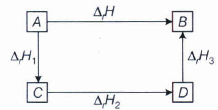
In general, if enthalpy of an overall reaction A\(\rightarrow \) B along one route is \(\Delta _{ r }H \ and \ \Delta _{ r }H_{ 1 },\Delta _{ r }H_{ 2 },\Delta _{ r }H_{ 3 }....\) representing enthalpies of reactions leading to same product B along another route, then we have
\(\Delta _{ r }H=\Delta _{ r }H_{ 1 }+\Delta _{ r }H_{ 2 }+\Delta _{ r }H_{ 3 }+....\)
Note
For a general reaction Hess's law of constant heat summation can be represented as
6.
\(N_{ 2 }{ O }_{ 4 }(g)\leftrightharpoons 2NO_{ 2 }(g)\)
If N2O4 is 50% dissociated,d, the mole fraction of both the substances is given by
\(x_{ N_{ 2 }O_{ 4 } }=\frac { 1-0.5 }{ 1+0.5 } \Rightarrow x_{ NO_{ 2 } }=\frac { 2\times 0.5 }{ 1+0.5 }\)
\( p_{ N_{ 2 }O_{ 4 } }=\frac { 0.5 }{ 1.5 } \times 1atm,\ p_{ NO_{ 2 } }=\frac { 1 }{ 1.5 } \times 1atm\)
The equilibrium constant Kp is given by
\(K_{ p }=\frac { (p_{ NO_{ 2 } })^{ 2 } }{ p_{ { N }_{ 2 }{ O }_{ 4 } } } =\frac { 1.5 }{ (1.5)^{ 2 }(0.5) } =1.33atm\)
Since,
\(\Delta _{ r }G^{ \circ }=-RT \ ln \ K_{ p }\)
\( \Delta _{ r }G^{ \circ }=(-8.314 \ JK^{ - } \ mol^{ - })\times (333K)\times (2.303)\times (0.1239)\)
\( =-763.8 \ kJmol^{ -1 }\)
7.
Ionic bond The bond formed, as a result of the electrostatic between the positive and negative ions was termed as the electrovalent bond or ionic bond. e.g. the formation of NaCL from sodium and chlorine can be explained as
\(Na\longrightarrow { Na }^{ + }+{ e }^{ - }\)
\(\left[ Ne \right] { 3s }^{ 1 } \ \left[ Ne \right] \)
\(Cl \ + { e }^{ - }\longrightarrow { Cl }^{ - }\)
\(\\ \left[ Ne \right] { 3s }^{ 2 }{ 3p }^{ 5 } \left[ Ne \right] { 3s }^{ 2 }{ 3p }^{ 6 }or\left[ Ar \right] \)
\({ Na }^{ + }+{ Cl }^{ - }\longrightarrow NaCl \ or \ { Na }^{ + }{ Cl }^{ - }\)
Similarly, the formation of CaF2 may be shown as
\( Ca \longrightarrow { Ca }^{ 2+ } +{ 2e }^{ - }\)
\(\left[ Ar \right] { 4s }^{ 2 } \left[ Ar \right] \)
\(F \ +\ { e }^{ - }\longrightarrow \ { F }^{ - }\)
\(\\ \left[ He \right] { 2s }^{ 2 }2p^{ 5 } \left[ He \right] { 2s }^{ 2 }2p^{ 6 }or \ \left[ Ne \right] \)
\({ Ca }^{ 2+ }+{ 2F }^{ - }\longrightarrow Ca{ F }_{ 2 } \ or \ { Ca }^{ 2+ }{ 2F }^{ - } \)
Covalent bond The bond formed between the two atoms by mutual sharing of electrons between them is called covalent bond. e.g. the formation of chlorine molecules can be explained
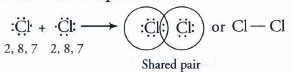
Similarly, in the formation of HCl

8.
The applications of dipole moment are
(a) The dipole moment helps to predict whether a molecule is polar or non-polar. As μ = q × d greater is the magnitude of dipole moment, higher will be the polarity of the bond. For non-polar molecules, the dipole moment is zero.
(b) The percentage of ionic character can be calculated as Percentage of ionic character \(=\frac { { \mu }_{ observed } }{ { \mu }_{ ionic } } \times 100\)
(c) Symmetrical molecules have zero dipole moment although they have two or more polar bonds.
(d) It helps to distinguish between cis and trans-isomers. Usually cis-isomer has higher dipole moment than trans-isomer.
(e) It helps to distinguish between ortho, meta and para-isomers. Dipole moment of para-isomer is zero. Dipole moment of ortho-isomer is greater than that of.
9.
All the elements of group IA (or I) i.e. alkali metals have the similar outer electronic configuration i.e. ns1 where n refers to the number of principle shells. Their electronic configurations are given below.
| Atomic Number | Symbol | Electronic configuration |
| 3 | Li | 1s22s1 (or) [He]2s1 |
| 11 | Na | 1s22s22p63s1 (or) [Na]3s1 |
| 19 | K | 1s22s22p63s23p64s1 (or) [Ar]4s1 |
| 37 | Rb | 1s22s22p63s23p64s23d104p65s1 (or) [Kr]5s1 |
| 55 | Cs | 1s22s22p63s23p63d104s24p64d105s25p66s1or [Xe] 6s1 |
| 87 | Fr | [Rn]7s1 |
Hence, placement of all these elements of group 1 of the periodic table because of similarity in electronic configuration and all the elements have similar properties. Thus, it is also evident that the physical and chemical properties of the elements depend on their atomic number and not on their atomic mass.
Thus, it is also evident that the physical and chemical properties of the elements depend on their atomic number and not in their atomic mass.

11th Standard CBSE Syllabus & Materials
11th Standard CBSE
CBSE 11th Business Studies Forms of Business Organisation Sample Question Papers Study Material - QB365 Set A
NEW11th Standard CBSE
CBSE 11th Business Studies Business, Trade and Commerce Sample Question Papers Study Material - QB365 Set A
NEW11th Standard CBSE
CBSE 11th Physics Waves Sample Question Papers Study Material - QB365 Set A
NEW11th Standard CBSE
CBSE 11th Physics Kinetic Theory Sample Question Papers Study Material - QB365 Set A



NCERT Books

Syllabus

Exam Pattern

Sample Question Papers

Previous year Question Papers

Important Notes

MCQ Practice test

NCERT Exemplers

Case study Questions

Image Based Questions

Passage based Questions

HOT Questions

Value Based Questions

Model Questions Papers
NCERT ( Book Back ) Questions

Assertion and Reason
Important Questions And Answers

CBSE 11th Standard CBSE Subjects
CBSE Standards







