
 100% FREE ACCESS
11th Standard CBSE Syllabus & Materials
11th Standard CBSE
CBSE 11th Economics PART-A - Presentation of Data - New Sample Question Papers Study Material - QB365 Set A
NEW11th Standard CBSE
CBSE 11th Economics PART-A - Organisation of Data - New Sample Question Papers Study Material - QB365 Set A
NEW11th Standard CBSE
CBSE 11th Economics PART-A - Collection of Data - New Sample Question Papers Study Material - QB365 Set A
NEW11th Standard CBSE
CBSE 11th Economics PART-A - Introduction to Economics and Statistics - New Sample Question Papers Study Material - QB365 Set A
NEW11th Standard CBSE
CBSE 11th Business Studies International Trade Sample Question Papers Study Material - QB365 Set A
NEW11th Standard CBSE
CBSE 11th Business Studies Evolution and Fundamentals of Business Sample Question Papers Study Material - QB365 Set A

Published on: 27/05/2021
QB365 Provides the updated NCERT Exemplar Questions for Class
11, and also provide the detail solution for each and every NCERT
Exemplar questions. NCERT Exemplar questions are latest updated
question pattern from NCERT, QB365 will helps to get more marks in Exams
Download CBSE Class 11th Standard CBSE Chemistry question papers, sample papers, important questions, and previous year solved papers in PDF format. Get free study materials, NCERT solutions, and exam preparation resources for Class 11th Standard CBSE Chemistry
Questions + Answers key
Take MCQ Chemistry Test
1.
The values of the van der Waal's constants for a gas are a = 4.10 dm6 bar mol-2 and b = 0.035 dm3 mol-1. Calculate the values of the critical temperature and critical pressure for the gas.
2.
A vessel of 120 mL capacity contains a certain amount of gas at 35°C and 1.2 bar pressure. The gas is transferred to another vessel of volume 180 mL at 35°C. What would be its pressure?
3.
Explain the term 'Laminar flow'. Is the velocity of molecules same in all the layers in laminar flow? Explain your answer.
4.
Calculate the total pressure in a mixture of 8 g of dioxygen and 4 g of dihydrogen confined in a vessel of 1 dm3 at 27\(^{o}\)C. (R = 0.083 bar dm3 K-1 mol-1)
5.
The variation of the vapour pressure of different liquids with temperature is shown in the figure below.
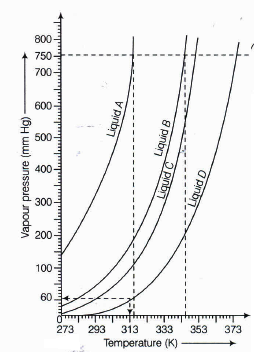
If we take liquid C in a closed vessel and heat it continuously, at what temperature will it boil?
1.
(i) Calculation of critical temperature (Tc)
a = 4.10 dm6 bar mol-1
b = 0.035 dm3 mol-1
R = 0.0821 dm3 bar mol-1 K-1.
Now, critical temperature, Tc = \(\frac{8a}{27Rb}\)
Substituting the values, Tc = \(\frac{8\times4.10}{27\times0.0821\times0.035}\)
(ii) Calculation of critical pressure (Pc)
Pc\(\frac{a}{27b^2}\) = \(\frac{4.10}{27\times0.0821\times0.035}\) = 123.96 bar
2.
Given,
Initial pressure, p1 = 1.2 bar
Initial volume, V1 = 120 mL
Final volume, V2 = 180 mL
Since the temperature remains constant, the final pressure (p2) can be calculated using Boyle’s law.
According to Boyle’s law,
\( p_{1} V_{1}=p_{2} V_{2} \)
\(p_{2}=\frac{p_{1} V_{1}}{V_{2}} \)
\(=\frac{1.2 \times 120}{180} \mathrm{bar} \)
\(=0.8 \mathrm{bar} \)
Therefore, the pressure would be 0.8 bar.
3.
When a liquid flows over a fixed surface, the layer of molecules in the immediate contact of surface is stationary. The velocity of the upper layers increases as the distance of layers from the fixed layer increases. This type of flow in which there is a regular gradation of velocity in passing from one layer to the next is called laminar flow.
In laminar flow, the velocity of molecules is not same in all the layers because every layers offers some resistance or friction to the layer immediately below it.
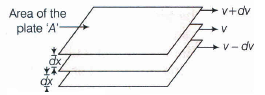
Graduation of velocity in the laminar flow.
4.
Moles of O2, nO2 = \(\cfrac{mass}{mol.wt.}=\cfrac{8}{32}=0.25mol\)
[mol.wt. of O2 = 16\(\times\)2 = 32]
Moles of H2, nH2 = \(\cfrac{4}{2}=2.0mol\)
[mol.wt. of H2 = 1 \(\times\)2 = 2 ]
Total number of moles = 0.25 + 2.0 = 2.25mol
Pressure, p = \(\cfrac{nRT}{V}\)
\(\cfrac { 2.25mol\times 0.083bar \ dm^{ 3 }K^{ -1 }mol^{ -1 }\times 300K) }{ (1 \ dm^{ 3 }) } \)
p = 56.025 bar
5.
In a closed vessel, liquid C will not boil because pressure inside keep on increasing.

11th Standard CBSE Syllabus & Materials
11th Standard CBSE
CBSE 11th Business Studies Forms of Business Organisation Sample Question Papers Study Material - QB365 Set A
NEW11th Standard CBSE
CBSE 11th Business Studies Business, Trade and Commerce Sample Question Papers Study Material - QB365 Set A
NEW11th Standard CBSE
CBSE 11th Physics Waves Sample Question Papers Study Material - QB365 Set A
NEW11th Standard CBSE
CBSE 11th Physics Kinetic Theory Sample Question Papers Study Material - QB365 Set A



NCERT Books

Syllabus

Exam Pattern

Sample Question Papers

Previous year Question Papers

Important Notes

MCQ Practice test

NCERT Exemplers

Case study Questions

Image Based Questions

Passage based Questions

HOT Questions

Value Based Questions

Model Questions Papers
NCERT ( Book Back ) Questions

Assertion and Reason
Important Questions And Answers

CBSE 11th Standard CBSE Subjects
CBSE Standards







