
 100% FREE ACCESS
11th Standard CBSE Syllabus & Materials
11th Standard CBSE
CBSE 11th Economics PART-A - Presentation of Data - New Sample Question Papers Study Material - QB365 Set A
NEW11th Standard CBSE
CBSE 11th Economics PART-A - Organisation of Data - New Sample Question Papers Study Material - QB365 Set A
NEW11th Standard CBSE
CBSE 11th Economics PART-A - Collection of Data - New Sample Question Papers Study Material - QB365 Set A
NEW11th Standard CBSE
CBSE 11th Economics PART-A - Introduction to Economics and Statistics - New Sample Question Papers Study Material - QB365 Set A
NEW11th Standard CBSE
CBSE 11th Business Studies International Trade Sample Question Papers Study Material - QB365 Set A
NEW11th Standard CBSE
CBSE 11th Business Studies Evolution and Fundamentals of Business Sample Question Papers Study Material - QB365 Set A

Published on: 10/09/2019
Organisation of Data
Download CBSE Class 11th Standard CBSE undefined question papers, sample papers, important questions, and previous year solved papers in PDF format. Get free study materials, NCERT solutions, and exam preparation resources for Class 11th Standard CBSE undefined
Questions + Answers key
Take MCQ Biology Test
1.
Convert the series given below into exclusive series.
| Age | No of Students |
| (x) | (f) |
| 0-9 | 3 |
| 10-19 | 4 |
| 20-29 | 10 |
| 30-39 | 7 |
| 40-49 | 6 |
2.
From the data given below, find:
(a) Range of the marks obtained by students;
(b) Divide the data into appropriate number of class interval to determine class interval using the formula 2k \(\ge\) N. and obtain the distribution of marks.
| 31 | 23 | 19 | 29 | 22 | 20 | 16 | 10 | 13 | 34 | 18 | 29 |
| 24 | 19 | 16 | 11 | 22 | 15 | 17 | 10 | 38 | 33 | 28 | 21 |
| 15 | 18 | 36 | 24 | 18 | 15 | 12 | 30 | 27 | 23 | 20 | 17 |
| 14 | 32 | 26 | 25 |
3.
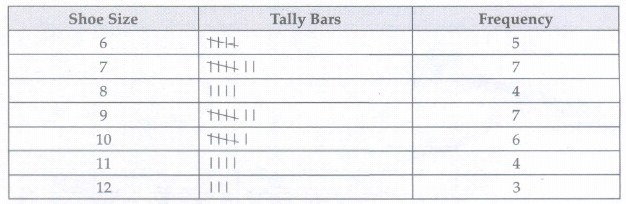
Prepare a discrete frequency distribution of shoe size of your class XI students.
| 7 | 6 | 7 | 8 | 9 | 6 | 7 | 9 | 10 | 12 | 7 | 7 |
| 6 | 8 | 9 | 10 | 11 | 11 | 10 | 9 | 12 | 11 | 10 | 8 |
| 9 | 7 | 6 | 10 | 11 | 12 | 10 | 9 | 9 | 8 | 7 | 6 |
4.
Which of the following alternatives is true?
Range is the:
Difference between the largest and smallest observations
Division between smallest and largest observations
Average the largest and smallest observations
Ratio of between the largest and smallest observations
5.
Which of the following alternatives is true?
Under exclusive method:
The upper class limit of a class is excluded in the class interval
The upper class limit of a class is included in the class interval
The Lower class limit of a class is excluded in the class interval
The Lower class limit of a class is included in the class interval
6.
Which of the following alternatives is true?
Statistical Calculations in classified data are based on:
The actual value of observations
The upper class limit
The lower class limit
Class Mid points
7.
Which of the following alternatives is true?
The frequency distribution of two variable is known as:
Univariate distribution
Bivariate distribution
Multivariate distribution
None of the above
8.
Which of the following alternatives is true?
The class MidPoint is equal to
The average of the upper class limit and lower class limit
The product of the upper class limit and lower class limit
The ratio of the upper class limit and lower class limit
None of the above
1.
The difference between upper limit and lower limit of two successive classes is1.
Divide one by two.
We get 0.5
Add 0.5 in upper limit of all classes and deduct it from lower limit of all classes. On doing so we get new class intervals as follows:
| Age | No of Students |
| (X) | (f) |
| - 0.5 -9.5 | 3 |
| 9.5 -19.5 | 4 |
| 19.5 - 29.5 | 10 |
| 29.5 - 39.5 | 7 |
| 39.5 - 49.5 | 63 |
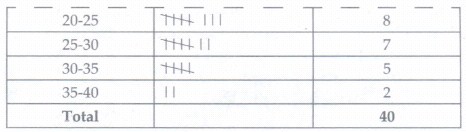
2.
Range is equal to Largest - Smallest Value
38 -10 = 28
Here, N = 40 observations. If we apply this rule, then we shall have
23 = 8 (<40),
24 = 16 (<40),
25 = 32 (<40).
26 = 64 (>40).
28/6 = 4.66
Rounded off to 5 and therefore, class interval is 5.
If we use range, then minimum classes should be five and accordingly, also we are taking six classes.

3.
4.
(a)
Difference between the largest and smallest observations
5.
(a)
The upper class limit of a class is excluded in the class interval
6.
(a)
The actual value of observations
7.
(b)
Bivariate distribution
8.
(a)
The average of the upper class limit and lower class limit

11th Standard CBSE Syllabus & Materials
11th Standard CBSE
CBSE 11th Business Studies Forms of Business Organisation Sample Question Papers Study Material - QB365 Set A
NEW11th Standard CBSE
CBSE 11th Business Studies Business, Trade and Commerce Sample Question Papers Study Material - QB365 Set A
NEW11th Standard CBSE
CBSE 11th Physics Waves Sample Question Papers Study Material - QB365 Set A
NEW11th Standard CBSE
CBSE 11th Physics Kinetic Theory Sample Question Papers Study Material - QB365 Set A



CBSE 11th Standard CBSE Subjects
CBSE Standards










