
 100% FREE ACCESS
11th Standard CBSE Syllabus & Materials
11th Standard CBSE
CBSE 11th Economics PART-A - Presentation of Data - New Sample Question Papers Study Material - QB365 Set A
NEW11th Standard CBSE
CBSE 11th Economics PART-A - Organisation of Data - New Sample Question Papers Study Material - QB365 Set A
NEW11th Standard CBSE
CBSE 11th Economics PART-A - Collection of Data - New Sample Question Papers Study Material - QB365 Set A
NEW11th Standard CBSE
CBSE 11th Economics PART-A - Introduction to Economics and Statistics - New Sample Question Papers Study Material - QB365 Set A
NEW11th Standard CBSE
CBSE 11th Business Studies International Trade Sample Question Papers Study Material - QB365 Set A
NEW11th Standard CBSE
CBSE 11th Business Studies Evolution and Fundamentals of Business Sample Question Papers Study Material - QB365 Set A

Published on: 04/10/2019
Straight Lines
Download CBSE Class 11th Standard CBSE Mathematics question papers, sample papers, important questions, and previous year solved papers in PDF format. Get free study materials, NCERT solutions, and exam preparation resources for Class 11th Standard CBSE Mathematics
Questions + Answers key
Take MCQ Mathematics Test
1.
Find the angle between the lines \(\sqrt { 3x } \)+y=1 and x+\(\sqrt { 3y } \)=1.
2.
Find what the following equation become when the origin is shifted to (1, 1). (i) x2+xy-3y2-y+2=0, (ii) xy-y2-x+y=0, (iii) xy-x-y+1=0
3.
Find the equation of the line through the intersection of 5x - 3y = 1 and 2x + 3y - 23 = 0 and perpendicular to the line 5x - 3y - 1= 0.
4.
Find the equation of line passing through the intersection of lines 2x-5y+9=0 and x+2y+3=0 and which is parallel to the line 3x + 4y + 7 = 0.
5.
Prove that the product of the lengths of the perpendiculars drawn from the points \((\sqrt{a^2-b^2},0)\) and \((-\sqrt{a^2-b^2},0)\) to the line \({x\over a}cos\theta+{y\over b}sin\theta=1\) is b2
6.
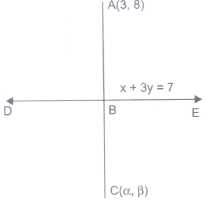
Find the image of the point (3, 8) with respect to the line x +3y = 7 assuming the line to be a plane mirror.
7.
Find the direction in which a straight line must be drawn through the point (-1,2) so that its point of intersection with the line x + y = 4 may be at a distance of 3 units from this point.
8.
Find the equation of the line passing through the point of intersection of the lines 4x + 7y - 3 = 0 and 2x - 3y + 1 = 0 that has equal intercepts on the axis.
9.
Find the area of the triangle formed by the lines y - x = 0, x + y = 0 and x - k = 0.
10.
Reduce the following equations into intercept form and find their intercepts on the axes.
(i) 3x + 2y - 12 = 0,
(ii) 4x - 3y = 6,
(iii) 3y + 2 = 0.
1.
We have \(\sqrt{3}x+y=1\)
\(\Rightarrow y=-\sqrt{3}x+1\)
\(\therefore m_1=-\sqrt{3}\)
Also \(x+\sqrt{3}y=1\)
\(\Rightarrow \sqrt{3}y=-x+1\)
\(\Rightarrow y=\frac{-1}{\sqrt{3}}x+\frac{1}{\sqrt{3}}\)
\(\therefore m_2=\frac{-1}{\sqrt{3}}\)
Let \(\theta\) be the angle between the lines. Then
\(\tan\theta=|\frac{-\sqrt{3}+\frac{1}{\sqrt{3}}}{1+(-\sqrt{3}(\frac{-1}{\sqrt{3}})}|\)
\(=|\frac{\frac{-3+1}{\sqrt{3}}}{1+1}|=|\frac{-2}{\sqrt{3}}\times \frac{1}{2}|\)
\(=|\frac{-1}{\sqrt{3}}|=\frac{1}{\sqrt{3}}\)
\(\tan\theta=\tan 30^o\) and \(\tan(180^o-30^o)\)
\(\theta=30^o\) and \(150^o\)
2.
(i) Let (x', y') the coordinates of the given point (x, y0 in the new system of translation of axes.
\(\therefore\) x'=x-h \(\Rightarrow\) x=x'+h=x'+1 and y=y'+k=y'+1
Substituting these values of x and y in the given equation x2+xy-3y2-y+2 = 0, we get
(x'+1)2+(x'+1)(y'+1)-3(y'+1)2-(y'+1)+2=0
\(\Rightarrow\) x'2+1+2x'+x'y'+x'+y'+1-3y'2-3-6y'-y'-1+2=0
\(\Rightarrow\) x'2+x'y'-3y'2+3x'-6y' = 0
Hence the equation of the given pair of straight lines in a new system is
x2+xy-3y2+3x-6y=0
(ii) The orgin is shifted to a point (1, 1) and Let (x',y') be the new coordinates of the given point (x, y) in the line.
\(\therefore\) x = x' + h
\(\Rightarrow\) x = x' + 1 and y = y' + 1
Substituting these values of x and y in the given equation xy - y2 - x+y=0 we get,
(x'+1) (y'+1)-(y'+1)2-(x'+1)+(y'+1) = 0
\(\Rightarrow\) x'y' +x' +y' +1-y'2-1-2y'-x'-1+y'+1 = 0
\(\Rightarrow\) x'y'-y'2 = 0
Hence the equation of the given pair of straight lines in a new system is xy-y2 = 0
(iii) Here h = 1 and k = 1
Let (x', y' ) be the coordinates of the new point
\(\therefore\) x = x'+h, y=y' +k
\(\Rightarrow\) x = x'+1, \(\Rightarrow\) y = y' +1
Now substituting the values of x and y is given equation xy-x-y+1 = 0, we get
(x' +1) (y'+1) - (x'+1)-(y'+1)+1=0
\(\Rightarrow\) x'y' +x' +y' +1-x'-1-y'-1+1 =0
\(\Rightarrow\) x' y' = 0
Hence the equation of the given pair of straight lines in a new system of translation of axes is xy = 0.
3.
The given lines are 5x - 3y - 1 = 0 and 2x + 3y - 23 = 0.
Equation of any line passing through the intersection of the given lines is in the form
(5x - 3y - 1) + k (2x + 3y - 23) = 0 ...(i)
⇒ (5 + 2k) x + (-3 + 3k) y - 1 - 23k = 0
Slope of the line = \(-(5+2k)\over -3+3k\)
=m1 (Say)
and the slope of the line 5x - 3y - 1 = 0...(ii)
\(={{-5\over -3}}=m_2\)(say)
\(∴\ m_2={5\over 3}\)
as the equation (i) is perpendicular to equation (ii)
∴ m1 x m2 =-1
\({-(5+2k)\over -3+3k}\times{5\over 3}=-1\)
\(⇒\ {5+2k\over -3+3k}={3\over 5}\)
⇒ 25 + 10k = -9 + 9k
⇒ k=-34
Now putting the value of k is equation (i) we get
(5x - 3y - 1) - 34 (2x + 3y - 23) = O·
⇒ 5x - 3y - 1 - 68x - 102y + 782 = 0
⇒ - 63x - 105y + 781 = 0
⇒ 63x + 105y -781 = 0
4.
The given equation are 2x-5y+9=0 and x+2y+3=0
Equation of any line passing through the point of intersection of the given lines is in the form
(2x-5y+9)+k(x+2y+3) = 0....(i)
\(\Rightarrow\) 2x-5y+9+kx+2ky+3k=0 \(\Rightarrow\) (2+k)x+(2k-5)y+(3k=9)=0
Slope of this line (i) is \(\frac { -(2+k) }{ (2k-5) } ={ m }_{ 1 }\) (Say)
Slope of the given line 3x + 4y + 7 = 0 is =\(\frac { -3 }{ 4 } ={ m }_{ 2 }\) (Say)
If these two lines are parallel to each other
then m1 = m2
\(\Rightarrow -\left( \frac { 2+k }{ 2k-5 } \right) =\frac { -3 }{ 4 } \Rightarrow \) 6k-15=8+4k \(\Rightarrow\) 2k = 23
\(\therefore k=\frac { 23 }{ 2 } \)
Now substituting the value of k in Eq. (1)
(2x-5y+9)+\(\frac { 23 }{ 2 } \)(x+2y+3) = 0
\(\Rightarrow\) 4x-10y+18+23x+46y+69=0
\(\Rightarrow\) 27x + 36y + 87 = 0
which is the required equation.
5.
\(\text { The equation of the given line is }\)
\(\frac{x}{a} \cos \theta+\frac{y}{b} \sin \theta=1 \)
\(\text { Or, bx } \cos \theta+a y \sin \theta-a b=0\)
\(\text { Length of the perpendicular from point }\left(\sqrt{a^{2}-b^{2}}, 0\right) \text { to line }(1) \text { is }\)
\(∴\ p_1=\left|{\sqrt{a^2-b^2}cos\theta\over a}+{0\times sin\theta\over b}-1\over \sqrt{ \left(cos\theta\over a\right)^2+\left(sin\theta\over b\right) ^2 } \right|\)
\(=\left| {\sqrt{a^2-b^2}cos\theta\over a}-1\over \sqrt{ {cos^2\theta\over a^2}+{sin^2\theta\over b^2} } \right|\)
\(\text { Length of the perpendicular from point }\left(-\sqrt{a^{2}-b^{2}}, 0\right) \text { to line }(2) \text { is }\)
\(p_2=\left|-{\sqrt{a^2-b^2}cos\theta\over a}+{0\times sin\theta\over b}-1\over \sqrt{ \left(cos\theta\over a\right)^2+\left(sin\theta\over b\right) ^2 } \right|\)
\(=\left| -{\sqrt{a^2-b^2}cos\theta\over a}-1\over \sqrt{ {cos^2\theta\over a^2}+{sin^2\theta\over b^2} } \right|\)
\(\text { On multiplying equations }(2) \text { and }(3), \text { we obtain }\)
now p1p2
\(=\left|{\sqrt{a^2-b^2}cos\theta\over a}+{0\times sin\theta\over b}-1\over \sqrt{ \left(cos\theta\over a\right)^2+\left(sin\theta\over b\right) ^2 } \right|\)\(\left|-{\sqrt{a^2-b^2}cos\theta\over a}+{0\times sin\theta\over b}-1\over \sqrt{ \left(cos\theta\over a\right)^2+\left(sin\theta\over b\right) ^2 } \right|\)
\({=\left|\left[{\sqrt{a^2-b^2}cos\theta\over a}-1\right]\left[{\sqrt{a^2-b^2}cos\theta\over a}+1 \right] \right|\over {cos^2\theta\over a^2}+{sin^2\theta\over b^2}}\)
= \(\left|\left[ {(a^2-b^2cos^2\theta\over a^2}-1\right]\right|\over {cos^2\theta\over a^2}+{1-cos^2\theta\over b^2}\)
\(={\left|\left[ {(a^2-b^2)cos^2\theta\over a^2}-1\right]\right|\over {a^2-(a^2-b^2)cos^2\theta\over b^2}}\)
\(=a^2 - (a^2 - b^2) cos^2θ\times{b^2\over a^2-(a^2-b^2)cos^2\theta}\)
= b2
6.
Let the image of the point A(3, 8) in the line mirror DE be \(C(\alpha, \beta)\) . Then AC is perpendicular bisector of DE.
The coordinates of point B are \((\frac{\alpha+3}{2},\frac{\beta+8}{2})\)
Since point B lies on the line x + 3y = 7,
\(\therefore \frac{\alpha +3}{2}+\frac{3(\beta+8)}{2}=7\)
\(\Rightarrow \alpha +3+3\beta+24 =14\)
\(\therefore \alpha+3\beta+13=0\).....(i)
Since AC is perpendicular on DE
\(\therefore\) Slope of AC x Slope of DE = -1
\(\Rightarrow \frac{\beta-8}{\alpha-3}\times \frac{-1}{3}=-1\Rightarrow\beta-8=3 \alpha -9\)
\(\Rightarrow 3\alpha - \beta - 1 = 0\)
Solving (i) and (ii) we get
\(\alpha=-1\) and \(\beta =-4\)
Thus image of point (3, 8)is (-1, -4).
7.
\(\text { Let } y=m x+c \text { be the line through point }(-1,2) \text { . }\)
\(\text { Accordingly, } 2=m(-1)+c\)
\(\Rightarrow 2=-m+c \)
\(\Rightarrow c=m+2\)
\(y=m x+m+2 \ldots(1)\)
\(\text { The given line is }\)
\(x+y=4 \ldots(2)\)
\(\text { On solya equations ili and } 121 \text { , we obtain }\)
\(x=\frac{2-m}{m+1} \text { and } y=\frac{5 m+2}{m+1}\)
\(\therefore\left(\frac{2-m}{m+1}, \frac{5 m+2}{m+1}\right) \text { is the point of intersection of lines (1) and (2). }\)
\(\text { Since this point is at a distance of } 3 \text { units from point }(-1,2), \text { according to distance formula } \)
\(\sqrt{\left(\frac{2-m}{m+1}+1\right)^{2}+\left(\frac{5 m+2}{m+1}-2\right)^{2}}=3 \)
\(\Rightarrow\left(\frac{2-m+m+1}{m+1}\right)^{2}+\left(\frac{5 m+2-2 m-2}{m+1}\right)^{2}=3^{2} \)
\(\Rightarrow \frac{9}{(m+1)^{2}}+\frac{9 m^{2}}{(m+1)^{2}}=9 \)
\(\Rightarrow \frac{1+m^{2}}{(m+1)^{2}}=1 \)
\(\Rightarrow 1+m^{2}=m^{2}+1+2 m \)
\(\Rightarrow 2 m=0 \)
\(\Rightarrow m=0\)
\(\text { Thus, the slope of the required line must be zero i.e., the line must be parallel to the x- axis }\)
8.
The equation of given lines are
4x + 7y - 3 = 0 and 2x - 3y + 1 = O.
Now the equation of any line through intersection of these lines is
4x + 7y - 3 + k (2x - 3y + 1) = 0....(i)
\(\Rightarrow\) (4 + 2k)x + (7 - 3k)y = 3 - k
\(\Rightarrow\) \(\frac{(4+2k)x}{3-k}+\frac{(7-3k)y}{3-k}=1\)
\(\Rightarrow\) \(\frac{x}{\frac{3-k}{4+2k}}+\frac{y}{\frac{3-k}{7-3k}}=1\)
It is given that \(\frac{3-k}{4+2k}=\frac{3-k}{7-3k}\)
\(\Rightarrow\) \((3-k)[\frac{1}{4+2k}-\frac{1}{7-3k}]=0\)
\(\Rightarrow\) 3 - k = 0
or \(\frac{1}{4+2k}-\frac{1}{7-3k}=0\Rightarrow 3=k\)
or 7 - 3k - 4 - 2k = 0
\(\Rightarrow\) k = 3 or -5k = -3
\(\Rightarrow\) k = 3 or \(k=\frac{3}{5}\)
Putting k = 3 in (i), we have
4x + 7y - 3 + 3(2x - 3y + 1) = 0
\(\Rightarrow\) 4x + 7y - 3 + 6x - 9y + 3 = 0
\(\Rightarrow\) 10x - 2y = 0 \(\Rightarrow\) 5x - y = 0
Putting \(k=\frac{3}{5}\) in equ (i), we have
4x + 7y - 3 + 3(2x - 3y + 1) = 0
\(\Rightarrow\) 20x + 35y - 15 + 6x - 9y + 3 = 0
\(\Rightarrow\) 13x + 13y - 6 = 0.
9.
The equation of lines are
y - x = 0.....(i)
x + y = 0....(ii)
x - k = 0....(iii)
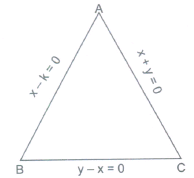
By solving (i) and (ii), we get the coordinates of point C.
\(\therefore\) Coordinate of Care (0, 0).
By solving (ii) and (iii), we get the coordinates of point A.
\(\therefore\) Coordinate of A are (k, - k).
By solving (i) and (iii), we get the coordinates of point B.
\(\therefore\) Coordinates of B are (k, k).
\(\therefore\) Area of \(\Delta ABC=\frac { 1 }{ 2 } \left| \begin{matrix} k & -k & 1 \\ k & k & 1 \\ 0 & 0 & 1 \end{matrix} \right| \)
= \(\frac{1}{2}\)[(k2 + k2) + (0 - 0) + (0 - 0)]
= \(\frac{1}{2}\times\) 2k2 = k2 sq.units.
10.
(i) The given equation is 3x + 2y – 12 = 0.
It can be written as
\(\Rightarrow\) 3x + 2y = 12
\(\Rightarrow \frac{3x}{12}+\frac{2y}{12}=1\Rightarrow\frac{x}{4}+\frac{y}{6}=1\)
\(\text { This equation is of the form } \frac{x}{a}+\frac{y}{b}=1 \text { , where } a=4 \text { and } b=6 \text { . }\)
Therefore, equation (1) is in the intercept form, where the intercepts on the x and y axes are 4 and 6 respectively.
(ii) The given equation is 4x – 3y = 6.
It can be written as
\(\Rightarrow \frac{4x}{6}-\frac{3y}{6}=1\Rightarrow \frac{2x}{3}-\frac{y}{2}=1\)
\(\Rightarrow \frac{x}{\frac{3}{2}}+\frac{y}{-2}=1\)
\(\text { This equation is of the form } \frac{x}{a}+\frac{y}{b}=1 \text { , where } a=\frac{3}{2} \text { and } b=-2 \text { . }\)
Therefore, equation (1) is in the intercept form, where the intercepts on the x and y axes are \(\frac {3}{2}\) and -2 respectively.
(iii) The given equation is 3y + 2 = 0.
It can be written as
\(\Rightarrow 3y=-2\Rightarrow\frac{3y}{2}=1\)
\(\Rightarrow{0x\over -2}+{3y\over -2}=1\Rightarrow {0x\over -2}+{y\over \frac{-2}{3}}=1\)
\(\text { This equation is of the form } \frac{x}{a}+\frac{y}{b}=1 \text { , where } a=0 \text { and } b=-\frac{2}{3} \text { . }\)
Therefore, equation (1) is in the intercept form, where the intercepts on the x and y axes are 0 and \(-\frac {2}{3}\) respectively.

11th Standard CBSE Syllabus & Materials
11th Standard CBSE
CBSE 11th Business Studies Forms of Business Organisation Sample Question Papers Study Material - QB365 Set A
NEW11th Standard CBSE
CBSE 11th Business Studies Business, Trade and Commerce Sample Question Papers Study Material - QB365 Set A
NEW11th Standard CBSE
CBSE 11th Physics Waves Sample Question Papers Study Material - QB365 Set A
NEW11th Standard CBSE
CBSE 11th Physics Kinetic Theory Sample Question Papers Study Material - QB365 Set A



CBSE 11th Standard CBSE Subjects
CBSE Standards









