
 100% FREE ACCESS
11th Standard CBSE Syllabus & Materials
11th Standard CBSE
CBSE 11th Economics PART-A - Presentation of Data - New Sample Question Papers Study Material - QB365 Set A
NEW11th Standard CBSE
CBSE 11th Economics PART-A - Organisation of Data - New Sample Question Papers Study Material - QB365 Set A
NEW11th Standard CBSE
CBSE 11th Economics PART-A - Collection of Data - New Sample Question Papers Study Material - QB365 Set A
NEW11th Standard CBSE
CBSE 11th Economics PART-A - Introduction to Economics and Statistics - New Sample Question Papers Study Material - QB365 Set A
NEW11th Standard CBSE
CBSE 11th Business Studies International Trade Sample Question Papers Study Material - QB365 Set A
NEW11th Standard CBSE
CBSE 11th Business Studies Evolution and Fundamentals of Business Sample Question Papers Study Material - QB365 Set A

Published on: 26/05/2021
QB365 Provides the updated NCERT Examplar Questions for Class 11 Maths, and also provide the detail solution for each and every ncert examplar questions , QB365 will give all kind of study materials will help to get more marks
Download CBSE Class 11th Standard CBSE Mathematics question papers, sample papers, important questions, and previous year solved papers in PDF format. Get free study materials, NCERT solutions, and exam preparation resources for Class 11th Standard CBSE Mathematics
Questions + Answers key
Take MCQ Mathematics Test
1.
A typical PIN(person identification number) is a sequence of any four symbols chosen from the 26 letters in the alphabet and the ten digits.If all PINs are equally likely, what is the probability that a random chosen PIN contains a repeated symbol?
2.
Three squaresof chess board are selected 2 squares of ane colour and other of a different colour.
3.
One card is drawn from a well-shuffled deck of 52 cards.Calculate the probability that the card will be
a red card
4.
One card is drawn from a well-shuffled deck of 52 cards.Calculate the probability that the card will be
not a black card
5.
One card is drawn from a well-shuffled deck of 52 cards.Calculate the probability that the card will be
an ace
6.
If f(x)=x100+x99+...+x+1, then find f'(1)
7.
Prove that the points (0, -1, -7), (2, 1, -9) and (6, 5, -13) are collinear. Find the ratio in which the first point divides the join of the other two.
8.
Find the eccentricity of the hyperbola \(\frac { { x }^{ 2 } }{ { a }^{ 2 } } -\frac { { y }^{ 2 } }{ { b }^{ 2 } } =1\) , when passes through the points (3,0) and \((3\sqrt { 2 } ,2)\)
9.
Find a point which is equidistant from the lines 4x + 3y + 10 = 0, 5x - 12y+26 = 0 and 7x + 24y - 50=0
10.
If x, 2y and 3z are in AP, where the distinct numbers x, y, z are in GP, then find the common ratio of the GP.
11.
If the integers r (>1), n (>2) and coefficients of (3r)th and (r + 2)nd terms in the expansion of (1 + x)2n are equal, then prove that n = 2r.
12.
How many 4 letters code can be formed using the first 10 letter of the English alphabet, if no letters can be repeated?
13.
Find the total number of words formed by 2 vowels and 3 consonants taken from 4 vowels and 5 consonants.
14.
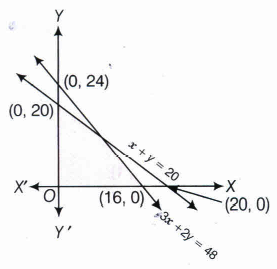
Find the linear inequalities for which the shaded region on the given figure is the solution set.
15.
The longest side of a triangle is twice the shortest side and the third side is 2cm longer than the shortest side. If the perimeter of the triangle is more than 166cm then find the minimum length of the shortest side.
16.
If \(\frac { z-1 }{ z+1 } \) is a purely imaginary number \((z\neq -1)\) then find the value of \(|z|\)
17.
If f(z) = \(\frac { 7-z }{ 1-{ z }^{ 2 } } \) where z= 1 + 2i , then find \(|f(z)|\)
18.
Find the real value of 'a' for which 3i3- 2ai2+(1-a)i + 5 is real.
19.
Find the domain of the function f defined by \(f(x)=\sqrt { 4-x } +\frac { 1 }{ \sqrt { { x }^{ 2 }-1 } } \)
20.
Draw the Venn diagrams to illustrate the following relationship among sets E, M and U, where E is the set of students studying English in a school, M is the set of students studying Mathematics in the same school and U is the set of all students in that school.
(i) All the students who study Mathematics also study English, but some students who study English do not study Mathematics.
Firstly , make a relation between sets under given condition. Then, it is easy to draw a Venn diagram.
21.
Identify the quantifiers and write the negation of the following statements
For all even integers x,x2 is also even
22.
Show that the following statement is true. p:For any real numbers x,y if x = y, then 2x + a = 2y + a when a \(\in\) Z.
23.
Prove that 2n<(n+2)! for all natural numbers n.
24.
Prove by the principle of mathematical induction that \(1\times 1!+2\times 2!+3\times 3!+....+n\times n!=(n+1)!-1\)for all natural numbers n.
1.
Total number of symbols = 36
There are 36 x 36 x 36 x 36 = (36)4 = 1679616 PINs in all.
[by fundamental principle of counting]
Note that, when repetition of symbols is not allowed, then there are 36 x 35 x 34 x 33 = 1413720 different PINs
Now, the number of PINs that contains at least one repeated symbol = 1679616 - 1413720 = 265896
= 0.1583
2.
We know that, in a chess board, there are 64 squares of which 32 are white and 32 are black.
Clearly, 3 squares can be selected in \(^{ 64 }{ C }_{ 3 }\) ways.
Let E be the event of getting 2 squares of one colour and other of a different colour.
Then, n(E) = \(^{ 32 }{ C }_{ 2 }\times ^{ 32 }{ C }_{ 2 }+^{ 32 }{ C }_{ 1 }\times ^{ 32 }{ C }_{ 2 }\)
[ 2 squares of one colour and 1 of other can be 2w, 1B or 1w , 2B]
\(2\times ^{ 32 }{ C }_{ 2 }\times ^{ 32 }{ C }_{ 1 }\)
\(\frac { 16 }{ 21 } \)
3.
\(\frac { 1 }{ 2 } \)
4.
\(\frac { 1 }{ 2 } \)
5.
\(\frac { 1 }{ 13 } \)
6.
\(f'(x)={ 100x }^{ 99 }+{ 99x }^{ 98 }+...+1+0\)
\(={ 100x }^{ 99 }+{ 99x }^{ 98 }++...+1\)
\(Now,\ f'(x)=100+99+...+1\)
\(=\frac { 100 }{ 2 } \left[ 2\times 100+(100-1)(-1) \right] =5050\)
7.
1:3 externally
8.
Let Since, it is passes through (3,0) and \((3\sqrt { 2 } ,2)\)
\(\frac { 9 }{ { a }^{ 2 } } -0=1\) and \(\frac { 18 }{ { a }^{ 2 } } -\frac { 4 }{ { b }^{ 2 } } =1\)
a2 = 9 and b2 = 4
b2 = a2 (e2-1)
\(e=\frac { \sqrt { 13 } }{ 2 } \)
9.
Let the point (h, k) id equidistant from the given lines.
Distance from line (i) = \(\frac { \left| 4h+3k+10 \right| }{ \sqrt { 16+9 } } \)
Distance from linr (ii) = \(\frac { \left| 5h-12k+26 \right| }{ \sqrt { 25+144 } } \)
Distance from linr (iii) = \(\frac { \left| 7h+24k-50 \right| }{ \sqrt { { 7 }^{ 2 }+{ 24 }^{ 2 } } } \)
Since, the point (h, k) is equidistant from lines (i), (ii) and (iii).
\(\therefore \frac { \left| 4h+3k+10 \right| }{ \sqrt { 16+9 } } =\frac { \left| 5h-12k+26 \right| }{ \sqrt { 25+144 } } =\frac { \left| 7h+24k-50 \right| }{ \sqrt { 49+576 } } \)
\(\Rightarrow \frac { \left| 4h+3k+10 \right| }{ 5 } =\frac { \left| 5h-12k+26 \right| }{ 13 } =\frac { \left| 7h+24k-50 \right| }{ 25 } \)
Clearly, if h=0, k=0, then \(\frac { 10 }{ 5 } =\frac { 26 }{ 13 } =\frac { 50 }{ 25 } =2\)
Ans. (0, 0)
10.
Since, x , 2y and 3z are in AP.
\(\therefore \) 4y = x + 3z
And x, y, z are in GP.
\(\therefore \) y = rx and z = xr2
On putting the value of y and z in Eq. (i), we get
4xr = x + 3xr2
\(\Rightarrow \) 3r2 - 4r + 1 = 0
r = \(\frac { 1 }{ 3 } \) [\(\because \) r = 1 is not possible]
11.
Here, r>1, n>2
\(\therefore \) T3r = 2nC3r-1 x3r-1; Tr+2 = 2nCr+1 xr+1
Then, 2nC3r-1= 2nCr+1
\(\Rightarrow \) 3r - 1 + r + 1 = 2n \(\Rightarrow \) n = 2r
12.
Total nuber of 4 letters code = 10C4
13.
7200
14.
For the equation x+y=20, the shaded area and origin both lies on the same side of the live, therefore the compounding inequality is \(x+y\le 20\).
Similarly, \(3x+2y\le 48\)
Also,the shaded portion lines in Ist quadrant.
\(\therefore \quad x\ge 0\quad and\quad y\ge 0\)
Ans. \(x+y\le 20,3x+2y\le 48,x\ge 0,y\ge 0\)
15.
Let the length of shortest side be x cm
Then, according to question, we have
Length of third side = (x+2) cm
Since the perimeter of the triangle is more than 166 cm.
2x+x+(x+2)>166
\(\Rightarrow 4x+2>166\)
\( \Rightarrow 4x>164\quad [subtracting\quad 2\quad from\quad both\quad sides]\)
\(\Rightarrow x>41\quad [dividing\quad both\quad sides\quad by\quad 4]\)
Hence,the length of the shortest side should be greater than 41cm.
16.
Let z = x + iy, then
\(\frac { z-1 }{ z+1 } =\frac { ({ x }^{ 2 }-1)+{ y }^{ 2 }+i[y(x+1)-y(x-1)] }{ ({ x }^{ 2 }+1)^{ 2 }+y^{ 2 } } \\ \)
\(\because \frac { z-1 }{ z+1 } \) is purely imaginary.
\(\therefore Re(\frac { z-1 }{ z+1 } ) =0\ i.e.\ \frac { ({ x }^{ 2 }-1)+{ y }^{ 2 } }{ ({ x }^{ 2 }+1)^{ 2 }+y^{ 2 } } =0\)
\({ x }^{ 2 }-1-{ y }^{ 2 }=0\ \Rightarrow { x }^{ 2 }+{ y }^{ 2 }=1= |z|=1\)
17.
\(\frac { 2-i }{ 2 } \)
18.
3i3- 2ai2+(1-a)i + 5
= 3( - i) + 2a + (1 - a)i+5 [i3 = -i and i2 = -1]
= (2a + 5) + i(1-a-3), which will be real,
if 1 - a - 3 =0,
i.e, a = - 2
19.
Domain = \((-\infty ,-1)\cup (1,4)\)
20.
Given E = set of students studying English
M =Set of students studying Mathematics
U= Set of all students
Since, all of the students who study Mathematics also study English, but some students who study English do not study Mathematics
\(\therefore \quad \quad M\subset E\subset U\)
Through Venn diagram, we represent it as
-S.png)
21.
The quantifier is 'for all' and the negation is There exists an even integer x such that x2 is not even
22.
Direct Method For any real number x,y, it is given
x = y \(\Rightarrow \) 2x = 2y
\(\Rightarrow \) 2x + a = 2y + a for some a \(\in\) Z.
Contrapositive Method The contrapositive statement of 'p' is 'For any real numbers x,y, if 2x+a\(\neq \)2y+a, where a\(\epsilon \)Z.then x\(\neq \)yn .
23.
2k<(k+2)!\(\Rightarrow \)2k+2(k+2)!+2]
\(\Rightarrow \) (k+1)2 < 2k + 2k [(2k+1)<2k for k\(\le \)3]
\(\Rightarrow \) (k+1)2 < 2k+1
24.
Step I: Let P(n) be the given statement
i.e. P(n): \(1\times 1!+2\times 2!+3\times 3!+....+n\times n!=(n+1)!-1\)
Step II : For n=1, we have
LHS=\(1\times 1!\)=1
and RHS=(1+1)!-1=2!-1=2-1=LHS
\(\because \) LHS=RHS
\(\therefore \) P(1) is true
Step III Let us assume that P(n) is true for n=k
Then, we have
P(k): \(1\times 1!+2\times 2!+3\times 3!+....+k\times k!+(k+1)!-1\quad \quad ....(i)\)
Step IV Now, we shall prove the statement for n=k+1. For this we have to show that
\(1\times 1!+2\times 2!+3\times 3!+....+k\times k!+(k+1)\times (k+1)!=(k+1+1)!-1\)
Then, LHS \(=1\times 1!+2\times 2!+3\times 3!+....+k\times k!+(k+1)\times (k+1)!\)
=(k+1)!-1+(k+1)!\(\times \)(k+1) [from Eq.(1)]
=(k+1+1)(k+1)!-1=(k+2)(k+1)!-1
=(k+2)!-1 [\(\because \)n(n-1)!=n]
Thus, P(k+1) is true, whenever P(k) is true. Hence, by the principle of mathematical induction, P(n) is true for all natural numbers n.

11th Standard CBSE Syllabus & Materials
11th Standard CBSE
CBSE 11th Business Studies Forms of Business Organisation Sample Question Papers Study Material - QB365 Set A
NEW11th Standard CBSE
CBSE 11th Business Studies Business, Trade and Commerce Sample Question Papers Study Material - QB365 Set A
NEW11th Standard CBSE
CBSE 11th Physics Waves Sample Question Papers Study Material - QB365 Set A
NEW11th Standard CBSE
CBSE 11th Physics Kinetic Theory Sample Question Papers Study Material - QB365 Set A



NCERT Books

Syllabus

Exam Pattern

Sample Question Papers

Previous year Question Papers

Important Notes

MCQ Practice test

NCERT Exemplers

Case study Questions

Image Based Questions

Passage based Questions

HOT Questions

Value Based Questions

Model Questions Papers
NCERT ( Book Back ) Questions

Assertion and Reason
Important Questions And Answers

CBSE 11th Standard CBSE Subjects
CBSE Standards







