
 100% FREE ACCESS
11th Standard CBSE Syllabus & Materials
11th Standard CBSE
CBSE 11th Economics PART-A - Presentation of Data - New Sample Question Papers Study Material - QB365 Set A
NEW11th Standard CBSE
CBSE 11th Economics PART-A - Organisation of Data - New Sample Question Papers Study Material - QB365 Set A
NEW11th Standard CBSE
CBSE 11th Economics PART-A - Collection of Data - New Sample Question Papers Study Material - QB365 Set A
NEW11th Standard CBSE
CBSE 11th Economics PART-A - Introduction to Economics and Statistics - New Sample Question Papers Study Material - QB365 Set A
NEW11th Standard CBSE
CBSE 11th Business Studies International Trade Sample Question Papers Study Material - QB365 Set A
NEW11th Standard CBSE
CBSE 11th Business Studies Evolution and Fundamentals of Business Sample Question Papers Study Material - QB365 Set A

Published on: 29/05/2021
QB365 Provides the HOT Question Papers for Class 11 Maths, and also provide the detail solution for each and every HOT Questions. HOT Questions will help to get more idea about question pattern in every exams and also will help to get more marks in Exams
Download CBSE Class 11th Standard CBSE Mathematics question papers, sample papers, important questions, and previous year solved papers in PDF format. Get free study materials, NCERT solutions, and exam preparation resources for Class 11th Standard CBSE Mathematics
Questions + Answers key
Take MCQ Mathematics Test
1.
An experiiment consists of rolling a die and then tossing a coin, once, if the number on the die is even. If the number in the die is odd, then coin is tossed twice. Write the sample space for this experiment.
2.
If A and B are two events such that P(A) = \(\frac { 1 }{ 4 } \) P(B) = \(\frac { 1 }{ 2 } \) and \(P(A\cap B)=\frac { 1 }{ 8 } \) .Then , find P ( not A and not B).
3.
Check whether the following probabilities P(A)=0.3, P(B)=0.65 and \(P(A\cup B)=7\) are consistently defined.
4.
A single letter is selected at random from the word 'PROBABILITY', then find the probability that letter is vowel.
5.
The number lock of a suitcase has four wheels, each labelled with 10 digits.i.e., from 0 to 9. The lock opens with a sequence of four digits with no repeats. What is the probability of a person getting the right sequence to open the suitcase?
1.
It is a two stage experiment. When a die is rolled, then it may show up any one of the six number 1, 2, 3, 4, 5, 6.
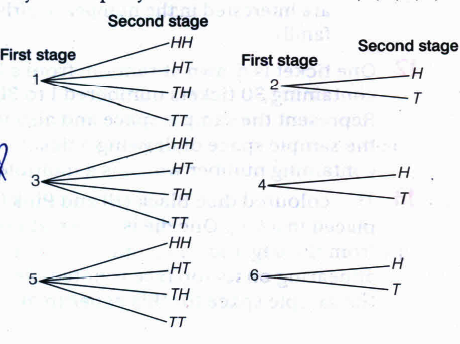
When the die shows up an odd number a coin is toasted twice and hence, corresponding to each of 1, 3 and 5, there are four possibilities.
When the die shows up an even number, a coin is tossed once and hence, corresponding to each of 2,4 and 6, there are only two possibilities.
Hence, the sample space is
S={2H,2T,4H,4T,6H,6T,1HH,1HT,1TH,1TT,3HH,3HT3TH,3TT,5HH,5HT,5TH,5TT}
2.
P( not A and not B) = \(P(\overline { A } \cap \overline { B } )\)
\(=P(\overline { A\cup B } )=1-P(A\cup B)\)
\(=1-[P(A)+P(B)-P(A\cap B)]\)
\(=1-\left[ \frac { 1 }{ 4 } +\frac { 1 }{ 2 } -\frac { 1 }{ 8 } \right] =1-\left[ \frac { 2+4-1 }{ 8 } \right] \)
\(=1-\frac { 5 }{ 8 } =\frac { 3 }{ 8 } \)
3.
Ans.Yes.
4.
There are 11 letters in the word PROBABILITY.
Since, a letter is selected randomly, therefore the possible outcomes are P, R, O, B, A, I, L, T, Y.
But here, outcomes are not equally likely
as P(letter P) = \(\frac { 1 }{ 11 } ;\) P (letter R) = \(\frac { 1 }{ 11 } \)
P(letter O)= \(\frac { 1 }{ 11 } ;\) P (letter B) = \(\frac { 2 }{ 11 } \)
[\(\because \) B repeated twice in the word]
P(letter A) = \(\frac { 1 }{ 11 } ;\) P(letter I) = \(\frac { 2 }{ 11 } \)
P(letter L) = \(\frac { 1 }{ 11 } ;\) P(letter T) = \(\frac { 1 }{ 11 } \)
and P(letter Y) = \(\frac { 1 }{ 11 } \)
Now, let E be event of getting a vowel. Then outcomes favourable to E are A, I and O.
\(\Rightarrow \) E={A,I,O}
Now,\(P(E)=P(A)+P(I)+P(O)\)
[by aximatixc approach to probability]
= \(\frac { 1 }{ 11 } +\frac { 2 }{ 11 } +\frac { 1 }{ 11 } =\frac { 4 }{ 11 } \)
5.
When the digits are not repeated, then first place may have one of 10 digits, the second 9, third 8 and fourth 7. Number of 4-digit numbers, n(S)=10 x 9 x 8 x 7 = 5040. Now lock can be opened only in 1 way.
\(\therefore\) n(E) = 1
Hence, probability of opening the lock = \(\frac { n(E) }{ n(S) } =\frac { 1 }{ 5040 } \)

11th Standard CBSE Syllabus & Materials
11th Standard CBSE
CBSE 11th Business Studies Forms of Business Organisation Sample Question Papers Study Material - QB365 Set A
NEW11th Standard CBSE
CBSE 11th Business Studies Business, Trade and Commerce Sample Question Papers Study Material - QB365 Set A
NEW11th Standard CBSE
CBSE 11th Physics Waves Sample Question Papers Study Material - QB365 Set A
NEW11th Standard CBSE
CBSE 11th Physics Kinetic Theory Sample Question Papers Study Material - QB365 Set A



NCERT Books

Syllabus

Exam Pattern

Sample Question Papers

Previous year Question Papers

Important Notes

MCQ Practice test

NCERT Exemplers

Case study Questions

Image Based Questions

Passage based Questions

HOT Questions

Value Based Questions

Model Questions Papers
NCERT ( Book Back ) Questions

Assertion and Reason
Important Questions And Answers

CBSE 11th Standard CBSE Subjects
CBSE Standards







