
 100% FREE ACCESS
11th Standard CBSE Syllabus & Materials
11th Standard CBSE
CBSE 11th Economics PART-A - Presentation of Data - New Sample Question Papers Study Material - QB365 Set A
NEW11th Standard CBSE
CBSE 11th Economics PART-A - Organisation of Data - New Sample Question Papers Study Material - QB365 Set A
NEW11th Standard CBSE
CBSE 11th Economics PART-A - Collection of Data - New Sample Question Papers Study Material - QB365 Set A
NEW11th Standard CBSE
CBSE 11th Economics PART-A - Introduction to Economics and Statistics - New Sample Question Papers Study Material - QB365 Set A
NEW11th Standard CBSE
CBSE 11th Business Studies International Trade Sample Question Papers Study Material - QB365 Set A
NEW11th Standard CBSE
CBSE 11th Business Studies Evolution and Fundamentals of Business Sample Question Papers Study Material - QB365 Set A

Published on: 03/10/2019
Gravitation
Download CBSE Class 11th Standard CBSE Physics question papers, sample papers, important questions, and previous year solved papers in PDF format. Get free study materials, NCERT solutions, and exam preparation resources for Class 11th Standard CBSE Physics
Questions + Answers key
Take MCQ Physics Test
1.
State Kepler's laws of planetary motion.
What would be the speed of rotation of the earth in order that a body on the equator has no weight?
Determine the apparent weights of the bodies situated at a latitude of 60° and at the poles. The radius of the earth = 6400 km and g = 9.8 ms-1.
2.
A star 2.5 times the mass of the sun and collapsed to a size of 12 km rotates with a speed of 1.2 rev. per second. (Extremely compact stars of this kind are known as neutron stars. Certain stellar objects called pulsars belong to this category). Will an object placed on its equator remain stuck to its surface due to gravity? (mass of the sun = 2 x 1030 kg).
3.
A rocket is fired from the earth towards the sun. At what distance from the earth's centre is the gravitational force on the rocket zero? Mass of the sun = 2 x 1030 kg, mass of the earth = 6 x 1024 kg. Neglect the effect of other planets etc. (orbital radius = 1.5 x 10¹¹ m).
4.
The earth-moon distance is \(3.8\times 10^{ 5 }km\). The mass of the earth is 81 times that of moon. Determine the distance from the earth to the point where the gravitational fields due to the earth and the moon cancel out.
5.
Two steel balls whose masses are 502 kg and 0.25 kg are placed with their centres half a metre apart with what force do they attract each other?
6.
A particle is fired vertically upwards with a speed of 15 km/s. Find the speed of particle when it goes out of the earth's gravitational pull.
7.
The planet Neptune travels around the sun with a period of 165 yr. Show that the radius of its orbit is approximately thirty times that of the earth's orbit, both being considered as circular.
8.
Choose the correct alternatives.
Acceleration due to gravity increases/decreases with increasing depth(assume the earth to be a sphere of uniform density).
9.
Consider two solid uniform spherical object of the same density \(\rho \) . One has a radius R and the other a radius 2R. They are in outer space where the gravitational field from other objects are negligible. If they are at rest with their surfaces touching, then what is the contact force between the objects due to their gravitational attraction?
10.
A spaceship is launched into a circular orbit close to the surface of the earth. What additional velocity has now to be imparted to the spaceship in the orbit to overcome the gravitational pull.
1.
For Kepler's laws of planetary motion, please see facts that matter.
The body will become weightless if the gravitational force mg on it is entirely used up in providing the centripetal acceleration for the rotation of the earth,
Then \(mg=\frac{m\theta^2}{R}=m\omega^2R\)
\(\omega^2=\frac{g}{R}=\frac{9.8}{6400\times10^3}\)
ω =1.237 x 10⁻³ rad s-1
If the earth rotates at this speed, the bodies on the equator will have no weight. At a latitude ф the apparent weight WA is given by
\(W_A=mg(1-\frac{\omega^2R}{g}cos^2\phi)\)
Here, however, g = ω2R
Therefore, WA= mg(1-cos2 ф )
When ф = 600,cos ф = \(\frac{1}{2}\)
\(W_A=mg(1-\frac{1}{4})=\frac{3}{4}\times true\ weight\)
At poles, \(\phi=\frac{\pi}{2}\)
WA mg = true weight
Thus, a body situated on the poles remains unaffected, whatever the speed of rotation of the earth.
2.
Acceleration due to gravity of the star \(g=\frac{GM}{R^2}\) .........(1)
Here M is the mass and R is the radius of the star.
The outward centrifugal force acting on a body of mass m at the equator of the star \(=\frac{mv^2}{R}=mR\omega^2\) .....(2)
From equation (i), the acceleration due to the gravity of the star
\(=\frac{6.67\times10^{-11}\times2.5\times2\times10^{30}}{(12\times10^3)^2}=2.316\times10^{12}m/s^2\)
\(\therefore\) Inward force due to gravity on a body of mass m
= m x 2.316 x 10¹² NFrom equation (ii), the outward centrifugal force = mRω2
\(=m\times(12\times10^3)\times(\frac{2\pi\times1.5}{-1})^2\)
= m x 1.06 x 10⁶ N
Since the inward force due to gravity on a body at the equator of the star is about 2.2 million times more than the outward centrifugal force, the body will remain stuck to the surface of the star.
3.
Mass of Sun, M = 2 x 1030 kg; Mass of Earth, m = 6 x 1024 kg
Distance between Sun and Earth, r = 1.5 x 10¹¹ m
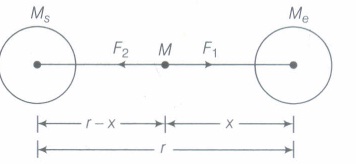
Let at the point P, the gravitational force on the rocket due to Earth
= gravitational force on the rocket due to Sun
Let x = distance of the point P from the Earth
Then \(\frac{G_m}{x^2}=\frac{GM}{(r-x)^2}\)
\(\Rightarrow\frac{(r-x)^2}{x^2}=\frac{M}{m}=\frac{2\times10^{30}}{6\times10^{24}}=\frac{10^6}{3}\)
\(\frac{r-x}{x}=\frac{10^3}{\sqrt 3}\Rightarrow \frac{r}{x}=\frac{10^3}{\sqrt 3}+1\simeq\frac{10^3}{\sqrt 3}\)
\(x=\frac{\sqrt 3 r}{10^3}=\frac{1.732\times1.5\times10^{11}}{10^3}=2.6\times10^8m.\)
4.
\(3.42\times 10^{ 5 }km\)
5.
\(3.468\times 10^{ -10 }N\)
6.
Initial velocity of the particle \(=15 \mathrm{~km} / \mathrm{s}\) Let its speed be V at intersteller space
\( \therefore\left(\frac{1}{2}\right) m\left[15 \times 10^3-v^2\right]=\int_R^{\infty} \frac{G M m}{x^2} d x \)
\( \Rightarrow\left(\frac{1}{2}\right) m\left[\left(15 \times 10^3\right)^2-v^2\right]=G M m\left[\frac{-1}{x}\right] \)
\( \Rightarrow\left(\frac{1}{2}\right) m\left[\left(225 \times 10^5\right)-v^2\right]=\frac{G M m}{R} \)
\( \Rightarrow 225 \times 10^5-v^2 \frac{2 \times 6.67 \times 10^{-11} \times 6 \times 10^{24}}{6400 \times 10^3} \)
\( \Rightarrow v^2=225 \times 10^6-\frac{40.02}{32} \times 10^8 \)
\(=2.25 \times 10^8-1.2 \times 10^8 \)
\(=10^8(1.05) \)
\( \text { orv }=1.01 \times 10^4 \mathrm{~m} / \mathrm{s} \)
\( =10 \mathrm{~km} / \mathrm{s}\)
7.
To solve this question, we use the Kepler’s third law. This states that the square of the period of the revolution of all the planets about the sun is directly proportional to the cube of the mean distance between the planets and the sun. This can be mathematically given as
T2 ∝ R3
⇒T2=kR3 where T is the period of the revolution of a planet around the sun, R is the mean radius of the planet to the sun.
Hence, we can write by comparison between two planets, that
\(\frac{T_1^2}{T_2^2}=\frac{R_1^3}{R_2^3}\)
We can use any planet with a known distance and period as the second planet. We choose earth.
\(\frac{T_N^2}{T_E^2}=\frac{R_N^3}{R_E^3}\) where the subscript N and E stands for Neptune and Earth respectively.
For earth, the period is 1 year. Hence, write that
\( \frac{165^2}{1^2}=\frac{R_N^3}{R_E^3} \)
\( \Rightarrow R_N^3=165^2 R_E^3\)
Hence, by finding the cube root of both sides, we have
\(R_N=\sqrt[3]{165^2} R_E\)
⇒RN=30RE
Radius of the earth is about 1.50×10¹¹m
Hence, RN=30(1.50×10¹¹)=4.5×10¹²m
8.
Acceleration due to gravity at depth d from the earth's surface is given by
\({ g }^{ ' }=g\left( 1-\frac { d }{ { R }_{ e } } \right) \)
Therefore, acceleration due to gravity decreases with increasing depth.
9.
Gravitational attraction between two point objects are given as:
\(F = \dfrac{{G{M_1}{M_2}}}{{{r^2}}}\)…….(1)
Where,
F is the attractive force,
G is gravitational constant,
M1 and M2 are the masses of two objects,
r is the distance between the center of masses of the two objects.
The volume of a sphere of radius R is given by:
\(V = \dfrac{4}{3}\pi {R^3}\)……. (2)
Where,
V is the volume of the sphere,
R is the radius of the sphere.
Mass of an object with given density and volume:
\(M = \rho .V\)……. (3)
Where,
M is the mass of the object,
ρ is the density of the object,
Complete step by step solution:
Given:
The radius of the smaller sphere is R.
The radius of a larger sphere is 2R.
The density of both spheres is ρ.
The spheres are kept with their surface touching each other.
To find: Contact force between the spheres.
Step 1:
Use eq.(2) in eq.(3) to get the mass of the first sphere of R as:
\(M_1=\rho \times\left(\frac{4}{3} \pi R^3\right) \)
\(\therefore M_1=\frac{4}{3} \pi \rho R^3\)
Step 2:
Similarly, Use eq.(2) in eq.(3) to get the mass of the first sphere of $2 R$ as:
\(M_2=\rho \times\left(\frac{4}{3} \pi(2 R)^3\right) \)
\(\therefore M_2=\frac{32}{3} \pi \rho R^3\)
Step 3:
For a uniform sphere, its center of mass always stays at its center. As they are kept just in touch so the distance between their center is r=R+2R=3R. Now, substitute r and the values of M1 and M2 obtained from eq.(4) and eq.(5) in eq.(1) to get the attractive force value as:
\(F=\frac{G \times\left(\frac{4}{3} \pi \rho R^3\right) \times\left(\frac{32}{3} \pi \rho R^3\right)}{(3 R)^2} \)
\( \therefore F=\frac{128}{81} G \pi^2 R^4 \rho^2
\)
10.
The orbital velocity in a circular orbit close to Earth is: \(v=\sqrt{\mathrm{gR}} \text {. }\)
The velocity required to escape is \(v_e=\sqrt{2 g R}\)
\(v_e-v=(\sqrt{2}-1) \sqrt{g R}\)
Hence additional velocity required is: \(v_e-v=0.414 \times \sqrt{9.8 \times 6400 \times 10^3}=3278.71 \frac{\mathrm{m}}{\mathrm{s}}=3.278 \frac{\mathrm{km}}{\mathrm{s}}\)

11th Standard CBSE Syllabus & Materials
11th Standard CBSE
CBSE 11th Business Studies Forms of Business Organisation Sample Question Papers Study Material - QB365 Set A
NEW11th Standard CBSE
CBSE 11th Business Studies Business, Trade and Commerce Sample Question Papers Study Material - QB365 Set A
NEW11th Standard CBSE
CBSE 11th Physics Waves Sample Question Papers Study Material - QB365 Set A
NEW11th Standard CBSE
CBSE 11th Physics Kinetic Theory Sample Question Papers Study Material - QB365 Set A



CBSE 11th Standard CBSE Subjects
CBSE Standards









