
 100% FREE ACCESS
11th Standard CBSE Syllabus & Materials
11th Standard CBSE
CBSE 11th Economics PART-A - Presentation of Data - New Sample Question Papers Study Material - QB365 Set A
NEW11th Standard CBSE
CBSE 11th Economics PART-A - Organisation of Data - New Sample Question Papers Study Material - QB365 Set A
NEW11th Standard CBSE
CBSE 11th Economics PART-A - Collection of Data - New Sample Question Papers Study Material - QB365 Set A
NEW11th Standard CBSE
CBSE 11th Economics PART-A - Introduction to Economics and Statistics - New Sample Question Papers Study Material - QB365 Set A
NEW11th Standard CBSE
CBSE 11th Business Studies International Trade Sample Question Papers Study Material - QB365 Set A
NEW11th Standard CBSE
CBSE 11th Business Studies Evolution and Fundamentals of Business Sample Question Papers Study Material - QB365 Set A

Published on: 04/10/2019
Mechanical Properties of Fluids
Download CBSE Class 11th Standard CBSE Physics question papers, sample papers, important questions, and previous year solved papers in PDF format. Get free study materials, NCERT solutions, and exam preparation resources for Class 11th Standard CBSE Physics
Questions + Answers key
Take MCQ Physics Test
1.
What are the three forms of energy possessed by a flowing fluid? Find their expressions.
2.
Derive the expression for excess pressure inside:
(a) a liquid drop
(b) a liquid bubble
(c) an air bubble.
3.
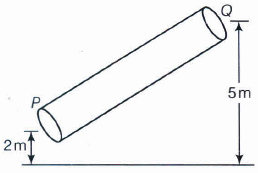
A non-viscous liquid of constant density 1000 kgm-3 flows in a streamline motion along a tube of variable cross-section. The tube is a kept inclined in the vertical plane as shown in figure. The area of cross-section of the tube at two points P and Q at heights of 2 m and 5 m are respectively, 4 x 10⁻³ m2 and 8 x 10⁻³ m2. The velocity of the liquid at point P is 1 ms-1. Find the work done per unit volume by the pressure and the gravity forces as the fluid flows from point P to Q.
4.
If a number of little droplets of water, each of radius r, coalesce to form a single drop of radius R, and the energy released is converted into kinetic energy then find out the velocity acquire by the bigger drop.
5.
If the terminal speed of a sphere of gold (density = 19.5\({ kg }/{ { m }^{ 3 } }\)) is 0.2m/s in viscous liquid (density = 19.5\({ kg }/{ { m }^{ 3 } }\)) is 0.2m/s in viscous liquid density (density = 1.5\({ kg }/{ { m }^{ 3 } }\)). Find out the terminal speed of a sphere of silver(density = 10.5\({ kg }/{ { m }^{ 3 } }\)) of the same size in the same liquid.
6.
Mercury has an angle of contact equal to 1400 with soda lime glass. A narrow tube of radius 1.00 mm made of this glass is dipped in a trough containing mercury. By what amount does the mercury dip down in the tube relative to the liquid surface outside? Surface tension of mercury at the temperature of th experiment is 0.456 N/m .Density of mercury? =13.6\(\times\)103 kg/m3
7.
Explain why?
A fluid flowing out of small hole in vessel results in a backward thrust on the vessel. According to Bernoulli's theorem, for horizontal flow of fluids, \(\left( p+\frac { 1 }{ 2 } \rho { v }^{ 2 }=constant \right) \) Therefore, when velocity of fluid increases, its pressure decreases and vice-versa.
8.
Explain why
(a) To keep a piece of paper horizontal, you should blow over, not under, it
(b) When we try to close a water tap with our fingers, fast jets of water gush through the openings between our fingers
(c) The size of the needle of a syringe controls flow rate better than the thumb pressure exerted by a doctor while administering an injection
(d) A fluid flowing out of a small hole in a vessel results in a backward thrust on the vessel (e) A spinning cricket ball in air does not follow a parabolic trajectory
9.
A liquid is kept in cylindrical vessel which is rotated along its axis. The liquid rises at the sides. If the radius of vessel is 0.05 m and the speed of rotation is 2 rev/s, find the difference in height of the liquid at the centre of the vessel and its sides.
10.
The reading of pressure meter attached with a closed pipe is \(3.5\times { 10 }^{ 5 }Nm^{ -2 }\) .On opening the valve of the pipe, the reading of the pressure meter is reduced to \(3.0\times { 10 }^{ 5 }Nm^{ -2 }\) .Calculate the speed of the water flowing in pipe.
1.
Three forms of energy possessed by a flowing fluid are as follows:
1. Pressure energy:
Let an ideal fluid of density P be contained in a rectangular vessel, provided with a small side tube at a depth ho below the free surface of fluid in the vessel. At the level of side tube, pressure of fluid along the axis of side tube
p = h0pg
If we want to introduce more fluid into the vessel at this very pressure, we can force it through the side tube by doing work on the piston, If 'A' be the cross-section area of the piston, then force acting on the piston F = PA.
\(\therefore\) Work done in moving the piston through a small distance \(\Delta r\) will be
\(\Delta W=F\Delta x=PA\Delta x=P\Delta V\)
As a result of motion of piston, the mass of the fluid forced in the vessel
\(\Delta m=\rho A\Delta x=\rho\Delta V\)
The work done is stored up in the liquid in the form of its pressure energy.
\(\therefore\) Pressure energy of liquid per unit mass = Work done per unit mass
\(=\frac{\Delta W}{\Delta m}=\frac{P\Delta V}{\rho\Delta V}=\frac{p}{\rho}\)
and pressure energy per unit volume = p.
2. Gravitational potential energy:
Let at any stage of its flow a fluid element of mass "m' be situated at a height 'h' from the reference line (generally taken to be earth's surface), then its gravitational potential energy in that position is mgh.
\(\therefore\) Gravitational potential energy per unit mass = \(\frac{mgh}{m}=gh\)
and gravitational potential energy per unit volume = pgh.
3. Kinetic energy:
Let at any stage of its flow, a fluid element of mass 'm' be moving with a speed 'v', then the kinetic energy of this fluid element is \(\frac{1}{2}v^2\)
\(\therefore\) Kinetic energy per unit mass = \(\frac{\frac{1}{2}mv^2}{m}=\frac{1}{2}v^2\)
and kinetic energy per unit volume = \(\frac{1}{2}\rho v^2\)
These three forms of energy possessed by a flowing fluid are mutually convertible from one form to another.
2.
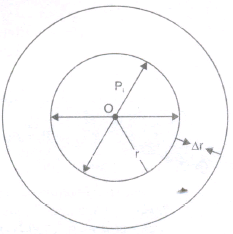
(a) Inside a liquid drop
Let r = radius of a spherieal liquid drop of centre O. T = surface tension of the liquid. Let Pi and Po be the values of pressure inside and outside the drop.
\(\therefore\) Excess pressure inside the liquid drop = Pi - Po
Let \(\Delta\)r be the increase in its radius due to excess pressure. It has one free surface outside.
\(\therefore\) increase in surface area of the liquid drop
= \(4\pi(r+\Delta r)^2-4\pi r^2\)
= \(4\pi[r^2+(\Delta r)^2+2r\Delta r-r^2]\)
= \(8\pi r\quad \Delta r\) .................(i)
\(\therefore\) increase in surface energy of the drop is
W = Surface tension x increase in area
= \(T\times 8\pi r\quad \Delta r\) .............. (ii)
Also W = Force due to excess of pressure x displacement
= Excess pressure x Area of drop x increase in radius
= \((p_i-p_0)4\pi r^2\Delta r\) ............(iii)
\(\therefore\) From eqns (ii) and (iii), we get
\((p_i-p_0)\times 4\pi r^2\quad \Delta r=T\times 8\pi r\quad \Delta r\)
\(\Rightarrow p_i-p_0=\frac{2T}{r}\)
(b) Inside a liquid bubbles:
A liquid bubble has air both inside and outside it and therefore it has two free surfaces.
Thus increase in its surfaces area
= \(2[4\pi (r+\Delta r)^2-4\pi r^2]\)
= \(2\times 8\pi r\Delta r=16\pi r\quad\Delta r\)
\(\therefore\) W = \(T\times 16\pi r\Delta r\) ...............(i)
Also W = \((p_i-p_0)4\pi r^2\times \Delta r\) ........(ii)
From eqnd (i) and (ii), we get
\((p_i-p_0)\times 4\pi r^2\times \Delta r=T.16\pi r\quad \Delta r\)
or \((p_i-p_0)=\frac{4T}{r}\)
(c) Inside an air bubble:
Air bubble is formed inside liquid, thus air bubble has one free surface inside it and liquid is outside.
If r = radius of air bubble
\(\Delta\)r = increase in its radius due to excess of pressure
(Pi - P0) inside it.
T = surface tension of the liquid in which bubble is formed.
\(\therefore\) increase in surface area = \(8\pi r \Delta r\).
\(\therefore\) W = T x \(8\pi r \Delta r\)
Also W = \((p_i-p_0)\times 4\pi r^2\Delta r\)
\(\therefore (p_i-p_0)\times 4\pi r^2\Delta r=T\times 8\pi r^2\Delta r\)
or \(p_i-p_0=\frac{2T}{r}\)
3.
Given, \(\rho =1000kg/{ m }^{ 3 }\), v1 = 1 m/s,a1 = \(4\times { 10 }^{ -3 }{ m }^{ 2 }\)
a2 = 8 x 10⁻³ m2,h1 = 2m,h2 = 5m
Apply Bernoulli's theorem,
\({ \rho }_{ 1 }+\frac { 1 }{ 2 } \rho { { v }_{ 1 } }^{ 2 }+g\rho { h }_{ 1 }={ \rho }_{ 2 }+\frac { 1 }{ 2 } \rho { { v }_{ 2 } }^{ 2 }+g\rho { h }_{ 2 }\)
\(\\ \left( { p }_{ 1 }-{ p }_{ 2 } \right) =\frac { 1 }{ 2 } \rho ({ { v }_{ 2 } }^{ 2 }-{ { v }_{ 1 } }^{ 2 })+\rho g({ h }_{ 2 }-{ h }_{ 1 })\)
Where,
\(\left( { p }_{ 1 }-{ p }_{ 2 } \right) \) = Work done by pressure per unit volume
\(\frac { 1 }{ 2 } \rho ({ { v }_{ 2 } }^{ 2 }-{ { v }_{ 1 } }^{ 2 })+\rho g({ h }_{ 2 }-{ h }_{ 1 })\)
From equation of continuity,
a1v1 = a2v2
\({ v }_{ 2 }=\frac { { a }_{ 1 }{ v }_{ 1 } }{ { a }_{ 2 } } =\frac { 4\times { 10 }^{ -3 }\times 1 }{ 8\times { 10 }^{ -3 } } =0.5m/s\)
\({ \left( \frac { W }{ Volume } \right) }_{ p }=\frac { 1 }{ 2 } \times 1000[0.25-1]+1000\times 10(5-2)\)
\(=-375+30,000=29625J/{ m }^{ 3 }\)
Work done per unit volume by the gravitational force
= \(\rho g({ h }_{ 1 }-{ h }_{ 2 })\)
= 1000 x 10(2 -5)
= -3 x 10⁴ J/m3
4.
Let n be the number of little droplets which coalesce to form a single drop. Then, Volume of n little droplets = Volume of single drop
\(n\times \frac { 4 }{ 3 } \pi { R }^{ 3 }=\frac { 4 }{ 3 } \pi { R }^{ 3 }\quad or\quad n{ r }^{ 3 }={ R }^{ 3 }\)
\(\\ Decrease\ in\ surface\ area\ =\ n\times 4\pi { r }^{ 2 }-4\pi { R }^{ 2 }\)
\(\\ =4\pi [n{ r }^{ 2 }-{ R }^{ 2 }]=4\pi \left[ \frac { n{ r }^{ 3 } }{ r } -{ R }^{ 2 } \right]\)
\( \\ =4\pi \left[ \frac { { R }^{ 3 } }{ r } -{ R }^{ 2 } \right] =4\pi { R }^{ 3 }\left[ \frac { 1 }{ r } -\frac { 1 }{ R } \right]\)
\( \\ The\ energy\ released,\)
\( \\ E=Surface\ tension\ \times \ decrease\ in\ sufface\ area\)
\(\\ =4\pi { SR }^{ 3 }\left[ \frac { 1 }{ r } -\frac { 1 }{ R } \right] \)
\(\\ The\ mass\ of\ bigger\ drop,\)
\(\\ M=\frac { 4 }{ 3 } \pi { R }^{ 3 }\times 1=\frac { 4 }{ 3 } \pi { R }^{ 3 }\)
\(\\ E=\frac { 4 }{ 3 } \pi { SR }^{ 3 }.3\left[ \frac { 1 }{ r } -\frac { 1 }{ R } \right] \)
\(\\ =3SM\left[ \frac { 1 }{ r } -\frac { 1 }{ R } \right] \quad \left[ \ \because M=\frac { 4 }{ 3 } \pi { R }^{ 3 } \right]\)
\( \because \ KE\ of\ bigger\ drop\ =Energy\ released\)
\(\\ \frac { 1 }{ 2 } M{ V }^{ 2 }=3SM\left[ \frac { 1 }{ r } -\frac { 1 }{ R } \right] \)
\(\\ V=\sqrt { 6S\left( \frac { R-r }{ Rr } \right) } \)
5.
\(1.76\times 10^{ -2 }{ N }/{ m }\)
6.
Given, angle of contact (\(\theta\)) =1400
Radius of tube (r) = 1mm = 10-3 m
Surface tension (S) = 0.465 N/m
Density of mercury (\(\rho\)) = 1.36\(\times\)103 kg/m3
Height of liquid rise or fall due to surface tension (h)
\(\frac { 2S\quad cos\theta }{ r\rho g } =\frac { 2\times 0.465\times cos\quad { 140 }^{ 0 } }{ 1\times { 10 }^{ -3 }\times 13.6\times { 10 }^{ 3 }\times 9.8 } \)
\(\\ =\frac { 2\times 0.465\times (-0.7660) }{ { 10 }^{ -3 }\times 13.6\times { 10 }^{ 3 }\times 9. } =5.34\times { 10 }^{ -3 }m\)
\(\\ =-5.34\ mm\)
\(\\ Hence,\ the\ mercury\ level\ wil\ depressed\ by\ 5.34\ mm\)
7.
A fluid flowing out of small hole in vessel have a large velocity and therefore, a large momentum. As no external force is acting, therefore according to law of conservation of momentum equal momentum in attained by the vessel. Therefore, a backward thrust \(\left( F=\frac { dp }{ dt } \right) \) acts on the vessel.
8.
(a) When air is blown under a paper, the velocity of air is greater under the paper than it is above it. As per Bernoulli’s principle, atmospheric pressure reduces under the paper. This makes the paper fall. To keep a piece of paper horizontal, one should blow over it. This increases the velocity of air above the paper. As per Bernoulli’s principle, atmospheric pressure reduces above the paper and the paper remains horizontal.
(b) By doing so the area of outlet of water jet is reduced, so velocity of water increases according to equation of continuity av = constant.
(c) The small opening of a syringe needle controls the velocity of the blood flowing out. This is because of the equation of continuity. At the constriction point of the syringe system, the flow rate suddenly increases to a high value for a constant thumb pressure applied.
(d) This is because of principle of conservation of momentum. While the flowing fluid carries forward momentum, the vessel gets a backward momentum.
(e) A spinning cricket ball has two simultaneous motions – rotatory and linear. These two types of motion oppose the effect of each other. This decreases the velocity of air flowing below the ball. Hence, the pressure on the upper side of the ball becomes lesser than that on the lower side. An upward force acts upon the ball. Therefore, the ball takes a curved path. It does not follow a parabolic path.
9.
0.02m
10.
Pressure ⇒ P1 = 3.5 × 10⁵N/m2
at end 1
Pressure ⇒P2 = 3.0×10⁵N/m2
end 2
\( \mathrm{v}_1=0(\because \text { Initially pipe was closed }) \)
\( \mathrm{v}_2=? \)
\( \text { Density of water }=\mathrm{s}=1000 \mathrm{Kg} \mid \mathrm{m}^3 \)
\(\text { Acc. to Bernoulli's theorem } \)
\( \text { for a horizontal pipe, } \)
\( P_1+\frac{1}{2} s v_1^2=P_2+\frac{1}{2} s v_2^2 \)
\( P_1=P_2+\frac{1}{2} s v_2^2 \)
\(v_2{ }^2=\frac{2\left(P_1-P_2\right)}{s} \)
\( v_2{ }^2=\frac{2\left(3.5 \times 10^5-3 \times 10^5\right)}{1000} \)
\( v_2{ }^2=\frac{3 \times 10^5 \times 0.5}{1000} \)
\( v_2=\sqrt{100} \)
\( v_2=10 \mathrm{~m} / \mathrm{s}
\)

11th Standard CBSE Syllabus & Materials
11th Standard CBSE
CBSE 11th Business Studies Forms of Business Organisation Sample Question Papers Study Material - QB365 Set A
NEW11th Standard CBSE
CBSE 11th Business Studies Business, Trade and Commerce Sample Question Papers Study Material - QB365 Set A
NEW11th Standard CBSE
CBSE 11th Physics Waves Sample Question Papers Study Material - QB365 Set A
NEW11th Standard CBSE
CBSE 11th Physics Kinetic Theory Sample Question Papers Study Material - QB365 Set A



CBSE 11th Standard CBSE Subjects
CBSE Standards









