
 100% FREE ACCESS
11th Standard CBSE Syllabus & Materials
11th Standard CBSE
CBSE 11th Economics PART-A - Presentation of Data - New Sample Question Papers Study Material - QB365 Set A
NEW11th Standard CBSE
CBSE 11th Economics PART-A - Organisation of Data - New Sample Question Papers Study Material - QB365 Set A
NEW11th Standard CBSE
CBSE 11th Economics PART-A - Collection of Data - New Sample Question Papers Study Material - QB365 Set A
NEW11th Standard CBSE
CBSE 11th Economics PART-A - Introduction to Economics and Statistics - New Sample Question Papers Study Material - QB365 Set A
NEW11th Standard CBSE
CBSE 11th Business Studies International Trade Sample Question Papers Study Material - QB365 Set A
NEW11th Standard CBSE
CBSE 11th Business Studies Evolution and Fundamentals of Business Sample Question Papers Study Material - QB365 Set A

Published on: 24/09/2019
Motion in a Straight Line
Download CBSE Class 11th Standard CBSE Physics question papers, sample papers, important questions, and previous year solved papers in PDF format. Get free study materials, NCERT solutions, and exam preparation resources for Class 11th Standard CBSE Physics
Questions + Answers key
Take MCQ Physics Test
1.
Two particles begin to fall freely from rest from the top of a tower within a gap of 1 s. How long after the first particle begins to fall, the two particles be 15 m apart? (Given g = 10 ms-2)
2.
Derive the three basic kinematic equations by calculus method.
3.
State the kinematic equations for uniformly accelerated motion.
4.
The speed-time graph of a particle moving along a fixed direction is shown in Fig. Obtain the distance traversed by the particle between
(a) t = 0 s to 10 s.
(b) t = 2 s to 6 s.
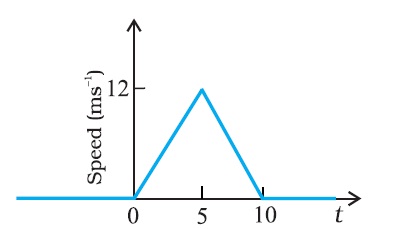
What is the average speed of the particle over the intervals in (a) and (b)?
5.
A ball is thrown upward with an initial velocity of 100 m/so After how much time will it return? Draw velocity-time graph for the ball and find from the graph.
(i) Maximum height attained by ball and
(ii) Height of the ball after 15 s. Take g = 10 ms-2.
6.
A train passes a station A at 40 kmh -I and maintains its speed for 7 km an? is then uniformly retarded, stopping at B which is 8.5 km from A. A second train starts from A at the instant the first train passes and being accelerated some part of the journey and uniformly retarded for the rest, stops at B at the same times as the first train. Calculate the maximum speed-of the second train, use only the graphical method.
7.
A motor boat covers the distance between two spots on the river in t1= 8 h and t2 = 12 h, downstream and upstream, respectively.What is the time required for the boat to cover this distance in still water?
8.
A juggler throws balls into air. He throws one whenever the previous one is at its highest point.How high do the balls rise if he throws n balls in each second? Take acceleration due to gravity as g.
9.
(i) Draw position-time graph for
(a) Accelerated motion
(b) Retarded motion
(ii) A juggler throws balls into air. He throws one whenever the previous one is at its highest point.How high do the balls rise if he throws n balls in each second? Take acceleration due to gravity as g.
10.
Two parallel rail tracks run North-South.Train A moves North with a speed of 54 kmh-1. and train B moves South with a speed of 90 kmh-1. What is the relative velocity of ground with respect to B?
1.
let the first particle takes time t to reach a position co-ordinate 15 m below the second particle. Obviously, the second body has fallen under gravity for a time (t -1) s only. Hence
15 = \({ y }_{ 1 }-{ y }_{ 2 }=\frac { 1 }{ 2 } gt^{ 2 }-\frac { 1 }{ 2 } g(t-1)^{ 2 }=gt-\frac { g }{ 2 } \)
or 15 = 10t - 5
\(\Rightarrow t=\frac { 15+5 }{ 10 } =2s.\)
2.
(i) Velocity attained by a particle after time t:
Let dt: be the change in velocity of the particle in time dt. Therefore, the acceleration of the particle is given by
\(a=\frac{dv}{dt} \ or \ dv=a \ dt\)
By integrating both sides, we get
\(\int{dv}= \int{a dt}\)
or \(\int{dv}= a \int{ dt}\)
or v = at + k --- (i)
where k is constant of integration.
when t = 0, v = u
Putting these values in equation (i), we get
k = u
Now putting the value of k in equation (i), we get
v = u + at
(ii) Displacement of the particle after time t:
Let dx be the displacement of the particle in time dt. Therefore, the velocity of the particle is given by
\(v=\frac{dx}{dt}\ or \ dx=vdt\)
Since v =u + at
∴ dx=(u+at)dt
Integrating both sides, we get
\(\int{dx}=\int{(u+at)}dt\)
or \(\int{dx}=\int{u}dt+\int{at \ dt}\)
\(x= u\int{dt}+a \int{t\ dt}\) [∵ u and a are constants]
or \(x=ut+a \frac{t^{2}}{2}+k\)
where k is constant of proportionality
where t = 0, x = x0
∴ from equation (ii), we get
\(x=x_{0}+ut+\frac{1}{2}at^{2}\)
or \(x-x_{0}=ut+\frac{1}{2}at^{2}\)
since x-x0= S, displacement of the particle in the time interval t.
S = \(ut+\frac{1}{2}at^{2}\)
(iii) Velocity attained by a particle after travelling a distance S:
We know, \(v=\frac{dx}{dt}\)
Multiplying and dividing R.H.S. by dv, we get
\(v=\frac{dx}{dt}.\frac{dv}{dv}=\frac{dx}{dv}.\frac{dv}{dt}\)
As \(\frac{dv}{dt}=a (acceleration)\)
∴ v = a\(\frac { dx }{ dv } \) or v dv=a dx
Integrating both sides, we get \(\int { v\ dv=\int { a\ dx=a\int { dx } } } \)
or = \(\frac { v^{ 2 } }{ 2 } \)ax+k
when x = 0,v = u
Then,from eqn.(i),k = \(\frac { u^{ 2 } }{ 2 } \)
Putting the value of k in eqn. (i), we get
\(\frac { v^{ 2 } }{ 2 } \)-ax+\(\frac { u^{ 2 } }{ 2 } \)
or \(\frac { v^{ 2 } }{ 2 } -\frac { u^{ 2 } }{ 2 } =ax\)
or v2-u2= 2ax
x = s, then
v2-u2 = 2 aS.
3.
For uniformly accelerated motion, we can derive some simple equations that relate displacement(x), time taken(t), Initial velocity(u), final velocity(v) and acceleration(a).
(i) Velocity attained after time t: The velocity-time graph for positive constant acceleration of a particle is shown in the figure.
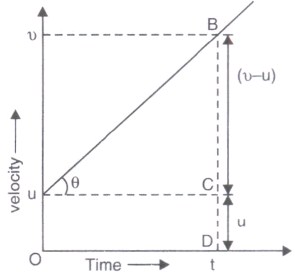
Let u be the initial velocity of the particle at t = 0 and v is the final velocity of the particle after time t. Consider two points A and B on the curve corresponding to t = 0 and t = t respectively.
Draw BD perpendicular to time axis. Also draw AC perpendicular to BD.
ஃ OA = CD = u;
BC = (v - u) and OD = t
Now slope of v-t graph = acceleration (a)
∴ a = slope of v - t graph = tan θ = \(\frac{BC}{AC}=\frac{BC}{OD} \ \ \ [∵ AC=OD]\)
∴ \(a=\frac{v-u}{t}\)
or v - u = at
v = u + at
(ii) Distance travelled in time t:
Let x0 position of the particle at t = 0 from the origin.
x = position of the particle at t = t from the origin.
∴ (x - x0) = S = distance travelled by the particle in the time interval (t - 0) = t
We know, distance travelled by a particle in the given time interval = area under velocity-time graph
∴ (x - x0) = Area OABD (see fig. above)
= Area of trapezium OABD
= \(\frac{1}{2}\) [Sum of parallel sides x perpendicular distance between parallel side]
=\(\frac{1}{2}(OA+BD)\times AC=\frac{1}{2}(u+v)t\)
Since v = u + at
∴ (x- x0) = \(\frac{1}{2}(OA+BD)\times AC = \frac{1}{2} (u+v) \times t\)
Since x - x0= S
∴ S = ut + \(\frac{1}{2}\)at2
(iii) Velocity attained after travelling a distance S:
We know, distance travelled by a particle in time t is equal to the area under velocitytime graph. Therefore, the distance (S) travelled by a particle during time interval tis given by
S = Area under v - t graph (see fig.) or
S = area of trapenium OABD
= \(\frac{1}{2}\)(sum of parallel sides) x perpendicular distance between these parallel
or S = \(\frac{1}{2}\)(OA + BD) x AC --- (i)
Now, acceleration, a = slope of v - t graph
or a = \(\frac{BC}{AC}=\frac{BD-CD}{AC}=\frac{v-u}{AC}\)
or \(AC=(\frac{v-u}{a})\) --- (ii)
Also OA = u and BD = v --- (iii)
Using equations (ii) and (iii) in equation (i), we get
\(S=\frac{1}{2}(v+u)\frac{(v-u)}{a}=\frac{v^{2}-u^{2}}{2a}\)
or, v2-u2 = 2aS
4.
(a) Distance travelled by the particle between t = 0 s to 10 s
= area of \(\Delta \)DAB = \(\frac { 1 }{ 2 } \) base x height
=\(\frac { 1 }{ 2 } \)x 10 x 12 = 60m
\(\therefore \) Average speed of particle vav = \(\frac { 60m }{ 10s } \)= 6 ms-1
(b) The distance traversed by the particle between
t = 2s to t = 6 s
= distance from 2 to 5 s (s1) + distance in 6th second (s2)
Now, u = 0, t = 5, v = 12 ms-1
\(\therefore \) Acceleration for 0 - 5 s, a =\(\frac { v-u }{ t } =\frac { 12-0 }{ 5 } \) ms-2 = 2.4 ms-2
∴ Distance covered from 2 to 5 s = distance covered in 5 s - distance covered in 2 s
S1 = \(\frac { 1 }{ 2 } a(5)^{ 2 }-\frac { 1 }{ 2 } a(2)^{ 2 }=\frac { 1 }{ 2 } \times 2.4\times \left[ (5)^{ 2 }-(2)^{ 2 } \right] \)
= 25.2 m.
For motion from 5 to 10 s, u = +12 ms-1 and a = -2.4 ms-2 and interval t = 5 s to t = 6 s means n = 1 for this motion.
∴ Distance covered in 6th second 52 = u + \(\frac { 1 }{ 2 } \)a (2n -1)
= 12 - \(\frac { 2.4 }{ 2 } \) (2 x 1-1 ) = 10.8 m
∴ Total distance covered from t = 2 s to 6 s = S1 + S2
= 25.2 + 10.8 = 36 m and average speed =\(\frac { 36M }{ (6-2)S } \) 9 ms-1.
5.
Here, u = 100 ms-1,g =- 10ms-1
At highest point, v=0
As v = u + gt
\(\Rightarrow \) 0 = 100 - 10\(\times \)t
Time taken to reach highest point
\(t=\frac { 100 }{ 10 } =10s\)
The ball will return to the ground at t = 20 s. Velocities of the ball at different instants of time will be as follows.
At t =0,\(v=100-10\times 0=100m{ s }^{ -1 }\)
At t =5 ,\(v=100-10\times 5=50m{ s }^{ -1 }\)
At t=10,\(v=100-10\times 10=0\)
At t=15,\(v=100-10\times 15=-50m{ s }^{ -1 }\)
At t = 20, \(v=100-10\times 20=-100m{ s }^{ -1 }\)
The velocity time-graph will be as shown in figure.
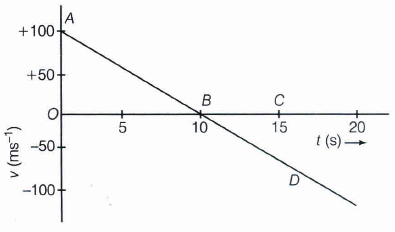
(i) Maximum height attained by ball
= Area of \(\Delta AOB\)
=\(\frac { 1 }{ 2 } \times 10s\times 100m{ s }^{ -1 }=500m\)
(ii) Height attained after 15 s
= Area of \(\Delta AOB\) + Area of \(\Delta BCD\)
= 500 + (15-10)x (- 50)
= 500-125 = 375 m
6.
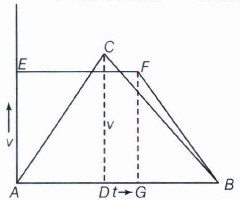
Area AEFG = AE x AG \(\Rightarrow \) 7 = 40 x AG
AG = \(\frac { 7 }{ 40 } h\)
Area FGB gives the distance covered under retardation, it is (8.5 -7) km = 1.5km
Area of \(\Delta FGB=\frac { 1 }{ 2 } GB\times FG\Rightarrow GB=\frac { 2\times 1.5 }{ 40 } h=\frac { 3 }{ 40 } h\)
Total time = \(\left( \frac { 7 }{ 40 } +\frac { 3 }{ 40 } \right) h=\frac { 1 }{ 4 } h\)
Area of
\(\Delta ACB=\frac { 1 }{ 2 } \times AB\times CD\)
\(8.5=\frac { 1 }{ 2 } \times \frac { 1 }{ 4 } \times v\)
\( v\ =8.5\times 8km{ h }^{ -1 }=68km{ h }^{ -1 }\)
7.
Given: t1=8 hr, t2=12 hr
Let, s be the distance between that two spots. Also assume that the velocity of the motor boat in still water is v and the velocity of flow of water is u.
Then, for downward journey,
\(\frac{\mathrm{s}}{\mathrm{t}_1}=\mathrm{v}+\mathrm{u}\)
For upward journey,
\(\frac{\mathrm{s}}{\mathrm{t}_2}=\mathrm{v}-\mathrm{u}\)
Adding equation (i) to (ii),
\( \frac{\mathrm{s}}{\mathrm{t}_1}+\frac{\mathrm{s}}{\mathrm{t}_2}=2 \mathrm{v} \)
\( 2 \mathrm{v}=\mathrm{s}\left[\frac{1}{8}+\frac{1}{12}\right]=s\left[\frac{5}{24}\right] \)
\(\mathrm{v}=\mathrm{s}\left[\frac{5}{48}\right] \Rightarrow \frac{\mathrm{s}}{\mathrm{v}}=\frac{48}{5}\)
Time required for boat to cover distance s in still water
\(\mathrm{t}=\frac{\mathrm{s}}{\mathrm{v}}\)
\(\therefore \mathrm{t}=\frac{48}{5}=9.6 \mathrm{hr}\)
Hence that proved
8.
Juggler throws the ball into the air with ball having initial velocity = u
At the highest point of its path velocity will be zero as at maximum height velocity =0
So final velocity=0
According to question juggler throws a ball each second so for "n" balls time taken to reach highest position (t)= 1/n
v=u+gt
0=u-g/n
-u=-g/n
u=g/n
S= ut-gt²/2
S=u/n-g/2n²
But u=g/n
S= g/n²-g/2n²
S=g/2n²
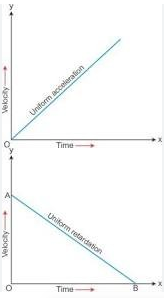
9.
(i) Draw position-time graph for
(a) Accelerated motion
(b) Retarded motion
(ii) Juggler throws the ball into the air with ball having initial velocity = u
At the highest point of its path velocity will be zero as at maximum height velocity =0
So final velocity=0
According to question juggler throws a ball each second so for "n" balls time taken to reach highest position (t)= 1/n
v=u+gt
0=u-g/n
-u=-g/n
u=g/n
S= ut-gt²/2
S=u/n-g/2n²
But u=g/n
S= g/n²-g/2n²
S=g/2n²
10.
Taking South to North direction as the positive direction
i.e., x-axis, we have \({ v }_{ A }=+54km/h=\frac { 54\times 1000 }{ 3600 } { ms }^{ -1 }=15ms^{ -1 }\)
\(\\ { v }_{ B }=-90km/h\ \)
\(=\frac { 90\times 1000 }{ 3600 } { ms }^{ -1 }=-25{ ms }^{ -1 }\)
Relative velocity of monkey with respect to train B
= 0- vB= 0 + 25 = 25ms-1
So, to an observer in train B, the Earth appears to move with a speed of 25 m/s from South to North.

11th Standard CBSE Syllabus & Materials
11th Standard CBSE
CBSE 11th Business Studies Forms of Business Organisation Sample Question Papers Study Material - QB365 Set A
NEW11th Standard CBSE
CBSE 11th Business Studies Business, Trade and Commerce Sample Question Papers Study Material - QB365 Set A
NEW11th Standard CBSE
CBSE 11th Physics Waves Sample Question Papers Study Material - QB365 Set A
NEW11th Standard CBSE
CBSE 11th Physics Kinetic Theory Sample Question Papers Study Material - QB365 Set A



CBSE 11th Standard CBSE Subjects
CBSE Standards









