
 100% FREE ACCESS
11th Standard CBSE Syllabus & Materials
11th Standard CBSE
CBSE 11th Economics PART-A - Presentation of Data - New Sample Question Papers Study Material - QB365 Set A
NEW11th Standard CBSE
CBSE 11th Economics PART-A - Organisation of Data - New Sample Question Papers Study Material - QB365 Set A
NEW11th Standard CBSE
CBSE 11th Economics PART-A - Collection of Data - New Sample Question Papers Study Material - QB365 Set A
NEW11th Standard CBSE
CBSE 11th Economics PART-A - Introduction to Economics and Statistics - New Sample Question Papers Study Material - QB365 Set A
NEW11th Standard CBSE
CBSE 11th Business Studies International Trade Sample Question Papers Study Material - QB365 Set A
NEW11th Standard CBSE
CBSE 11th Business Studies Evolution and Fundamentals of Business Sample Question Papers Study Material - QB365 Set A

Published on: 29/05/2021
QB365 Provides the HOT Question Papers for Class 11 Physics, and also provide the detail solution for each and every HOT Questions. HOT Questions will help to get more idea about question pattern in every exams and also will help to get more marks in Exams
Download CBSE Class 11th Standard CBSE Physics question papers, sample papers, important questions, and previous year solved papers in PDF format. Get free study materials, NCERT solutions, and exam preparation resources for Class 11th Standard CBSE Physics
Questions + Answers key
Take MCQ Physics Test1.
The efficiency of a Carnot engine is 1/2. If the sink temperature is reduced by 100o C, then engine efficiency becomes 2/3. Find
(i) sink temperature
(ii) source temperature
(iii) Explain, why a Carnot engine cannot have 100% efficiency?
2.
Aman went for a weekend trip with his parents and grandparents to a remote village. His grandfather showed him the fields and the crops they grow. As they moved forward, they saw that a bullock cart got struck in wet mud and the driver was not able to push it out by himself. Seeing him in distress, Aman ran to his help and together they pushed it out, but iron rim of the wheel came out.
They tried to put it on the wheel but it was smaller than diameter of wheel. Suddenly, he got an idea. He collected some wood and set them on fire and heated the rim and then rim easily slipped on the wheel. Cartman thanked Aman and moved away.
(i) What values of Aman does the incident show?
(ii) If the diameter of the rim and ring were 5.243 m and 5.231 m respectively at 27 \(^{0}\)C. To what temperature had Aman heated the ring so as to fit the rim of the wheel? Coefficient of linear expansion of iron = 1.20 x 10⁻⁵ K-1
(iii) Which property of solids is used in this phenomenon?
3.
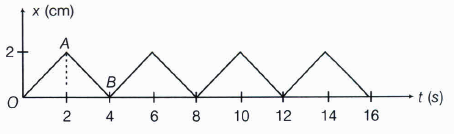
Figure below shows the position-time graph of a body of mass 0.04 kg. Suggest a suitable physical context for this motion. What is the time between two consecutive impulses received by the body? What is the magnitude of each impulse?
4.
Explain why? It is easier to pull a lawn mower than to push it.
5.
Just as precise measurements are necessary in science, it is equally important to be able to make rough estimates of quantities using rudimentary ideas and common observations. Think of ways by which you can estimate the following (where an estimate is difficult to obtain, try to get upper bound on the quantity).
The number of strands of hair on our head
6.
Just as precise measurements are necessary in science, it is equally important to be able to make rough estimates of quantities using rudimentary ideas and common observations. Think of ways by which you can estimate the following (where an estimate is difficult to obtain, try to get upper bound on the quantity).
The total mass of rain-bearing clouds over India during the monsoon.
1.
Efficiency , \(\eta =1-\frac { { T }_{ 2 } }{ { T }_{ 1 } } \)
where, T2 = sink temperature
T1 = source temperature.
\(1-\frac { { T }_{ 2 } }{ { T }_{ 1 } } =\frac { 1 }{ 2 } \quad ...(i)\)
\(\\ 1-\left( \frac { { T }_{ 2 }-100 }{ { T }_{ 1 } } \right) =\frac { 2 }{ 3 } \ ...(ii)\)
From Eq. (i), \(\frac { { T }_{ 2 } }{ { T }_{ 1 } } =\frac { 1 }{ 2 } \) and Eq. (ii)
\(\frac { { T }_{ 2 }-100 }{ { T }_{ 1 } } =\frac { 1 }{ 3 } \)
On dividing, we get
\(\frac { { T }_{ 2 } }{ { T }_{ 2 }-100 } =\frac { 3 }{ 2 } \Rightarrow { T }_{ 2 }=300K\)
(ii) Substituting in Eq.(i) T1 = 600K
(iii) As efficiency, \({ \eta }_{ 2 }\Rightarrow 1-\frac { { T }_{ 2 } }{ { T }_{ 1 } } \)
It equals to 1 only when \(\frac { { T }_{ 2 } }{ { T }_{ 1 } } =0\quad or\quad { T }_{ 2 }=0K\)
But absolute zero is not possible.
2.
(i) Aman loves nature and his helpful boy. He also has presence of mind as he thought of an excellent idea to help cartman.
(ii) \({ L }_{ 1 }=5.231m,{ L }_{ 2 }=5.243m,{ T }_{ 1 }=27 ^{0}C,{ T }_{ 2 }=?\)
As we know
\(\therefore { T }_{ 2 }-{ T }_{ 1 }=\frac { { L }_{ 2 }-{ L }_{ 1 } }{ { L }_{ 1 }\times \alpha } \)
\(\\ { T }_{ 2 }=\frac { { L }_{ 2 }-{ L }_{ 1 } }{ { L }_{ 1 }\alpha } \)
\({ T }_{ 2 }=\frac { 5.243-5.231 }{ 5.231\times 1.2\times { 10 }^{ -5 } } +27\)
\(\\ =218 \ ^{0} C\)
(iii) Linear expansion of solids i.e increase in length of solid on heating.
3.
Mass of the body,m = 0.04 kg
The position time graph OA from t = 0 to t = 2s is a straight line therefore body is moving with a constant velocity.
Velocity of the body,v=Slope of x-t graph
= \(\frac { 2-0 }{ 2-0 } =1cm/s={ 10 }^{ -2 }m/s\quad [\because 1\quad cm={ 10 }^{ -2 }m]\)
Part AB of position time graph is also a straight line.Therefore velocity of the body
\({ v }^{ \prime }=\frac { 0-2 }{ 0-2 } =-1\quad cm/s=-{ 10 }^{ -2 }cm/s\)
Negative sign shows that the direction of velocity is reversed after 2 s and it is being repeated.
A suitable physical context for this motion is a ball moving with a constant velocity of 10-2 m/s between two walls located at x=0 and at x=2m and rebounded repeadedtly on striking each wall.
magnitude of the impulse imparted to the ball after every two seconds
= chage in momentum of teh ball
= mv - mv' = m(v - v')
= \(0.04[{ 10 }^{ -2 }-(-{ 10 }^{ -2 })]=8\times { 10 }^{ -4 }kg-m/s\)
4.
In pulling a lawn mower, a force F is applied in upward direction, making an angle \(\theta \) with the horizontal [Fig]. Its vertical component in upward direction decreasing the effective weight of the mower.
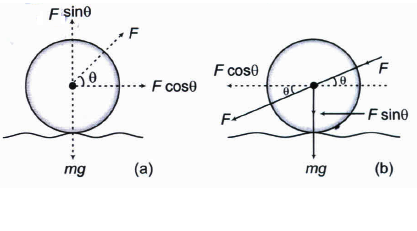
In pushing a lawn mower, a force F is applied in downward direction, making an angle \(\theta \) with the horizontal [Fig]. Its vertical component is in downward direction increasing the effective weight of the mower. Therefore, it is easier to pull a lawn mower than to push it.
5.
The number of strands of hair on our head
If we assume a uniform distribution of strands of hair on head then, the number of strands of hair
= Area of the head/Area of cross-section of hair
The thickness of a strand of hair is measured by an appropriate instrument, if it is obtained
d = 5 x 10-5 = 5 x 10⁻³ cm
Then, area of cross-section of human hair
\(=\pi \left( \frac { d }{ 2 } \right) ^{ 2 }=\frac { \pi d^{ 2 } }{ 4 } \)
\(\\ =\frac { 3.14\times (5\times 10^{ -3 })^{ 2 } }{ 4 } =\frac { 3.14\times 25 }{ 4 } \times 10^{ -6 }cm^{ 2 }\)
Average radius of human head (r)=8 cm
\(\because \) Area of human head \(=\pi r^{ 2 }=3.14\times (8)^{ 2 }\)
3.14 x 64 cm2
\(\therefore \)The number of strands of hair \(=\frac { 3.14\times 64 }{ 3.14\times \frac { 25 }{ 4 } \times 10^{ -6 } } \)
\(\approx 10\times 10^{ 6 }=10^{ 7 }\)
6.
The total mass of rain-bearing clouds over India during the monsoon
If meteorologist record 10 cm of average rainfall during monsoon then
Height of average rainfall (h) = 10 cm = 0.1 m
Area of India (A) = 3.3 million square km
= 3.3 x 10⁶ square km [\(\because \) 1 million = 106]
= 3.3 x 10⁶(103m)2
= 3.3 x 106 x 106m2 = 3.3 x 10¹²m2 [\(\because \) 1 km = 103]
Volume of rain water (V) = Area x height
= Axh = 3.3 x 10¹²m2 x 0.1m
=3.3x10¹¹m3
Density of water (\(\rho \) ) = 103 kg/m3
Mass of rain water (m) = Volume x Density
= m = vx
= 3.3 x 10¹¹m3 x 103 kg/m3
[Density = [\(\because \) mass/Volume]
= 3.3 x 10¹⁴ kg
Therefore, total mass of rain bearing clouds over India during the monsoon is 3.3 x 10¹⁴ kg.

11th Standard CBSE Syllabus & Materials
11th Standard CBSE
CBSE 11th Business Studies Forms of Business Organisation Sample Question Papers Study Material - QB365 Set A
NEW11th Standard CBSE
CBSE 11th Business Studies Business, Trade and Commerce Sample Question Papers Study Material - QB365 Set A
NEW11th Standard CBSE
CBSE 11th Physics Waves Sample Question Papers Study Material - QB365 Set A
NEW11th Standard CBSE
CBSE 11th Physics Kinetic Theory Sample Question Papers Study Material - QB365 Set A



NCERT Books

Syllabus

Exam Pattern

Sample Question Papers

Previous year Question Papers

Important Notes

MCQ Practice test

NCERT Exemplers

Case study Questions

Image Based Questions

Passage based Questions

HOT Questions

Value Based Questions

Model Questions Papers
NCERT ( Book Back ) Questions

Assertion and Reason
Important Questions And Answers

CBSE 11th Standard CBSE Subjects
CBSE Standards








