
 100% FREE ACCESS
11th Standard CBSE Syllabus & Materials
11th Standard CBSE
CBSE 11th Economics PART-A - Presentation of Data - New Sample Question Papers Study Material - QB365 Set A
NEW11th Standard CBSE
CBSE 11th Economics PART-A - Organisation of Data - New Sample Question Papers Study Material - QB365 Set A
NEW11th Standard CBSE
CBSE 11th Economics PART-A - Collection of Data - New Sample Question Papers Study Material - QB365 Set A
NEW11th Standard CBSE
CBSE 11th Economics PART-A - Introduction to Economics and Statistics - New Sample Question Papers Study Material - QB365 Set A
NEW11th Standard CBSE
CBSE 11th Business Studies International Trade Sample Question Papers Study Material - QB365 Set A
NEW11th Standard CBSE
CBSE 11th Business Studies Evolution and Fundamentals of Business Sample Question Papers Study Material - QB365 Set A

Published on: 26/05/2021
QB365 Provides the updated NCERT Exemplar Questions for Class
11, and also provide the detail solution for each and every NCERT Exemplar questions. NCERT Exemplar questions are latest updated question pattern from NCERT, QB365 will helps to get more marks in Exams
Download CBSE Class 11th Standard CBSE Physics question papers, sample papers, important questions, and previous year solved papers in PDF format. Get free study materials, NCERT solutions, and exam preparation resources for Class 11th Standard CBSE Physics
Questions + Answers key
Take MCQ Physics Test1.
A hoop of radius 2 m weighs 100 kg. It rolls along a horizontal floor so that its centre of mass has a speed of 20 cm/s. How much work has to be done to stop it?
2.
If C is rms speed of molecules in a gas and V is the speed of sound waves in the gas, show that c/v is constant and independent of temperature for all diatomic gases.
3.
Explain,
(i) why there is no atmosphere on moon.
(ii) there is fall in temperature with altitude
4.
An isolated container containing monatomic gas of molar mass m is moving with a velocity v0. If the container is suddenly stopped, find the change in temperature.
5.
The molecules of a given mass of a gas have root mean square speeds of 100 ms-1 at 270 C and 1.00 atm pressure. What will be the root mean square speeds of the molecules of the gas at 1270C and 2.0 atm pressure?
6.
The container shown in figure has two chambers, separated by a partition of volumes V1=2.0 L and V2 =3.0 L. The chambers contain \({ \mu }_{ 1 }=4.0\ and\ { \mu }_{ 2 }=5.0\) moles of a gas at pressure p1=1.00 atm and p2= 2.00 atm. Calculate the pressure after the partition is removed and the mixtures attains equilibrium.
| V1 | V2 |
| \({ \mu }_{ 1 }\) | \({ \mu }_{ 2 }\) |
| p1 | p2 |
7.
Identical springs of steel and copper are equally stretched.On which, more work will have to be done?
8.
An object if mass m is raised from the surface of the earth to a height equal to the radius of the earth, that is, taken from a distance R to 2R from the centre of the earth. What is the gain in its potential energy?
9.
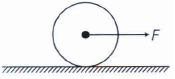
uniform disc of radius R is resting on a table on its rim. The coefficient of friction between disc and table is \(\mu \)(figure). Now, the disc is lled with a force F as shown in the figure. What is the maximum value of F for which the disc rolls without slipping?
10.
A car weighs 1800 kg. The distance between its front and back axles is 1.8 m. Its centre of gravity is 1.05 m behind the front axle. Determine the force exerted by the level ground on each front wheel and each back wheel.
11.
A hoop of radius 2m weighs 100 kg. It rolls along a horizontal floor so that its centre of mass has a speed of 20 cm/s. How much work has to be done to stop it?
12.
A child stands at centre of a turntable with his arms out stretched. The turntable is set rotating with an angular speed of 40 rev/min.
Show that child's new kinetic energy of rotations is more than the initial kinetic energy. How do you account for this increase in kinetic energy?
13.
A wheel in uniform motion about an axis passing through its centre and perpendicular to its plane is considered to be in mechanical (translation and rotational) equilibrium because no net external torque is required to sustain its motion.
However, the particles that constitute the wheel to experience a centripetal acceleration towards the centre. How do you reconcile this fact with the wheel begin in equilibrium?
How would you set a half wheel into uniform motion about an axis passing through the centre of mass of the wheel and perpendicular to its plane? Will you require external forces to sustain the motion?
14.
Two towns A and B are connected by a regular bus service witha bus leaving in either direction every t min. A man cycling with a speed of 20 km/h in the direction A to B notices that a bus goes past him every 18 min in the direction of his motion and every 6 min in the opposite direction .What is the period T of the bus servioce and with what speed ( assumed constant) do the buses ply on the road?
15.
A police van moving on a highway with a speed of 30 km h–1 fires a bullet at a thief’s car speeding away in the same direction with a speed of 192 km h–1. If the muzzle speed of the bullet is 150 m s–1, with what speed does the bullet hit the thief’s car ? (Note: Obtain that speed which is relevant for damaging the thief’s car).
1.
Here, R = 2m M = 100 kg
v = 20 cm/s = 0.2 m/s
Total energy of the hoop = \(\frac { 1 }{ 2 } { Mv }^{ 2 }+\frac { 1 }{ 2 } I{ \omega }^{ 2 }\)
= \(\frac { 1 }{ 2 } {Mv }^{ 2 }+\frac { 1 }{ 2 } (MR^{ 2 }){ \omega }^{ 2 }\)
=\(\frac { 1 }{ 2 } { Mv }^{ 2 }+\frac { 1 }{ 2 } { Mv }^{ 2 }={ Mv }^{ 2 }\)
Work required to stop the hoop = total energy of the hoop
W = Mv2 = 100 (0.2)2 = 4 Joule.
2.
From Kinetic theory of gases,
\(p=\frac { 1 }{ 3 } pc^{ 2 }\), where c is rms speed of molecules of gas.
\(\Rightarrow c=\sqrt { \frac { 3p }{ p } } \)
v = speed of sound in the gas = \(\sqrt { \frac { p }{ \Upsilon \rho } } \)
\(\Rightarrow from\ eqs.(i)\ and\ (ii)\)
\( \frac { c }{ v } =\sqrt { \frac { 3p }{ \rho } \times \frac { \rho }{ \Upsilon \rho } } =\sqrt { \frac { 3 }{ \Upsilon } } \)
Fer diatomic gases,
\(\Upsilon =1.4=\ constant\)
\(\\ \Rightarrow \frac { c }{ v } =\sqrt { \frac { 3 }{ 1.4 } } =1.46 =\ constant\)
3.
(i) The moon has small gravitational; force and hence the escape velocity is small .As the moon is in tyhe proximity of the earth as seen from the sun, the moon has the same amount of heat per unit area as that of the earth , The air molecules have l;arge range of speeds.
Even though the rms speed of the air molecules is smaller than the escape velocity on the moon, a significant number of molecules have speed greater than escape velocity and they escape.
Now, rest of the molecules arrange the speed distribution for the equilibrium temperature. Again, a significant number of molecules escape as their speeds exceed escape sppeed. Hence, over a long time the moon has lost most of its atmosphere.
(ii) As the molecules move higher , their potential energy increases and hence kinetic energy decreases and hence temperature reduces.
At greater height, more volume is available and gas expands and hencde some cooling takes place.
4.
Loss in kinetic energy of gas = \(\triangle E=\frac { 1 }{ 2 } (mn){ v }_{ 0 }^{ 2 }\)
where, n is number of moles mass.
If its temperature changes by \(\triangle T\) , then
\(n\frac { 3 }{ 2 } R\triangle T=\frac { 1 }{ 2 } mn{ v }_{ 0 }^{ 2 }\)
\(\therefore \) Change in temperature,\(\triangle T=\frac { m{ v }_{ 0 }^{ 2 } }{ 3R } \)
5.
According to ideal gas equation, we get
\(\frac { { p }_{ 1 }{ V }_{ 1 } }{ { T }_{ 1 } } =\frac { { p }_{ 2 }{ V }_{ 2 } }{ { T }_{ 2 } } \)
\(\\ \frac { { V }_{ 1 } }{ { V }_{ 2 } } =\frac { { p }_{ 2 }{ T }_{ 1 } }{ { p }_{ 1 }{ T }_{ 2 } } =\frac { 2\times 300 }{ 1\times 400 } =\frac { 3 }{ 2 } \)
\(\\ { p }_{ 1 }=\frac { 1 }{ 3 } \frac { M }{ { V }_{ 1 } } \left( { v }_{ rms } \right) _{ 1 }^{ 2 },\quad { p }_{ 2 }=\frac { 1 }{ 3 } \frac { M }{ { V }_{ 2 } } \left( { v }_{ rms } \right) _{ 2 }^{ 2 }\)
\(\\ \left( { v }_{ rms } \right) _{ 2 }^{ 2 }=\left( { v }_{ rms } \right) _{ 1 }^{ 2 }\times \frac { { V }_{ 2 } }{ { V }_{ 1 } } \times \frac { { p }_{ 2 } }{ { p }_{ 1 } }\)
\( \\=\left( 100 \right) ^{ 2 }\times \frac { 2 }{ 3 } \times 2\)
\(\\ or\ \left( { v }_{ rms } \right) _{ 2 }=\frac { 200 }{ \sqrt { 3 } } \ { ms }^{ -1 }\)
6.
\(Given,{ V }_{ 1 }=2.0\ L,{ V }_{ 1 }=3.0\ L,{ \mu }_{ 1 }=4.0\ moles,{ \mu }_{ 2 }\ =5.0\ moles\)
\(\\ { p }_{ 1 }=1.00atm,{ p }_{ 2 }=2.00atm\)
\(\\ { p }_{ 1 }{ V }_{ 1 }={ \mu }_{ 1 }{ RT }_{ 1 },{ p }_{ 2 }{ V }_{ 2 }={ \mu }_{ 2 }{ RT }_{ 2 }\)
\(mu ={ \mu }_{ 1 }+{ \mu }_{ 2 },V={ V }_{ 1 }+{ V }_{ 2 }\)
\(\\ For\quad 1\ \ mole,\ pV=\frac { 2 }{ 3 } E\ \)
\( For\ { \mu }_{ 1 }\ mole,\ { p }_{ 1 }{ V }_{ 1 }=\frac { 2 }{ 3 } { \mu }_{ 1 }{ E }_{ 1 }\)
\(\\ For\ { \mu }_{ 2 }\ mole,\ { p }_{ 2 }{ V }_{ 2 }=\frac { 2 }{ 3 } { \mu }_{ 2 }{ E }_{ 2 }\)
\(\\ Total\ energy\ is\ ({ \mu }_{ 1 }{ E }_{ 1 }+{ \mu }_{ 2 }{ E }_{ 2 })=\frac { 3 }{ 2 } ({ p }_{ 1 }{ V }_{ 1 }+{ p }_{ 2 }{ V }_{ 2 })\)
\(\\ p\left( { V }_{ 1 }+{ V }_{ 2 } \right) =\frac { 2 }{ 3 } \times \frac { 3 }{ 2 } ({ p }_{ 1 }{ V }_{ 1 }+p_{ 2 }{ V }_{ 2 })\)
\(\\ p=\frac { { p }_{ 1 }{ V }_{ 1 }+{ p }_{ 2 }{ V }_{ 2 } }{ { V }_{ 1 }+{ V }_{ 2 } } \ ---\ (i)\)
\(=\left( \frac { 1.00\times 2.0+2.00\times 3.0 }{ 2.0+3.0 } \right) =\frac { 8.0 }{ 5.0 } =1.60\ atm\)
7.
\(Work\ done\ in\ strtching\ a\ wire\ is\ given\ by\)
\(\\ W=\frac { 1 }{ 2 } F\times \triangle l\)
\(\\ As\ springs\ of\ steel\ and\ copper\ are\ equally\ streched.Therefore,for\ same\ force(F).\)
\(\\ W\propto \triangle l\)
\(\\ Young's\ modulus\ (Y)=\frac { F }{ A } \times \frac { l }{ \triangle l } \)
\(\\ or\ \triangle l=\frac { F }{ A } \times \frac { l }{ Y } \)
\(\\ As\ both\ springs\ are\ identical\)
\( \triangle l\propto \frac { 1 }{ Y } \)
\(\\ From \ Eqs.(i) \ and \ (ii),\ we \ get \ W\propto \frac { 1 }{ Y }\)
\( \\ \therefore \frac { { W }_{ steel } }{ { W }_{ copper } } =\frac { { Y }_{ copper } }{ { Y }_{ steel } } <1\ [as\ { Y }_{ steel }>{ Y }_{ copper }]\)
\(\\ or\ { W }_{ steel }\ <\ { W }_{ copper }\)
\(\\ Therefore,\ more\ work\ will\ be\ done\ for\ stretching\ copper\ spring.\)
8.
Gain in PE,
\(\triangle U={ U }_{ f }-{ U }_{ i }\)
\(=-\frac { GMm }{ 2R } -\left( -\frac { GMm }{ R } \right)\)
\( =\frac { GMm }{ R } \left( -\frac { 1 }{ 2 } +1 \right) =\frac { GMm }{ 2R } \)
\(\\ =\frac { (g{ R }^{ 2 })m }{ 2R } =\frac { 1 }{ 2 } mgR\ \left[ as\ g=\frac { GM }{ R^{ 2 } } \right] \)
9.
Let the acceleration of the centre of mass of disc be a, then , Ma = F - f
The angular acceleration of the disc is a =a/ R (if there is no sliding).
Then, \(\left( \frac { 1 }{ 2 } M{ R }^{ 2 } \right) \alpha \) = Rf \(\Rightarrow \) Ma =2f
Thus, f = F /3.Since, there is no sliding.
\(\Rightarrow \) f <\(\mu \) F\(\le \) 3\(\mu \) Mg
10.
Total mass of the car = 1800kg
Let m and (900-m)kg be the masses of each front wheel and each back wheel, respectively.
Distance of centre of gravity from the back axle = 1.80-1.05 = 0.75m
Taking torque about centre of gravity,
\(m\times 1.05=(900-m)\times 0.75\)
\(\\ 1.05m+0.75m=900\times 0.75\)
\(1.80m=900\times 0.75\)
\(\\ m=\frac { 900\times 0.75 }{ 1.80 } =375kg\)
\( \therefore \ (900-m)=900-375=525kg\)
\(\\ \therefore \ Weight\ of\ each\ front\ wheel(w_{ 1 })={ m }_{ 1 }g\)
\({ (w }_{ 1 })=375\times 9.8=3675N\)
Forced exerted by the level ground on each front wheel.
= force exerted by each front wheel on the level ground \({ (w }_{ 1 })=3675N\)
Weight of each back wheel (\({ w }_{ 2 }\))=525 x 9.8= 5145N
Forced exerted by the level ground on each back wheel = 5145N.
11.
Moment of inertia of hoop about its centre
\(I={ MR }^{ 2 }\)
and energy of loop = translational kinetic energy of CM and rotational kinetic energy about axis through CM.
\(=\frac { 1 }{ 2 } { mv }_{ CM }^{ 2 }+\frac { 1 }{ 2 } { I\omega }^{ 2 }\quad \quad \quad \left[ I={ mR }^{ 2 }and\quad \omega =\frac { v }{ R } \right] \)
\(=\frac { 1 }{ 2 } { mv }_{ CM }^{ 2 }+\frac { 1 }{ 2 } { MR }^{ 2 }\times \frac { { v }_{ CM }^{ 2 } }{ { R }^{ 2 } } ={ mv }_{ CM }^{2}\)
Work done is stopping the hoop
= total KE of loop
= \({ mv }_{ CM }^{ 2 }\) = \(100\times { \left( 0.2 \right) }^{ 2 }=4J\).
12.
Initial KE = \(\frac { 1 }{ 2 } { I }_{ i }{ \omega }_{ i }^{ 2 }=\frac { 1 }{ 2 } \times{ I }_{ i }\times(40{ ) }^{ 2 }\)
\(=\frac { 1 }{ 2 } \times{ I }_{ i }\times1600=800{ I }_{ i }\)
Final KE = \(\frac { 1 }{ 2 } { I }_{ f }{ \omega }_{ f }^{ 2 }=\frac { 1 }{ 2 } \times\frac { 2 }{ 5 } { I }_{ i }\times(100{ ) }^{ 2 }\)
\(=\frac { 1 }{ 2 } \times\frac { 2 }{ 5 } \times{ I }_{ i }\times100\times100=2000{ I }_{ i }\)
Clearly, final KE > initial KE. This energy is obtained from conversion of muscular work in KE. Muscular work has to be done in folding of arms.
13.
The centripetal acceleration in a wheel arise due to internal elastic forces which in pairs cancel each other. So the system remains in equilibrium during rolling.
In a half wheel, the system is not symmetrical so, direction of angular momentum does not coincide with the direction of angular velocity and hence an external torque is required to maintain the rotation.
14.
let v km/h be the constant speed with which the buses plying between the towns A and B .The relative velociy of the bus ( for the motion A to B ) with respect to the cyclist ( i.e. in the direction in which the cyclist is going = ( v - 20 ) kmh-1.The relative velocity of the bus from B to A with respect to then cyclist ( v + 20 ) km/h.
the distance travellled by the bus in time T(minutes) = vT
As per question ,
\(\frac{vT}{v-20} \) = 18 or vT = 18v - 18\(\times\)20 .....(i)
and \( \frac{vT}{v-20}\) = 6 or 6v + 20 \(\times\)6.........(ii)
By Eqs.(i) and (ii), we get
18 v -18\(\times\)20 = 6v +20\(\times\)6
or 12 v = 20\(\times\)6 +18\(\times\)20
= 480
or v = 40 km/h
Putting this value of v in Eq. (i) , we get
40T = 18\(\times\) 40 -18\(\times\)20
= 18\(\times\)20
T = 18\(\times\)20 / 40
= 9 min
15.
Muzzle speed of the bullet,
v = 150 ms-1
= 150\( \times \) \(\frac{18}{5}\)
= 540 kmh-1
Speed of police van, vp = 30 km/h
speed of the thief's car, vr = 192 km/h
Since the bullet is sharing the velocity of the police van, its effectively velocity is
vB = v + vP
= 540 +30
= 570 km /h
Since the speed of the bullet w.r.t the thief's car ,oving in the same direction .
vBT = vB - vT
= 570 - 192
= 378 km / h
= \( \frac{378 \times 1000}{60 \times 60 } \)
= 105 ms-1

11th Standard CBSE Syllabus & Materials
11th Standard CBSE
CBSE 11th Business Studies Forms of Business Organisation Sample Question Papers Study Material - QB365 Set A
NEW11th Standard CBSE
CBSE 11th Business Studies Business, Trade and Commerce Sample Question Papers Study Material - QB365 Set A
NEW11th Standard CBSE
CBSE 11th Physics Waves Sample Question Papers Study Material - QB365 Set A
NEW11th Standard CBSE
CBSE 11th Physics Kinetic Theory Sample Question Papers Study Material - QB365 Set A



NCERT Books

Syllabus

Exam Pattern

Sample Question Papers

Previous year Question Papers

Important Notes

MCQ Practice test

NCERT Exemplers

Case study Questions

Image Based Questions

Passage based Questions

HOT Questions

Value Based Questions

Model Questions Papers
NCERT ( Book Back ) Questions

Assertion and Reason
Important Questions And Answers

CBSE 11th Standard CBSE Subjects
CBSE Standards








