
 100% FREE ACCESS
11th Standard CBSE Syllabus & Materials
11th Standard CBSE
CBSE 11th Economics PART-A - Presentation of Data - New Sample Question Papers Study Material - QB365 Set A
NEW11th Standard CBSE
CBSE 11th Economics PART-A - Organisation of Data - New Sample Question Papers Study Material - QB365 Set A
NEW11th Standard CBSE
CBSE 11th Economics PART-A - Collection of Data - New Sample Question Papers Study Material - QB365 Set A
NEW11th Standard CBSE
CBSE 11th Economics PART-A - Introduction to Economics and Statistics - New Sample Question Papers Study Material - QB365 Set A
NEW11th Standard CBSE
CBSE 11th Business Studies International Trade Sample Question Papers Study Material - QB365 Set A
NEW11th Standard CBSE
CBSE 11th Business Studies Evolution and Fundamentals of Business Sample Question Papers Study Material - QB365 Set A

Published on: 15/02/2019
Units and Measurements Important Questions
Download CBSE Class 11th Standard CBSE Physics question papers, sample papers, important questions, and previous year solved papers in PDF format. Get free study materials, NCERT solutions, and exam preparation resources for Class 11th Standard CBSE Physics
Questions + Answers key
Take MCQ Physics Test
1.
Obtain the dimensions of relative density
2.
Let us consider an equation \(\frac { 1 }{ 2 } { mv }^{ 2 }=mgh\) where m is the mass of the body, v its velocity, g is the acceleration due to gravity and h is the height. Check whether this equation is dimensionally correct.
3.
Find the value of 1 J of energy in CGS system of units.
4.
If \(x=a+bt+ct^{ 2 }\), where x is in meters and t is second, what is the dimensional formula of c?
5.
Are all constant dimensionless?
6.
Write the dimensional equation of molar gas constant R.
7.
The speed of sound in a solid is given by the formula \(V=\sqrt { \frac { E }{ \rho } } \) where, E is coefficient of elasticity and p is density of given solid. Check the relation by method of dimensional analysis.
8.
Suppose we use a physical balance to measure the mass of an object and find the mean value of our observation to be 156.28 g. Represent this result correctly.
9.
Precisions describes the limitations of the measuring instruments. It is statements false?
10.
Are inertial and gravitational mass of a body different from one another?
11.
It is claimed that the two cesium clocks, if allowed to run for 100 yr, free from any disturbance, may differ by only about 0.02 s. What does this imply for the accuracy of the standard cesium clock in measuring a time interval of 1s?
12.
A student measures the thickness of a human hair by looking at it through a microscope of magnification 100. He makes 20 observations and finds that the average width of the hair in the field of view of the microscope is 3.5 mm. What is the estimate on the thickness of hair ?
13.
Define one Barn.How it is related with metre?
14.
Human heart is an inbuilt clock.comment.
15.
Write down the number of significant figure in the following.
0.060
16.
Is it possible to have length and velocity both as fundamental quantities? Why?
17.
Suresh went to London to his elder brother Lalit who is a Civil Engineer there. Suresh found there the currency is quite different from his country. He could not understand pound and how it is converted into rupees. He asked there an Englishman how far is the Central London from here. He replied that it is 16 miles. Suresh again got confused because he never used these units in India. In the evening Suresh inquired all about it. His brother told him about the unit system used in England. He explained his brother that here F.P.S. system is used. It means, distance is measured in foot, mass in pound and time in seconds whereas in India it is MKS system.
(i) What values are displayed by Suresh?
(ii) How many unit systems are there?
18.
the force experienced by a mass moving with a uniform speed v in a circular path of radius experiences a force which depends on its mass, speed and radius. Prove that the relation is \(f=\frac { m{ v }^{ 2 } }{ r } \)
19.
The nearest star to our solar system is 4.29 light years away. How much is this distance in terms of par sec? How much parallax would this star show viewed from two locations of the earth six months apart in its orbit around the sun?
20.
In successive measurements, the reading of the period of oscillation of a simple pendulum were found to be 2.63 s,2.56 s,2.42 s,2.71 s and 2.80 s in an experiment.Calculate mean absolute error
21.
A physical quantity x is calculated from the relation \(x=\frac { { a }^{ 3 }{ b }^{ 3 } }{ c\sqrt { d } } \). If percentage error in a, b, c, d are 2%, 1%, 3% and 4%, respectively. What is percentage error in x?
22.
Obtain a relation between the distance travelled by a body in time t, if its initial velocity be u and acceleration f.
23.
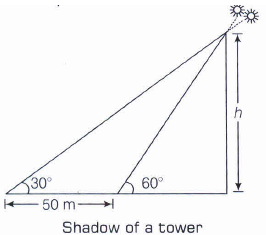
The shadow of a tower standing on a level plane is found to be 50 m longer when Sun's altitude is 30° than when it is 60°. Find the height of the tower.
24.
A calorie is a unit of heat (energy in transit) and it equals about 4.2 J where 1J = 1 kg-m2/s2 .Suppose we employ a system of units in which the unit of mass equals α kg, the unit of length equals β m, the unit of time is γ s. Show that a calorie has a magnitude 4.2 α –1 β –2 γ 2 in terms of the new units.
25.
A large fluid star oscillates in shape under the influence of its own gravitational field. Using dimensional analysis, find the expression for period of oscillation (T) in terms of radius of star (R). Mean density of fluid (p) and universal gravitational constant (G).
26.
Two resistors of resistance \({ R }_{ 1 }=\left( 100\pm 3 \right) \Omega \) and \({ R }_{ 2 }=\left( 200\pm 4 \right) \Omega \) are connected (i) in series, (ii) in parallel. Find the equivalent resistance of the parallel combination.
Use for the relation \(\frac { 1 }{ { R }^{ ' } } =\frac { 1 }{ { R }_{ 1 } } +\frac { 1 }{ { R }_{ 2 } } \) and \(\frac { { \triangle R }^{ ' } }{ { R }^{ { '2 } } } =\frac { \triangle { R }_{ 1 } }{ { R }_{ 1 }^{ 2 } } +\frac { \triangle { { R }_{ 2 } } }{ { R }_{ 2 }^{ 2 } } \).
27.
The Sun is a hot plasma (ionized matter) with its inner core at a temperature exceeding 107 K, and its outer surface at a temperature of about 6000 K. At these high temperatures, no substance remains in a solid or liquid phase. In what range do you expect the mass density of the Sun to be, in the range of densities of solids and liquids or gases ? Check if your guess is correct from the following data : mass of the Sun = 2.0 ×1030 kg, radius of the Sun = 7.0 × 10⁸ m
1.
As relative density is defined as the ratio of the density of given substance and the density of standard distance (water), it is a dimensionless quantity.
2.
The dimensions of LHS are \([\mathrm{M}]\left[\mathrm{L} \mathrm{T}^{-1}\right]^{2}=[\mathrm{M}]\left[\mathrm{L}^{2} \mathrm{~T}^{-2}\right]\)
\(=\left[\mathrm{M} \mathrm{L}^{2} \mathrm{~T}^{-2}\right]\)
The dimensions of RHS are \([\mathrm{M}]\left[\mathrm{L} \mathrm{T}^{-2}\right] \quad[\mathrm{L}]=[\mathrm{M}]\left[\mathrm{L}^{2} \mathrm{~T}^{-2}\right]\)
\(=\left[\mathbf{M} \mathrm{L}^{2} \mathrm{~T}^{-2}\right]\)
The dimensions of LHS and RHS are the same and hence the equation is dimensionally correct.
3.
107 CGS units.
4.
Here, x = [L]
t = [T]; x = ct2
[L] = c × [T2]
\(\Rightarrow \frac{[L]}{\left[T^2\right]}=c \Rightarrow c=\left[L T^{-2}\right]\)
5.
No, it is not possible.
6.
Molar gas constant [R]=[ML2T−2K−1mol−1]
7.
In the given relation dimensions of LHS terms v are [LT-1]. Dimensional formula for E and p are [ML-1T-2] and [ML-3].
Dimensions of RHS \(=\sqrt { \frac { { ML }^{ -1 }{ T }^{ -2 } }{ { ML }^{ -3 } } } =\sqrt { { L }^{ 2 }{ T }^{ -2 } } \)
= [LT-1]
As dimensions of LHS and RHS of the equation are same, Hence the equation is dimensionally correct.
8.
It least count of physical balance is 0.1 g, the mass measured will be correctly represented as m=(156.3±0.1)g
9.
No, the statement is true
10.
No, the inertial and gravitational mass of a body are equivalent.
11.
Given, Total time (t) = 100 yr
= 100 x 365\(\frac { 1 }{ 4 } \) days
= 100 x 365 \(\frac { 1 }{ 4 } \) x 24 h
= 100 x 365 \(\frac { 1 }{ 4 } \) x 24 x 60 x 60 s
Difference in time (\(\triangle \) t) = 0.02 s
Error in 1s = \(\frac { 0.02 }{ 100\times365\frac { 1 }{ 4 } \times24\times60\times60 } \)
\(\\ =\frac { 2\times{ 10 }^{ -2 }\times4 }{ 1461\times24\times36\times{ 10 }^{ 4 } }\)
\( \\ =6.34\times{ 10 }^{ -12 }s\)
\(\\ \approx { 10 }^{ -12 }s\)
Therefore, the accuracy of the standard cesium clock in measuring a time interval of 1 s is 10-12 s.
12.
Given, Magnification of microscope = 100
Observed width of the hair = 3.5 mm
Estimates on the thickness of hair is given by,
Magnification = \(\frac { observed \ width }{ Real \ width } \)
or Real width = \(\frac { Observed\ width }{ Magnification } =\frac { 3.5 }{ 100 } \)
= 0.035 mm
13.
One Barn is a small unit of area used to measure area of nuclear cross-section
∴ 1 barn = 10-28 m2.
14.
True, because human heart beats at a regular rate.
15.
Two
16.
No, since length is fundamental quantity and velocity is the derived quantity.
17.
(i) Sincerity, Curiosity, dedicated and helping nature
(ii) Unit system are :
(a) FPS system
(b) MKS system
(c) CGS system
18.
\(f\propto { m }^{ a }{ v }^{ b }{ r }^{ c }\)
\(\\ [f]=k[{ m] }^{ a }[{ v] }^{ b }[{ r] }^{ c }\)
where k is a constant
or \([ML{ T }^{ -2 }]=[{ M] }^{ a }[L{ T }^{ -1 }][{ L] }^{ c }\)
Compare the powers of M, Land T, we have
a = 1, b + C = 1 and - b = - 2
Solving above equations, we get
a = 1, b = 2 and c = - 1
\(\therefore\) f = kM1 v2 r-1
\(f=\frac { m{ v }^{ 2 } }{ r } \)
Here k=1
\(f=\frac { m{ v }^{ 2 } }{ r } \)
19.
Given, x = 4.29 light years = 4.29 x 9.46 x 1015 m
= \(\frac { 4.29\times9.46\times{ 10 }^{ 15 } }{ 3.08\times{ 10 }^{ 16 } } par\ sec\ =1.317par\ sec\)
\(\\ \theta =\frac { l }{ r } =\frac { 2AU }{ x } \)
Radius of the Earth orbit = 1 AU
= 1.496 x 10¹¹m
\(=\frac { 2\times1.496\times{ 10 }^{ 11 } }{ 4.29\times9.46\times{ 10 }^{ 15 } } rad\)
\(\\ =7.39\times{ 10 }^{ -6 }rad\)
\(\\ =.39\times{ 10 }^{ -6 }\times\frac { 180\times60\times60 }{ \pi } s=1.52s\)
20.
Mean absolute error\(=\frac { \sum { \left| \triangle { T }_{ i } \right| } }{ n }\)
\( \\ \triangle \overline { T } =\frac { 0.01+0.06+0.20+0.09+0.18 }{ 5 } \)
\(\\ =\frac { 0.54 }{ 5 } =0.108s=0.11s\)
21.
As, \(x=\frac { { a }^{ 3 }{ b }^{ 3 } }{ c\sqrt { d } } \)
\(\therefore \quad\frac { \triangle x }{ x } =\pm \left[ 2\frac { \triangle a }{ a } +3\frac { \triangle b }{ b } +\frac { \triangle c }{ c } +\frac { 1 }{ 2 } \frac { \triangle d }{ d } \right] \)
Percentage error in x is given by
\(\frac { \triangle x }{ x } \times 100\) = \(\pm\) \([2\times 2\)% + \(3\times 1\)% +3% + \(\frac { 1 }{ 2 } \times 4\)%\(]\)
\(=\pm 12\)%
22.
Let the distance covered is S,
Then S = K ua fb tc ; where k is a constant. Writing dimensions on both the sides, we have
[L] = [LT-1]a[LT-2]b[T]c
or [L] = [La+bT-a-2b+c]
Comparing powers on both sides, we get
1 = a + b
and 0 = - a - 2b + C
We have only two equations with three unknowns, therefore, we split the problem into two parts.
(a) Let the body have no acceleration,
then S = k1uatb
or [L] = [LT-1]a[T]b
= [LaT-a+b]
or a = 1
-a + b = 0 or b = 1
S = k1ut ------------------(i)
(b) Suppose the body has no initial velocity
then S=k2fatb
[L] = k2[LT-2]a[T]b
or [L] =[LaT-2a+b] or a = 1
- 2a + bOor b = 2a = 2
S = k2ft2 ------------------(ii)
If the body has both the initial velocity and acceleration comparing (i) and (ii), we get,
S = k1 ut + k2 ft2
This is the required equation
If we put k1= 1, k2 =\(\frac{1}{2}\), we get
S = ut +\(\frac{1}{2}\)ft2
23.
Given d=50 m, \({ \theta }_{ 1 }=60°,\quad { \theta }_{ 2 }=30°\)
h = \(\frac { d }{ \cot { { \theta }_{ 2 } } -\cot { { \theta }_{ 1 } } } =\frac { 50 }{ \cot { 30° } -\cot { 60° } } \)
or h = \(\frac { 50 }{ \sqrt { 3 } -1/\sqrt { 3 } } =\frac { 50\sqrt { 3 } }{ 3-1 } =25\sqrt { 3 } \)
= \(25\times 1.732\)
= 43.3 m
24.
The dimensional formula of energy = [ML2T-2]
Let M1 ,L1, T1 and M2 ,L2 ,T2 are the units of mass, length and time in given two systems
\(M_{ 1 }=1 \ kg,\quad M_{ 2 }=\alpha \ kg\)
\(\\ L_{ 1 }=1 \ m,\quad L_{ 2 }=\beta \ m\)
\(\\ T_{ 1 }=1 \ s,\quad T_{ 2 }=\gamma \ s\)
For any physical quantity, the product of its magnitude and unit is always constant
\({ n }_{ 1 }{ u }_{ 1 }={ n }_{ 2 }{ u }_{ 2 }\)
\(\\ or\ { n }_{ 2 }={ n }_{ 1 }\frac { u_{ 1 } }{ u_{ 2 } } =4.2\times [\frac { [{ M }_{ 1 }{ L }_{ 1 }^{ 2 }{ T }_{ 1 }] }{ [{ M }_{ 2 }{ L }_{ 2 }^{ 2 }{ T }_{ 2 }^{ -2 }] }\)
\( \\ =4.2\left[ \frac { { M }_{ 1 } }{ { M }_{ 2 } } \right] \times \left[ \frac { { L }_{ 1 } }{ { L }_{ 2 } } \right] ^{ 2 }\times \left[ \frac { { T }_{ 1 } }{ { T }_{ 2 } } \right] ^{ -2 }\)
\(\\ =4.2\left[ \frac { 1 }{ \alpha } \right] kg\times \left[ \frac { 1 }{ \beta } m \right] ^{ 2 }\left[ \frac { 1 }{ \gamma } s \right] ^{ -2 }\)
\(\\ n_{ 2 }=4.2{ \alpha }^{ -1 }{ \beta }^{ -2 }{ \gamma }^{ 2 } \text{ new unit}\)
\(\therefore \ 1 \ cal=4.2{ \alpha }^{ -1 }{ \beta }^{ -2 }{ \gamma }^{ 2 } \text{ new unit}\)
25.
Suppose period of oscillation T depends on radius of star R, mean density of fluid p and universal gravitational constant (G) as
T = kRapbGc, where k is a dimensionless constant
[M0L0T1] = [L]a[ML-3]b[M-1L3T-2]c
= Mb-cLa-3b+3c T-2c
Comparing powers of M,L and T, we have
b - c = 0
a - 3b + 3c = 0 and - 2c-=1
On simplifying these equations, we get
c = -1/2, b = -1/2, a = 0
Thus, we have T = kp-1/2G-1/2 =\(\frac { k }{ \sqrt { \rho G } } \)
26.
Here, \({ R }_{ 1 }=\left( 100\pm 3 \right) \Omega \), \({ R }_{ 2 }=\left( 200\pm 4 \right) \Omega \)
Parallel combination
\(\frac { 1 }{ { R }^{ ' } } =\frac { 1 }{ { R }_{ 1 } } +\frac { 1 }{ { R }_{ 2 } } \) \(=\frac { 1 }{ 100 } +\frac { 1 }{ 200 } =\frac { 3 }{ 200 } \)
\({ R }^{ ' }=\frac { 200 }{ 3 } =66.7\Omega \)
\(\frac { { \triangle R }^{ ' } }{ { R }^{ { '2 } } } =\frac { \triangle { R }_{ 1 } }{ { R }_{ 1 }^{ 2 } } +\frac { \triangle { { R }_{ 2 } } }{ { R }_{ 2 }^{ 2 } } \)
\({ \triangle R }^{ ' }=\triangle { R }_{ 1 }{ \left( \frac { { R }^{ ' } }{ { R }_{ 1 } } \right) }^{ 2 }+\triangle { { R }_{ 2 } }{ \left( \frac { { R }^{ ' } }{ { R }_{ 2 } } \right) }^{ 2 }\)
\(=3{ \left( \frac { 200 }{ 3\times 100 } \right) }^{ 2 }+4{ \left( \frac { 200 }{ 3\times 200 } \right) }^{ 2 }=1.8\Omega \)
\(\\ Hence,\quad { R }^{ ' }=\left( 66.7\pm 1.8 \right) \Omega \)
27.
Given, Mass of the Sun =\(2.0\times { 10 }^{ 30 }kg\)
Radius of the Sun =\(7.0\times { 10 }^{ 8 }m\)
Density of the Sun = \(\frac { Mass \ of \ the \ Sun \ (M) }{ Volume \ of \ the\ Sun \ (S) } \)
\(\left[ \therefore \text{Density}=\frac { Mass }{ Volume } \right] \)
\(\rho =\frac { M }{ \frac { 4 }{ 3 } \pi { R }^{ 3 } } =\frac { 3 }{ 4 } \frac { M }{ \pi { R }^{ 3 } }\)
\( \\ =\frac { 3\times 2.0\times { 10 }^{ 30 } }{ 4\times 3.14\times { (7.0\times { 10 }^{ 8 }) }^{ 3 } } \)
\(\\ =\frac { 3\times { 10 }^{ 30 } }{ 6.28\times 343\times { 10 }^{ 24 } }\)
\( \\ =1.392\times { 10 }^{ 3 }\)
\( \rho \approx 1.4\times { 10 }^{ 3 }kg/{ m }^{ 3 }\)
This density is the order of density of solids and liquids and not of gases.
The temperature of inner core of the sun is 107 K while the temperature of the outer layers is nearly 6000 K. At so high temperature, no matter can be exist in its solid or liquid state.
Every matter is highly ionised and present as a mixture of nucleus, free electr4onbs and ions which is called plasma. The density of plasma is so high due to inward gravitational attraction on outer layers due o inner layers of the sun.

11th Standard CBSE Syllabus & Materials
11th Standard CBSE
CBSE 11th Business Studies Forms of Business Organisation Sample Question Papers Study Material - QB365 Set A
NEW11th Standard CBSE
CBSE 11th Business Studies Business, Trade and Commerce Sample Question Papers Study Material - QB365 Set A
NEW11th Standard CBSE
CBSE 11th Physics Waves Sample Question Papers Study Material - QB365 Set A
NEW11th Standard CBSE
CBSE 11th Physics Kinetic Theory Sample Question Papers Study Material - QB365 Set A



CBSE 11th Standard CBSE Subjects
CBSE Standards









