
 100% FREE ACCESS
12th Standard CBSE Syllabus & Materials
12th Standard CBSE
CBSE 12th Economics Government Budget and the Economy Previous year Question Papers Study Material - QB365 Set A
NEW12th Standard CBSE
CBSE 12th Computer Science Interface Python with MySQL - New Previous year Question Papers Study Material - QB365 Set A
NEW12th Standard CBSE
CBSE 12th Computer Science Database Concept - New Previous year Question Papers Study Material - QB365 Set A
NEW12th Standard CBSE
CBSE 12th Computer Science Data Structures - New Previous year Question Papers Study Material - QB365 Set A
NEW12th Standard CBSE
CBSE 12th Computer Science Functions - New Previous year Question Papers Study Material - QB365 Set A
NEW12th Standard CBSE
CBSE 12th Computer Science Python Revision Tour I - New Previous year Question Papers Study Material - QB365 Set A

Published on: 20/08/2026
Download CBSE Class 12th Standard CBSE Computer Science question papers, sample papers, important questions, and previous year solved papers in PDF format. Get free study materials, NCERT solutions, and exam preparation resources for Class 12th Standard CBSE Computer Science
Questions + Answers key
Take MCQ Computer Science Test
1.
Explain wireless technology and give a brief note on the following
(a) Bluetooth (b) Radiowave
2.
How packet switching different from circuit switching?
3.
What is VolP?
4.
Expand the term SMTP. What is the use of SMTP?
5.
Out of the following, which is the fastest wired and wireless medium of transmission?
Infrared, Coaxial cable, Optical fibre, Microwave, Ethernet cable
6.
(a) Write the full forms of the following
(i) IP (ii) TCP
(b) What is the need of protocols?
7.
What is protocol? Which protocol is used to copy a file from/to a remote server?
8.
Write two advantages of using an optical fibre cable over an ethernet cable to connect two service stations, which are 190 m away from each other.
9.
In twisted pair cable, two insulated wires are twisted around each other which provides protection against noise. Explain.
10.
Differentiate between wired and wireless transmission.
11.
A composite signal contains frequencies between 500 MHz and 1GHz. What is the bandwidth of a signal?
12.
What is a protocol in data communication? Explain with an example.
13.
Write short note on the following:
(a) Bandwidth
(b) Data transfer rate
(c) Bluetooth
14.
Compare wired and wireless media.
15.
What is the significance of MAC address?
16.
Mention any two main advantages of using a network of computing devices.
17.
List various types of senders on a network.
18.
Do mobile phones have a MAC address? Is it different from the IMEI number of mobile phones?
19.
How is IP address different from MAC address? Discuss briefly.
20.
Explore how 5G can impact society.
21.
Sanjeevani is a big group of educational institutions with its head office in Hyderabad. It is planning to set up a new University in Amritsar. The Amritsar University Campus will have four blocks/buildings ADMIN, ACADEMIC, HOSTEL, SPORTS. You, as a network expert, need to suggest the best network-related solutions for them to resolve the issues/problems mentioned in points (i) to (v), keeping in mind the distances between various blocks/buildings and other given parameters.
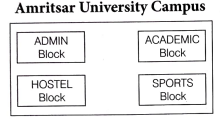
Block to Block distances (in Mtrs.)
FROM | TO | DISTANCE |
|---|---|---|
ADMIN | ACADEMIC | 60 M |
ADMIN | HOSTEL | 160 M |
ADMIN | SPORTS | 80 M |
ACADEMIC | HOSTEL | 40 M |
ACADEMIC | SPORTS | 120 M |
HOSTEL | SPORTS | 150 M |
Distance of Hyderabad Head Office from Amritsar University Campus = 2000 km.
Number of computers in each block is as follows:
ADMIN | 25 |
|---|---|
ACADEMIC | 600 |
HOSTEL | 120 |
SPORTS | 50 |
(i) Suggest the most appropriate location of the server inside the Amritsar University Campus. Justify your choice.
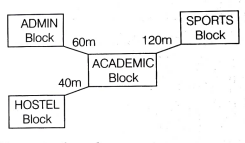
(ii) Draw the cable layout to efficiently connect various blocks within the Amritsar University Campus.
(iii) Name any two wired media that can be used to connect various computers of a block inside Amritsar Campus.
(iv) For the academic purpose, the University will provide its own 24 × 7 FM channel within the University Campus. Which communication medium, out of the following, is used by FM?
(A) Radio Waves
(B) Micro Waves
(C) Infrared Waves
(v) (a) The students will be attending a lot of and online academic sessions workshops. These will involve audio-visual communication. Write the full name of the protocol which will be used for such a communication through the internet.
Or (b) Where should a repeater be installed in Amritsar University campus to boost the signal between blocks? Justify your answer.
22.
A small company, "Creative Designs," has been experiencing consistently slow internet speeds in their office. They have several computers connected to a wireless router provided by their Internet service provider (ISP).
They primarily use the internet for web browsing, sending emails with attachments, and occasionally uploading large design files to a cloud storage service. Employees have been complaining about the time it takes to load web pages and the frequent delays in sending and receiving emails.
(i) What is the most probable cause of slow internet speeds experienced by multiple users connected to the same wireless router in the office?
(A) Problems with the physical wiring outside the office building.
(B) Inefficient routing protocols used by the ISP.
(C) Overcrowding of the wireless channel or interference from other devices.
(D) Incorrect IP address configurations on the individual computers.
(ii) If Creative Designs frequently uploads large design files, which factor related to their internet connection would most directly impact the time it takes for these uploads?
(A) The type of web browser used by the employees.
(B) The upload speed provided by their internet service plan.
(C) The domain name of their cloud storage service.
(D) The type of email client software they are using.
(iii) The office uses email extensively, often with attachments. Which network protocol is primarily responsible for sending these emails from their Computers?
(A) HTTP
(B) FTP
(C) SMTP
(D) POP3
(iv) If some employees are closer to the wireless router and experience faster speeds than those further away, what could be a contributing factor to this difference?
(A) The IP addresses assigned to the closer computers are prioritized.
(B) The wired connection to the ISP is experiencing intermittent issues.
(C) The signal strength of the wireless network weakens with distance.
(D) The web servers of the websites they are visiting are located further away.
(v) Creative Designs' ISP provided a wireless router. What is the primary function of this router in their local network?
(A) To store all the company's files and applications.
(B) To translate domain names into IP addresses.
(C) To facilitate communication between the computers on the local network and provide access to the internet.
(D) To manage the email accounts of all the employees.
1.
Wireless technology is also known. as unguided media. This media does not use any wires or cable for its connectivity in the network. It uses electromagnetic waves. Some of the wireless technologies are:
(i) Bluetooth
(ii) Radiowave
(iii) Infrared
(iv) Microwave
(v) Satellite communication
(a) Bluetooth It is used for exchanging data over a short distance from fixed and mobile devices. This type of media comes under PAN (Personal Area Network).
(b) Radiowave When two terminals are connected by using radio frequencies, then such type of communication is known as radiowave transmission. Radiowave transmission set-up has two parts.
• Transmitter Devices, which transmit signals are termed as transmitter.
• Receiver Devices, which receive signals are known as receiver.
2.
The differences between Packet Switching and Circuit Switching are as follows:
Packet Switching | Circuit Switching |
|---|---|
Data is broken into packets and transmitted independently. | A dedicated communication path is established for the entire duration of the call. |
More efficient for bursty data traffic, as the network resources are shared. | Less efficient, as the dedicated path remains unused if no data is being sent. |
Connection is established as needed, with no constant connection required. | A fixed, continuous connection is maintained throughout the session. |
Suitable for data, email, and internet traffic. | Suitable for voice calls and |
Example The internet, where packets are routed based on the current network conditions. | Example Traditional telephone networks. |
3.
VoIP is a technology that allows people to make voice calls using the internet instead of a traditional telephone line. Applications like skype, whatsApp, Zoom and google meet use VoIP.
4.
SMTP stands for Simple Mail Transfer Protocol.
SMTP is used for sending emails from one computer or mail server to another. It handles the outgoing mail-transfering messages from the sender's email client (like Outlook or Gmail) to the recipient's mail server.
5.
Wired → Optical fibre
Wireless → Microwave
6.
(a) (i) IP - Internet protocol
(ii) TCP- Transmission Control Protocol
(b) Protocol allows connected devices communicate with each other regardless of any differences in their internal processes, structure or design.
7.
A protocol is a set of rules that two or more computers must follow to communicate on a network. FTP (File Transfer Protocol) is used to copy a file from/to a remotely located server.
8.
Low power Because signals in optical fibres degrade less, lower power transmitters can be used.
Higher data rate Due to higher bandwidth, data rate of optical fibre is more than the data rate of ethernet cable (upto 1Gbps).
9.
Twisting the cables keeps them close together so that any external magnetic fields must cross both cable at the same time, so the interference created in one cable is cancelled by an almost equal and opposite amount of interference in the other cable.
10.
Differences between wired and wireless transmission are as follows:
Wired Transmission | Wireless Transmission |
|---|---|
These are also called guided | These are also called unguided media. |
In this media, the computers | In this media, the computers |
11.
Highest frequency (fH) = 1 GHz
= 1000 MHz
Lowest frequency (fL) = 500 MHz
Bandwidth (BW) = fH- fL
= 1000 MHz – 500 MHz
= 500 MHz
So, the bandwidth of the signal is: 500 MHz or 0.5 GHz.
12.
A protocol in data communication is a set of rules and standards that define how data is transmitted, received, and interpreted between devices in a network. It ensures that devices from different manufacturers can communicate correctly and efficiently.
Example
The HTTP (HyperText Transfer Protocol) is used for communication between a web browser and a web server. When you open a website, your browser uses HTTP to request the webpage, and the server responds using the same protocol to send the data back.
13.
(a) Bandwidth It refers to the maximum amount of data that can be transmitted Over a communication channel in a given period of time. It is measured in Hertz (Hz) - the difference between the highest and lowest frequencies in a signal.
(b) Data Transfer Rate It is the speed at which data is transmitted from one device to another. It indicates how quickly information can move across a network or connection and is also measured in bps, Kbps, Mbps, or Gbps.
(c) Bluetooth It is a short-range wireless communication technology used to connect devices like mobile phones, laptops, and headphones. It operates in the 2.4 GHz frequency range and allows data exchange within a range of about 10 meters.
14.
Basis | Wired Media | Wireless Media |
|---|---|---|
Transmission Medium | Uses physical cables like twisted pair, coaxial, or fiber optic. | Uses electromagnetic waves for data transmission. |
Speed and Reliability | Faster and more reliable. | Comparatively slower and affected by interference. |
Mobility | Limited mobility due to cables. | Provides high mobility and flexibility. |
Installation Cost | Costly and difficult to install over long distances. | Easier and cheaper to set up in large arears. |
15.
A MAC (Media Access Control) address is a unique identifier assigned to network devices, ensuring accurate data transmission and network security.
MAC addresses prevent data misrouting, enable secure communication, and simplify troubleshooting. They are essential for various network technologies, including Ethernet, Wi-Fi, and Bluetooth.
16.
The two main advantages of using a network of computing devices are as following:
1. Network of computing devices enhanced collaboration and communication, it enables:
• Real-time data sharing and synchronization.
• Video conferencing and online meetings.
• Instant messaging and email.
• Collaborative work on projects and documents.
2. Network of computing devices increased flexibility and scalability as a result:
• Easy to add new devices and users.
• Network architecture can be modified or expanded as needed.
• Network architecture can grow or shrink as organization needs change.
• Users can easily access network resources from anywhere, at any time.
17.
Ina network, various types of senders(or devices that transmit data) include:
• Computers (PCs, Laptops) Common devices that send data packets over a network to other devices Or servers.
• Servers Sends the data to clients in client-server models, such as web servers or database servers.
• Mobile Devices Smartphones and tablets that send the data through Wi-Fi or cellular networks.
• IoT Devices Sensors and smart devices that send the data continuously, often in small packets.
• Routers and Switches It sends routing information and forward data packets between network segments.
• Printers/Scanners Network-enabled printers or Scanners that send data to devices like computers.
18.
Yes, mobile phones have a MAC (Media Access Control) address, but it's not directly related to the IMEI (International Mobile Equipment Identity) number. MAC address, typically represented by 12-digit hexadecimal code (e.g., 00:11:22:33:44:55) and is used for device authentication and security within local networks.
In contrast, the IMEI is a 15-digit numerical identifier (e.g., 987892365389002) that uniquely identifies the device at an international level and is tied to its hardware.
19.
IP address different from MAC address are as follows
IP Address | MAC Address |
|---|---|
An IP address is a logical address used for routing data packets between networks. | A MAC address is a physical address assigned by the device manufacturer for local network communication. |
It is assigned by a network administrator and changes with each network Connection. | It is unique and permanent identifier, remaining static across networks. |
An IP address is typically 32 bits (IPv4) or 128 bits (IPv6) in length. | A MAC address is 48 bits (6 bytes) in length and represented in hexadecimal format. |
IP addresses function at the network layer. | MAC address operate at the data-link layer. |
20.
5G has the ability to significantly impact society by enabling faster, more reliable communication and Supporting a wide range of new technologies.
Main areas of impact include:
• Enhanced Connectivity 5G offers faster data speeds and lower latency, improving internet access and connectivity for smart cities, IoT devices, and remote areas.
• Healthcare Remote surgeries, telemedicine, and real-time patient monitoring can be easily done with 5G, improving healthcare delivery and outcomes.
• Industry and Automation 5G will accelerate industry 4.0 by enabling more advanced automation, real-time monitoring, and the use of Al in manufacturing, logistics, and supply chains.
• Entertainment and Media 5G will enable higher-quality streaming, VR, and AR experiences, transforming gaming, education and other industries.
• Transportation Autonomous vehicles and smart traffic systems will benefit from 5G's high-speed communication, improving safety and reducing congestion.
21.
(i) ACADEMIC block
Justification
• It has the maximum number of computers (600)
• Most data traffic will originate from here
• Reduces network congestion and improves efficiency
(ii)
(iii) Two wired media
• Twisted Pair Cable
• Optical Fiber Cable
(iv) (A) Radio Waves
(v) (a) VoIP (Voice over Internet Protocol)
Or (b) Install repeater between:
ADMIN ↔ HOSTEL (160 m) or
HOSTEL ↔ SPORTS(150 m)
Justification
• These distances are longest
• Signal may weaken over long distances
• Repeater boosts signal strength
22.
(i) (C) Overcrowding of the wireless channel or interference from other devices.
(ii) (B) The upload speed provided by their internet service plan.
(iii) (C) SMTP
(iv) (C) The signal strength of the wireless network weakens with distance.
(v) (C) To facilitate communication between the computers on the local network and provide access to the internet.

12th Standard CBSE Syllabus & Materials
12th Standard CBSE
CBSE 12th Business Studies Planning Important Questions And Answers Study Material - QB365 Set A
NEW12th Standard CBSE
CBSE 12th Business Studies Business Environment Important Questions And Answers Study Material - QB365 Set A
NEW12th Standard CBSE
CBSE 12th Business Studies Principles of Management Important Questions And Answers Study Material - QB365 Set A



NCERT Books

Syllabus

Exam Pattern

Sample Question Papers

Previous year Question Papers

Important Notes

MCQ Practice test

NCERT Exemplers

Case study Questions

Image Based Questions

Passage based Questions

HOT Questions

Value Based Questions

Model Questions Papers
NCERT ( Book Back ) Questions

Assertion and Reason
Important Questions And Answers

CBSE 12th Standard CBSE Subjects
CBSE Standards








