
 100% FREE ACCESS
7th Standard CBSE Syllabus & Materials
7th Standard CBSE
CBSE 7th Social Science Theme E - Understanding Market - New Sample Question Papers Study Material - QB365 Set A
NEW7th Standard CBSE
CBSE 7th Social Science Theme E - From Barter to Money - New Sample Question Papers Study Material - QB365 Set A
NEW7th Standard CBSE
CBSE 7th Social Science Theme D - The Constitution of India- An Introduction - New Sample Question Papers Study Material - QB365 Set A
NEW7th Standard CBSE
CBSE 7th Social Science Theme D - From the Rulers to the Ruled : Types of Governments - New Sample Question Papers Study Material - QB365 Set A
NEW7th Standard CBSE
CBSE 7th Social Science Theme B - The Age of Reorganisation - New Sample Question Papers Study Material - QB365 Set A
NEW7th Standard CBSE
CBSE 7th Social Science Theme B - The Rise of Empires - New Sample Question Papers Study Material - QB365 Set A

Published on: 31/10/2025
Download CBSE Class 7th Standard CBSE Mathematics question papers, sample papers, important questions, and previous year solved papers in PDF format. Get free study materials, NCERT solutions, and exam preparation resources for Class 7th Standard CBSE Mathematics
Questions + Answers key
Take MCQ Mathematics Test
1.
We can construct a triangle only when the sum of any two sides is
less than the third side
greater than the third side
equal to the third side
equal to the perimeter of the triangle
2.
A cow is tied with a rope of 7 m. The grass grazed field by the cow is
144 m2
140 m2
154 m2
164 m2
3.
The value of 3x2 - 5x + 3 when x = 1 is
1
0
-1
11
4.
Which of the following letters of English alphabets have more than 2 lines of symmetry?
Z
O
E
H
5.
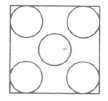
The angle of rotation for the figure given below is
45°
60°
90°
180°
6.
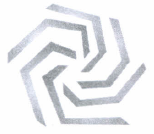
The order of rotational symmetry in the figure given below is
4
8
6
infinitely many
7.
The reciprocal of \(\left( \frac { -2 }{ 5 } \right) ^{ 2 }\) is
\(\left( \frac { -5 }{ 2 } \right) ^{ 2 }\)
\(\left( \frac { 5 }{ 2 } \right) ^{ 2 }\)
\(\frac { 4 }{ 25 } \)
\(\frac { 25 }{ 4 } \)
8.
The subtraction \(6\frac { 4 }{ 5 } \)from \(\frac { 50 }{ 5 } \)
\(3\frac { 1 }{ 5 } \)
\(2\frac { 1 }{ 5 } \)
\(\frac { 31 }{ 95 } \)
\(\frac { 39 }{ 95 } \)
9.
Simplify the following and write the answer in exponential form:
\([{5^6\over 5^3}]\times 5^2\)
10.
Construct a triangle ABC when AB = 5.5 cm, BC = 4.5 cm and \(\angle\)B = 60°.
11.
The perimeter of a rectangular sheet is 100cm. If the length is 35 cm, find its breadth. Also, find the area.
12.
Construct the right angled ΔPQR, where mㄥQ = 90°, QR = 8 cm and PR = 10 cm.
13.
Find the order of the rotational symmetry of a square.
14.
Find the value of the following expressions, when n =-2:5n2 + 5n-2
15.
Find the area, in hectare, of a field whose length is 240 m and breadth 110 m
16.
Simplify: [(52)3 x 54] \(\div\) 57.
17.
Find a rational number exactly halfway between:
a) \(\frac{-1}{3}\) and \(\frac{1}{3}\) b)\(\frac{1}{6}\) and \(\frac{1}{9}\)
18.
What will be the product of the following:
\(\frac { 6 }{ 3 } \times \left( -\frac { 3 }{ 5 } \right) \) (b)\(\left( -\frac { 11 }{ 4 } \right) \times \frac { 5 }{ 7 } \)
19.
Two cross roads, each of width 3 m, run at right angles through the centre of a rectangular park of length 70 m and breadth 45 m and parallel to its sides. Find the area of the roads. Also find the cost of constructing the roads at the rate of Rs.110 per m2.
20.
Simplify the following:
(a) (6-1 - 8-1)-1 + (2-1 - 3-1)-1
(b) \({ \left\{ { 6 }^{ -1 }+{ \left( \frac { 3 }{ 2 } \right) }^{ -1 } \right\} }^{ -1 }\)
1.
(b)
greater than the third side
2.
(c)
154 m2
3.
(a)
1
4.
(b)
O
5.
(c)
90°
6.
(c)
6
7.
(a)
\(\left( \frac { -5 }{ 2 } \right) ^{ 2 }\)
8.
(a)
\(3\frac { 1 }{ 5 } \)
9.
we have \([{5^6\over 5^3}]\times 5^2\) =[56-3]x52 \((\because {a^m\over a^n}=a^{m-n})\)
= 53 X 52
= 53 + 2 \((\because a^m \times a^n =a^{m+n})\)
= 55
Thus,\([{5^6\over 5^3}]\times 5^2=5^5\)
10.
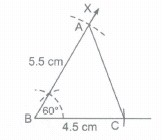
Steps of construction:
I. Draw a line segment BC = 4.5 cm.
II. Construct \(\angle\)CBX = 60° at B.
III. From BX, cut off line segment BA = 5.5 cm,
IV. Join AC
Thus, ABC is the required triangle.
11.
Given, perimeter of a rectangular sheet = 100 cm and length of a rectangular sheet, I = 35 cm
Let b be the breadth of a rectangular sheet .
We know that, perimeter of a rectangular sheet = 2 (/ + b)
\(\Rightarrow\) 2(/ + b) = 100 \(\Rightarrow\) 2(35 + b) = 100
\(\Rightarrow\) \(35+b=\frac{100}{2}\) [dividing by 2 on both sides]
\(\Rightarrow\) 35 + b = 50 \(\Rightarrow\) b = 50 - 35 \(\Rightarrow\) b = 15 cm
\(\therefore\) Area of a rectangular sheet = I X b = 35 x 15 = 525 cm2
Hence, the breadth and area of a rectangular sheet are 15 cm and 525 cm2, respectively.
12.
Given, two sides and an angle of ΔPQR are QR = 8 cm, PR = 10 cm and mㄥQ = 90°.
To construct a triangle with these two sides and one right angle, we use the following steps:
Steps of construction
Step I Firstly, we draw a rough sketch with measures marked on it.
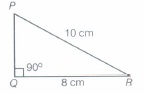
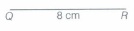
Step II Draw a line segment QR = 8 cm.
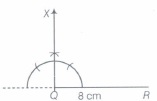
Step III At point Q, draw QX 丄 QR.
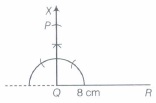
Step IV With R as centre and radius 10 cm, draw an arc which intersects ray QX at P.
Step V Join PR.
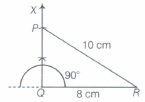
Thus, ΔPQR is the required triangle.
13.
Let us consider a square ABCD.
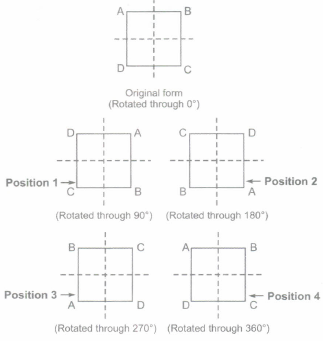
Obviously, each of the above four times, the figure fits on-to-it self.
∴ It has a rotational symmetry of order 4.
14.
In 5n2 + 5n - 2, we have
For n = - 2, 5n - 2 = - 12 and,5n2 = 5 x (- 2)2 = 5 x 4 = 20
Combining,
5n2 + 5n - 2 = 20 - 12 = 8
15.
Length of the field = 240 m,
Breadth of the field = 110 m
\(\therefore\) Area of the field = (240 x 110) m2
= 26400 m2
= hectare = 2.64 hectare
= \(\frac { 26400 }{ 10000 } \) hectare = 2.64 hectare
[\(\therefore\) 10000 m2 = 1 hectare]
16.
\([(5^2)\times 5^4]\div 5^7=\frac{5^6\times 5^4}{5^7}\)
\(=\frac{5^{6+4}}{5^7}=\frac{5^{10}}{5^7}\)
= 510-7
= 53.
17.
We have, \(\frac{-1}{3}\) and \(\frac{1}{3}\)
\(\therefore\) Half of \(\frac{-1}{3}\) and \(\frac{1}{3}\)=\(\frac { \left( \frac { -1 }{ 3 } +\frac { 1 }{ 3 } \right) }{ 2 } =\frac { \left( \frac { -1+1 }{ 3 } \right) }{ 2 } \)
=\(\frac { \left( \frac { 0 }{ 3 } \right) }{ 2 } \)=\(\frac{0}{2}\)=0
(b) We have, \(\frac{1}{6}\) and \(\frac{1}{9}\)

LCM of 6 and 9 = 3 x 2 = 18
\(\therefore\) Half of \(\frac{1}{6}\) and \(\frac{1}{9}\)=\(\frac { \left( \frac { 1 }{ 6 } +\frac { 1 }{ 9 } \right) }{ 2 } =\frac { \left( \frac { 3 }{ 18 }+\frac { 2 }{ 18 } \right) }{ 2 } \)
\(\left[ \frac { 1 }{ 6 } \times \frac { 3 }{ 3 } =\frac { 3 }{ 18 } ,\frac { 1 }{ 9 } \times \frac { 2 }{ 2 } =\frac { 2 }{ 18 } \right] \)
=\(\frac { \left( \frac { 5 }{ 18 } \right) }{ 2 } \)=\(\frac{5}{18}\times\frac{1}{2}\)=\(\frac{5}{36}\)
18.
(a) \(\frac { 6 }{ 7 } \times \left( -\frac { 3 }{ 5 } \right) =\frac { 6\times (-3) }{ 7\times 5 } \)
=\(\frac{18}{35}\)
(b) \(\left( -\frac { 11 }{ 4 } \right) \times \frac { 5 }{ 7 } =\frac { (-11)\times 5 }{ 4\times 7 } \)
=-\(\frac{55}{28}\)
19.
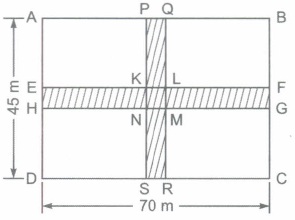
Here, Length of the rectangular park = 70 m
Breadth of the rectangular park = 45 m
The cross paths are shown by EFGH and PQRS in the figure.
Now, PQ =3 m and PS = 45 m
EH = 3 m and EF = 70 m
KL = 3 m and KN = 3 m
Now, area of the path = [Area of rectangle PQRS] + [Area of rectangle EFGH]- [Area of square KLMN]
= [PS x PQ] + [EF x EH] - [KL x KN]
= [45 x 3] m2 + [70 x 3] m2 - [3 x 3] m2
= 135 m2 + 210 m2 - 9 m2 = 336 m2
Now, cost of constructing the path = Rs. 110 x 336 = Rs. 36960.
Note: While finding the area of cross roads, the area of the middle square (here, KLMN) is taken twice
which is to be subtracted once.
20.
(a) (6-1 - 8-1)-1 + (2-1 - 3-1)-1
\(=(\frac{1}{6}-\frac{1}{8})^{-1}+(\frac{1}{2}-\frac{1}{3})^{-1}\)
\(=(\frac{4-3}{24})^{-1}+(\frac{3-2}{6})^{-1}\)
\((\frac{1}{24})^{-1}+(\frac{1}{6})^{-1}\)
= 24 + 6 = 30
(b) \({ \left\{ { 6 }^{ -1 }+{ \left( \frac { 3 }{ 2 } \right) }^{ -1 } \right\} }^{ -1 }\)
\(=(\frac{1}{6}+\frac{2}{3})^{-1}\)
\(=(\frac{1+4}{6})^{-1}=(\frac{5}{6})^{-1}\)
\(=\frac{6}{5}\)

7th Standard CBSE Syllabus & Materials
7th Standard CBSE
CBSE 7th Social Science Theme B - New Beginnings : Cities and States - New Sample Question Papers Study Material - QB365 Set A
NEW7th Standard CBSE
CBSE 7th Social Science Theme A - Climates of India - New Sample Question Papers Study Material - QB365 Set A
NEW7th Standard CBSE
CBSE 7th Social Science Theme A - Geographical Diversity of India - New Sample Question Papers Study Material - QB365 Set A
NEW7th Standard CBSE
CBSE 7th Science Earth, Moon and the Sun - New Sample Question Papers Study Material - QB365 Set A



NCERT Books

Syllabus

Exam Pattern

Sample Question Papers

Previous year Question Papers

Important Notes

MCQ Practice test

NCERT Exemplers

Case study Questions

Image Based Questions

Passage based Questions

HOT Questions

Value Based Questions

Model Questions Papers
NCERT ( Book Back ) Questions

Assertion and Reason
Important Questions And Answers

CBSE 7th Standard CBSE Subjects
CBSE Standards


