
 100% FREE ACCESS
7th Standard CBSE Syllabus & Materials
7th Standard CBSE
CBSE 7th Social Science Theme E - Understanding Market - New Sample Question Papers Study Material - QB365 Set A
NEW7th Standard CBSE
CBSE 7th Social Science Theme E - From Barter to Money - New Sample Question Papers Study Material - QB365 Set A
NEW7th Standard CBSE
CBSE 7th Social Science Theme D - The Constitution of India- An Introduction - New Sample Question Papers Study Material - QB365 Set A
NEW7th Standard CBSE
CBSE 7th Social Science Theme D - From the Rulers to the Ruled : Types of Governments - New Sample Question Papers Study Material - QB365 Set A
NEW7th Standard CBSE
CBSE 7th Social Science Theme B - The Age of Reorganisation - New Sample Question Papers Study Material - QB365 Set A
NEW7th Standard CBSE
CBSE 7th Social Science Theme B - The Rise of Empires - New Sample Question Papers Study Material - QB365 Set A

Published on: 31/10/2025
Download CBSE Class 7th Standard CBSE Mathematics question papers, sample papers, important questions, and previous year solved papers in PDF format. Get free study materials, NCERT solutions, and exam preparation resources for Class 7th Standard CBSE Mathematics
Questions + Answers key
Take MCQ Mathematics Test
1.
Express 65% as a fraction
2.
6 bowls cost Rs.90. What would be the cost of 10 such bowls?
3.
At what rate per cent, will a sum of money triple itself in 10 years?
4.
Rs 10000 is invested at 5% interest rate p.a. Find the interest at the end of one year.
5.
If 45 m of a uniform rod weighs 171 kg, then what will be the weights of 12 m of the same rod?
6.
A wire is cut into three pieces in the ratio 2 : 5: 9. If the longest piece is cut further into three equal pieces and each such piece is 15 cm long, then what is the original length of the wire?
7.
Calculate the value of x, if 4 : x :: 1: 4.
8.
An ant can carry 50 times its weight. If a person can do the same, how much would you be able to carry?
9.
By selling a colour TV for Rs 23520, a dealer suffers a loss of 4%. What is the cost price of the colour TV?
10.
What rate gives Rs 280 as interest on a sum of Rs 56000 in 2 yr?
11.
A shopkeeper bought a chair for Rs 375 and sold it for Rs 400. Find the gain percentage.
12.
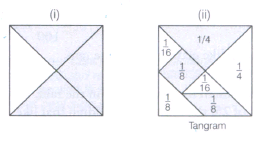
What per cent of these figures are shaded?
13.
Mala has a collection of bangles. She has 20 gold bangles and 10 silver bangles. What is the percentage of bangles of each type? Can you put it in the tabular form as done in the above example?
14.
Population of Rajasthan = 570 1akhs and population of UP = 1660 1akhs. Area of Rajasthan = 31akh km2 and area of UP = 21akh km2.
(i) How many people are there per km2 in both these states?
(ii) Which state is less populated?
15.
What is the time period for which Rs 8000 amount to Rs 12000 at 20 per annum of simple interest?
16.
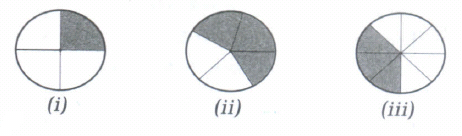
Estimate what part of the figures is coloured and hence find the per cent which is coloured.
17.
What rate gives Rs.280 as interest on a sum of Rs.56000 in 2 years?
2.5%
0.25%
25%
0.025%
18.
Ram saves Rs.400 from his salary. If this is 10% of his salary, what is his salary?
40000
9000
4000
10000
19.
The simple interest for Rs.2,000 at the rate of 5% p.a. for 3 years is
Rs.400
Rs.150
Rs.250
Rs.300
20.
The sum which will earn a simple interest of Rs 126 in 2 yr at 14% per annum is
Rs 394
Rs395
Rs450
RS 540
21.
The ratio of Fatima's income to her savings is 4 : 1. The percentage of money saved by her is
20%
25%
40%
80%
22.
If 5: x = 3: 4, then what will be the value of 'x'?
3/20
15/4
20/3
4/15
1.
We have \(65\%=65\times{1\over100}={65\over100}\)
\(={13\over20}\)
Thus, \(65\%={13\over20}\)
2.
Cost of bowl =Rs.90
Cost of 1 bowl = Rs. \(\frac { 90 }{ 6 } \)
Hence, cost of 10 bowls = Rs.\(\frac { 90 }{ 6 } \times 10\)
= Rs.150.
3.
Let the principal P = Rs.x, R =?, T = 10 years, A = 3 times of P = Rs.3x, 51 = A - P = 3x - x = Rs. 2x
Now, we know that \(R={S\times 100\over P \times T}={2 \times 10 \over x \times 10}=20\%\)
Thus, at 20% per annum, a sum of money will triple itself in 10 years.
4.
Given, Principal, P = Rs 10000; Rate of interest, R = 5%
Time, T= 1yr
\(\therefore Interest , I = {P\times R\times T\over 100}={10000\times 5\times 1\over100}=100\times 5=Rs500\)
Hence, the interest at the end of 1 yr is Rs 500.
5.
45.6kg
6.
80cm
7.
16
8.
I will be able to carry 50 times of my weight.
9.
Rs 24500
10.
Given, Principal, P = Rs 56000, Interest, I = Rs 280,
Time,T=2yr
Let rate of interest be R % p. a.
Now,
\(I={P\times R\times T\over 100}\)
\( \\ \Rightarrow R=({I\times 100\over P\times T}) \%=({280\times100\over 56000\times 2})\%=({28\over 56\times 2})\)
\( ={1\over4}\%=0.25\%\)
Hence, the rate of interest is 0.25%.nj
11.
Given, CP (cost price) of a chair = Rs 375
SP (selling price) of a chair = Rs 400
Here, SP> CP. So, gain = SP - CP = Rs (400 - 375)= Rs 25
Now, gain percentage=\(({Gain \over CP \ of \ a \ chair }\times 100)\%\)
\(=({25\over375}\times 100)\%={100\over15}\%={20\over3}\%=6{2\over3}\%\)
Hence, the gain percentage is \(6{2\over3}\%\)
12.
(i) It is clear from the figure that, shaded triangular parts are 3 out of 4.
Shaded triangular parts in fraction \(={3\over4}\)
\(\therefore\)Percentage of shaded part \( = ({3\over4}\times 100)\%=75\%\)
Hence, 75% of the figure is shaded.
(ii)From the figure,
fraction of tangram which is not shaded
\(={1\over16}+{1\over16}+{1\over8}+{1\over 4}={1+1+2+4\over16}={8\over16}={1\over2}\)
i.e. half of the tangram is shaded.
\(\therefore\)Percentage of tangram which is shaded|
\(=({1\over2}\times100)\%=50\%\)
Hence, 50% of the tangram is shaded.
13.
Putting the data in the tabular form, we get
| Bangles | Number | Fraction | Denominator Hundred | In Percentage |
| Gold | 20 | \({20\over30}\) | \({20\over30}\times{100\over100}={200\over3}\times{1\over100}\) | \(66.67\% or 66{2\over3}\%\) |
| Silver | 10 | \({10\over30}\) | \({10\over30}\times{100\over100}={100\over3}\times{1\over100}\) | \(33.33\% or 33{1\over3}\%\) |
| Total | 30 |
14.
Given, population of Rajasthan = 570 lakhs
Population of UP = 1660 lakhs
Area of Rajasthan = 3 lakh km 2, Area of UP = 2 lakh km 2
(i) For Rajasthan,
Number of people per km2 \(={Population \ of \ Rajasthan \over Area \ of \ Rajasthan} \)
\(={570\over3}=190\)
Hence, the number of people in Rajasthan is
190 per km 2.
For Up,
Number of people per km 2
\(={Population \ of \ UP \over Area \ of \ UP}\)
\( ={1660\over2}=830\)
Hence, the number of people in UP is 830 per km 2.
(ii) It is clear from part (i) that Rajasthan is less populated
15.
2.5yr
16.
(i) Total parts = 4 and coloured part = 1
\(\therefore\)Coloured parts of the figure in fraction =\({1\over4}\)
Now, required per cent of coloured parts
=\(({1\over4}\times100)\%=25\%\)
(ii) Total parts = 5 and coloured parts = 3
\(\therefore\)Coloured parts of the figure in fraction=\({3\over5}\)
Now, required per cent of coloured parts =\(({3\over5}\times100)\%\)
\(=(3\times20)\%=60\%\)
(iii) Total parts = 5 and coloured parts = 3
\(\therefore\)Coloured parts of the figure in fraction =\({3\over8}\)
Now, required per cent of coloured part = \(({3\over8}\times 100)\%\)
\(=({3\over2}\times25)\%=({75\over2})\%=37.5\%\)
17.
(b)
0.25%
18.
(c)
4000
19.
(d)
Rs.300
20.
(c)
Rs450
21.
(a)
20%
22.
(c)
20/3

7th Standard CBSE Syllabus & Materials
7th Standard CBSE
CBSE 7th Social Science Theme B - New Beginnings : Cities and States - New Sample Question Papers Study Material - QB365 Set A
NEW7th Standard CBSE
CBSE 7th Social Science Theme A - Climates of India - New Sample Question Papers Study Material - QB365 Set A
NEW7th Standard CBSE
CBSE 7th Social Science Theme A - Geographical Diversity of India - New Sample Question Papers Study Material - QB365 Set A
NEW7th Standard CBSE
CBSE 7th Science Earth, Moon and the Sun - New Sample Question Papers Study Material - QB365 Set A



NCERT Books

Syllabus

Exam Pattern

Sample Question Papers

Previous year Question Papers

Important Notes

MCQ Practice test

NCERT Exemplers

Case study Questions

Image Based Questions

Passage based Questions

HOT Questions

Value Based Questions

Model Questions Papers
NCERT ( Book Back ) Questions

Assertion and Reason
Important Questions And Answers

CBSE 7th Standard CBSE Subjects
CBSE Standards


