
 100% FREE ACCESS
7th Standard CBSE Syllabus & Materials
7th Standard CBSE
CBSE 7th Social Science Theme E - Understanding Market - New Sample Question Papers Study Material - QB365 Set A
NEW7th Standard CBSE
CBSE 7th Social Science Theme E - From Barter to Money - New Sample Question Papers Study Material - QB365 Set A
NEW7th Standard CBSE
CBSE 7th Social Science Theme D - The Constitution of India- An Introduction - New Sample Question Papers Study Material - QB365 Set A
NEW7th Standard CBSE
CBSE 7th Social Science Theme D - From the Rulers to the Ruled : Types of Governments - New Sample Question Papers Study Material - QB365 Set A
NEW7th Standard CBSE
CBSE 7th Social Science Theme B - The Age of Reorganisation - New Sample Question Papers Study Material - QB365 Set A
NEW7th Standard CBSE
CBSE 7th Social Science Theme B - The Rise of Empires - New Sample Question Papers Study Material - QB365 Set A

Published on: 31/10/2025
Download CBSE Class 7th Standard CBSE Mathematics question papers, sample papers, important questions, and previous year solved papers in PDF format. Get free study materials, NCERT solutions, and exam preparation resources for Class 7th Standard CBSE Mathematics
Questions + Answers key
Take MCQ Mathematics Test
1.
Given below are measurements of some parts of two triangles. Examine whether the two triangles are congruent or not using RHS congruence rule. Write the result in symbolic form.
In ΔABC:ㄥB=90°, AC = 8 cm, AB = 4 cm
In ΔPQR:ㄥP=90°, PR = 4 cm, QR = 8 cm
2.
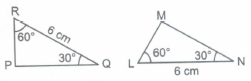
In the following figures, measures of some parts are indicated. By applying ASA congruence rule, state which pairs of triangles are congruent. In case of congruence, write the result in symbolic form.
3.
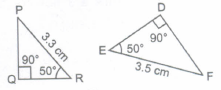
In the following figures, measures of some parts are indicated. By applying ASA congruence rule, state which pairs of triangles are congruent. In case of congruence, write the result in symbolic form.
4.
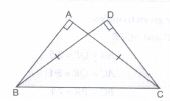
In the given figure, triangles ∆ABC and ΔBCD are right angled at A and D respectively. Prove that ΔABC≌ΔDCB.
Is AB = DC ? give reason.
5.
In the following figures, lengths of the sides of the triangles are indicated. By applying SSS congruence rule, state which pairs of triangles are congruent? In case of congruent triangles, write the result in symbolic form.

6.
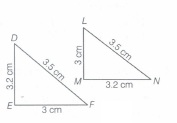
In the following figures, lengths of the sides of the triangles are indicated. By applying SSS congruence rule, state which pairs of triangles are congruent? In case of congruent triangles, write the result in symbolic form.
7.
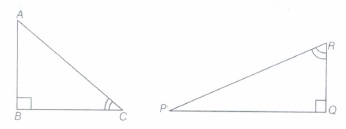
If ΔABC and ΔPQR are to be congruent, name one additional pair of corresponding parts. What criterion did you use?
8.
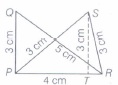
In a squared sheet, draw two triangles of equal areas such that, the triangles are not congruent. What can you say about their perimeters?
9.
In a squared sheet, draw two triangles of equal areas such that, the triangles are congruent.
10.
ΔDEF and ΔLMN are both isosceles with DE = DF and LM = LN, respectively. If DE = LM and EF = MN, then are the two triangles congruent? Which condition do you use? If ㄥE = 40°, what is the measure of ㄥN?
11.
It is to be established by RHS congruence rule that ΔABC ≅RPQ. What additional information is needed, if it is given that ㄥB =ㄥP = 900 and AB = RP?
12.
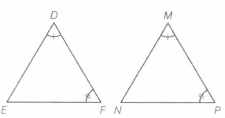
You want to establish ΔDEF ≅ ΔMNP, using ASA congruence rule. You are given that ㄥD = ㄥM and ㄥF = ㄥP. What information is needed to establish the congruence? (Draw a rough figure and then try)
13.
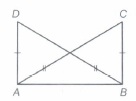
In the given figure, AC = BD and AD = BC. Which of the following statements is meaningfully written?
(i) ΔABC ≅ ΔABD
(ii) ΔABC ≅ ΔBAD
14.
If ΔABC ≌ ΔFEDunder the correspondence ABC ↔️ FED, then write all the corresponding congruent parts of the triangles.
15.
When two triangles, say ABC and PQR are given, there are in all, six possible matchings or correspondences. Two of them are
(i) ABC ↔️ PQR (ii) ABC ↔️ QRP
Find the other four correspondences by using two cut outs of triangles. Will all these correspondences lead to congruence?
1.
.: Side opposite to right angle is hypotenuse
:. In ΔABC, hypotenuse = AC and in Δ PQR, hypotenuse=RQ
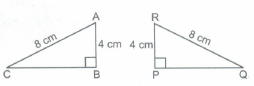
We have 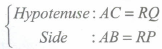 [each =8 cm] [each =4cm]
\(\therefore \)The two triangles are congruent
Now, B ↔️P, A ↔️R and C ↔️ Q [By RHS congruence rule]
\(\therefore \)ΔABC≅ΔRPQ
2.
ΔPQR and ΔLMN:
We have 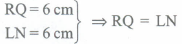
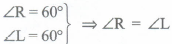
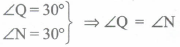
Therefore, using ASA congruence rule, the two triangles are congruent.
Now, R \(\leftrightarrow \) L,Q \(\leftrightarrow \) N and P\(\leftrightarrow \) M
\(\therefore \)ΔPQR ≅ ΔMNL
3.
ΔPQR and ΔDEF:
In ΔPQR, ㄥP=ㄥ180° - (90° + 50°)= 40°
Also in ΔDEF, ㄥF = 180° - 90° - 50°=40°
Now in ΔPQR and ΔDEF, we have
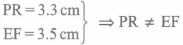
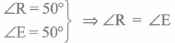
and 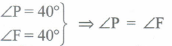
\(\therefore \)Using the ASA congruence rule, we can say that the two triangles are not congruent
4.
In ∆ABC and ΔDCB,
AC= DB
\(\angle\) BAC = \(\angle\) CDB = 90°
So by R.H.S. congruency we have
ΔABC ≌ΔDBC
\(\Rightarrow\) by C.P.C T., AB = DC
5.
In ΔABD and ΔADC, we have
AB= AC =35 cm, BD= DC = 25 cm and AD = AD [common]
Therefore, the three sides of MBD are equal to three sides of ΔADC.
So, two triangles are congruent by SSS congruence rule.
From the above equality relations, we have
A ↔️ A, B ↔️ C, and D ↔️ D
In symbolic form, ΔABD ≅ ΔACD
6.
In ΔDEF and ΔLMN, we have
DE= MN =3.2 cm, DF= LN = 35 cm, EF = LM = 3 cm
Therefore, the three sides of ΔDEF are equal to three sides of ΔLMN.
So, two triangles are congruent by SSS congruence rule.
From the above equality relations, we have
D ↔️ N, E ↔️ M and F ↔️ L
In symbolic form, ΔDEF ≅ ΔNML
7.
Given, ΔABC = ΔPQR
Also given ㄥB = ㄥQ and ㄥC = ㄥR
[from the given figure)
To apply the condition for congruency, included side of one triangle is equal to the included side of the other triangle.
∴ BC=QR
Hence, we use the ASA congruence criterion.
8.
Area \(\triangle PQR=\frac { 1 }{ 2 } \times PQ\times PR=\frac { 1 }{ 2 } \times 4\times 3=6\quad cm^{ 2 }\)
Area \(\triangle PRS=\frac { 1 }{ 2 } \times PR\times ST=\frac { 1 }{ 2 } \times 4\times 3=6\quad cm^{ 2 }\quad \)
∵ Area of ΔPQR = Area of ΔPRS
But these two triangles are not congruent. Perimeter of ΔPQR
= PQ + QR + RP = 3 + 5 + 4 = 12 ern
and perimeter of ΔPRS = PR + RS + SP = 4 + 3 + 3 = 10 cm
∵ Perimeter of ΔPQR ≠ Perimeter of ΔPRS
Hence, we can say that perimeters of two congruent triangles are equal and perimeters of two non-congruent triangles need not be equal.
9.
Area \(\triangle ABC=\frac { 1 }{ 2 } \times AB\times BC=\frac { 1 }{ 2 } \times 4\times 3=6\quad cm^{ 2 }\)
Area \(\triangle EDC=\frac { 1 }{ 2 } \times DE\times CD=\frac { 1 }{ 2 } \times 4\times 3=6\quad cm^{ 2 }\)
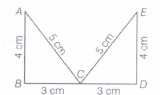
Area of ΔABC = Area of ΔEDC
Also, three sides of MBC are equal to three corresponding sides of ΔEDC, so these two triangles are congruent.
Perimeter of ΔABC = AB + BC + CA = 4 + 3 + 5 = 12 cm
and perimeter of ΔEDC = CD + DE + EC = 3 + 4 + 5 = 12 cm
∴ Perimeter of ΔABC = Perimeter of ΔEDC.
10.
According to the question, we have following figures.
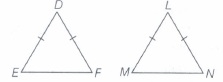
Since, both triangles are isosceles.
DE = DF [given]
LM = LN [given]
where, DE = LM [given]
EF = MN [given]
Also, DF = LN [∵ DE = DF, LM = LN]
Since, three sides of triangles ΔDEF and ΔLMN are equal.
So, ΔDEF ≅ ΔLMN [by SSS congruence criterion]
If ㄥE = 400 , then ㄥN = 400 [by CPCT]
11.
In the given figure,
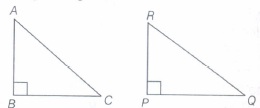
Since, ㄥ B = ㄥP [each 900]
AB = RP [height of right angled triangle]
If we add AC = RQ
[hypotenuse of right angled side]
Hence, ΔABC ≅ ΔRPQ
[by RHS congruence criterion]
12.
Here, we want to establish ΔDEF ≅ ΔMNP, by using ASA congruence rule.
Given, ㄥD = ㄥM
and ㄥF= ㄥP
So, the additional information needed to establish the congruence is
DF=MP [side included between given angles]
Hence, ΔDEF \(≅\) ΔMNP
13.
Given, AC = BD and AD = BC
In ΔABC and ΔABD, AC = BD [given]
BC = AD [given]
AB = AB [common]
Therefore, i.e. the three sides of ΔABC are equal to the three sides of ΔABD. So, the two triangles are congruent.
From the above equality relations, we have
A ↔️ B, B ↔️ A and C ↔️ D
(i) ΔABC ≅ ΔABD is false or meaningless.
(ii) ΔABC ≅ ΔBAD is true or meaningful.
14.
If ΔABC ≅ ΔFED under the correspondence ABC ↔️ FED, this means A↔️ F, B ↔️ E and C ↔️D.
Therefore, all the corresponding congruent parts of ΔABC and ΔFED are ㄥB ↔️ ㄥE, ㄥC ↔️ ㄥD and \(\bar { AB } \leftrightarrow \bar { FE } \bar { ,BC } \leftrightarrow \bar { ED } ,\bar { CA } \leftrightarrow \bar { DF } \).
15.
In Δ ABC and Δ PQR, there are side possible matchings or correspondences. Out of them, four correspondences are as follow:
(i) ABC ↔️ PRQ
(ii) ABC ↔️ RPQ
(iii) ABC ↔️ RQP
(iv) ABC ↔️ QPR
Yes, all these correspondences may lead to congruence.

7th Standard CBSE Syllabus & Materials
7th Standard CBSE
CBSE 7th Social Science Theme B - New Beginnings : Cities and States - New Sample Question Papers Study Material - QB365 Set A
NEW7th Standard CBSE
CBSE 7th Social Science Theme A - Climates of India - New Sample Question Papers Study Material - QB365 Set A
NEW7th Standard CBSE
CBSE 7th Social Science Theme A - Geographical Diversity of India - New Sample Question Papers Study Material - QB365 Set A
NEW7th Standard CBSE
CBSE 7th Science Earth, Moon and the Sun - New Sample Question Papers Study Material - QB365 Set A



NCERT Books

Syllabus

Exam Pattern

Sample Question Papers

Previous year Question Papers

Important Notes

MCQ Practice test

NCERT Exemplers

Case study Questions

Image Based Questions

Passage based Questions

HOT Questions

Value Based Questions

Model Questions Papers
NCERT ( Book Back ) Questions

Assertion and Reason
Important Questions And Answers

CBSE 7th Standard CBSE Subjects
CBSE Standards


