
 100% FREE ACCESS
7th Standard CBSE Syllabus & Materials
7th Standard CBSE
CBSE 7th Social Science Theme E - Understanding Market - New Sample Question Papers Study Material - QB365 Set A
NEW7th Standard CBSE
CBSE 7th Social Science Theme E - From Barter to Money - New Sample Question Papers Study Material - QB365 Set A
NEW7th Standard CBSE
CBSE 7th Social Science Theme D - The Constitution of India- An Introduction - New Sample Question Papers Study Material - QB365 Set A
NEW7th Standard CBSE
CBSE 7th Social Science Theme D - From the Rulers to the Ruled : Types of Governments - New Sample Question Papers Study Material - QB365 Set A
NEW7th Standard CBSE
CBSE 7th Social Science Theme B - The Age of Reorganisation - New Sample Question Papers Study Material - QB365 Set A
NEW7th Standard CBSE
CBSE 7th Social Science Theme B - The Rise of Empires - New Sample Question Papers Study Material - QB365 Set A

Published on: 31/10/2025
Download CBSE Class 7th Standard CBSE Mathematics question papers, sample papers, important questions, and previous year solved papers in PDF format. Get free study materials, NCERT solutions, and exam preparation resources for Class 7th Standard CBSE Mathematics
Questions + Answers key
Take MCQ Mathematics Test
1.
Solve the equation. 2q+6=12
2.
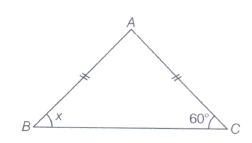
In the following figure, find the value of x.
3.
A coin is tossed. What is the probability of getting a tail?
4.
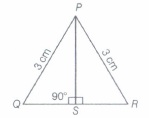
In the given figures, measures of some parts of triangles are given. By applying RHS congruence rule, state which pairs of triangles are congruent? In case of congruent triangles, write the result in symbolic form.
5.
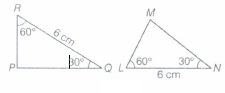
In the given figure, measures of some parts are indicated. By applying ASA congruence rule, state which pairs of triangles are congruent? In case of congruence, write the result in symbolic form.
6.
Find \(\frac{3}{4}\)of (i) 16 (ii) 36
7.
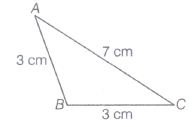
Classify the following triangle on the basis of sides.
8.
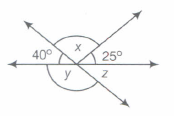
Find the values of the angles x,y and z in each of the following:
9.
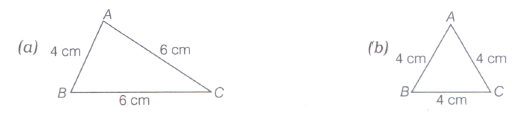
Look at the following given figures and classify each of the triangle according to its sides.
10.
Arrange the following integers in descending order. -7, 0, 5, -3, -10
11.
Verify a - (-b) = a + b for the following values of a and b. a= 21 and b= 18
12.
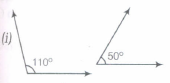
Find the pairs of supplementary angles in the question figure.
13.
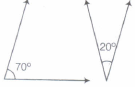
Which pairs of the following angles are complementary?
14.
Write equations for The sum of numbers x and 4 is 9
15.
Find the mean of the first five whole numbers.
16.
Solve \(\frac{7}{10}+\frac{2}{5}+\frac{3}{2}\)
17.
Convert the following equation in statement form x+5 =6
18.
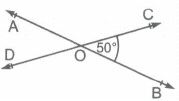
In the adjoining figure, the lines \(\overleftrightarrow { AB } \) and \(\overleftrightarrow { CD } \) intersect at O.If \(\angle \)COB = 50°, find the measures of the other three angles.
19.
The sum of three consecutive integers is 12 more than twice the smallest integer. Find the integers.
20.
If length of rectangle is 0.5 metre and its breadth is 1.5 metre, find its area.
21.
(i) Provide the number in the box, such that \(\frac{2}{3}\times \Box=\frac{10}{30}\)
(ii) The simplest form of the number obtained in \(\Box\) is ___________.
22.
In the given figure, AB = AC and Dis the mid-point of \(\bar { BC } \).
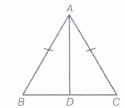
(i) State the three pairs of equal parts in ΔADB and ΔADC.
(ii) Is ΔADB ≅ ΔADC? Give reasons.
(iii) Is ㄥB = ㄥC? Why?
23.
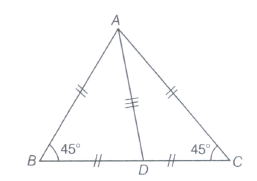
From the above figure, find the value of \(\angle A\).
24.
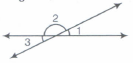
In the given figure, if \(\angle \) 1=30°, find \(\angle \) 2 and \(\angle \) 3.
25.
Rita goes 20 km towards East from a point A to the point B. From B, she moves 30 km towards West along the same road. If the distance towards East is represented by a positive integer, then how will you represent the distance travelled towards West? By which integer will you represent her final position from A?
26.
The enrolment in a school during six consecutive years was as follows:
1555,1670,1750,2013,2540,2820
Find the mean enrolment of the school for this period
27.
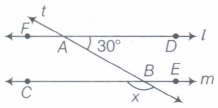
In the given figure, the value of x = _______________
28.
If the arithmetic mean of 3, 9, 4, x, 9, 7,6 is 6, then the value of x is.............
29.
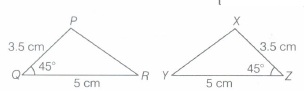
In the given figures, ΔPQR ≅ Δ ______
30.
[ 13 + (- 12) ] + ______ = 13 + [ (- 12) + (- 7) ]
31.
If two angles are supplementary, then the sum of their measures is _____________
32.
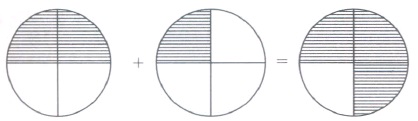
The picture interprets
\(\frac{1}{3} \div 4\)
\(3\times \frac{1}{4}\)
\(\frac{3}{4}\times 4\)
\(3\div\frac{1}{3}\)
33.
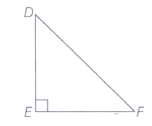
In the given figure, DEF is a right angled triangle with \(\angle E=90^0\) What type of angles are \(\angle D\ and \angle F\)?
They are equal angles
They form a pair of adjacent angles
They are complementary angles
They are supplementary angles
34.
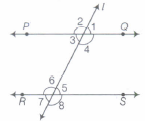
In the given figure, PQ II RS. If \(\angle\)1 = (2a + b)° and \(\angle\)6 = (3a - b)°, then the measure of \(\angle\)2 in terms of b is
(2+b)°
(3-b)°
(108-b)°
(180-b)°
35.
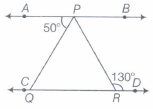
In the following figure, if AB II CD, \(\angle \)APQ = 50° and \(\angle \)PRD = 130°, then \(\angle \)QPR is
130°
50°
80°
30°
36.
The number of trees in different parks of a city are 33, 38, 48, 33, 34, 34, 33 and 24. The mode of this data is
24
34
33
48
37.
Which of the following numbers satisfies the equation -6 + x = -18?
10
-13
-12
-16
38.
Two figures are said to be congruent, if they have exactly the same
area
perimeter
shape and size
length and width
39.
If * represents 3 mangoes, then 18 mangoes are represented by
***
****
******
None of these
40.
Two triangles ABC and DEF are congruent. If ㄥA=70° andㄥB=40°, then what is the measure of ㄥF?
41.
In a right triangle, what is the measure of its greatest angle?
42.
What is the mean of four highest single digit counting numbers?
43.
Write the number in the expanded form 234.34
44.
Find x if:
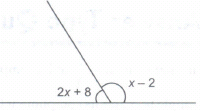
45.
What is the additive identity for integers?
1.
We have,
2q + 6 = 12
\(\Rightarrow\) 2q + 6-6 = 12 - 6
[Subtraction 6 from both sides]
\(\Rightarrow\)2q = 6
\(\Rightarrow \quad \frac { 2q }{ 2 } =\frac { 6 }{ 2 } \)
Dividing both sides by 2]
\(\Rightarrow\) q = 3
So, q = 3 is the solution of the given equation.
2.
In the given figure, two sides of the triangle are equal.
We know that, the base angles opposite to equal sides are equal.
So, x = 60°
Hence, the value of x is 60°.
3.
\(\frac { 1 }{ 2 } \)
4.
In ΔPQS and ΔPRS, ㄥPSQ = ㄥPSR = 90°
Hypotenuse PQ = Hypotenuse PR = 3 cm
PS = PS [common]
Therefore, by RHS congruence rule, two triangles are congruent. The correspondence is P ↔️ P, Q ↔️ R,
S ↔️ S.
In symbolic form, ΔPQS ≌ ΔPRS
5.
In ΔPQR and ΔMNL,
ㄥR = ㄥL = 60° [given]
RQ= LN = 6 cm [given]
ㄥQ = ㄥN = 30° [given]
Therefore, by ASA congruence rule, two triangles are congruent.
The correspondence is P ↔️ M, Q ↔️ N and R ↔️ L.
In symbolic form, ΔPQR ≅ ΔMNL
6.
(i) We have, \(\frac{3}{4}\)of 16=\(\frac{3}{4}\times 16\)=\(\frac{3\times 16}{4}=\frac{48}{4}=12\)
(ii) We have, \(\frac{3}{4}\)of 27=\(\frac{3}{4}\times 36\)=\(\frac{3\times 36}{3}=\frac{108}{4}=27\)
7.
Isosceles triangle
8.
\(\angle \)y + 40° = 180° [by linear pair]
\(\Rightarrow\) \(\angle \)y = 180° - 40°\(\Rightarrow\) \(\angle \)y = 140°
\(\angle \).z = 40° [verticallyopposite angles]
\(\because\) \(\angle \)x + 25° + \(\angle \)z = 180° [by linear pair]
\(\angle \)x + 25° + 40° = 180°
\(\Rightarrow\)\(\angle \)x=180°-65°=1l5°
Hence, \(\angle \)x = 115°, \(\angle \)y = 140° and \(\angle \)z = 40°
9.
(a) In the given figure,\(\bar { AC } =6cm,\bar { BC } =6cm\bar { ,AB } =4cm,\) \(\quad \because \bar { AC } =\bar { BC } \)
Hence, \(\triangle ABC\) is an isosceles triangle.
(b) In the given figure, \(\bar { AC } =4cm,\bar { AB } =4cm,\bar { BC } =4cm\) \(\because \bar { AC } =\bar { AB } =\bar { BC } \)
Hence, \(\triangle ABC\) is an equilateral triangle.
10.
5, 0, -3, -7, -10
11.
Given, a = 21 and b = 18
\(\therefore\) LHS = a-(-b) = 21-(-18) = 21+18 = 39
and RHS = a + b = 21 + 18 = 39
Hence, LHS = RHS
12.
In this pair, measures of the given angles are 110° and 50°.
\(\therefore\) Sum of the given angles = 110° + 50° = 160°,
which is less than 180°.
So, this pair of angles is not supplementary.
13.
In this pair, sum of two angles = 70° + 20° = 90° So, this pair of angles is complementary.
14.
According to the question,
Sum of x and 4 = x + 4 and the sum = 9
Hence, the required equation is x + 4 = 9.
15.
We know that, whole numbers are those, which start from zero (0).
So, first five whole numbers are 0, 1,2,3 and 4.
\(\therefore\) \(mean=\frac { sum\ of\ number }{ number\ of\ terms } =\frac { 0+1+2+3+4 }{ 5 } =\frac { 10 }{ 5 } =2\)
Hence, the mean of first five whole numbers is 2.
16.
We have, \(\frac{7}{10}+\frac{2}{5}+\frac{3}{2}\)
\(\therefore \frac{7}{10}+\frac{2}{5}+\frac{3}{2}=\frac{7+4+15}{10}\)
=\(\frac{26}{10}=\frac{13}{5}\)
[dividing numerator and denominator by 2]
17.
x + 5 = 6, Add x and 5 to get 6.
18.
∵ \(\angle \)COB = 50° [Given]
∴ \(\angle \)AOD = 50° [Vertically opposite angles]
Now, \(\angle \)AOC and \(\angle \)COB form a linear pair.
Thus, \(\angle \)AOC + \(\angle \)COB = 180°
=> \(\angle \)AOC + 50° = 180°
=> \(\angle \)AOC = 180° - 50° = 130°
Also, \(\angle \)AOC and \(\angle \)BOD are vertically opposite angles.
∴ \(\angle \)BOD = \(\angle \)AOC = 130°
Thus, the required measures of the remaining
three angles are:\(\begin{matrix} \angle AOD={ 50 }^{ o } \\ \angle AOC=130^{ o } \\ \angle BOD=130^{ o } \end{matrix} \)}
19.
Let the smallest integer be x.
\(\therefore\)The three consecutive integers are x, (x + 1) and (x + 2).
Sum of the integers = x + (x + 1) + (x + 2) = 3x + 3
According to the condition,
[Sum of the consecutive integers]
= 2 x [The smallest integer] + 12
\(\Rightarrow \)(3x + 3) = 2(x) + 12
\(\Rightarrow \)3x + 3 = 2x + 12
Transposing 3 to R.H.S. and 2x to L.H.S., we have
3x - 2x = 12 - 3
\(\Rightarrow \)x=9
Thus, the three consecutive numbers are 9, 9 + 1 and 9 + 2 or 9, 10 and 11.
Hence, the required numbers are 9, 10 and 11.
20.
For rectangle,
Area = Length \(\times\) Breadth
Since, Length = 0.5 m
Breadth = 1.5 m
∴ Area = (1.5\(\times\)0.5)m2
= \(\left( \frac { 15 }{ 10 } \times \frac { 5 }{ 10 } \right) \)m2
= \(\frac { 75 }{ 100 } \)m2
=0.75 m2
21.
(i) \(\frac{2}{3}\times \Box=\frac{10}{30}\)
Here, 2 X5 = 10 and 3 X10 = 30
Hence, the required number in the box is \(\frac{5}{10}\).
(ii) Simplest form of \(\frac{5}{10}=\frac{1}{2}\)
22.
Given, ABC is a triangle in which AB = AC and D is the mid-point of \(\bar { BC } \)
(i) The three pairs of equal parts in ΔADB and ΔADC are
AD = AD [common]
AB = AC [given]
DB = DC [since, D is the mid-point of BC]
(ii) Yes, from part (i), we have
ΔADB ≅ ΔADC [by SSS congruence rule]
(iii) Yes, because ΔADB ≅ ΔADC
⇒ ㄥB = ㄥC
[since, corresponding part of congruent triangles are equal]
23.
\(\angle A=90^0\) [Hint Use the concept of is isosceles triangle]
24.
Given, \(\angle \)1= 30°
Since, \(\angle \)1 and \(\angle \)2 form a linear pair.
\(\therefore\) \(\angle \)1+ \(\angle \)2 = 180° \(\Rightarrow\) 30° + \(\angle \)2 = 180°
[transposing 30° to RHS]
\(\Rightarrow\) \(\angle \)2 = 180° - 30°\(\Rightarrow\) \(\angle \) 2 = 150°
Now, \(\angle \)3 = \(\angle \)1= 30° [vertically opposite angles]
Hence, \(\angle \)2 = 150° and \(\angle \)3 = 30°
25.

From the given figure, it is clear that the directions East and West are opposite to each other.
According to the question,
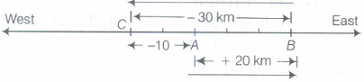
If moving towards East is a positive integer, then moving towards West is represented by a negative integer.
Now, distance moved towards West = - 30 km
and distance moved towards East = 20 km
\(\therefore\) Rita's final position from A = 20 + (- 30) = 20 - 30
= -10 km (i.e. West)
26.
Given, the enrolment of a school during six consecutive years
1555,1670,1750,2013,2540,2820
Now, sum of enrolments
= 1555 + 1670 + 1750 + 2013 + 2540 + 2820 = 12348
Number of years = 6
\(\therefore\) Mean enrolment of the school for this period
= \(\frac { sum\quad of\quad enrolments }{ number\quad of\quad years } =\frac { 12348 }{ 6 } =2058\)
Hence, the mean enrolment of the school for this period is 2058.
27.
()
150°
28.
Since, arithmetic mean of 3,9,4,x 9,7,6 is 6
Arithmetic mean = \(\frac { sum\ of\ observations }{ Number\ of\ observations } \)
6 = \(\frac { 3+9+4+x+9+7+6 }{ 7 } \)
6 x 7 = 38 + x \(\Rightarrow\) 42 = 38 + x
x = 42-38 = 4
x = 4
29.
()
XZY.
30.
()
[ 13 + (-12) ] + (-7) = 13 + [ (-12) + (- 7) ] [\(\because\) addition of integers is associative]
31.
()
180°
32.
(b)
\(3\times \frac{1}{4}\)
33.
(c)
They are complementary angles
34.
(c)
(108-b)°
35.
(c)
80°
36.
(c)
33
37.
(c)
-12
38.
(c)
shape and size
39.
(c)
******
40.
()
70°
41.
()
90°
42.
()
7.5
43.
()
234.34 = 2\(\times\)100 + 3\(\times\)10 + 4\(\times\)1 +\(\frac { 3 }{ 10 } +\frac { 4 }{ 100 } +\frac { 5 }{ 1000 } \)
44.
()
2x + 8 + x - 2 = 180°
3x + 6 = 180°
3x = 180- 6
3x = 174°
\(x=\frac{174^0}{3}=58^0\)
45.
()
Zero

7th Standard CBSE Syllabus & Materials
7th Standard CBSE
CBSE 7th Social Science Theme B - New Beginnings : Cities and States - New Sample Question Papers Study Material - QB365 Set A
NEW7th Standard CBSE
CBSE 7th Social Science Theme A - Climates of India - New Sample Question Papers Study Material - QB365 Set A
NEW7th Standard CBSE
CBSE 7th Social Science Theme A - Geographical Diversity of India - New Sample Question Papers Study Material - QB365 Set A
NEW7th Standard CBSE
CBSE 7th Science Earth, Moon and the Sun - New Sample Question Papers Study Material - QB365 Set A



NCERT Books

Syllabus

Exam Pattern

Sample Question Papers

Previous year Question Papers

Important Notes

MCQ Practice test

NCERT Exemplers

Case study Questions

Image Based Questions

Passage based Questions

HOT Questions

Value Based Questions

Model Questions Papers
NCERT ( Book Back ) Questions

Assertion and Reason
Important Questions And Answers

CBSE 7th Standard CBSE Subjects
CBSE Standards


