
 100% FREE ACCESS
7th Standard CBSE Syllabus & Materials
7th Standard CBSE
CBSE 7th Social Science Theme E - Understanding Market - New Sample Question Papers Study Material - QB365 Set A
NEW7th Standard CBSE
CBSE 7th Social Science Theme E - From Barter to Money - New Sample Question Papers Study Material - QB365 Set A
NEW7th Standard CBSE
CBSE 7th Social Science Theme D - The Constitution of India- An Introduction - New Sample Question Papers Study Material - QB365 Set A
NEW7th Standard CBSE
CBSE 7th Social Science Theme D - From the Rulers to the Ruled : Types of Governments - New Sample Question Papers Study Material - QB365 Set A
NEW7th Standard CBSE
CBSE 7th Social Science Theme B - The Age of Reorganisation - New Sample Question Papers Study Material - QB365 Set A
NEW7th Standard CBSE
CBSE 7th Social Science Theme B - The Rise of Empires - New Sample Question Papers Study Material - QB365 Set A

Published on: 31/10/2025
Download CBSE Class 7th Standard CBSE Mathematics question papers, sample papers, important questions, and previous year solved papers in PDF format. Get free study materials, NCERT solutions, and exam preparation resources for Class 7th Standard CBSE Mathematics
Questions + Answers key
Take MCQ Mathematics Test
1.
If \(12 \frac{4}{4}\) is divided by \(\frac{2}{4}\),then find the simplified value.
2.
Evaluate the following, using the distributive property. (-85) \(\times\) 43 + 43 \(\times\) (-15)
3.
A bag contains 3 black balls and 2 white balls. A ball is drawn without looking into the bag. What is the probability that the colour of the ball will be white?
4.
Find \(\frac{3}{4}\)of (i) 16 (ii) 36
5.
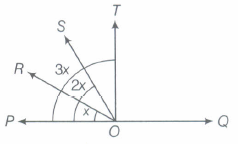
In the following figure, find the value of x.
6.
Solve the following equation \(2y+\frac{5}{2}=\frac{37}{2}\)
7.
Add the following integers using number line: -2 and 5
8.
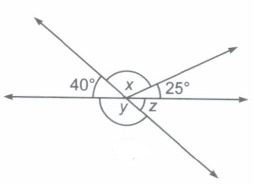
Find the value of the angles x, y and z in each of the following:
9.
Arushi deposits Rs 2000 per month in her account for six months as saving. But when she is in need, she withdraw Rs 1600 and once again she withdraw Rs 5,000 from her account.
(a) If withdrawal of amount is represented by (-ve) sign and deposition by (+ve) sign, what is the present position (balance) of her account?
(b) Which mathematical concept is used in this problem?
(c) What is its value?
10.
Calculate the value of \([3\frac{6}{9}\times 4\frac{1}{5}]\div [4\frac{1}{45}]\)
11.
A multistorey building has 25 floors above the ground level each of height 5 m. It also has 3 floors in the basement each of height 5 m. A lift in building moves at the rate of 1m/s. If a man starts from 50 m above the ground, how long will it take him to reach at the 2nd floor of the basement?
12.
What happens to the value of the product, when we multiply two improper fractions?
| \(\frac{7}{3}\times \frac{5}{2}=\frac{35}{6}\) | \(\frac{35}{6}>\frac{7}{3},\frac{35}{6}>\frac{5}{2}\) | Product is greater than each of the fractions |
| \(\frac{6}{5}\times \frac{\boxed {}}{3}=\frac{24}{15}\) | ||
| \(\frac{9}{2}\times \frac{7}{\boxed {}}=\frac{63}{8}\) | ||
| \(\frac{3}{\boxed {}}\times \frac{8}{7}=\frac{24}{14}\) |
13.
Take the data giving the minimum and the maximum temperature of various cities given in the below table. Plot a double bar graph using the data and answer the following:
| A temperature of cities as on 20.06.2006 | ||
|---|---|---|
| City | maximum | Minimum |
| Ahmedabad | 380C | 290C |
| Amritsar | 270C | 260C |
| Bangalore | 280C | 210C |
| Chennai | 360C | 270C |
| Delhi | 380C | 280C |
| Jaipur | 390C | 290C |
| Jammu | 410C | 260C |
| Mumbai | 320C | 270C |
Which city has the largest difference in the minimum and maximum temperatures on the given date?
14.
\(42.47 \div =\)________0.4247
15.
30% of 300 =________________
16.
In an isosceles triangle, angles opposite to equal sides are______________.
17.
If we multiply ____________ number of negative integers, then the resulting integer is positive.
18.
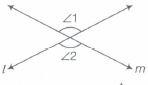
In the adjacent figure, if I and m are two straight lines, then \(\angle \)1 and \(\angle \)2 are ____________ angles.
19.
If \(\frac{9}{5}x=\frac{18}{5}\) then x = ________.
20.
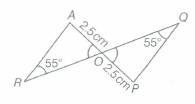
In the given figure, ΔARO ≅ Δ _____
21.
Replace the blank with an integer to make it a true statement. (-3) x _____ =27
22.
The ascending arrangement of\(\frac { 2 }{ 3 } ,\frac { 6 }{ 7 } ,\frac { 14 }{ 21 } \)is
\(\frac { 1 }{ 5 } ,\frac { 3 }{ 7 } ,\frac { 7 }{ 10 } \)
\(\frac { 13 }{ 21 } ,\frac { 2 }{ 3 } ,\frac { 6 }{ 7 } \)
\(\frac { 6 }{ 7 } ,\frac { 13 }{ 21 } ,\frac { 2 }{ 3 } \)
\(\frac { 2 }{ 3 } ,\frac { 6 }{ 7 } ,\frac { 13 }{ 21 } \)
23.
Madhre is standing in the middle of a bridge which is 20 m above the water level of a river. If a 35m deep river is flowing under the bridge, then the vertical distance between the foot of Madhre and bottom level of the river is:
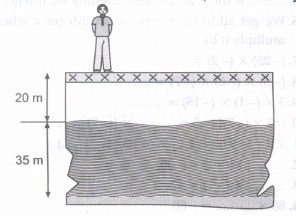
55 m
35 m
20 m
15 m
24.
How many pieces of 13.2 cm can be cut from a 330 cm long rod?
25
28
21
35
25.
The product of \(\frac{11}{13}\) and 4 is
\(3 \frac{5}{13}\)
\(5\frac{3}{13}\)
\(13\frac{5}{5}\)
\(13\frac{5}{3}\)
26.
In the given figure, find the value of x.
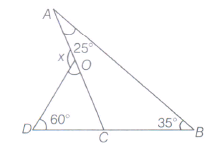
75°
90°
120°
60°
27.
If \(\bigotimes \) , O and \(\bullet\) represent some integers on the number line, then descending order of these numbers is

\(\bullet ,\bigotimes ,\oslash ,O\)
\(\bigotimes ,\bullet ,\oslash ,O\)
\(O,\oslash ,\bigotimes ,\bullet \)
\(O,\bullet ,\bigotimes ,\oslash \)
28.
In the following figure, the value of x is
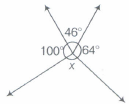
110°
46°
64°
150°
29.
Angles which are both supplementary and vertically opposite are
95°,85°
90°,90°
100°,80°
45°,45°
30.
A bag is having 4 red balls and 6 yellow balls. If a ball is pulled out without seeing them, then find the probability of getting a red ball.
\(\frac { 2 }{ 5 } \)
\(\frac { 3 }{ 5 } \)
\(\frac { 9 }{ 12 } \)
\(\frac { 2 }{ 3 } \)
31.
The number of trees in different parks of a city are 33, 38, 48, 33, 34, 34, 33 and 24. The mode of this data is
24
34
33
48
32.
If k + 7 = 16, then the value of 8k - 72 is equal to
0
1
112
56
33.
If a and b are positive integers, then the solution of the equation ax = b will always be a
positive number
negative number
1
0
34.
Which congruence criterion do you use in the following?
Given, ZX = RP, RQ =ZY, ㄥPRQ = ㄥXZY. So, ΔPOR ≅ ΔXYZ
ASA rule
SSS rule
RHS rule
SAS rule
35.
If * represents 3 mangoes, then 18 mangoes are represented by
***
****
******
None of these
36.
In the following figure, X and Y are the points on sides PO and PR of \(\triangle PQR\).such that XY II OR. If \(\angle Q=40^0,\angle P=30^0\),find the angle (i) \(\angle a\) (ii) \(\angle b\) (iii) \(\angle c\).
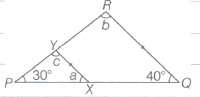
37.
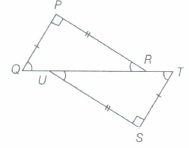
In the given figure, ΔPQR is a right angled at P, V and T are the points on line QRT, if QP II ST and US II RP, find ㄥS.
38.
0 is called the additive identity of integers.
39.
Product of two fractions =\(\frac { Product\ of\ their\ denominators }{ Product\ of\ their\ numerators } \)
40.
A linear pair may have two acute angles.
41.
Two supplementary angles always from a linear pair.
42.
a ÷ b = b ÷ a
43.
5 - (- 8) is same as 5 + 8.
44.
Range of the data is always from the data.
45.
The mode of the observation 23, 26,15,12,28,38,19, 23, 26, 23 is 28.
46.
If \(\frac { 2x-3 }{ 5 } +\frac { x+3 }{ 4 } =\frac { 4x+1 }{ 7 } \) , find the value of x.
47.
Find:
(a) 9% of Rs.700
(b) 6\(\frac { 2 }{ 3 } \)% of 75 m
(c) 7'5% of 80 kg
(d) 8% of 5 litres
48.
In the figure, identify:
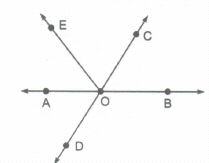
Two pairs of vertically opposite angles
49.
What value of x will make \(\angle \)AOB and \(\angle \)BOC a linear pair?
.JPG)
50.
Find each of the following and classify the result as whole numbers, proper or improper fraction:
14\(\div\)4\(\frac{3}{4}\)
51.
Pankaj's age is 5 years more than three times the Raju's age. Find the Raju's age if Pankaj's age is 44 years.
52.
What is the median of 10, 1, 9, 2, 8, 3, 7, 4, 6,5?
53.
If 15x = 27 + 6x, find x.
1.
26
2.
-4300
3.
\(\frac { 2 }{ 5 } \)
4.
(i) We have, \(\frac{3}{4}\)of 16=\(\frac{3}{4}\times 16\)=\(\frac{3\times 16}{4}=\frac{48}{4}=12\)
(ii) We have, \(\frac{3}{4}\)of 27=\(\frac{3}{4}\times 36\)=\(\frac{3\times 36}{3}=\frac{108}{4}=27\)
5.
x = 30°
6.
We have, \(2y+\frac{5}{2}=\frac{37}{2}\)
On transposing \((+\frac{5}{2})\) from LHS to RHS, we get
\(2y=\frac{37}{2}-\frac{5}{2}\quad \Rightarrow 2y=\frac{1}{2}(37-5)\) [taking \(\frac{1}{2}\) as common]
\(\Rightarrow \quad 2y=\frac{32}{2}=16\)
On dividing both sides by 2, we get
\(\frac{2y}{2}=\frac{16}{2}\quad \Rightarrow y=8\)
Hence, y = 8 is a solution of the given equation.
7.
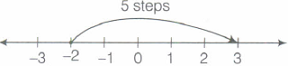
We have, -2 and 5
In this case, firstly we go to (-2) and then move (5) step to the right of (-3).
Thus, we reached to (3), i.e. (-2) + (5) = 3
8.
Since 40° and z are vertically opposite angles,
∴ z=40°
Again y and 40° form a linear pair.
∴ y + 40° = 180°
[Transposing 40° to R.H.S]
or y = 180° - 40°
or y = 140°
∵ y and (x + 25°) are vertically opposite angles
∴ (x + 25°) = y = 140°
[∵ y = 140o]
or x = 140° - 25°
[Transposing 25° to R.H.S.]
or x = 115°
Thus, x = 115°, y = 140° and z = 40°
9.
(a) Since, she deposits Rs 2000 per month
∴ Amount deposit by her in six months
= Rs 2000 \(\times\) (6)
= Rs 12,000
She withdraw Rs 1600 and Rs 5000 in need.
So, withdrawal = - (1600 + 5000)
So, present position of account
= 12000- (1600 + 5000)
= 12000- 6600
= 5400
So, she has balance Rs 5400 in her account.
(b) Multiplication and subtraction of integers.
(c) If you save the money you can use it in need.
10.
\(3\frac{150}{181}\)
11.
In the following figure, we can clearly see that man will have to cover 60 m to reach the second floor of the basement.
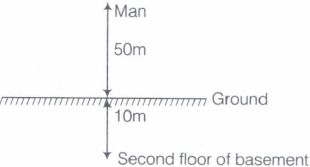
Since lift moves with a speed of 1 m/s.
Hence, time taken to reach the second floor of basement = \(\frac { Distance }{ Speed } =\frac { 60m }{ 1{ m }/{ s } } \) = 60 s or 1 min
12.
| \(\frac{7}{3}\times \frac{5}{2}=\frac{35}{6}\) | \(\frac{35}{6}>\frac{7}{3},\frac{35}{6}>\frac{5}{2}\) | Product is greater than each of the fractions |
| \(\frac{6}{5}\times \frac{\boxed {}}{3}=\frac{24}{15}\) | \(\frac{24}{15}>\frac{6}{5},\frac{24}{15}>\frac{4}{3}\) | Product is greater than each of the fractions |
| \(\frac{9}{2}\times \frac{7}{\boxed {}}=\frac{63}{8}\) | \(\frac{63}{8}>\frac{9}{2},\frac{63}{8}>\frac{7}{4}\) | Product is greater than each of the fractions |
| \(\frac{3}{\boxed {}}\times \frac{8}{7}=\frac{24}{14}\) | \(\frac{24}{14}>\frac{3}{2},\frac{24}{14}>\frac{8}{7}\) | Product is greater than each of the fractions |
13.
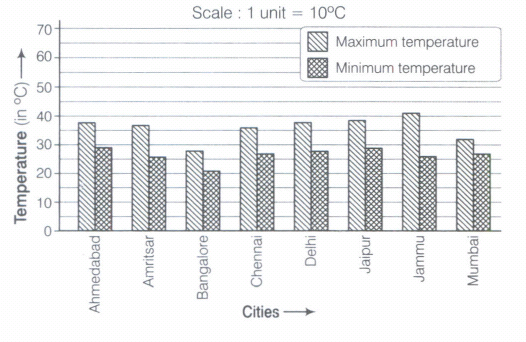
Jammu is a city in which, there is largest difference in the minimum and maximum temperature
14.
()
100
15.
()
90
16.
()
equal
17.
()
even
18.
()
vertically opposite
19.
Given, \(\frac{9}{5}x=\frac{18}{5}\quad \Rightarrow x=\frac{18\times 5}{5\times 9}\)
\(\Rightarrow x=\frac{18\times 1}{1\times 9}=2\)
So, if \(\frac{9}{5}x=\frac{8}{5}\) then x = 2.
20.
()
PQO
21.
()
(- 3) x (- 9) = 27
22.
(b)
\(\frac { 13 }{ 21 } ,\frac { 2 }{ 3 } ,\frac { 6 }{ 7 } \)
23.
(a)
55 m
24.
(a)
25
25.
(a)
\(3 \frac{5}{13}\)
26.
(c)
120°
27.
(c)
\(O,\oslash ,\bigotimes ,\bullet \)
28.
(d)
150°
29.
(b)
90°,90°
30.
(a)
\(\frac { 2 }{ 5 } \)
31.
(c)
33
32.
(a)
0
33.
(a)
positive number
34.
(d)
SAS rule
35.
(c)
******
36.
a = 40° ,b = 110° ,c = 110°
37.
Given ㄥQPR = 90°, ORT is a line, OP II ST and US II PR, ㄥS=?
Now, we extend US up to U such that it intersects QP at U.
PR || US [given]
⇒ PR || U'S, U'P is a transversal.
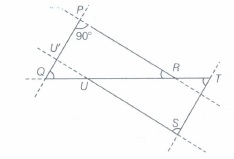
So, ㄥP + ㄥU' = 180° [by the property, sum of two interior angles on the same side of a transversal]
900 + ㄥU = 180°
ㄥU' = 180° - 90°
ㄥU = 90°
Similarly, OP II ST [given]
Then, US is a transversal.
So, ㄥU' + ㄥS =180° ⇒ 90° + ㄥS =180°
⇒ ㄥS=1800 - 90° ⇒ ㄥS = 90°.
38.
(a)
39.
(b)
40.
(b)
41.
(a)
42.
(b)
43.
(a)
44.
(b)
45.
(b)
46.
Given, \(\frac { 2x-3 }{ 5 } +\frac { x+3 }{ 4 } =\frac { 4x+1 }{ 7 } \)
\(\Rightarrow \quad \frac { 4(2x-3) }{ 5\times 4 } +\frac { 5(x+3) }{ 5\times 4 } =\frac { 4x+1 }{ 7 } \)
\(\Rightarrow \quad \frac { 8x-12 }{ 20 } +\frac { 5x+15 }{ 20 } =\frac { 4x+1 }{ 7 } \)
\(\Rightarrow \quad \frac { 8x-12+5x+15 }{ 20 } =\frac { 4x+1 }{ 7 } \)
\(\Rightarrow \quad \frac { 13x+3 }{ 20 } =\frac { 4x+1 }{ 7 } \)
\(\Rightarrow\) 7(13x + 3) = 20(4x + 1)
\(\Rightarrow\) 91x + 21 = 80x + 20
\(\Rightarrow\) 91x - 80x = 20 - 21
\(\Rightarrow\) 11x = -1
Thus, \(x=-\frac { 1 }{ 11 } \)
47.
(a) 9% of Rs.700= \(\frac { 9 }{ 100 } \times \)700
= 9 X 7
= Rs.63
(b) 6 \(\frac { 2 }{ 3 } \)% of 75m =\(\frac { 20 }{ 3 } \)% of 75 m
=\(\frac { 20 }{ 300 } \times \)75 m
=\(\frac { 1 }{ 15 } \times \)75 m
=5 m
(c) 7.5 % of 80 kg =\(\frac { 7.5 }{ 100 } \times \)80 kg
=\(\frac { 3 }{ 40 } \times \)80 = 6 kg
(d) 8% of 5 liters =\(\frac { 8 }{ 100 } \times \)5 litres
=\(\frac { 40 }{ 100 } \times \)0.4 litre.
48.
()
[\(\angle \)BOC and [\(\angle \)AOD] and [[\(\angle \)AOC and [\(\angle \)BOD]
49.
()
34°
50.
()
\(\frac{56}{19}\)(Improper fraction)
51.
()
13 years
52.
()
5.5
53.
()
15x - 6x = 27
9x = 27
\(x=\frac { 27 }{ 9 } =3\)

7th Standard CBSE Syllabus & Materials
7th Standard CBSE
CBSE 7th Social Science Theme B - New Beginnings : Cities and States - New Sample Question Papers Study Material - QB365 Set A
NEW7th Standard CBSE
CBSE 7th Social Science Theme A - Climates of India - New Sample Question Papers Study Material - QB365 Set A
NEW7th Standard CBSE
CBSE 7th Social Science Theme A - Geographical Diversity of India - New Sample Question Papers Study Material - QB365 Set A
NEW7th Standard CBSE
CBSE 7th Science Earth, Moon and the Sun - New Sample Question Papers Study Material - QB365 Set A



NCERT Books

Syllabus

Exam Pattern

Sample Question Papers

Previous year Question Papers

Important Notes

MCQ Practice test

NCERT Exemplers

Case study Questions

Image Based Questions

Passage based Questions

HOT Questions

Value Based Questions

Model Questions Papers
NCERT ( Book Back ) Questions

Assertion and Reason
Important Questions And Answers

CBSE 7th Standard CBSE Subjects
CBSE Standards


