
 100% FREE ACCESS
7th Standard CBSE Syllabus & Materials
7th Standard CBSE
CBSE 7th Social Science Theme E - Understanding Market - New Sample Question Papers Study Material - QB365 Set A
NEW7th Standard CBSE
CBSE 7th Social Science Theme E - From Barter to Money - New Sample Question Papers Study Material - QB365 Set A
NEW7th Standard CBSE
CBSE 7th Social Science Theme D - The Constitution of India- An Introduction - New Sample Question Papers Study Material - QB365 Set A
NEW7th Standard CBSE
CBSE 7th Social Science Theme D - From the Rulers to the Ruled : Types of Governments - New Sample Question Papers Study Material - QB365 Set A
NEW7th Standard CBSE
CBSE 7th Social Science Theme B - The Age of Reorganisation - New Sample Question Papers Study Material - QB365 Set A
NEW7th Standard CBSE
CBSE 7th Social Science Theme B - The Rise of Empires - New Sample Question Papers Study Material - QB365 Set A

Published on: 31/10/2025
Download CBSE Class 7th Standard CBSE Mathematics question papers, sample papers, important questions, and previous year solved papers in PDF format. Get free study materials, NCERT solutions, and exam preparation resources for Class 7th Standard CBSE Mathematics
Questions + Answers key
Take MCQ Mathematics Test
1.
Find each of the following product: (-21) x (-30)
2.
Multiply and reduce to lowest form (if possible).\(\frac{9}{5}\times \frac{3}{5}\)
3.
A number line representing integer is given below:

-5 and -4 are marked by E and F respectively, which integers are marked by B, C, I, J and K.
4.
Verify a - (-b) = a + b for the following values of a and b. a= 75, b= 84
5.
The heights of 10 girls were measured (in cm) and the results are as follows: 135, 150,139, 128, 151, 132, 146, 149, 143, 141 - What is the mean height of the girls?
6.
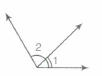
Are the angles marked 1 and 2 in figure adjacent? If they are not adjacent, say 'why',
7.
Solve \(\frac{7}{10}+\frac{2}{5}+\frac{3}{2}\)
8.
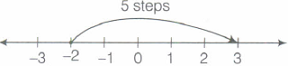
Add the following integers using number line: -2 and 5
9.
The product of two decimal numbers is 2.2144. If one of them is 0.64, then find the other decimal number.
10.
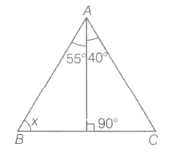
In the given figure, find the value of x.
11.
Write down a pair of integers whose difference is -19
12.
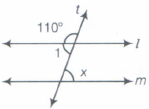
Find the value of x in each of the following figures, if 1|| m.
13.
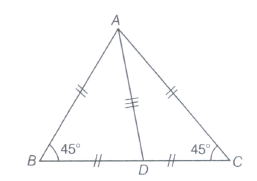
From the above figure, find the value of \(\angle A\).
14.
The bar graph given below shows the marks of students of a class in a particular subject
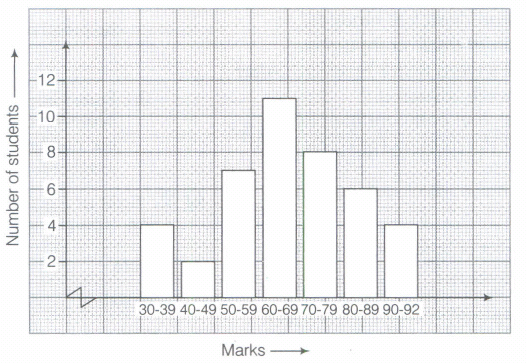
How many students got marks from 50 to 69?
15.
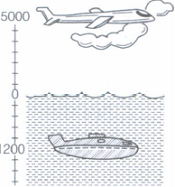
A plane is flying at the height of 5000 m above the sea level. At a particular point, it is exactly above a submarine floating 1200m below the sea level. What is the vertical distance between them?
16.
Following table shows the points of each player scored in four games
| Players | Game | Game | Game | Game |
|---|---|---|---|---|
| 1 | 2 | 3 | 4 | |
| A | 14 | 16 | 10 | 10 |
| B | 0 | 8 | 6 | 4 |
| C | 8 | 11 | Did not play | 13 |
Who is the best performer?
17.
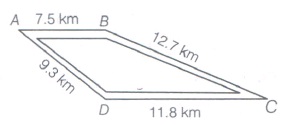
Dinesh went from place A to place B and from there to place C. A is 7.5 km from Band B is 12.7 km from C. Ayub went from place A to place D and from there to place C. D is 9.3 km from A and C is 11.8 km from D. Who travelled more and by how much?
18.
A water tank has steps inside it. A monkey is sitting on the topmost step i.e. the first step. The water level is at the ninth step.
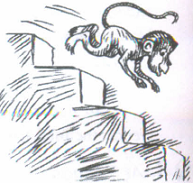
(i) He jumps 3 steps down and then jumps back 2 steps up. In how many jumps will he reach the water level?
(ij) After drinking water, he wants to go back. For this, he jumps 4 steps up and then jumps back 2 steps down in every move. In how many jumps will he reach back the top step?
(iii) If the number of steps moved down is represented by negative integers and the number of steps moved up by positive integers, represent his moves in parts (i) and (ii) by completing the following
(a) -3 + 2- ... = -8
(b) 4 -2 + ... = 8
In part (a), the sum (-8) represents going down by eight steps. What will the sum 8 in part (b) represent?
19.
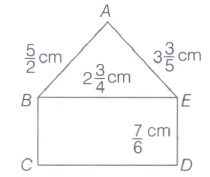
Find the perimeters of
(i) △ABE
(ii) the rectangle BCDE in this figure. Whoseperimeter is greater?
20.
It is possible to have a triangle in which each angle is less than 60°.
21.
If 4x - 7 = 11, then x = 4.
22.
1 is the only number which has its own reciprocal.
23.
(-3) \(\div\) (-3) = 1
24.
Two right angles are always supplementary to each other.
25.
The data 6, 4, 3, 8, 9, 12, 13, 9 has mean 9
26.
The reciprocal of \(\frac{2}{7}\) is ________
27.
-14 x 4 = -(______x_____ ) = ________
28.
x + 7 = 16 has solution _________.
29.
The mode of the following data 62,61,49,37, 91,61,47, 53, 54, 97, 98, 99 is
30.
If the arithmetic mean of 3, 9, 4, x, 9, 7,6 is 6, then the value of x is.............
31.
Replace the blank with an integer to make it a true statement. (-3) x _____ =27
32.
[ 13 + (- 12) ] + ______ = 13 + [ (- 12) + (- 7) ]
33.
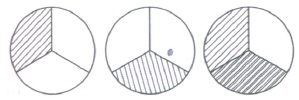
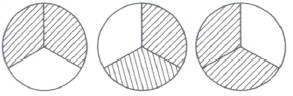
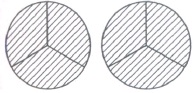
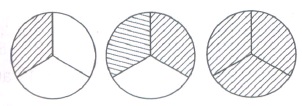
Pictorial representation of \(3\times \frac{2}{3} \)is
34.
Which of the following is the ratio of 3 km to 300 m?
10: 1
1 : 10
100: 1
1 : 100
35.
When zero is subtracted from an integer, we get
1
0
the inverse of the number
the same number
36.
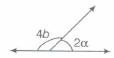
In the following figure, \(\alpha\) = 35°, then the value of b is
27.5
26.5
29
28.5
37.
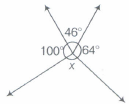
In the following figure, the value of x is
110°
46°
64°
150°
38.
The equation having -3 as a solution is
x + 3 = 1
8 + 2x = 3
10 + 3x = 1
2x + 1 = 3
39.
If 7x + 4 = 39, then x is equal to
6
-4
5
8
40.
The mode of the data 22,29, 27, 23, 43, 41, 27 is
23 and 27
27
23 and 43
22
41.
Which of the following rule of congruency say that ΔABC ≅ ΔPQR
SSS
RHS
ASA
SAS
42.
Number of elements of a triangle is
6
5
4
3
43.
If the sum of two integers a and b is zero, then
a=0, b=0
a = -b
Both (a) and (b) are not zero
None of these
44.
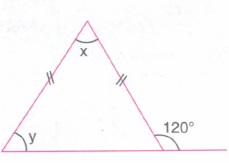
Find angles x and y in each figure.
1.
We have, (- 21) x (- 30) = 21 x 30 = 630
2.
We have,\(\frac{9}{5}\times \frac{3}{5}=\frac{9\times 3}{5\times 5}=\frac{27}{25}\)
3.
B = - 8, C = - 7, I = -1, J = 0,K = + 1
4.
Given, a = 75 and b = 84
\(\therefore\) LHS = a - (-b) = 75 - (-84) = 75 + 84 =159
and RHS = a + b = 75 + 84 = 159
Hence, LHS = RHS
5.
On arranging the data in ascending order, we get 128,132,135,139,141,143,146,149,150,151
Mean heigher of the girls\(=\frac { Sum\ of\ height\ of\ all\ girls }{ number\ of\ girls } \)
= \(\frac { 128+132+135+139+141+143+146+149+150+151 }{ 10 } \)
= \(\frac { 1410 }{ 10 } \)
=141.4
Hence, the mean height of the girls is 141.4 cm
6.
In the given figure \(\angle \)1 and \(\angle \)2 are not adjacent angles because \(\angle \)1 is a part of \(\angle \)2, i.e. the other arms of the angles marked \(\angle \)1 and \(\angle \)2 are not on the opposite of the common arm or \(\angle \)1 and \(\angle \)2 do not fulfill the condition that there are no common interior point.
7.
We have, \(\frac{7}{10}+\frac{2}{5}+\frac{3}{2}\)
\(\therefore \frac{7}{10}+\frac{2}{5}+\frac{3}{2}=\frac{7+4+15}{10}\)
=\(\frac{26}{10}=\frac{13}{5}\)
[dividing numerator and denominator by 2]
8.
We have, -2 and 5
In this case, firstly we go to (-2) and then move (5) step to the right of (-3).
Thus, we reached to (3), i.e. (-2) + (5) = 3
9.
Given, the product of two decimal numbers is 2.2144
One of the decimal number = 0.64
Let the other decimal number be x.
So, according to the question.
\(0.64 \times x=2.2144\)
\(x=\frac{2.2144}{0.64} \Rightarrow x=\frac{22144}{10000}\times \frac{100}{64}\)
x=\(\frac{22144}{100}\times \frac{1}{64}=\frac{346}{100}=3.46\)
x = 3.46
Hence, the other number is 3.46.
Check = 3.46\(\times\)0.64= 346\(\times\)64= 22144
Place decimal point after 4 digits starting from the
extreme right of 22144 and 64.
So, 3.46x 0.64= 2.2144
10.
We know that, the sum of all three angles in a triangle is equal to 180°.
So, x + 55° + 90° =180°
\(\Rightarrow\) x + 145° =180°
\(\Rightarrow\) x = 180° -145°
\(\Rightarrow\) x = 35°
11.
For a pair of integers, whose difference is -19.
= -12-7 = -19
12.
We have, l II m and t is a transversal.
\(\therefore \quad \angle x=\angle 1\) [ alternate interior angles]
Now, \(\angle \)1+110°=180° [by linear pair]
\(\therefore\) \(\angle \)1=180°-110°=70° \(\Rightarrow\) \(\angle \)x = 70°
Hence, the required value of x is 70°.
13.
\(\angle A=90^0\) [Hint Use the concept of is isosceles triangle]
14.
Number of students getting marks from 50-69
= Number of students getting marks from 50-59 + Number of students getting marks from 60-69
= 7+11=18
15.
Here, the sea level is at 0 m and the plane is 5000m above the sea level.
\(\therefore\) Distance between plane and the sea level = 5000 m
Also, the submarine is floating 1200 m below the sea level.
\(\therefore\) Distance between the submarine and the sea level = 1200 m
Hence, the vertical distance between the plane and the submarine = Distance between the plane and the sea level + Distance between the sea level and submarine
= 5000 + 1200 = 6200 m
16.
Average number of points scared by A = 12.5 [as calculated in part (i)]
Average number of points scared by B = 4.5 [as calculated in part (iii)]
\(=\frac { sum\ of\ points\ in\ games }{ number\ of\ games } \)
= \(\frac { 8+11+13 }{ 3 } =\frac { 32 }{ 3 } \) =10.67
\(\because\) 12.5 > 10.67 > 4.5
Hence, A is the best performer.
17.
Given, distance between A and B = 7.5 km
Distance between Band C = 12.7 km
∴ Distance travelled by Dinesh = AB + BC
= 7.5+ 12.7
= 20.2km
Distance between A and D = 9.3 km
Distance between D and C = 11.8 km
∴ Distance travelled by Ayub = AD + DC
= 9.3+ 11.8
= 21.1 km
Hence, it is clear that 21.1>20.2.
∴ Ayub travelled more distance i.e. 21.1 km.
Now, difference between distances, they both travelled
= (21.1- 20.2) km
=0.9km
Hence, Ayub travelled 0.9 km more than Dinesh.
18.
Let the number of steps moved down to be represented by negative integers and number of steps moved up to be represented by positive integers. Given that, the total number of steps to be moved down to reach water level= 9
(i) Number of steps moved down in one jump = - 3
and number of steps moved up in one jump = 2
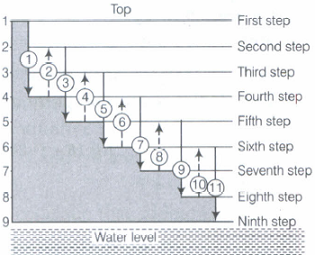
From the above figure, monkey will reach the water level in 11 jumps.
Alternate Method:
The monkey is sitting on the topmost step i.e. the first step. While going down, the monkey jumps 3 steps down and then jumps back 2 steps up. To reach the water level, he has to jump as follows:
-3 + 2 -3 + 2 -3 + 2 -3 + 2 -3 + 2 -3 = -8
Hence, he takes 11 jumps to reach the water level.
ii) In one jump number of steps moved up = 4
In one jump, number of steps moved down = - 2
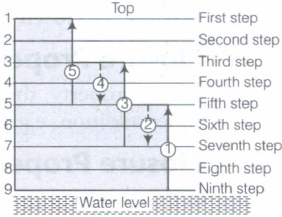
Distance covered in single jump = 4 - 2 =2
Now, total number of steps for top = 9
From the above figure, he will reach back the top step in 5 jumps.
Alternate Method
Afterdrinkingwaters,he has to jump as followsto go back:
4 -2 + 4 - 2 + 4 = 8
Hence, he takes 5 jumps to reach back the top
(iii) (a) We have,
-3 + 2 -3 + 2 - 3 + 2 - 3 + 2 - 3 + 2 -3 = -8
(b) 4 - 2 + 4 - 2 + 4 = 8
According to the question, the sum 8 in part (b) represents going up 8 steps.
19.
(i) Given, AB = \(\frac{5}{2}\)cm
BE = 2 \(\frac{3}{4}\)cm \(=\frac{2\times4+3}{4}=\frac{11}{4}\)cm
and AE = 3\(\frac{3}{5}\)cm\(=\frac{3\times5+3}{5}=\frac{18}{5}\)cm
Now, perimeter of △ABE = Sum of all sides of a triangle = AB + BE + AE = \(\frac{5}{2}\)+\(\frac{11}{4}\)+\(\frac{18}{5}\)
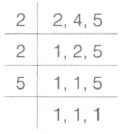
∴ LCM of 2, 4, 5 = 2 x 2 x 5 = 20
ஃ \(\frac{5}{2}\)+\(\frac{11}{4}\)+\(\frac{18}{5}\)
\(=\frac{5\times10+11\times5+18\times 4}{20}\)
=\(\frac{50+55+72}{20}=\frac{177}{20}\) and or \(8\frac{17}{20}\) cm
(ii) Given, length of rectangle BCDE,
I = BE = CD = \(2-\frac{3}{4}\) cm \(=\frac{2\times 4+3}{4}=\frac{11}{4}\)cm
and breadth of rectangle, b = BC = DE =\(\frac{7}{6}\)cm
∴ Now, perimeter of rectangle BCDE = 2(l + b)
\(=2(\frac{11}{4}+\frac{7}{6})=2(\frac{11\times 3+7\times 2}{12})\) [∵ LCM of 4 and 6 = 12]
=\(2(\frac{33+14}{12})=\frac{47}{6}\)cm
Now, perimeter of MBC =\(\frac{177}{20}\)cm
and perimeter of rectangle BCDE =\(\frac{47}{6}\)cm
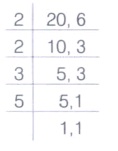
LCM of 20 and 6 = 2 x 2 x 3 x 5 = 60
On converting both fractions into like fractions, we get
\(\frac{177}{20}\)=\(\frac{177\times 3}{20\times 3}=\frac{531}{60}\)cm
and \(\frac{47}{6}=\frac{47\times 6}{47\times10}=\frac{470}{60}\)
Since, 531>470 [numerators of fractions]
So, \(\frac{531}{60}>\frac{470}{60} i.e., \frac{177}{20}>\frac{47}{6}\)
Hence, the perimeter of triangle is greater than the perimeter of rectangle.
20.
(b)
21.
(b)
22.
(a)
23.
(a)
24.
(a)
25.
(b)
26.
()
\(\frac{7}{2}\)
27.
()
- (14 x 4 ) = - 56
28.
Given, x + 7 = 16 \(\Rightarrow\) x = 16 - 7 = 9
So, x + 7 = 16 has solution 9.
29.
Mode = maximum occuring observation = 67 (occurs 2 times)
30.
Since, arithmetic mean of 3,9,4,x 9,7,6 is 6
Arithmetic mean = \(\frac { sum\ of\ observations }{ Number\ of\ observations } \)
6 = \(\frac { 3+9+4+x+9+7+6 }{ 7 } \)
6 x 7 = 38 + x \(\Rightarrow\) 42 = 38 + x
x = 42-38 = 4
x = 4
31.
()
(- 3) x (- 9) = 27
32.
()
[ 13 + (-12) ] + (-7) = 13 + [ (-12) + (- 7) ] [\(\because\) addition of integers is associative]
33.
(b)
34.
(a)
10: 1
35.
(d)
the same number
36.
(a)
27.5
37.
(d)
150°
38.
(c)
10 + 3x = 1
39.
(c)
5
40.
(b)
27
41.
(b)
RHS
42.
(a)
6
43.
(b)
a = -b
44.
(i) x + y = 1200 ...(1)
The exterior angle of a triangle is equal to the sum of its two interior opposite angles
x + y + y = 1800
Base angles opposite to the equal sides of an isosceles triangle are equal and the sum of the measures of the three angles of a triangle is 1800
\(\Rightarrow\)x + 2y = 1800 ... (2)
Subtracting equation (1) from equation (2),
y = 60°
Put y = 60° in equation (1),
x + 60° = 120°
\(\Rightarrow\)x = 120° - 60°
\(\Rightarrow\)x = 60°

7th Standard CBSE Syllabus & Materials
7th Standard CBSE
CBSE 7th Social Science Theme B - New Beginnings : Cities and States - New Sample Question Papers Study Material - QB365 Set A
NEW7th Standard CBSE
CBSE 7th Social Science Theme A - Climates of India - New Sample Question Papers Study Material - QB365 Set A
NEW7th Standard CBSE
CBSE 7th Social Science Theme A - Geographical Diversity of India - New Sample Question Papers Study Material - QB365 Set A
NEW7th Standard CBSE
CBSE 7th Science Earth, Moon and the Sun - New Sample Question Papers Study Material - QB365 Set A



NCERT Books

Syllabus

Exam Pattern

Sample Question Papers

Previous year Question Papers

Important Notes

MCQ Practice test

NCERT Exemplers

Case study Questions

Image Based Questions

Passage based Questions

HOT Questions

Value Based Questions

Model Questions Papers
NCERT ( Book Back ) Questions

Assertion and Reason
Important Questions And Answers

CBSE 7th Standard CBSE Subjects
CBSE Standards


