
 100% FREE ACCESS
7th Standard CBSE Syllabus & Materials
7th Standard CBSE
CBSE 7th Social Science Theme E - Understanding Market - New Sample Question Papers Study Material - QB365 Set A
NEW7th Standard CBSE
CBSE 7th Social Science Theme E - From Barter to Money - New Sample Question Papers Study Material - QB365 Set A
NEW7th Standard CBSE
CBSE 7th Social Science Theme D - The Constitution of India- An Introduction - New Sample Question Papers Study Material - QB365 Set A
NEW7th Standard CBSE
CBSE 7th Social Science Theme D - From the Rulers to the Ruled : Types of Governments - New Sample Question Papers Study Material - QB365 Set A
NEW7th Standard CBSE
CBSE 7th Social Science Theme B - The Age of Reorganisation - New Sample Question Papers Study Material - QB365 Set A
NEW7th Standard CBSE
CBSE 7th Social Science Theme B - The Rise of Empires - New Sample Question Papers Study Material - QB365 Set A

Published on: 31/10/2025
Download CBSE Class 7th Standard CBSE Mathematics question papers, sample papers, important questions, and previous year solved papers in PDF format. Get free study materials, NCERT solutions, and exam preparation resources for Class 7th Standard CBSE Mathematics
Questions + Answers key
Take MCQ Mathematics Test
1.
Sameera purchased 3\(\frac { 1 }{ 2 } \)kg apples and 4\(\frac { 3 }{ 4 } \)kg oranges.What is the total weight of fruits purchased by her?
2.
Simplify \(\frac { 14 }{ 25 } \times \frac { 35 }{ 51 } \times \frac { 34 }{ 49 } \)
3.
Mukul solved \(\frac { 2 }{ 7 } \)part of an exercise while Deeksha solved \(\frac { 4 }{ 5 } \)of it. Who solved less?
4.
If length of rectangle is 0.5 metre and its breadth is 1.5 metre, find its area.
5.
Evaluate 2.73÷1.3
6.
Evaluate 3.25÷0.5
7.
Ridhaan goes 25 km towards East from point A to the point B. Now from B. he moves 35 krn towards West along the same Road.
(a) If the distance of East is represented by (+ ve) sign, then how will you represent the distance of West. Again by which sign will you represent the position of Ridhaan from A.
(b) Which mathematical concept is used in this problem?
(c) What is its value?
8.
Ravi can walk 3\(\frac{1}{3}\)km in one hour. How long will it take him to walk to his office which is 10 km from his home?
9.
Find the value of 2\(\frac{1}{3}\) of 4\(\frac{7}{9}\)of \(\frac{1}{2}\).
10.
An auto driver charges Rs 10.20 per km. Then, how much will he charge for a journey of 118.5 km?
11.
Choose the smaller 12.04 or 12.004.
12.
Which is greater? 2.03 or 2.30
13.
Find \(6 \div 5 \frac{1}{3}\)
14.
Observe the following table and complete it.
| Statement | Observation | |
| (i) | 7-9 = -2 | Result is an integer |
| (ii) | 17 - (-21) = | |
| (iii) | -8 - (-14) = 6 | Result is an integer |
| (iv) | -21- (-10)= | |
| (v) | 32 - (-17) = | |
| (vi) | -18 - (-18) = | |
| (vii) | -29 - 0 = |
15.
Following are some pairs of integers. Observe the following table and complete it:
| Statement | Observation | |
| (i) | 17 + 23 = 40 | Result is an integer |
| (ii) | -10 + 3 = | |
| (iii) | -75 + 18 = | Result is an integer |
| (iv) | 19 + (-25) = - 6 | |
| (v) | 27 + (-27) = | |
| (vi) | -20 + 0 = | |
| (vii) | -35 + (-10) = |
16.
Rita goes 20 km towards East from a point A to the point B. From B, she moves 30 km towards West along the same road. If the distance towards East is represented by a positive integer, then how will you represent the distance travelled towards West? By which integer will you represent her final position from A?
17.
In a quiz, positive marks are given for correct answers and negative marks are given for incorrect answers. If Jack's scores in five successive rounds were25, - 5, - 10, 15 and 10, what was his total at the end?
18.
Following number line shows the temperature in degree Celsius (oC) at different places on a particular day.

What is the temperature difference between the hottest and the coldest places among the above?
19.
In a 'magic square', the sum of the numbers in each row, in each column and along the diagonals are the same. Is this a magic square?
| \(\frac{4}{11}\) | \(\frac{9}{11}\) | \(\frac{2}{11}\) |
| \(\frac{3}{11}\) | \(\frac{5}{11}\) | \(\frac{7}{11}\) |
| \(\frac{8}{11}\) | \(\frac{1}{11}\) | \(\frac{6}{11}\) |
[along the first row \(\frac{4}{11}\)+\(\frac{9}{11}\)+\(\frac{2}{11}\)+\(\frac{15}{11}\)]
20.
A number line representing integers is given below:

-3 and -2 are marked by E and F, respectively. Which integers are marked by B, D, H, J, M and O?
1.
Total weight of the fruits purchased by Sameera is \(\left( 3\frac { 1 }{ 2 } +4\frac { 3 }{ 4 } \right) \)kg
Now, \(3\frac { 1 }{ 2 } +4\frac { 3 }{ 4 } =\frac { 7 }{ 2 } +\frac { 19 }{ 4 } \)
= \(\frac { 7\times 2 }{ 2\times 2 } =\frac { 19\times 1 }{ 4\times 1 } \)
= \(\frac { 14 }{ 4 } +\frac { 19 }{ 4 } =\frac { 14+19 }{ 4 } =\frac { 33 }{ 4 } =8\frac { 1 }{ 2 } 2\)
Hence, total weight 8\(\frac { 1 }{ 4 } \) is kg
2.
\(\frac { 14 }{ 25 } \times \frac { 35 }{ 51 } \times \frac { 34 }{ 49 } \)=\(\frac { 14\times 35\times 34 }{ 25\times 51\times 49 } =\frac { 2\times 1\times 2 }{ 5\times 3\times 1 } =\frac { 4 }{ 15 } \)
3.
In order to know who solved less part of the exerci.se, we will compare \(\frac { 2 }{ 7 } \)and\(\frac { 4 }{ 5 } \)
We have,
LCM of denominators (i.e., 7 and 5), 7 \(\times\)5 = 35.
Converting each fraction into an equivalent fraction having 35 as its denominator, we have
\(\frac { 2 }{ 7 } =\frac { 2\times 5 }{ 7\times 5 } =\frac { 10 }{ 35 } \)and\(\frac { 4 }{ 5 } =\frac { 4\times 7 }{ 5\times 7 } =\frac { 28 }{ 35 } \)
∵10 < 28
∴ \(\frac { 10 }{ 35 } <\frac { 28 }{ 35 } \Rightarrow \frac { 2 }{ 7 } <\frac { 4 }{ 5 } \)
Hence, Mukul solved lesser part than Deeksha.
4.
For rectangle,
Area = Length \(\times\) Breadth
Since, Length = 0.5 m
Breadth = 1.5 m
∴ Area = (1.5\(\times\)0.5)m2
= \(\left( \frac { 15 }{ 10 } \times \frac { 5 }{ 10 } \right) \)m2
= \(\frac { 75 }{ 100 } \)m2
=0.75 m2
5.
2.73÷1.3=\(\frac { 2.73 }{ 1.3 } =\frac { 2.73 }{ 1.30 } \)
= \(\frac { 275 }{ 130 } \)
= \(\frac { 21 }{ 10 } \)
=2.1
6.
3.25÷0.5=\(\frac { 3.25 }{ 0.5 } =\frac { 3.25 }{ 0.50 } \)
=\(\frac { 325 }{ 50 } \)=6.5
OR
3.25÷0.5= \(\frac { 325 }{ 100 } \times \frac { 10 }{ 5 } \)
= \(\frac { 65 }{ 100 } \times \frac { 10 }{ 1 } \)
= \(\frac { 65 }{ 10 } \)
=6.5
7.
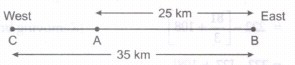
Distance towards East denoted (+ve) sign and Distance towards West denoted (-ve) sign.
Since first Ridhaan goes toward East 25 km
So distance covered by him = + 25 km
Again, he goes towards West.
So, distance covered by him on same road
= -35 km.
So,position of Ridhaan from A= + 25 - 35
= -10 km.
(b) Value: Addition of Integers.
(c) Value: A rolling stone can gather no moss.
8.
Given, Ravi can walk 3\(\frac{1}{3}\)km in 1h.
i.e. 3\(\frac{1}{3}\)km/h =\(\frac{(3\times 3)+1}{3}\)
=\(\frac{9+1}{3}=\frac{10}{3}\)km/h
∵ Distance between Ravi's and his office = 10 km
∵ Time=\(\frac{Distance\ between\ Ravi' s\ and\ his\ office}{Ravi' s\ speed\ in\ 1h}\)
=\(\frac{10 km}{\frac{10}{3}km/h}=\frac{10}{1}\times \frac{3}{10}\) [∵division is reverse of multiplication]
=\(\frac{30}{10}\)=3h
Hence, Ravi reaches office in 3 h
9.
Given, 2\(\frac{1}{3}\) of 4\(\frac{7}{9}\)of \(\frac{1}{2}\)
∵ \(2 \frac{1}{3}=\frac{(2\times 3)+1}{3}=\frac{6+1}{3}=\frac{7}{3}\)
\(4\frac{7}{9}=\frac{(4\times 9)+7}{9}=\frac{36+7}{9}=\frac{43}{9}\)
∴ \(\frac{7}{3}\)of \(\frac{43}{9}\) of \(\frac{1}{2}\)
Now, \(\frac{7}{3}\) of \(\frac{43}{9}\times= \frac{7}{3}\times \frac{43}{9}=\frac{7\times 43}{3\times 9}=\frac{301}{27}\)
and again,\(\frac{301}{27}\) of \(\frac{1}{2}=\frac{301}{27}\times \frac{1}{2}=\frac{301\times 1}{27\times2}=\frac{301}{54}=5\frac{31}{54}\)
Hence, \(\frac{7}{3}\)of \(\frac{43}{9}\)of \(\frac{1}{2}\)=5\(\frac{31}{54}\)
10.
Rs 1208.7
11.
12.004 is smaller
12.
We have, 2.03 or 2.30
First, we compare the digits on the left of the decimal point starting from the leftmost digit. Here, both the digits to the left at the decimal point are same. i.e. 2. So, we compare the digits on the right of the decimal point starting from the tenth place.
Here, 0 < 3
So, 2.03 < 2.30
Hence, 2.30 is greater.
13.
We have, \(6 \div 5 \frac{1}{3}=6 \div (\frac{5\times 3+1}{3})\)
=\((6\div \frac{15+1}{3})=6 \div \frac{16}{3}\)
=6\(\times\frac{3}{16}\) [∵ reciprocal of \(\frac{16}{3}\)is \(\frac{3}{16}\)]
=\(\frac{6\times 3}{16}=\frac{18}{16}=\frac{9}{8}=1\frac{1}{8}\) [dividing numerator and denominator by 2]
14.
The complete table is shown as below:
| Statement | Observation | |
| (i) | 7-9 = -2 | Result is an integer |
| (ii) | 17 - (-21) = 38 | Result is an integer |
| (iii) | -8 - (-14) = 6 | Result is an integer |
| (iv) | -21- (-10) = -11 | Result is an integer |
| (v) | 32 - (-17) = 49 | Result is an integer |
| (vi) | -18 - (-18) = 0 | Result is an integer |
| (vii) | -29 - 0 = -29 | Result is an integer |
15.
The complete table is shown as below:
| Statement | Observation | |
| (i) | 17 + 23 = 40 | Result is an integer |
| (ii) | -10 + 3 = -7 | Result is an integer |
| (iii) | -75 + 18 = -57 | Result is an integer |
| (iv) | 19 + (-25) = - 6 | Result is an integer |
| (v) | 27 + (-27) = 0 | Result is an integer |
| (vi) | -20 + 0 = -20 | Result is an integer |
| (vii) | -35 + (-10) = -45 | Result is an integer |
16.

From the given figure, it is clear that the directions East and West are opposite to each other.
According to the question,
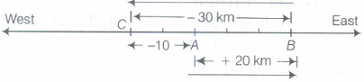
If moving towards East is a positive integer, then moving towards West is represented by a negative integer.
Now, distance moved towards West = - 30 km
and distance moved towards East = 20 km
\(\therefore\) Rita's final position from A = 20 + (- 30) = 20 - 30
= -10 km (i.e. West)
17.
Given, Jack's score ofIst round = 25
Score of IInd round = - 5
Score of IIIrd round = - 10
Score of IVth round = 15
and score of Vth round = 10
Now, total score = Sum of score of all rounds
= 25 + (- 5) + (-10) + 15 + 10 = 25 - 5 -10 + 15 + 10
= (25 + 15 + 10) + (- 5 -10)
=(40+10)+(-15) =50-15=35
Hence, the total score of Jack was 35.
18.
Number line with all numbers is shown below:

From the above number line, the temperature of the indicated places are as follow:
| Places | Temperature |
| Lahulspiti | - 8o C |
| Srinagar | - 2o C |
| Shimla | 5o C |
| Ooty | 14o C |
| Bangalore | 22o C |
19.
Along first row =\(\frac{4}{11}\)+\(\frac{9}{11}\)+\(\frac{2}{11}\)=\(\frac{4+9+2}{11}=\frac{15}{11}\)
Along second row= \(\frac{3}{11}\)+\(\frac{5}{11}\)+\(\frac{7}{11}\)=\(\frac{3+5+7}{11}\)=\(\frac{15}{11}\)
Along thi.rd row =\(\frac{8}{11}\)+\(\frac{1}{11}\)+\(\frac{6}{11}\)=\(\frac{8+1+6}{11}=\frac{15}{11}\)
Along first column =\(\frac{4}{11}\)+\(\frac{3}{11}\)+\(\frac{8}{11}\)=\(\frac{4+3+8}{11}=\frac{15}{11}\)
Along second column = \(\frac{9}{11}\)+\(\frac{5}{11}\)+\(\frac{1}{11}\)=\(\frac{9+5+1}{11}=\frac{15}{11}\)
Along third column =\(\frac{2}{11}\)+\(\frac{7}{11}\)+\(\frac{6}{11}\)=\(\frac{2+7+6}{11}=\frac{15}{11}\)
Along one diagonal = \(\frac{4}{11}\)+\(\frac{5}{11}\)+\(\frac{6}{11}\)=\(\frac{4+5+6}{11}=\frac{15}{11}\)
and along other di.agonal =\(\frac{2}{11}\)+\(\frac{5}{11}\)+\(\frac{8}{11}\)=\(\frac{2+5+8}{11}=\frac{15}{11}\)
Since, sum of the numbers in each row, in each column and along the diagonals are same.
Hence, it is a magic square.
20.
We have,
Now, completing the given number line is as follows:

Hence, the position of required letters is shown in the following table:
| Letter | Position of integer |
| B | -6 |
| D | -4 |
| H | 0 |
| J | 2 |
| M | 5 |
| O | 7 |

7th Standard CBSE Syllabus & Materials
7th Standard CBSE
CBSE 7th Social Science Theme B - New Beginnings : Cities and States - New Sample Question Papers Study Material - QB365 Set A
NEW7th Standard CBSE
CBSE 7th Social Science Theme A - Climates of India - New Sample Question Papers Study Material - QB365 Set A
NEW7th Standard CBSE
CBSE 7th Social Science Theme A - Geographical Diversity of India - New Sample Question Papers Study Material - QB365 Set A
NEW7th Standard CBSE
CBSE 7th Science Earth, Moon and the Sun - New Sample Question Papers Study Material - QB365 Set A



NCERT Books

Syllabus

Exam Pattern

Sample Question Papers

Previous year Question Papers

Important Notes

MCQ Practice test

NCERT Exemplers

Case study Questions

Image Based Questions

Passage based Questions

HOT Questions

Value Based Questions

Model Questions Papers
NCERT ( Book Back ) Questions

Assertion and Reason
Important Questions And Answers

CBSE 7th Standard CBSE Subjects
CBSE Standards


