
 100% FREE ACCESS
7th Standard CBSE Syllabus & Materials
7th Standard CBSE
CBSE 7th Social Science Theme E - Understanding Market - New Sample Question Papers Study Material - QB365 Set A
NEW7th Standard CBSE
CBSE 7th Social Science Theme E - From Barter to Money - New Sample Question Papers Study Material - QB365 Set A
NEW7th Standard CBSE
CBSE 7th Social Science Theme D - The Constitution of India- An Introduction - New Sample Question Papers Study Material - QB365 Set A
NEW7th Standard CBSE
CBSE 7th Social Science Theme D - From the Rulers to the Ruled : Types of Governments - New Sample Question Papers Study Material - QB365 Set A
NEW7th Standard CBSE
CBSE 7th Social Science Theme B - The Age of Reorganisation - New Sample Question Papers Study Material - QB365 Set A
NEW7th Standard CBSE
CBSE 7th Social Science Theme B - The Rise of Empires - New Sample Question Papers Study Material - QB365 Set A

Published on: 31/10/2025
Download CBSE Class 7th Standard CBSE Mathematics question papers, sample papers, important questions, and previous year solved papers in PDF format. Get free study materials, NCERT solutions, and exam preparation resources for Class 7th Standard CBSE Mathematics
Questions + Answers key
Take MCQ Mathematics Test
1.
Convert \(\frac { 5 }{ 2 } \) as a rational number with denominator 12.
2.
Copy the diagram and show the resultant figure after rotating 270°, clockwise.

3.
Identify the greater number, wherever possible, in each of the following? 210 or 102
4.
Classify into monomials, binomials and trinomials. 5 - 3t
5.
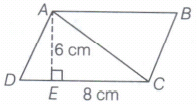
Find the area of the following parallelogram.
6.
Multiply and reduce to lowest form and convert into a mixed fraction.\( \frac{2}{3}\times4\)
7.
How much 2x3 - 3x2 + 4x + 5 is greater than 2x3 + 7x2 - 2x + 7?
8.
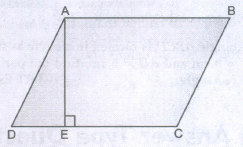
ABCD is a parallelogram in which AB = 8 cm, = 6 cm and AE = 4 cm. Find the altitude corresponding to side AD.
9.
Construct ∆ABC in which ∠B = 60°; AB = 5 cm and BC = 6 cm.
10.
Find the sum \(\frac { 5 }{ 4 } +\left( \frac { -11 }{ 4 } \right) \)
11.
If 2n+2 - 2n+1 +2n = c x 2n, then find the value of c.
12.
Here are some activities you could try in your free time to help you visualise some solid objects and how they look. Take some cubes and arrange them as shown in figure.
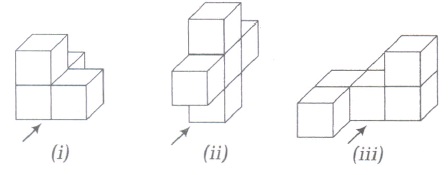
Now ask your friend to guess how many cubes are there when observed from the view shown by the arrow mark.
13.
Three boys earned a total of Rs 235.50. What was the average amount earned per boy?
14.
Simplify the expression 2(a2 + ab) + 3 - ab and find its value, when a = 5 and b = - 3
15.
Find the cost of polishing a circular table top of diameter 1.6 m, if the rate of polishing is Rs 15 per m2.(take \(\pi\) = 3.14)
16.
State the number of lines of symmetry for the following figures.
(a) An equilateral triangle
(b) An isosceles triangle
(c) A scalene triangle
(d) A square
(e) A rectangle
(f) A rhombus
(g) A parallelogram
(h) A quadrilateral
(i) A regular hexagon
(j) A circle
17.
Using laws of exponents, solve the following: \(\left[ { \left( \frac { -2 }{ 3 } \right) }^{ 4 }\times \left( \frac { 216 }{ 125 } \right) \right] \div \left[ { \left( \frac { 6 }{ 5 } \right) }^{ 2 }\times \left( \frac { 4 }{ 9 } \right) \right] \)
18.
Simplify and write the correct answer. - a - [a + {a + b - 2a - (a - 2b)} - b]
19.
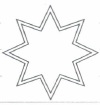
Draw the line of symmetry of the given figure below and also determine the order of rotational symmetry.
20.
A basket containing 36 eggs is \(\frac{3}{11}\)full. How many more eggs are needed to fill it up?
21.
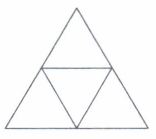
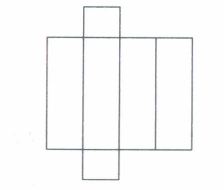
Draw the nets of the followings:
(i) Triangular prism (ii) Tetrahedron (iii) Cuboid
22.
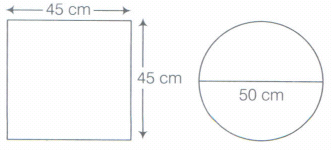
Pizza Factory has come out with two kinds of pizzas. A square pizza of side 45 cm costs Rs 150 and a circular pizza of diameter 50 cm cost Rs 160. Which pizza is a better deal?
23.
Construct ΔPQR, if PQ = 5 cm, mㄥPQR = 105° and mㄥQRP = 40°.
24.
If \(\frac{-7}{11}=\frac{14}{?}\) then?=
11
-11
22
-22
25.
What cross-section do you get when you give a vertical cut to a round apple?
Circle
Triangle
Square
Rectangle.
26.
How many lines of symmetry are there in a regular pentagon?
1
2
3
5
27.
If 'x ' is a rational number and 'a' and 'b' are whole numbers, then the value of xa·xb is:
xa+b
xa-b
xab
xa/b
28.
What is the coefficient of y2in expression 6y2 + 2?
6
2
y2
none of these
29.
The breadth of a rectangle whose length is 12 cm and perimeter is 36 cm is
6 cm
3 cm
9 cm
12 cm
30.
A diagonal of a quadrilateral is 40 em and the lengths of perpendiculars to it from the opposite vertex are 6.6 em and 8.4 em. Find the area of the quadrilateral.
31.
If A = 2a - 3b, B = - 3a + 4b and C = - a + b, find A + B + C and A + B - C.
32.
Find x, such that \(\left(1\over5\right)^5\times\left(1\over 5\right)^{19}=\left(1\over 5\right)^{8x}\)
33.
Write four numbers in the following pattern :
\(\frac { -1 }{ 3 } ,\frac { -2 }{ 6 } ,\frac { -3 }{ 9 } '\frac { -4 }{ 12 } ,...\)
1.
\(\frac { 30 }{ 12 } \)
2.

3.
We have, 210 or 102
\(\therefore\) 210 = 2 x 2 x 2 x 2 x 2 x 2 x 2 x 2 x 2 x 2 = 1024
and 102 = 10 x 10 = 100
\(\because\) 1024 > 100 \(\Rightarrow\) 210 > 102
Hence, 210 is greater than 102.
4.
Expression 5 - 3t is a binomial because it contains 2 unlike terms 5 and -3t
5.
In the given parallelogram ABCD, DC = Base = 8 cm and AE = Height = 6cm
\(\therefore\) Area of the parallelogram = DC x AE = 8 X 6 cm2 = 48 cm2.
6.
∴ Mixed fraction =Quotient \(\frac{Reminder}{Divisor}=2 \frac{2}{3}\)
7.
The required expression
= (2x3-3x2 + 4x + 5) - (2x3 + 7x2 - 2x + 7)
= 2x3 - 3x2 + 4x + 5 - 2x3 - 7x2 + 2x - 7
= (2x3 - 2x3) + (-3x2-7x2) + (4x + 2x)+ (5-7)
= (2 - 2)x3 + (-3 - 7)x2 + (4 + 2)x + (5 - 7)
= (O)x3 + (-10)x2 + (6)x + (-2)
=-10x2+6x-2
Thus, the expression (2x3 - 3x2 + 4x + 5) is greater than ( 2x3 + 7x2 - 2x + 7) by the expression (-10x2 + 6x - 2).
8.
Area of parallelogram ABCD = AB x AE
= 8 x 4 cm2 = 32 cm2
Let altitude corresponding to AD be h. Then,
h x AD = 32
or h x 6 = 32
or h = \(\frac { 32 }{ 6 } \) = \(\frac { 16 }{ 3 } \)
Thus, altitude corresponding to AD is \(\frac { 16 }{ 3 } \)cm
9.
In order to construct the ΔABC, we follow the following steps:
(a) Draw \(\angle XBY\) of measure 60°.
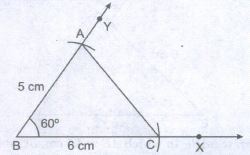
(c) From ray BY, cut off line segment BA of length 5 cm.
(d) Join AC to obtain the required triangle ABC, where \(\angle B\) = 60°, AB = 5 cm and BC = 6 cm.
10.
\(\frac { 5 }{ 4 } +\left( \frac { -11 }{ 4 } \right) =\frac { 5+(-11) }{ 4 } =\frac { -6 }{ 4 } =\frac { -3 }{ 2 } \) [ on dividing numerator and denominator by 2 ]
11.
Given, 2n+2- 2n = c x 2n
⇒ 2n+2 = 2n x 22, 2n+1 = 2n x 21
So, 2n x 22 - 2n x 21 + 2n = c x 2n
Taking ~ common from both the side, we get
2n (22-21)= c x 2n
⇒ (22-21+1)c
∴ c = 4-2+1 [∵ 22= 2 x 2=4, 21=2]
=2 +1 =3
12.
In Fig. (i), there are 3 cubes when observed from the view shown by the arrow mark. In Fig. (ii), there are 3 cubes when observed from the view shown by the arrow mark. In Fig. (iii), there are 4 cubes when observed from the view shown by the arrow mark.
13.
Three boys earned = Rs 235.50
∴ Average amount earned = \(\frac{235.50}{3}=\frac{23550}{300}=\frac{2355}{30}\)=Rs 78.50
Hence, each boy earned Rs 78.50
14.
We have,2(a2 +ab)+3-ab = 2a2 +2ab+3-ab
= 2a2 + 2ab - ab + 3 [rearranging terms]
= 2a2 + ab(2 -1) + 3 = 2a2 + ab + 3
On putting a = 5 and b = - 3, we get
The value of 2a2 + ab + 3 = 2(5)2 5 x (-3) + 3
= 2 x 5 x 5 + 5 x(-3)+3 = 50 - 15 +3 = 38
Hence, the simplified expression is 2a2 + ab + 3 and its required value is 38
15.
Given, diameter of the circular table top = 1.6 m
Then, radius of the circular table top = \(\frac{1.6}{2}\) = 0.8 m
\(\therefore\) Area of the circular table top = \(\pi\)r2 = 3.14 x (0.8)2
= 3.14 x 0.8 x 0.8 = 2.0096 m2
Now, cost of polishing 1 sq m = Rs 15
\(\therefore\) Cost of polishing 2.0096 m2 = Rs (15 x 2.0096) = Rs 30.144
= Rs 30.14 (approx.)
Hence, the cost of polishing the circular tabletop at the rate of Rs 15 per sq m2 is Rs 30.14 (approx.)
16.
Number of lines of symmetry for the given figures arc as follows:
| Figure | lines of symmetry |
|---|---|
| (a) An equilateral triangle | 3 |
| (b) An isosceles triangle | 1 |
| (c) A scalene triangle | 0 |
| (d) A square | 4 |
| (e) A rectangle | 2 |
| (f) A rhombus | 2 |
| (g) A parallelogram (not a special type of parallelogram e.g. square, rectangle, rhombus, etc) |
0 |
| (h) A quadrilateral (not a special type of quadrilateral e.q. square, rectangle, rhombus,etc.) |
0 |
| (i) A regular hexagon | 6 |
| (j) A circle | Infinite |
17.
\(\frac { 8 }{ 3 } \)
18.
-2b
19.
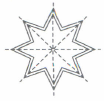
Line of symmetry = 4
Order of symmetry = 8 (angle of rotation = 45°)
20.
96 eggs
21.
(i) Net for triangular prism
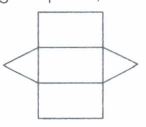
(ii) Net for tetrahedron,
(iii) Net for cuboid
22.
\(\therefore\) Side of square pizza = 45 cm
\(\therefore\) Area of a square pizza = (Side)2
= (45)2 = 2025 cm2
Diameter of circular pizza = 50 cm
Radius = \(\frac{50}{2}\) = 25 cm.
\(\therefore\) Area of a circle = \(\pi r^2\)
\(\therefore\) Area of the circular pizza = \(\pi r^2\)
= \(\frac{22}{7}\times 25\times 25=\frac{22}{7}\times 625\)
= \(\frac{13750}{7}\) = 1964.28 cm2
Price of 1 cm square pizaa = \(\frac{2025}{150}\) = Rs 135
Price of 1 cm circular pizaa = \(\frac{1964.29}{160}\) = Rs 12.27
Hence, the circular pizza is a better deal.
23.
Given, PQ = 5 cm, mㄥPQR = 105° and m ㄥQRP = 40°
In ΔPQR, by angle sum property, we have
ㄥPQR + ㄥQRP + ㄥRPQ = 180°
⇒ 105° + 40° + ㄥRPQ = 180°
⇒ ㄥRPQ = 180° -145° = 35°
Thus, we have PQ = 5 cm, ⇒ ⇒P = 35° and ⇒Q = 105°
Now, to draw ΔPQR, we use the following steps:
Steps of construction
Step I Firstly, we draw a rough sketch of traingle with measures marked on it.
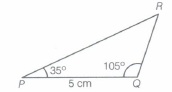
Step II Draw a line segment PQ = 5 cm.
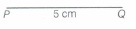
Step III At point P, draw a ray PX making an angle of 350 with PQ i.e., ㄥQPX = 350.
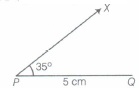
Step IV At point Q, draw a ray QY making an angle of 105° with PQ i.e. ㄥPQY = 105°.
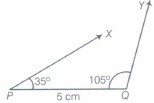
Step V Extend the ray PX and QY. Let rays PX and QY intersect at R.
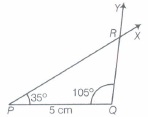
Thus, ΔPQR is the required triangle.
24.
\(\frac{-7}{11}=\frac{-7\times-2}{11\times-2}=\frac{14}{-22}\)
25.
(a)
Circle
26.
(d)
5
27.
(a)
xa+b
28.
(a)
6
29.
(a)
6 cm
30.
Let ABCD be the quadrilateral in which AC is a diagonal, such that AC = 40 cm
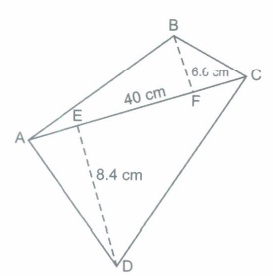
Suppose DE \(\bot \) AC and BF \(\bot \) AC, such that
DE = 8.4 cm and BF = 6.6 cm.
Now, area of the quadrilateral ABCD
= [Area of \(\Delta\)ABC] + [Area of \(\Delta\)ADC]
=\(\left[ \frac { 1 }{ 2 } \times AC\times BF \right] \)+\(\left[ \frac { 1 }{ 2 } \times AC\times DE \right] \)
=\(\left[ \frac { 1 }{ 2 } \times 40cm\times 66cm\right] \)+\(\left[ \frac { 1 }{ 2 } \times 40cm\times 8.4cm\right] \)
=\(\left[ \frac { 1 }{ 2 } \times 40\times \frac { 66 }{ 10 } { cm }^{ 2 } \right] \)+\(\left[ \frac { 1 }{ 2 } \times 40\times \frac { 84 }{ 10 } { cm }^{ 2 } \right] \)
= [2 x 66 cm2] + [2 x 84 cm2]
= 132 cm2 + 168 cm2 = 300 cm2
Thus, the area of the quadrilateral ABCD = 300 cm2.
31.
A = 2a - 3b
B=-3a+4b
C = -a + b
A+B+C=?
A + B + C = (2a-3b) + (-3a + 4b) + (-a + b)
= 2a-3b-3a + 4b-a + b
= a(2 - 3 -1) + b(- 3 + 4 + 1)
= a(2 - 4) + b(1 + 1)
=-2a+2b
A+B-C=?
A + B - C = (2a- 3b) + (- 3a + 4b) - (- a + b)
= 2a-3b-3a + 4b + a-b
= a(2-3 + 1) + b(-3 + 4-1)
= a(0) + b(-4 + 4)
= a(0) + b(0)
= 0.
32.
\(⇒\ \left(1\over 5\right)^{5+19}=\left(1\over 5\right)^{8x}\)
[∵ am x an = am+n]
\(⇒\ \left(1\over 5\right)^{24}=\left(1\over 5\right)^{8x}\)
When bases are equal, then by equating their exponents, we get
8x = 24
\(∴\ x={24\over 8}=3\)
33.
Given pattern is
\(-\frac { 1 }{ 3 } ,\frac { 2 }{ 6 } ,\frac { 3 }{ 9 },-\frac { 4 }{ 12 } ...\)
Here, \(-\frac { 1 }{ 3 } =\frac { (-1)\times 1 }{ 3\times 1 } \)
\(-\frac { 2 }{ 6 } =\frac { (-1)\times 2 }{ 3\times 2 } \)
\(-\frac { 3 }{ 9 } =\frac { (-1)\times 3 }{ 3\times 3 } \)
and \(-\frac { 4 }{ 12 } =\frac { (-1)\times 4 }{ 3\times 4 } \)
Hence, next four numbers are
\(\frac { (-1)\times 5 }{ 3\times 5 } =-\frac { 5 }{ 15 } \)
\(\frac { (-1)\times 6 }{ 3\times 6 } =-\frac { 6 }{ 18 } \)
\(\frac { (-1)\times 7 }{ 3\times 7 } =-\frac { 7 }{ 21 } \)
\(\frac { (-1)\times 8 }{ 3\times 8 } =-\frac { 8 }{ 24 } \).

7th Standard CBSE Syllabus & Materials
7th Standard CBSE
CBSE 7th Social Science Theme B - New Beginnings : Cities and States - New Sample Question Papers Study Material - QB365 Set A
NEW7th Standard CBSE
CBSE 7th Social Science Theme A - Climates of India - New Sample Question Papers Study Material - QB365 Set A
NEW7th Standard CBSE
CBSE 7th Social Science Theme A - Geographical Diversity of India - New Sample Question Papers Study Material - QB365 Set A
NEW7th Standard CBSE
CBSE 7th Science Earth, Moon and the Sun - New Sample Question Papers Study Material - QB365 Set A



NCERT Books

Syllabus

Exam Pattern

Sample Question Papers

Previous year Question Papers

Important Notes

MCQ Practice test

NCERT Exemplers

Case study Questions

Image Based Questions

Passage based Questions

HOT Questions

Value Based Questions

Model Questions Papers
NCERT ( Book Back ) Questions

Assertion and Reason
Important Questions And Answers

CBSE 7th Standard CBSE Subjects
CBSE Standards


