
 100% FREE ACCESS
7th Standard CBSE Syllabus & Materials
7th Standard CBSE
CBSE 7th Social Science Theme E - Understanding Market - New Sample Question Papers Study Material - QB365 Set A
NEW7th Standard CBSE
CBSE 7th Social Science Theme E - From Barter to Money - New Sample Question Papers Study Material - QB365 Set A
NEW7th Standard CBSE
CBSE 7th Social Science Theme D - The Constitution of India- An Introduction - New Sample Question Papers Study Material - QB365 Set A
NEW7th Standard CBSE
CBSE 7th Social Science Theme D - From the Rulers to the Ruled : Types of Governments - New Sample Question Papers Study Material - QB365 Set A
NEW7th Standard CBSE
CBSE 7th Social Science Theme B - The Age of Reorganisation - New Sample Question Papers Study Material - QB365 Set A
NEW7th Standard CBSE
CBSE 7th Social Science Theme B - The Rise of Empires - New Sample Question Papers Study Material - QB365 Set A

Published on: 31/10/2025
Download CBSE Class 7th Standard CBSE Mathematics question papers, sample papers, important questions, and previous year solved papers in PDF format. Get free study materials, NCERT solutions, and exam preparation resources for Class 7th Standard CBSE Mathematics
Questions + Answers key
Take MCQ Mathematics Test
1.
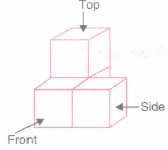
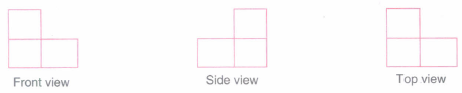
Draw the front view, side view and top view of the given objects.
A solid
2.
If P = -2, then find the value of -3p2 + 4p + 7.
3.
Find the value of:
53
4.
Illustrate the rotation of an equilateral triangle and find its order of rotational order.
5.
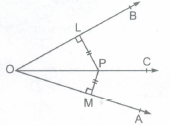
In the figure, PL \(\bot \)OB and PM \(\bot \)OA such that PL=PM. prove that \(\triangle \)PLO\(\cong \)\(\triangle \)PMO.
6.
The heights (in em) of the students of a class are given below. Find the modal height of the class.
162, 163, 165, 160, 163, 164, 163, 162, 163, 165, 160, 163, 160, 163, 164, 162, 163, 164, 162 161, 163, 160, 163, 165, 168, 160, 161, 162, 163, 164.
7.
If 5 is added to both the numerator and the denominator of the fraction 5/9 will the value of the fraction be changed? If so, will the value increase or decrease
8.
If A = 3x2 + 2x,B = 3x + 1.
Find the value of A-B.
9.
Find the area of a square park, whose perimeter is 200 m.
10.
Simplify: 118- [121 ÷ (11 \(\times\) 11)- (- 4) - {3- \(\overline { 9-2 } \) }]
11.
Two cubes each with 2 cm edge are placed side by side to form a cuboid. Try to make on oblique sketch and say what could be its length, breadth and height.
12.
Find the value of: [32 + 2 \(\times\) 17 + (- 6)] ÷ 15
13.
Divide: - 91 by 13
14.
Find the values of a and b in following algebraic expressions:
b-2=1
15.
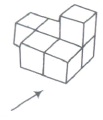
Find the number of cubes in each of the following figures.
16.
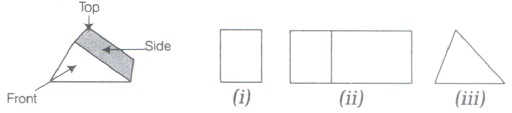
For each solid, the three views (i), (ii), (iii) are given. Identify for each solid the corresponding top, front and side views.
17.
Find (- 75) \(\div\) 5
18.
Find each of the following product: (- 1) x ( - 2) x (- 3) x 4
19.
Find 6 x (- 19)
20.
Write down a pair of integers whose: sum is - 7
21.
Solve the following addition and subtraction problems and verify the closure property under addition and subtraction:
18 - (-24)
22.
Solve the following addition and subtraction problems and verify the closure property under addition and subtraction:
9 + (-64)
23.
Verify a - (-b) = a + b for the following values of a and b.
24.
Verify a - (-b) = a + b for the following values of a and b. a= 75, b= 84
25.
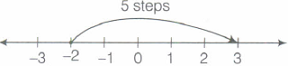
Add the following integers using number line: -2 and 5
1.
2.
-13
3.
125
4.
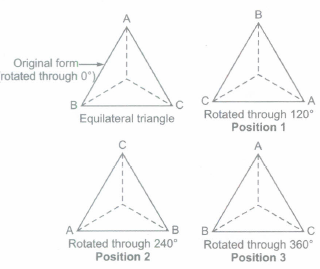
Since, each of the above three positions fits into the original.
∴ It has a rotational symmetry of order 3.
5.
In \(\triangle \)PLO and \(\triangle \)PMO, we have
\(\angle PLO=\angle PMO=\)90°[Given]
\(\overline { OP } =\overline { OP } \) [Hypotenuse]
PL=PM [Given]
\(\therefore \)Using RHS congruency, we get
\(\triangle \)PLO \(\cong \)\(\triangle \)PMO
6.
\(\because \) Large number of data is given
\(\therefore \)Putting them in a tabular form, we have
| Heights (in cm) | Tally marks | Number of students (Frequency) |
| 160 |  |
5 |
| 161 | \(\parallel \) | 2 |
| 162 | |
5 |
| 163 | |
10 |
| 164 | \(||||\) | 4 |
| 165 | \(|||\) | 3 |
| 166 | 0 | |
| 167 | 0 | |
| 168 | \(|\) | 1 |
\(\because \)The frequency of 163 cm is maximum, i.e. 10.
\(\therefore \)163 em occurring the maximum number of times.
Thus, the mode of the given data is 163 cm.
7.
Fraction =\(\frac { 5 }{ 9 } \)
5 is added to both numerator and denominator.
New fraction =\(\frac { 5+5 }{ 9+5 } =\frac { 10 }{ 14 } \)
By comparing fraction \(\frac { 5 }{ 9 } ,\frac { 10 }{ 14 } \)
 [by cross multiplication]
5\(\times\)14 < 9\(\times\)10
70 < 90
So, new fraction is increased in value as compared to the given fraction
8.
A = 3x2 + 2x and B = 3x + 1
A - B = 3x2 + 2x - 3x - 1
= 3x2 -x-1
9.
Perimeter of square = 4 x side
\(\Rightarrow\) 4 x side = 200
\(\Rightarrow\) side \(={200\over 4}\) = 50 m
\(\Rightarrow\) Area of park = (side)2
= (50)2 = 50 x 50
= 2500 m2.
10.
118-[121 ÷ (11 \(\times\) 11)-(-4)-{3- \(\overline { 9-2 } \)}]
= 118-[121 ÷ (11 \(\times\) 11)-(-4)-{3-7}]
= 118- [121 ÷ 121- (- 4) - {3- 7}]
= 118- [1- (- 4) - {- 4}]
= 118- [1 + 4 + 4]
= 118 - 9
= 109.
11.
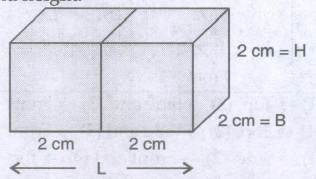
Let us place two cubes with 2 cm edge side by side as shown in the diagram. Its length only increases and becomes (2 + 2) cm. i.e., 4 cm. But breadth and height remain same as 2 cm.
12.
We have,
[32 + 2 \(\times\) 17 + ( - 6) ] ÷ 15
= [32 + 34 + (- 6)] ÷ 15
= (66-6) ÷ 15
= 60 ÷ 15
=\(\frac{60}{15}\)
=4
13.
We have, -91 ÷ 13 = \(\frac{-91}{13}=-\frac{91}{13}\)
=-7
14.
Since, b - 2 = 1
⇒ b = 1 + 2
⇒ b = 3
15.
6
16.
(i) ➝ Side, (ii) ➝ Top, (iii) ➝ Front
17.
We have, (- 75) \(\div\) 5 = - (75 \(\div\) 5) = -75/5 = -15
18.
We have, (-1) x (- 2) x (- 3) x 4 = - (1 x 2 x 3 x 4)
= -24
19.
We have, 6 x (-19) = - ( 6 x 19 ) = -114
20.
A pair of integers, whose sum is - 7, can be - 2 and - 5.
\(\because\) Sum = -2 + (-5) = -2 -5 = -7
21.
18 - (-24)
Forsubtraction 18 - (-24) = 18 + 24 [\(\because\) (-)(-) = (+)]
= 42 [\(\because\) higher integer sign is (+)]
Verification First integer (x) = 18 [given]
Second integer (y) = (-24) [given]
For closure property x - y = 18 - (-24) = 18+ 24 = 42 (integer) i.e. subtraction is closed.
22.
9 + (-64)
For addition 9 + (-64) = 9 - 64 [\(\because\) (+)(-) = (-)]
= - 55 [\(\because\) higher integer sign is (-)]
Verification First integer (x) = 9 [given]
Second integer (y) = -64 [given]
For closure property x + y = 9 + (-64) = 9 - 64 = - 55 (integer) i.e. addition is closed
23.
Given, a = 28 and b = 11
\(\therefore\) LHS = a - (-b) = 28 - (-11) = 28+11 = 39
and RHS = a + b = 28 + 11= 39
Hence, LHS = RHS
24.
Given, a = 75 and b = 84
\(\therefore\) LHS = a - (-b) = 75 - (-84) = 75 + 84 =159
and RHS = a + b = 75 + 84 = 159
Hence, LHS = RHS
25.
We have, -2 and 5
In this case, firstly we go to (-2) and then move (5) step to the right of (-3).
Thus, we reached to (3), i.e. (-2) + (5) = 3

7th Standard CBSE Syllabus & Materials
7th Standard CBSE
CBSE 7th Social Science Theme B - New Beginnings : Cities and States - New Sample Question Papers Study Material - QB365 Set A
NEW7th Standard CBSE
CBSE 7th Social Science Theme A - Climates of India - New Sample Question Papers Study Material - QB365 Set A
NEW7th Standard CBSE
CBSE 7th Social Science Theme A - Geographical Diversity of India - New Sample Question Papers Study Material - QB365 Set A
NEW7th Standard CBSE
CBSE 7th Science Earth, Moon and the Sun - New Sample Question Papers Study Material - QB365 Set A



NCERT Books

Syllabus

Exam Pattern

Sample Question Papers

Previous year Question Papers

Important Notes

MCQ Practice test

NCERT Exemplers

Case study Questions

Image Based Questions

Passage based Questions

HOT Questions

Value Based Questions

Model Questions Papers
NCERT ( Book Back ) Questions

Assertion and Reason
Important Questions And Answers

CBSE 7th Standard CBSE Subjects
CBSE Standards


