
 100% FREE ACCESS
7th Standard CBSE Syllabus & Materials
7th Standard CBSE
CBSE 7th Social Science Theme E - Understanding Market - New Sample Question Papers Study Material - QB365 Set A
NEW7th Standard CBSE
CBSE 7th Social Science Theme E - From Barter to Money - New Sample Question Papers Study Material - QB365 Set A
NEW7th Standard CBSE
CBSE 7th Social Science Theme D - The Constitution of India- An Introduction - New Sample Question Papers Study Material - QB365 Set A
NEW7th Standard CBSE
CBSE 7th Social Science Theme D - From the Rulers to the Ruled : Types of Governments - New Sample Question Papers Study Material - QB365 Set A
NEW7th Standard CBSE
CBSE 7th Social Science Theme B - The Age of Reorganisation - New Sample Question Papers Study Material - QB365 Set A
NEW7th Standard CBSE
CBSE 7th Social Science Theme B - The Rise of Empires - New Sample Question Papers Study Material - QB365 Set A

Published on: 31/10/2025
Download CBSE Class 7th Standard CBSE Mathematics question papers, sample papers, important questions, and previous year solved papers in PDF format. Get free study materials, NCERT solutions, and exam preparation resources for Class 7th Standard CBSE Mathematics
Questions + Answers key
Take MCQ Mathematics Test
1.
Find the product of \(\frac { 1 }{ 3 } and\frac { 7 }{ 5 } \)
2.
Find the product of \(\frac { 1 }{ 2 } and\frac { 5 }{ 8 } \)
3.
Express as rupees using decimals. 7 paise
4.
Convert \(\frac{2}{3}\)into decimal number.
5.
Convert 0.24 into a fraction.
6.
Find \(\frac{13}{11}\times 6\)
7.
Find \(3\times \frac{1}{8}\)
8.
Find \(\frac{9}{7}\times 6\)
9.
Find \(\frac{2}{7}\times 3\)
10.
Find the product of the following: \(\frac{1}{15} \times \frac{1}{12}\)
11.
Find the product of the following: \(\frac{4}{7}\times 3\)
12.
Simplify \(\frac{4}{9}-\frac{4}{11}+\frac{1}{2}\)
13.
Arrange the following in ascending order : \(\frac{2}{9},\frac{4}{5},\frac{7}{9}\).
14.
Find the value of 14\(\frac{1}{2}-6\frac{1}{2}\).
15.
Arrange the following in descending order \(\frac{1}{5},\frac{3}{7},\frac{7}{10}\)
16.
Solve \(8\frac{1}{2}-3\frac{5}{8}\)
17.
Solve \(2\frac{2}{3}+3\frac{1}{2}\)
18.
Solve 4+\(\frac{7}{8}\)
19.
Arrange the fractions \(\frac{2}{5},\frac{3}{10},\frac{9}{14} and \frac{16}{35}\) in ascending order.
20.
Solve \(\frac{7}{10}+\frac{2}{5}+\frac{3}{2}\)
21.
Solve \(\frac{3}{5}+\frac{2}{7}\)
22.
Solve 2-\(\frac{3}{5}\)
23.
Solve the following additions and subtractions. \(4\frac{2}{5}+6\frac{1}{5}\)
24.
Rohan solved \(\frac{3}{7}\) part of an exercise, while Ramu solved \(\frac{2}{5}\) of it, who solved lesser part?
25.
Convert the fractions \(\frac{5}{6},\frac{7}{9},\frac{11}{12}\) into like fractions.
1.
\(\frac { 1 }{ 3 } \times \frac { 7 }{ 5 } =\frac { 1\times 7 }{ 3\times 5 } =\frac { 7 }{ 15 } \)
2.
\(\frac { 1 }{ 2 } \times \frac { 5 }{ 8 } =\frac { 1\times 5 }{ 2\times 8 } =\frac { 5 }{ 16 } \)
3.
We know that, Rs 1= 100paise or 1 paise=Rs \(\frac{1}{100}\)
∴ 7 paise =\(7 \times \frac{1}{100}=\frac{7}{100}\)=Rs 0.07
4.
We have, \(\frac{2}{3}\)
Now,
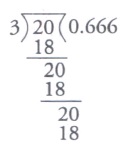
Hence, 0.666 is required decimal number.
5.
We have, 0.24
\(\frac{0.24}{1}\) on removing decimal, \(\frac{024}{100}\), In simplest form =\(\frac{6}{25}\)
6.
\(\frac{13}{11}\times 6=\frac{13\times 6}{11}=\frac{78}{11}=7\frac{1}{11}\)
7.
\(3\times \frac{1}{8}=\frac{3\times 1}{8}=\frac{3}{8}\)
8.
\(\frac{9}{7}\times 6=\frac{9\times 6}{7}=\frac{54}{7}=7\frac{5}{7}\)
9.
\(\frac{2}{7}\times 3=\frac{2\times 3}{7}=\frac{6}{7}\)
10.
\(\frac{1}{15} \times \frac{1}{12}=\frac{1\times 1}{15\times 12}\frac{1}{180}\)
11.
\(\frac{4}{7}\times 3=\frac{4}{7}\times \frac{3}{1}=\frac{4\times 3}{7\times 1}=\frac{12}{7}=1\frac{5}{7}\)
12.
\(\frac{115}{198}\)
13.
\(\frac{2}{9}<\frac{7}{9}<\frac{4}{5}\)
14.
8
15.
We have\(\frac{1}{5},\frac{3}{7},\frac{7}{10}\)

LCM of 5, 7 and 10 = 5\(\times\)7\(\times\)2 = 70
On converting given fractions into like fractions, we get
\(\frac { 1 }{ 5 } =\frac { 1\times 4 }{ 5\times 14 } =\frac { 14 }{ 70 } \)
\(\frac { 3 }{ 7 } =\frac { 3\times 10 }{ 7\times 10 } =\frac { 30 }{ 70 } \)
and \(\frac { 7 }{ 10 } =\frac { 7\times 7 }{ 10\times 7 } =\frac { 49 }{ 70 } \)
∵ 14 < 30 < 49 [numerators of fractions]
∴ \(\frac { 14 }{ 70 } <\frac { 30 }{ 70 } <\frac { 40 }{ 70 } \)
Thus,
Hence, descending order of given fractions is \(\frac { 7 }{ 10 } ,\frac { 3 }{ 7 } ,\frac { 1 }{ 5 } \)
16.
\(8\frac { 1 }{ 2 } -3\frac { 5 }{ 8 } =\frac { 17 }{ 2 } -\frac { 29 }{ 8 } \)
\(\left[ \because 8\frac { 1 }{ 2 } =\frac { 8\times 2+1 }{ 2 } =\frac { 16+1 }{ 2 } =\frac { 17 }{ 2 } and3\frac { 5 }{ 8 } =\frac { 3\times 8+5 }{ 8 } =\frac { 29 }{ 8 } \right] \)
= \(\frac { 17\times 4 }{ 2\times 4 } -\frac { 29\times 1 }{ 8\times 1 } \)
[L.C.M of 2 and 8 = 8]
= \(\frac { 68 }{ 8 } -\frac { 29 }{ 8 } =\frac { 68-29 }{ 8 } \)
= \(\frac { 39 }{ 8 } =4\frac { 7 }{ 8 } \)
17.
We have, \(2\frac{2}{3}+3\frac{1}{2}\)
On converting given mixed fractions into improper fractions, we get
\(2\frac{2}{3}+3\frac{1}{2}=\frac{2\times 3+2}{3}+\frac{3\times 2+1}{2}\)
=\(\frac{8}{3}+\frac{7}{2}\)
Now, LCM of 3 and 2 = 3 X2 = 6
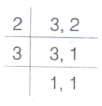
\(\therefore \frac{8}{3}+ \frac{7}{2}= \frac{8\times 2+7\times 3}{6}\)
=\( \frac{16+21}{6}= \frac{37}{6}\)
18.
We have, 4+\(\frac{7}{8}\)=\(\frac{4}{1}+\frac{7}{8}=\frac{4\times 8+7\times1}{8}\) [∵ LCM of 8and 1=8]
=\(\frac{10-3}{5}=\frac{7}{5}\)
19.
The given frraacctnions are \(\frac{2}{5},\frac{3}{10},\frac{9}{14} , \frac{16}{35}\)
LCM of 5,10, 14,35 = 70
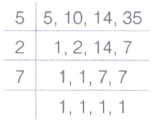
Now, \(\frac{2}{5}=\frac{2\times 14}{5\times 14}=\frac{21}{70},\frac{9}{14}=\frac{9\times5 }{14\times 5}=\frac{45}{70}\) and \(\frac{16}{35}=\frac{16\times 2}{35 \times 2}=\frac{32}{70}\)
Clearly, \(\frac{21}{70}<\frac{28}{70}<\frac{32}{70}<\frac{45}{70}\) So, \(\frac{3}{10}<\frac{2}{5}<\frac{16}{35}<\frac{9}{14}\)
Hence, thee zgiiven firacn..ons in ascendimg order are \(\frac{3}{10}<\frac{2}{5}<\frac{16}{35}<\frac{9}{14}\)
Now, let us change each of the given fractions into an equivalent fraction having 70 as its denominator.
20.
We have, \(\frac{7}{10}+\frac{2}{5}+\frac{3}{2}\)
\(\therefore \frac{7}{10}+\frac{2}{5}+\frac{3}{2}=\frac{7+4+15}{10}\)
=\(\frac{26}{10}=\frac{13}{5}\)
[dividing numerator and denominator by 2]
21.
We have, \(\frac{3}{5}+\frac{2}{7}\)
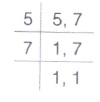
LCM of 5 and 7 = 5X7 = 35
∴ \(\frac{3}{5}+\frac{2}{7}=\frac{3\times 7+2\times 5}{35}\)
=\(\frac{21+10}{35}=\frac{31}{35}\)
22.
We have, 2-\(\frac{3}{5}\)=\(\frac{2}{1}-\frac{3}{5}=\frac{2\times 5-3\times 1}{5}\) [∵ LCM of 5 and 1=5]
=\(\frac{10-3}{5}=\frac{7}{5}\)
23.
\(4\frac{2}{5}+6\frac{1}{5}\) LCM of 5 and 5 is 5.
So, \(\frac{(5\times 4)+2}{5}+\frac{(5\times 6)+1}{5}\)Then \(\frac{22}{5}+\frac{31}{5}=\frac{22+31}{5}=\frac{53}{5}=10\frac{3}{5}\)
24.
Solved part of exercise by Rohan = \(\frac{3}{7}\) [given]
Solved parr of exercise by Ramu = \(\frac{2}{5}\) [given]
Let us compare \(\frac{3}{7}\)and \(\frac{2}{5}\)
LCM is 7 and 5 is 35.
\(\frac{3}{7}=\frac{3}{7}\times \frac{5}{5}=\frac{15}{35}\) and \(\frac{2}{5}=\frac{2}{5}\times \frac{7}{7}=\frac{14}{35}\). Thus, \(\frac{15}{35}>\frac{14}{35}\) or \(\frac{3}{7}>\frac{2}{5}\)
So, Ramu solved lesser part i.e. \(\frac{2}{5}\).
25.
Th e given fractions are \(\frac{5}{6},\frac{7}{9},\frac{11}{12}\)
LCM of 6, 9,12 =36
Now, \(\frac{5}{6}=\frac{5\times 6}{6 \times 6}=\frac{30}{36}, \frac{7}{9}=\frac{7\times 4}{9\times 4}=\frac{28}{36},\frac{11}{12}=\frac{11\times 3}{12 \times 3}=\frac{33}{36}\)
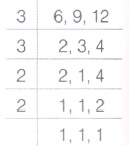
Hence, Iike fractoins are \(\frac{30}{36},\frac{28}{36},\frac{33}{36}\)

7th Standard CBSE Syllabus & Materials
7th Standard CBSE
CBSE 7th Social Science Theme B - New Beginnings : Cities and States - New Sample Question Papers Study Material - QB365 Set A
NEW7th Standard CBSE
CBSE 7th Social Science Theme A - Climates of India - New Sample Question Papers Study Material - QB365 Set A
NEW7th Standard CBSE
CBSE 7th Social Science Theme A - Geographical Diversity of India - New Sample Question Papers Study Material - QB365 Set A
NEW7th Standard CBSE
CBSE 7th Science Earth, Moon and the Sun - New Sample Question Papers Study Material - QB365 Set A



NCERT Books

Syllabus

Exam Pattern

Sample Question Papers

Previous year Question Papers

Important Notes

MCQ Practice test

NCERT Exemplers

Case study Questions

Image Based Questions

Passage based Questions

HOT Questions

Value Based Questions

Model Questions Papers
NCERT ( Book Back ) Questions

Assertion and Reason
Important Questions And Answers

CBSE 7th Standard CBSE Subjects
CBSE Standards


