
 100% FREE ACCESS
7th Standard CBSE Syllabus & Materials
7th Standard CBSE
CBSE 7th Social Science Theme E - Understanding Market - New Sample Question Papers Study Material - QB365 Set A
NEW7th Standard CBSE
CBSE 7th Social Science Theme E - From Barter to Money - New Sample Question Papers Study Material - QB365 Set A
NEW7th Standard CBSE
CBSE 7th Social Science Theme D - The Constitution of India- An Introduction - New Sample Question Papers Study Material - QB365 Set A
NEW7th Standard CBSE
CBSE 7th Social Science Theme D - From the Rulers to the Ruled : Types of Governments - New Sample Question Papers Study Material - QB365 Set A
NEW7th Standard CBSE
CBSE 7th Social Science Theme B - The Age of Reorganisation - New Sample Question Papers Study Material - QB365 Set A
NEW7th Standard CBSE
CBSE 7th Social Science Theme B - The Rise of Empires - New Sample Question Papers Study Material - QB365 Set A

Published on: 31/10/2025
Download CBSE Class 7th Standard CBSE Mathematics question papers, sample papers, important questions, and previous year solved papers in PDF format. Get free study materials, NCERT solutions, and exam preparation resources for Class 7th Standard CBSE Mathematics
Questions + Answers key
Take MCQ Mathematics Test
1.
Each side of a regular hexagon is 3.5 cm long. The perimeter of the given polygon is
17.5 cm
21 cm
18.3 cm
20 cm
2.
Which of the following is the value of 0.1\(\times\) 51.7 ?
517
51.7
0.517
5.17
3.
A car runs 16km using 1 litre of petrol. How much distance will it cover using 2.5 litres of petrol?
16 km
40 km
32 km
50 km
4.
\(\frac { 2 }{ 5 } \times 5\frac { 1 }{ 5 } \) is equal to
\(\frac { 26 }{ 25 } \)
\(\frac { 52 }{ 25 } \)
\(\frac { 2 }{ 5 } \)
6
5.
The largest of the following is
0.0001
\(\frac { 1 }{ 1000 } \)
(0.100)2
\(\frac { 1 }{ 10 } \div 0.1\)
6.
Which of the following has the largest value?
\(\frac { 32 }{ 0.05 } \)
\(\frac { 0.320 }{ 50 } \)
\(\frac { 3.2 }{ 0.05 } \)
\(\frac { 3.2 }{ 50 } \)
7.
Evaluate: The place value of 5 in 103.2523 - place value of 2 in 115.552.
8.
A carton contains 40 boxes of nails and each box weights3\(\frac { 3 }{ 4 } \)kg. How much would a carton of nails weigh?
9.
Simplify: \(4\frac { 5 }{ 6 } -2\frac { 3 }{ 8 } +3\frac { 7 }{ 12 } \)
10.
Simplify:\(\frac { 15 }{ 16 } -\frac { 11 }{ 12 } \)
11.
Find the product of 1 and reciprocal of 1
12.
Find \(\frac { 4 }{ 9 } \div \frac { 2 }{ 3 } \)
13.
Multiply \(2\frac { 3 }{ 5 } \times 3\)
14.
A bucket contains 24\(\frac { 3 }{ 4 } \) litres of water. How many \(\frac { 3 }{ 4 } \)litre jugs can be filled from the bucket to get it emptied?
15.
If the cost of a notebook is Rs 8\(\frac { 3 }{ 4 } \) how many notebooks can be purchased for Rs 131\(\frac { 1 }{ 4 } \) ?
16.
The product of two numbers is 20\(\frac { 5 }{ 7 } \) If one of the numbers is 6\(\frac { 2 }{ 3 } \) find the other
17.
Sameera purchased 3\(\frac { 1 }{ 2 } \)kg apples and 4\(\frac { 3 }{ 4 } \)kg oranges.What is the total weight of fruits purchased by her?
18.
Evaluate 3.25÷0.5
19.
Simplify \(4\frac { 2 }{ 3 } -3\frac { 1 }{ 4 } +2\frac { 1 }{ 6 } \)
20.
In a class of 40 students, \(\frac { 1 }{ 5 } \)of the total number of students like to study English, \(\frac { 2 }{ 5 } \)of the total number like to study Maths and remaining students likes to study Science
(a) How many students like to study English?
(b) How many students like to study Maths?
(c) What fraction of the total number of students like to study Science?
21.
Ritika studies for 11\(\frac { 1 }{ 3 } \) hours daily. She devotes 5\(\frac { 3 }{ 5 } \)hours of her time for Hindi and Sanskrit.How much time does she devote for other subjects?
1.
(b)
21 cm
2.
(d)
5.17
3.
(b)
40 km
4.
(b)
\(\frac { 52 }{ 25 } \)
5.
(d)
\(\frac { 1 }{ 10 } \div 0.1\)
6.
(a)
\(\frac { 32 }{ 0.05 } \)
7.
Place value of 5 in 103.2523 - Place value of 2 in 115.552
= 0.0500 - 0.002
= 0.050 - 0.002
= \(\frac { 50 }{ 1000 } -\frac { 2 }{ 1000 } \)
= \(\frac { 50-2 }{ 1000 } =\frac { 48 }{ 1000 } \)
= 0.048
8.
Weight of 1 box = 3\(\frac { 3 }{ 4 } \)kg =\(\frac { 15 }{ 4 } \)kg
\(\therefore\) Weight of 40 boxes =\(\left( \frac { 15 }{ 4 } \times 40 \right) \)kg = \(\left( \frac { 15 }{ 4 } \times \frac { 40 }{ 1 } \right) \) kg
=\(\frac { 15\times 40 }{ 4\times 1 } \)kg
= 150 kg
Hence, weight of the carton is 150 kg.
9.
\(4\frac { 5 }{ 6 } -2\frac { 3 }{ 8 } +3\frac { 7 }{ 12 } \)
=\(\frac { 6\times 4+5 }{ 6 } -\frac { 2\times 8+3 }{ 8 } =\frac { 3\times 12+7 }{ 12 } \)
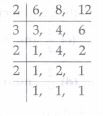
= \(\frac { 29 }{ 6 } -\frac { 19 }{ 8 } +\frac { 43 }{ 12 } \)
= \(\frac { 29\times 4 }{ 6\times 4 } -\frac { 19\times 3 }{ 8\times 3 } +\frac { 43\times 2 }{ 12\times 2 } \)
[∵ LCM of 6,8,12 is 2\(\times\)3\(\times\)2\(\times\)2=24]
= \(\frac { 116 }{ 24 } -\frac { 57 }{ 24 } +\frac { 86 }{ 24 } =\frac { 116-57+86 }{ 24 } =\frac { 202-57 }{ 24 } \)
= \(\frac { 145 }{ 24 } =6\frac { 1 }{ 24 } \)
10.
LCM of 16 and 12 = (4\(\times\)4\(\times\)3) =
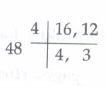
∴ \(\frac { 15 }{ 16 } -\frac { 11 }{ 12 } =\frac { 15\times 3 }{ 16\times 3 } =\frac { 11\times 4 }{ 12\times 4 } \)
[Converting each fraction to an equivalent fraction with denominator 48]
= \(\frac { 45 }{ 48 } -\frac { 44 }{ 48 } =\frac { 45-44 }{ 48 } =\frac { 1 }{ 48 } \)
11.
1 \(\times\) 1 = 1
as reciprocal of 1 is 1
12.
\(\frac { 4 }{ 9 } \div \frac { 2 }{ 3 } \)=\(\frac { 4 }{ 9 } \times \frac { 3 }{ 2 } \)
= \(\frac { 2 }{ 3 } \)
13.
\(2\frac { 3 }{ 5 } \times 3\)=\(\frac { 13 }{ 5 } \times 3\)
= \(\frac { 39 }{ 5 } =7\frac { 4 }{ 5 } \)
14.
Volume of water in the bucket =24 \(\frac { 3 }{ 4 } \) litres =\(\frac { 99 }{ 4 } \)litres
Capacity of jug =\(\frac { 3 }{ 4 } \) litre
\(\therefore\) Number of jugs that can be filled to get the bucket emptied
=\(\frac { 99 }{ 4 } \div \frac { 3 }{ 4 } =\frac { 99 }{ 4 } \times \frac { 4 }{ 3 } =\frac { 99\times 4 }{ 4\times 3 } =33\)
Hence, 33 jugs of\(\frac { 3 }{ 4 } \) litre can be filled to get the bucket emptied.
15.
We have,
Cost of one note book = Rs 8\(\frac { 3 }{ 4 } \)=Rs \(\frac { 35 }{ 4 } \)
Total amount = Rs 131\(\frac { 1 }{ 4 } \)= Rs \(\frac { 525 }{ 4 } \)
\(\therefore\) Number of notebooks =\(\frac { Total\ amount }{ Cost\ of\ one\ notebook } \)
=\(\frac { 525 }{ 4 } \div \frac { 35 }{ 4 } =\frac { 525 }{ 4 } \times \frac { 4 }{ 35 } =\frac { 525\times 4 }{ 4\times 35 } =15\)
16.
We have,
Product of two numbers = 20\(\frac { 5 }{ 7 } \)=\(\frac { 145 }{ 7 } \)
One of the number =6\(\frac { 2 }{ 3 } \)=\(\frac { 20 }{ 3 } \)
The other number = (Product of the numbers ÷ One of the numbers)
= \(\frac { 145 }{ 7 } \div \frac { 20 }{ 3 } \)
=\(\frac { 145 }{ 7 } \times \frac { 3 }{ 20 } =\frac { 145\times 3 }{ 7\times 20 } =\frac { 29\times 3 }{ 7\times 4 } =\frac { 87 }{ 28 } =3\frac { 3 }{ 28 } \)
Hence, the other number is 3 \(\frac { 3 }{ 28 } \)
17.
Total weight of the fruits purchased by Sameera is \(\left( 3\frac { 1 }{ 2 } +4\frac { 3 }{ 4 } \right) \)kg
Now, \(3\frac { 1 }{ 2 } +4\frac { 3 }{ 4 } =\frac { 7 }{ 2 } +\frac { 19 }{ 4 } \)
= \(\frac { 7\times 2 }{ 2\times 2 } =\frac { 19\times 1 }{ 4\times 1 } \)
= \(\frac { 14 }{ 4 } +\frac { 19 }{ 4 } =\frac { 14+19 }{ 4 } =\frac { 33 }{ 4 } =8\frac { 1 }{ 2 } 2\)
Hence, total weight 8\(\frac { 1 }{ 4 } \) is kg
18.
3.25÷0.5=\(\frac { 3.25 }{ 0.5 } =\frac { 3.25 }{ 0.50 } \)
=\(\frac { 325 }{ 50 } \)=6.5
OR
3.25÷0.5= \(\frac { 325 }{ 100 } \times \frac { 10 }{ 5 } \)
= \(\frac { 65 }{ 100 } \times \frac { 10 }{ 1 } \)
= \(\frac { 65 }{ 10 } \)
=6.5
19.
We have
\(4\frac { 2 }{ 3 } -3\frac { 1 }{ 4 } +2\frac { 1 }{ 6 } \)=\(\frac { 14 }{ 3 } -\frac { 13 }{ 4 } +\frac { 13 }{ 6 } \)
= \(\frac { 14\times 4 }{ 3\times 4 } -\frac { 13\times 3 }{ 4\times 3 } +\frac { 13\times 2 }{ 6\times 2 } \)
∵ LCM of 3, 4 and 6 is 12, so we convert each fraction into an equivalent fraction with denominator 12
i,e \(\frac { 56 }{ 12 } -\frac { 39 }{ 12 } +\frac { 26 }{ 12 } =\frac { 56-39+26 }{ 12 } \)
= \(\frac { 82-39 }{ 12 } =\frac { 43 }{ 12 } =3\frac { 7 }{ 12 } \)
20.
(a) No. of students like to study English
= \(\frac { 1 }{ 5 } \times 40\)
= 8
(b) No. of students like to study Maths
= \(\frac { 2 }{ 5 } \times 40\)
= 2\(\times\) 8
= 16
(c) No. of students who like to study Science
=40 - (8 + 16)
= 40-24
= 16
In part (ii), we know
\(\frac { 2 }{ 5 } \times 40\) = 16
So,\(\frac { 2 }{ 5 } \)of the total number of students like to study Science
21.
Total hours spend by Ritika for studies =11\(\frac { 1 }{ 3 } \) hours =\(\frac { 34 }{ 3 } \)hours
Total hours devoted by Ritika for Hindi and Sanskrit 5\(\frac { 3 }{ 5 } \)= \(\frac { 28 }{ 5 } \)hours
Total hours devoted by Ritika for other subjects
= \(\frac { 34 }{ 3 } -\frac { 28 }{ 5 } \)
= \(\frac { 170-84 }{ 15 } =\frac { 86 }{ 15 } \)
=5\(\frac { 11 }{ 15 } \) hours

7th Standard CBSE Syllabus & Materials
7th Standard CBSE
CBSE 7th Social Science Theme B - New Beginnings : Cities and States - New Sample Question Papers Study Material - QB365 Set A
NEW7th Standard CBSE
CBSE 7th Social Science Theme A - Climates of India - New Sample Question Papers Study Material - QB365 Set A
NEW7th Standard CBSE
CBSE 7th Social Science Theme A - Geographical Diversity of India - New Sample Question Papers Study Material - QB365 Set A
NEW7th Standard CBSE
CBSE 7th Science Earth, Moon and the Sun - New Sample Question Papers Study Material - QB365 Set A



NCERT Books

Syllabus

Exam Pattern

Sample Question Papers

Previous year Question Papers

Important Notes

MCQ Practice test

NCERT Exemplers

Case study Questions

Image Based Questions

Passage based Questions

HOT Questions

Value Based Questions

Model Questions Papers
NCERT ( Book Back ) Questions

Assertion and Reason
Important Questions And Answers

CBSE 7th Standard CBSE Subjects
CBSE Standards


